
The Smith-James Bank has an ROE of 17.5%, an asset utilization ratio of 13%, and a
net profit margin of 9%. What is the bank’s ROA?
A. 14.96 percent
B. 1.58 percent
C. 1.17 percent
D. 134.62 percent
E. None of the options is correct
Answer:
Banks with _______ in assets are generally called community banks.
A. more than $1 billion
B. less than $1 billion
C. more than $5 million
D. less than $1 trillion
E. more than $1 trillion
Answer:

Which of the following is an advantage of an interest rate swap agreement?
A. Little or no basis risk
B. Low brokerage fees
C. Increased flexibility as compared to other hedging techniques
D. Little or no credit risk
E. All of the options are advantages of interest rate swap agreements.
Answer:
The textbook discusses several alternative defenses banks have against risk. These
defenses include: A. quality management.
B. portfolio diversification.
C. geographic diversification.
D. deposit insurance.
E. All of the options are correct.
Answer:

As per the Basel Committee, a bank’s operational risk includes:
A. employee fraud.
B. accounting errors.
C. computer breakdowns.
D. natural disasters.
E. All of the options are correct.
Answer:
Suppose a U.S. bank borrows money in London while a British company borrows
money in New York. At the end of the loan period the U.S. company needs pounds to
repay their loan and the British company needs dollars to repay their loan. Which of the
following might be a good tool for these companies to reduce their currency risk?
A. Currency futures contract
B. Currency option contract
C. Interest rate futures contract
D. Interest rate swap contract
E. Currency swap contract
Answer:

A loan whose principal is not due to be paid back until the loan’s term ends and in
which only interest is paid periodically during the life of the loan is called a (or an):
A. working capital loan.
B. project loan.
C. bullet loan.
D. interim construction loan.
E. None of the options is correct.
Answer:
A bank quotes an APY of 8%. A small business that has an account with the bank had
$2,500 in their account for half the year and $5,000 in their account for the other half of
the year. How much in total interest earnings did the business make during the year?
A. $300
B. $200
C. $400
D. $150
E. None of the options is correct

Answer:
The term of an inventory loan is being set to match the exact length of time needed to
generate sufficient cash to repay the loan. What type of loan is this?
A. Self-liquidating inventory loan
B. Working capital loan
C. Security dealer financing
D. Revolving credit financing
E. None of the options is correct.
Answer:
A financial institution that has ready access to immediately spendable funds at
reasonable cost and at precisely the time those funds are needed is considered:
A. risk-free.
B. liquid.
C. efficient.
D. profitable.

Answer:
Which of the following is a guideline for liquidity managers of banks?
A. A liquidity manager must keep track of activities of all departments of the bank
B. A liquidity manager must know in advance (if possible) the plans of major creditors
and depositors
C. A liquidity manager should make sure the bank has clear priorities and objectives
for liquidity management
D. A liquidity manager must analyze the liquidity needs of the bank on a continuous
basis
E. All the options are guidelines for liquidity managers
Answer:
Which of the following is a type of nonbank businesses a bank holding company can
own?
A. Retail Computer Store
B. Security Brokerage Firm
C. Retail Grocery Store
D. Wholesale Electronic Distribution Company
E. All the options are correct
Answer:
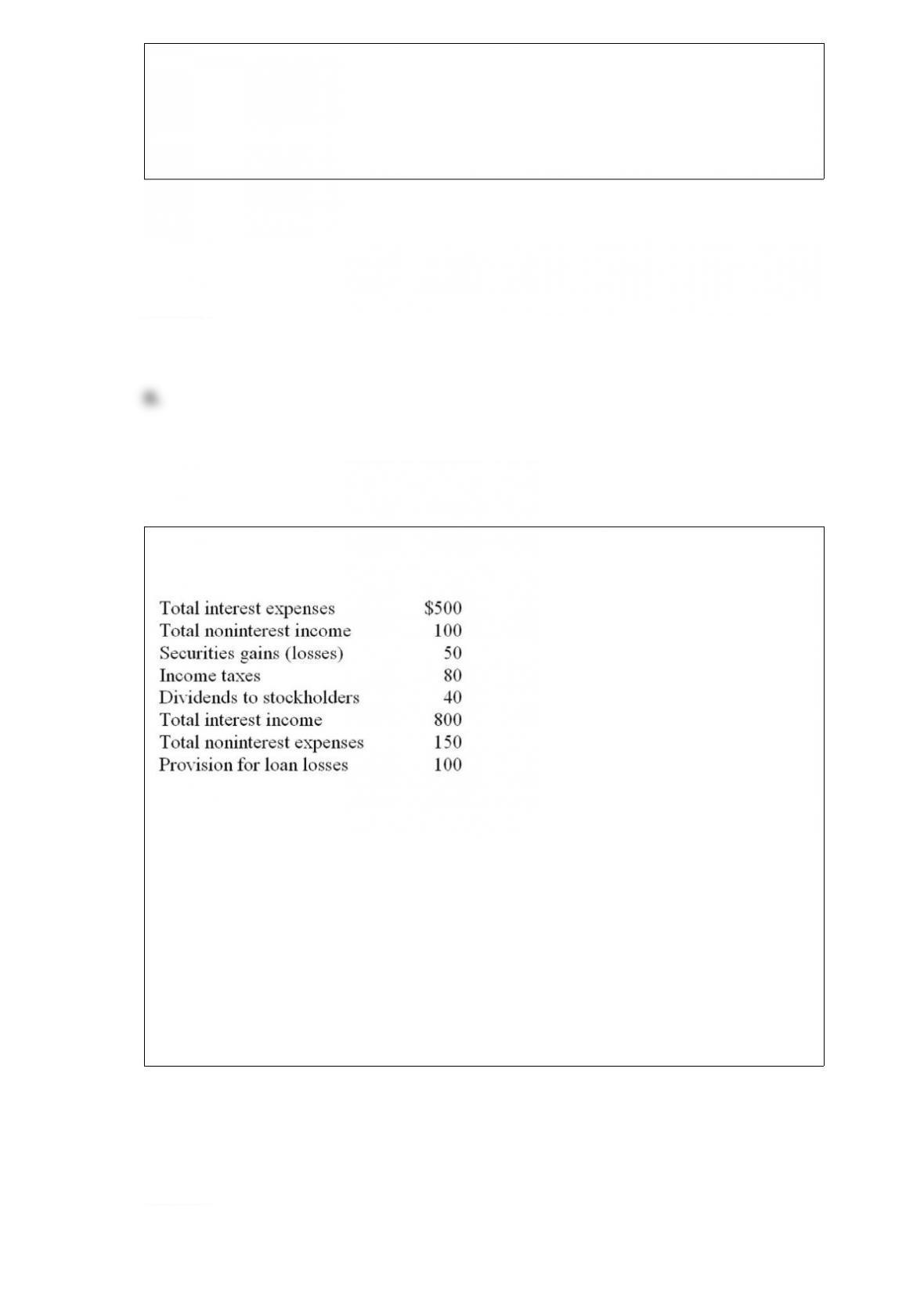
You know the following information about the Davis National Bank:
Given this information, what is the value of this firm’s net income?
A. $300
B. $150
C. ($50)
D. $120
E. $80
Answer:

The Michelson Bank of Stetson, wants to protect itself from risk. It decides to make
loans in Florida, Georgia, Texas, and Oklahoma as well as invest in municipal bonds
from California and Oregon. What defense against risk is this bank making?
A. Portfolio diversification
B. Geographic diversification
C. Quality management
D. Increasing owners’ capital
E. None of the options is correct.
Answer:
Maryellen Epplin notices that a particular T-Bill has a banker’s discount rate of 9
percent in the Wall Street Journal. She knows that this T-Bill has 20 days to maturity
and has a face value of $10,000.
What price is this T-Bill selling for in the market?
A. $9,100
B. $10,000
C. $9,950
D. $1,900
E. None of the options is correct.

Answer:
Marking off a certain neighborhood by a bank within their trade area and declining to
extend financial services (especially credit) to the residents of that neighborhood is
known as: A. redlining.
B. redlisting.
C. protectionism.
D. collective dominance.
E. managerial hubris.
Answer:
Jackson State Bank is worried because many of the loans it has made are home
mortgages which can be paid off early by the homeowner. What type of risk would this
be an example of?
A. Default risk
B. Inflation risk
C. Liquidity risk

D. Call risk
E. Basis risk
Answer:
The increasingly popular type of financing, in which merchants receive cash advances
and pay them off from their credit card sales, is called:
A. asset-based financing.
B. retailer credit financing.
C. operating capital credit financing.
D. credit card receivables financing.
E. revolving credit financing.
Answer:
When different financial service providers offer a similar range of services including
banking, insurance and securities services, it is known as:
A. consolidation.

B. convergence.
C. economies of scale.
D. e-efficiencies.
E. None of the options are correct.
Answer:
A bank wants to examine the financial success of a company by examining the profits
of a company. What ratio will help the bank examine this issue?
A. Selling and administrative expenses/Net sales
B. Net sales/Total assets
C. Current assets – Current liabilities
D. Net income/Total assets
E. Long term debt/(Long term debt + Net worth)
Answer:

A project loan granted on its own merits and which does not have a sponsor to
guarantee the loan is known as a project loan granted on:
A. recourse basis.
B. resort basis.
C. nonrecourse basis.
D. sponsorship basis.
E. leverage basis.
Answer:
Of the principal reasons for regulating banks, what was the primary purpose of the
Consumer Credit Protection Act?
A. Establish a network to clear and collect checks
B. Control of the money supply
C. Prevent banks from realizing monopoly powers
D. Ensure that customers are aware of their rights and responsibilities under a loan
agreement
E. None of the options are correct.
Answer:

A ____________ uses an average of a debtor’s last six months of gross income to
determine whether an applicant must file for bankruptcy under chapter 7 or 13 of the
bankruptcy code.
A. ways test
B. means test
C. income test
D. feasibility test
E. bankruptcy test
Answer:
A bank has capital to risk-weighted assets of 9.2%, Tier 1 capital to risk-weighted assets
of 4.5% and a leverage ratio of 3.7%. What type of bank is this?
A. Well capitalized
B. Adequately capitalized
C. Undercapitalized
D. Significantly undercapitalized
E. Critically undercapitalized
Answer:

The maximum outstanding loans for all FDIC-insured institutions are classified as:
A. lease financing receivables.
B. miscellaneous loans.
C. loans to depository institutions.
D. real estate loans.
E. agricultural loans.
Answer:
Chester National Bank is considering adding a new branch bank. It knows that it will
cost $2.5 million to build the branch and it believes that it will generate $214,526 per
year for the next 25 years. Chester National Bank requires a return of 10% on all new
projects it undertakes. What is this project’s expected rate of return or internal rate of
return? (Round to the nearest whole percent)
A. 0%
B. 7%
C. 12%
D. 2%
E. 25%

Answer:
A study of history shows that one of the first services offered by banks was:
A. equipment leasing.
B. currency exchange.
C. security brokerage and underwriting.
D. sale of real estate.
Answer:
A bank sells shares of its common stock with a par value of $100 for $200 in the
market. Which two accounts on the bank’s balance sheet are going to be affected?
A. Retained earnings and surplus accounts
B. Subordinated notes and debentures and commons stock outstanding accounts
C. Retained earnings and common stock outstanding accounts
D. Common stock outstanding and surplus accounts

E. Only the common stock outstanding account
Answer:
A futures contract which calls for the delivery of a $100,000 T-bond with a minimum of
15 years to maturity is called a:
A. U.S. Treasury bond futures contract.
B. One-month LIBOR futures contract.
C. Eurodollar time deposit futures contract.
D. Federal Funds futures contract.
E. None of the options are correct.
Answer:
Which of the following is a sign of a potential loan problem?
A. Timely receipt of financial statements from the company that has taken a loan
B. Regular increase in the stock price of the company that has taken a loan

C. Increase in earnings for each of the last three years of a company that has taken a
loan
D. Changes in the methods used to account for inventory, depreciation, and other items
E. All of the options are signs of problems with the loan
Answer:
Short-term loans drawn upon by individuals and families for immediate cash needs and
repayable in a lump sum are known as:
A. noninstallment loans.
B. installment loans.
C. residential mortgage loans.
D. nonresidential cash loans.
E. None of the options is correct
Answer:

The _______________________ is the risk premium that has to do with the time to
maturity on the borrowed funds.
Answer:
A(n) _________________________________________ is a contractual promise by a
bank to lend to a customer up to a maximum amount of money at a set interest rate (or
rate markup over the rate prime or LIBOR). The only way the bank can renege on its
promise is if there has been a “material adverse change” in the borrower’s financial
condition.
Answer:
Many mergers arise from expected ___________________________ benefits. This
takes place particularly when an acquired firm has earnings losses that can be used to
offset taxable profits of the acquirer.
Answer:

______________________________________ is a practice of granting loans to weaker
borrowers and charging them excessive fees and interest rates, increasing their risk of
default.
Answer:
A(n) ______________________ is a more complete organizational form for
international banks than a representative office. It does not generally take deposits from
the public but gives commitments to make or purchase loans, among other things.
Answer:
In 1980, the __________________________ was passed, which lifted U.S government
ceilings on deposit interest rates in favor of free-market interest rates.
Answer:

Fees that arise from a financial firm’s trust activities, fees for managing a corporation’s
interest and dividend payments, and fees for managing corporate or individual
retirement plans are all included in the category of fees arising from __________.
Answer:
The __________________________ brought bank holding companies under the
jurisdiction of the Federal Reserve.
Answer:
Household borrowings tend to be relatively interest ______________________ by
nature, that is, consumers are more concerned about the size of the debt repayments
than the interest rate charged.
Answer:

A financial institution goes _________________________ in the futures market by
buying a futures contract.
Answer:
Temporarily buying and selling securities by a securities firm in a thinly traded market
so as to influence the price is known as ________________.
Answer:
A(n) _________________________ is an interest bearing checking account that gives
the offering bank the right to insist on prior notice before customer withdrawals can be
honored.

Answer:
_________________ is the purchase for resale of new stocks, bonds, and other
financial instruments in the money and capital markets on behalf of clients who need to
raise new money.
Answer:
______________________ loans are those that are granted to businesses to cover
purchases of inventory, paying taxes, and meeting payrolls.
Answer:
________________ are time deposits of fixed maturity issued by the world’s largest
banks, headquartered in financial centers around the globe. The heart of this market is
in London.

Answer:
A financial institution goes _________________________ in the futures market by
selling a futures contract.
Answer:
The ______________________________________ is the risk premium that has to do
with the quality of the borrower.
Answer: