
The value of a bond is dependent on the:
A. coupon rate and the current yield.
B. coupon rate and the yield to maturity.
C. current yield and the yield to maturity.
D. coupon rate but neither the current yield nor the yield to maturity.
E. yield to maturity but neither the current yield nor the coupon rate.
Answer:
Which one of the following is most apt to align management’s priorities with
shareholders’ interests?
A. Increasing employee retirement benefits
B. Compensating managers with shares of stock that must be held for three years before
the shares can be sold
C. Allowing a manager to decorate his or her own office once he or she has been in that
office for a period of three years or more
D. Increasing the number of paid holidays that long-term employees are entitled to
receive
E. Allowing employees to retire early with full retirement benefits
Answer:
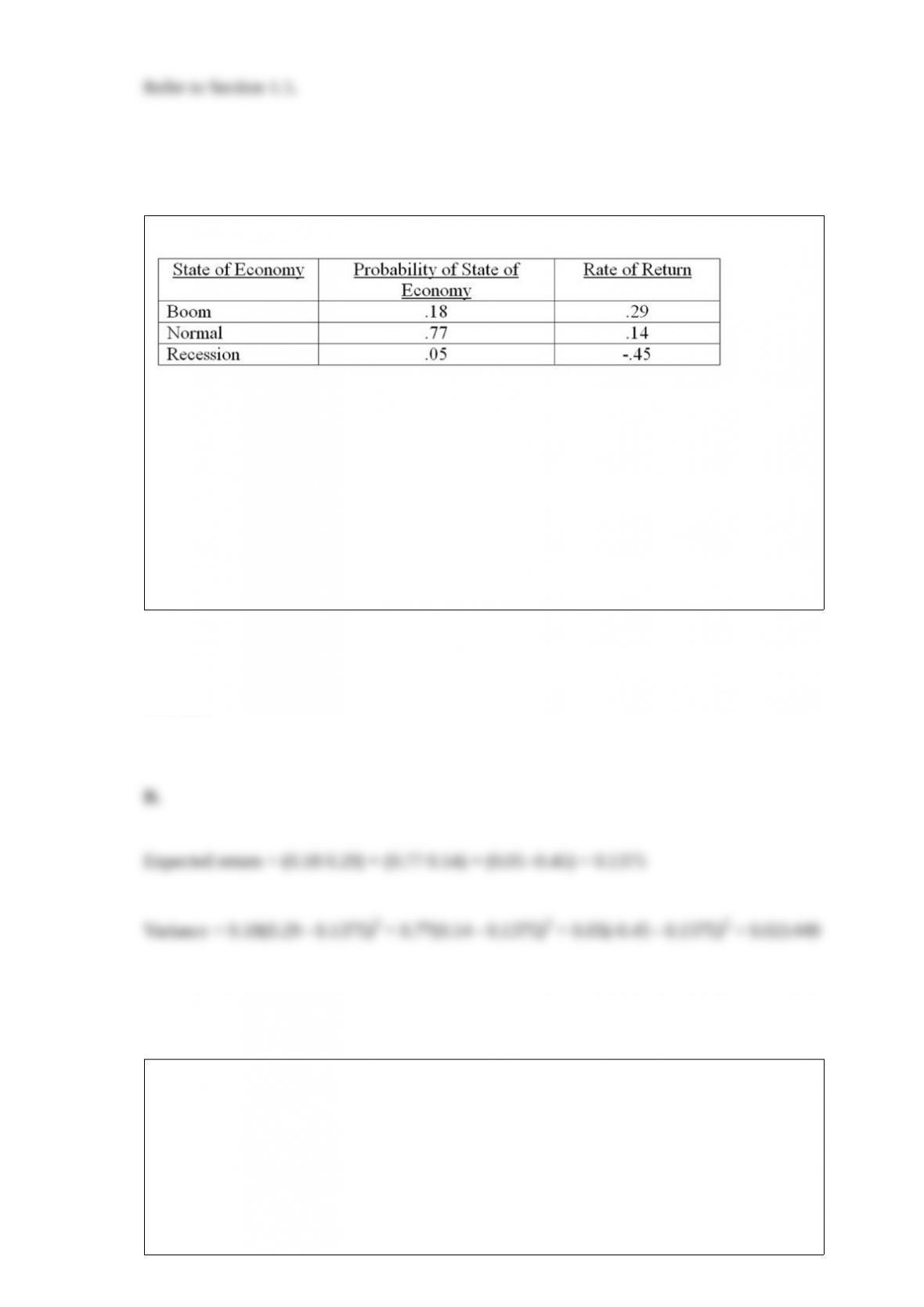
Given the following information, what is the variance of the returns on this stock?
A. 0.021387
B. 0.021449
C. 0.021506
D. 0.021538
E. 0.0215641
Answer:
The required return on a stock is equal to which one of the following if the dividend on
the stock decreases by 1 percent per year?
A. (P0/D1) – g
B. (D1/P0)/g

C. Dividend yield + capital gains yield
D. Dividend yield – capital gains yield
E. Dividend yield capital gains yield
Answer:
A cost that should be ignored when evaluating a project because that cost has already
been incurred and cannot be recouped is referred to as which type of cost?
A. Fixed
B. Forgotten
C. Variable
D. Opportunity
E. Sunk
Answer:

Firm A uses straight-line depreciation. Firm B uses MACRS depreciation. Both firms
bought $60,000 worth of equipment last year. Both firms are in the 35 percent tax
bracket. The operating cash flows for each firm are identical except for the depreciation
effects. Given this, you know the:
A. depreciation expense for Firm A will be greater than Firm B’s expense every year.
B. equipment has a higher value on Firm B’s books than on Firm A’s at the end of year
2.
C. operating cash flow of Firm A is less than that of Firm B for year 2.
D. market value of Firm A’s equipment is greater than the market value of Firm B’s
equipment.
E. market value of Firm B’s equipment is greater than the market value of Firm A’s
equipment.
Answer:
A.B. Securities assists issuers by pricing and selling new securities to the general
public. Which one of the following terms best fits the role that A. B. Securities is
playing?
A. Underwriter
B. Investment advisor
C. Specialist
D. Securities dealer
E. Venture capitalist
Answer:

Your firm has cash of $3,800, accounts receivable of $8,600, inventory of $33,100, and
net working capital of $1,100. What is the cash ratio?
A. 0.08
B. 0.09
C. 0.90
D. 1.21
E. 3.45
Answer:
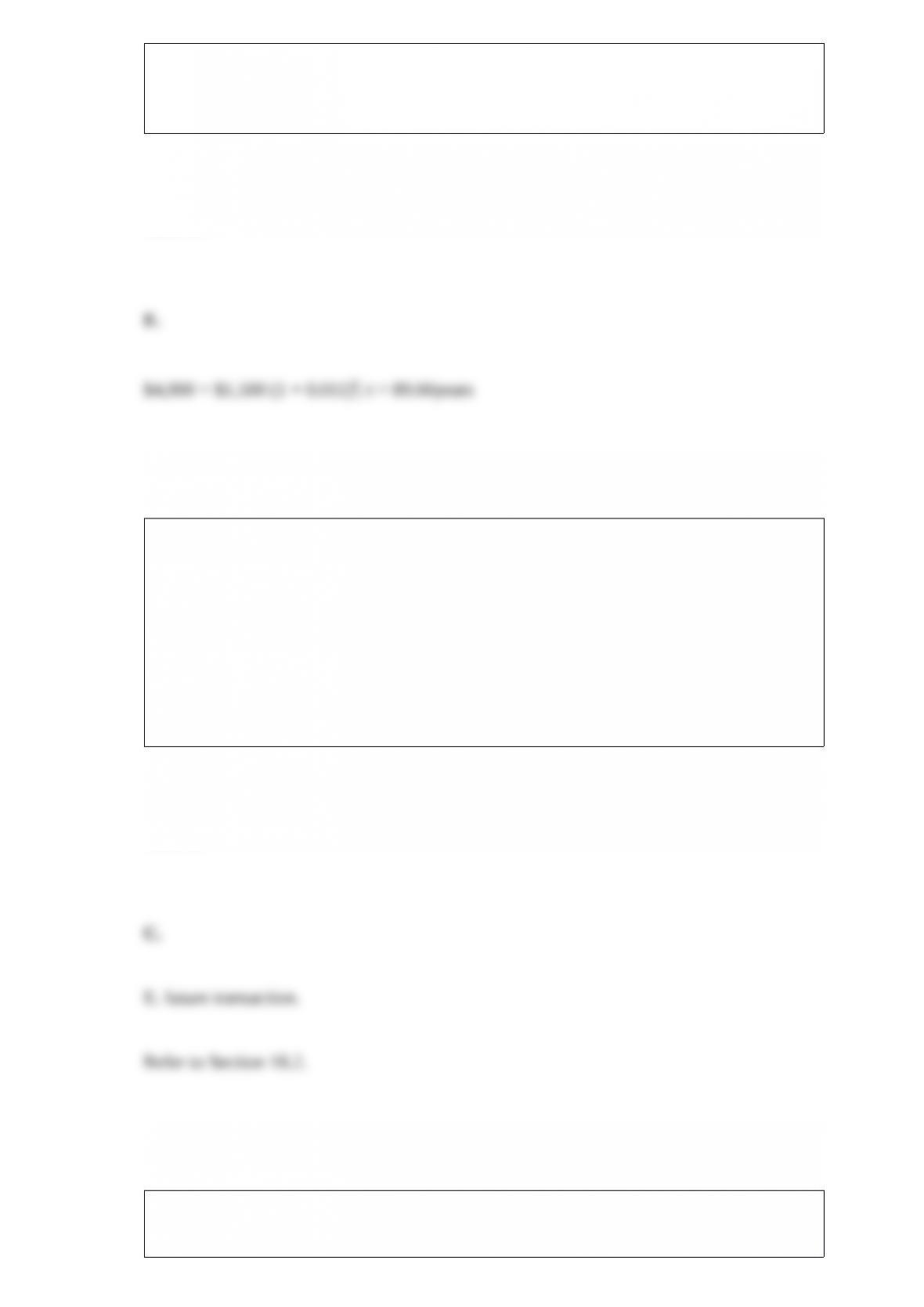
You have $1,500 today in your savings account. How long must you wait for your
savings to be worth $4,000 if you are earning 1.1 percent interest, compounded
annually?
A. 76.68 years
B. 79.69 years
C. 72.13 years
D. 80.57 years
E. 89.66 years
Answer:
The spot exchange rate is the exchange rate that applies to a(n):
A. LIBOR transaction.
B. ADR transaction.
C. spot trade.
D. forward trade.
Answer:
MLK, Inc. wants to issue new 15-year bonds for some much-needed expansion
projects. The company currently has 6.5 percent coupon bonds on the market that sell

for $975.00, make semiannual payments, and mature in 15 years. What coupon rate
should the company set on its new bonds if it wants them to sell at par?
A. 3.38 percent
B. 6.37 percent
C. 6.50 percent
D. 6.67 percent
E. 6.77 percent
Answer:
Assume that large-company stocks had an average return of 11.4 percent and a standard
deviation of 19.7 percent for a 40-year period. What range of returns would you expect
to see on these stocks 95 percent of the time?
A. -50.3 percent to 53.2 percent
B. -50.3 percent to 73.9 percent
C. -50.3 percent to 64.1 percent
D. 28.0 percent to 50.8 percent
E. -28.0 percent to 50.8 percent

Answer:
Which one of the following parties on the NYSE floor posts bid and asked prices?
A. Floor traders
B. DMMs
C. Floor brokers
D. Commission brokers
E. Fee brokers
Answer:
What is the payback period for a project with the following cash flows?
A. 2.56 years

B. 2.89 years
C. 3.17 years
D. 3.74 years
E. never
Answer:
Great Lakes Shipping is an all-equity firm with anticipated earnings before interest and
taxes of $439,000 annually forever. The present cost of equity is 16.4 percent.
Currently, the firm has no debt but is considering borrowing $1.25 million at 8.5
percent interest. The tax rate is 36 percent. What is the value of the levered firm?
A. $2,163,171
B. $2,406,519
C. $2,588,547
D. $2,666,667
E. $2,818,181
Answer: