
1) Which of the following statements is CORRECT?
a. Suppose a firm’s total assets turnover ratio falls from 1.0 to 0.9, but at the same time
its profit margin rises from 9% to 10%, and its debt increases from 40% of total assets
to 60%. Under these conditions, the ROE will decrease
b. Suppose a firm’s total assets turnover ratio falls from 1.0 to 0.9, but at the same time
its profit margin rises from 9% to 10% and its debt increases from 40% of total assets to
60%. Under these conditions, the ROE will increase
c. Suppose a firm’s total assets turnover ratio falls from 1.0 to 0.9, but at the same time
its profit margin rises from 9% to 10% and its debt increases from 40% of total assets to
60%. Without additional information, we cannot tell what will happen to the ROE
d. The modified DuPont equation provides information about how operations affect the
ROE, but the equation does not include the effects of debt on the ROE
e. Other things held constant, an increase in the debt ratio will result in an increase in
the profit margin on sales
2) Bloome Co.’s stock has a 25% chance of producing a 30% return, a 50% chance of
producing a 12% return, and a 25% chance of producing a -18% return. What is the
firm’s expected rate of return?
a.7.72%
b.8.12%
c.8.55%
d.9.00%
e.9.50%

3) Assuming all else is constant, which of the following statements is CORRECT?
a.For any given maturity, a 1.0 percentage point decrease in the market interest rate
would cause a smaller dollar capital gain than the capital loss stemming from a 1.0
percentage point increase in the interest rate
b.From a corporate borrower’s point of view, interest paid on bonds is not
tax-deductible
c.Price sensitivity as measured by the percentage change in price due to a given change
in the required rate of return decreases as a bond’s maturity increases
d.For a bond of any maturity, a 1.0 percentage point increase in the market interest rate
(rd) causes a larger dollar capital loss than the capital gain stemming from a 1.0
percentage point decrease in the interest rate
e.A 20-year zero coupon bond has more reinvestment rate risk than a 20-year coupon
bond
4) The two stocks in your portfolio, X and Y, have independent returns, so the
correlation between them, rXY is zero. Your portfolio consists of $50,000 invested in
Stock X and $50,000 invested in Stock Y. Both stocks have an expected return of 15%,
betas of 1.6, and standard deviations of 30%. Which of the following statements best
describes the characteristics of your 2-stock portfolio?
a.Your portfolio has a standard deviation less than 30%, and its beta is greater than 1.6
b.Your portfolio has a beta equal to 1.6, and its expected return is 15%
c.Your portfolio has a beta greater than 1.6, and its expected return is greater than 15%
d.Your portfolio has a standard deviation greater than 30% and a beta equal to 1.6
e.Your portfolio has a standard deviation of 30%, and its expected return is 15%
5) Which of the following statements is CORRECT?
a.Since its stockholders are not directly responsible for paying a corporation’s income
taxes, corporations should focus on before-tax cash flows when calculating the WACC
b.An increase in a firm’s tax rate will increase the component cost of debt, provided the
YTM on the firm’s bonds is not affected by the change in the tax rate
c.When the WACC is calculated, it should reflect the costs of new common stock,
reinvested earnings, preferred stock, long-term debt, short-term bank loans if the firm
normally finances with bank debt, and accounts payable if the firm normally has
accounts payable on its balance sheet

d.If a firm has been suffering accounting losses that are expected to continue into the
foreseeable future, and therefore its tax rate is zero, then it is possible for the after-tax
cost of preferred stock to be less than the after-tax cost of debt
e.Since the costs of internal and external equity are related, an increase in the flotation
cost required to sell a new issue of stock will increase the cost of reinvested earnings
6) Myron Gordon and John Lintner believe that the required return on equity increases
as the dividend payout ratio is decreased. Their argument is based on the assumption
that
a. investors require that the dividend yield and capital gains yield equal a constant
b. capital gains are taxed at a higher rate than dividends
c. investors view dividends as being less risky than potential future capital gains
d. investors value a dollar of expected capital gains more highly than a dollar of
expected dividends because of the lower tax rate on capital gains
e. investors are indifferent between dividends and capital gains
7) Granby Foods’ (GF) balance sheet shows a total of $25 million long-term debt with a
coupon rate of 8.50%. The yield to maturity on this debt is 8.00%, and the debt has a
total current market value of $27 million. The company has 10 million shares of stock,
and the stock has a book value per share of $5.00. The current stock price is $20.00 per
share, and stockholders’ required rate of return, rs, is 12.25%. The company recently
decided that its target capital structure should have 35% debt, with the balance being
common equity. The tax rate is 40%. Calculate WACCs based on book, market, and
target capital structures. What is the sum of these three WACCs?
a.28.36%
b.29.54%
c.30.77%
d.32.00%
e.33.28%

8) Safety Window and Door Co. buys on terms of 2/15, net 60 days. It does not take
discounts, and it typically pays on time, 60 days after the invoice date. Net purchases
amount to $450,000 per year. On average, how much “free” trade credit does the firm
receive during the year? (Assume a 365-day year, and note that purchases are net of
discounts.)
a.$18,493
b.$19,418

c.$20,389
d.$21,408
e.$22,479
9) Suppose the suppliers of your firm offered you credit terms of 2/10 net 30 days. Your
firm is not taking discounts, but is paying after 25 days instead of waiting until Day 30.
You point out that the nominal cost of not taking the discount and paying on Day 30 is
approximately 37%. But since your firm is neither taking discounts nor paying on the
due date, what is the effective annual percentage cost (not the nominal cost) of its costly
trade credit, using a 365-day year?
a.60.3%
b.63.5%
c.66.7%
d.70.0%
e.73.5%
10) Connor Publishing’s preferred stock pays a dividend of $1.00 per quarter, and it
sells for $55.00 per share. What is its effective annual (not nominal) rate of return?
a.6.62%
b.6.82%
c.7.03%
d.7.25%
e.7.47%

11) Assume that interest rates on 15-year noncallable Treasury and corporate bonds
with different ratings are as follows:
T-bond = 7.72%A = 9.64%
AAA = 8.72%BBB = 10.18%
The differences in rates among these issues were most probably caused primarily by:
a.Tax effects
b.Default risk differences
c.Maturity risk differences
d.Inflation differences
e.Real risk-free rate differences
12) Farmer Co. is considering Projects S and L, whose cash flows are shown below.
These projects are mutually exclusive, equally risky, and not repeatable. If the decision
is made by choosing the project with the shorter payback, some value may be forgone.
How much value will be lost in this instance? Note that under some conditions
choosing projects on the basis of the shorter payback will not cause value to be lost.
WACC:10.25%
Year01234
CFS-$950$500$800 $0 $0
CFL-$2,100$400$800$800$1,000
a.$24.14
b.$26.82
c.$29.80
d.$33.11
e.$36.42

13) Which of the following statements is CORRECT?
a.The preferred stock of a given firm is generally less risky to investors than the same
firm’s common stock
b.Corporations cannot buy the preferred stocks of other corporations
c.Preferred dividends are not generally cumulative
d.A big advantage of preferred stock is that dividends on preferred stocks are tax
deductible by the issuing corporation
e.Preferred stockholders have a priority over bondholders in the event of bankruptcy to
the income, but not to the proceeds in a liquidation
14) Edwards Electronics recently reported $11,250 of sales, $5,500 of operating costs
other than depreciation, and $1,250 of depreciation. The company had no amortization
charges, it had $3,500 of bonds that carry a 6.25% interest rate, and its
federal-plus-state income tax rate was 35%. How much was its net cash flow?
a.$3,284.75
b.$3,457.63
c.$3,639.61
d.$3,831.17
e.$4,032.81
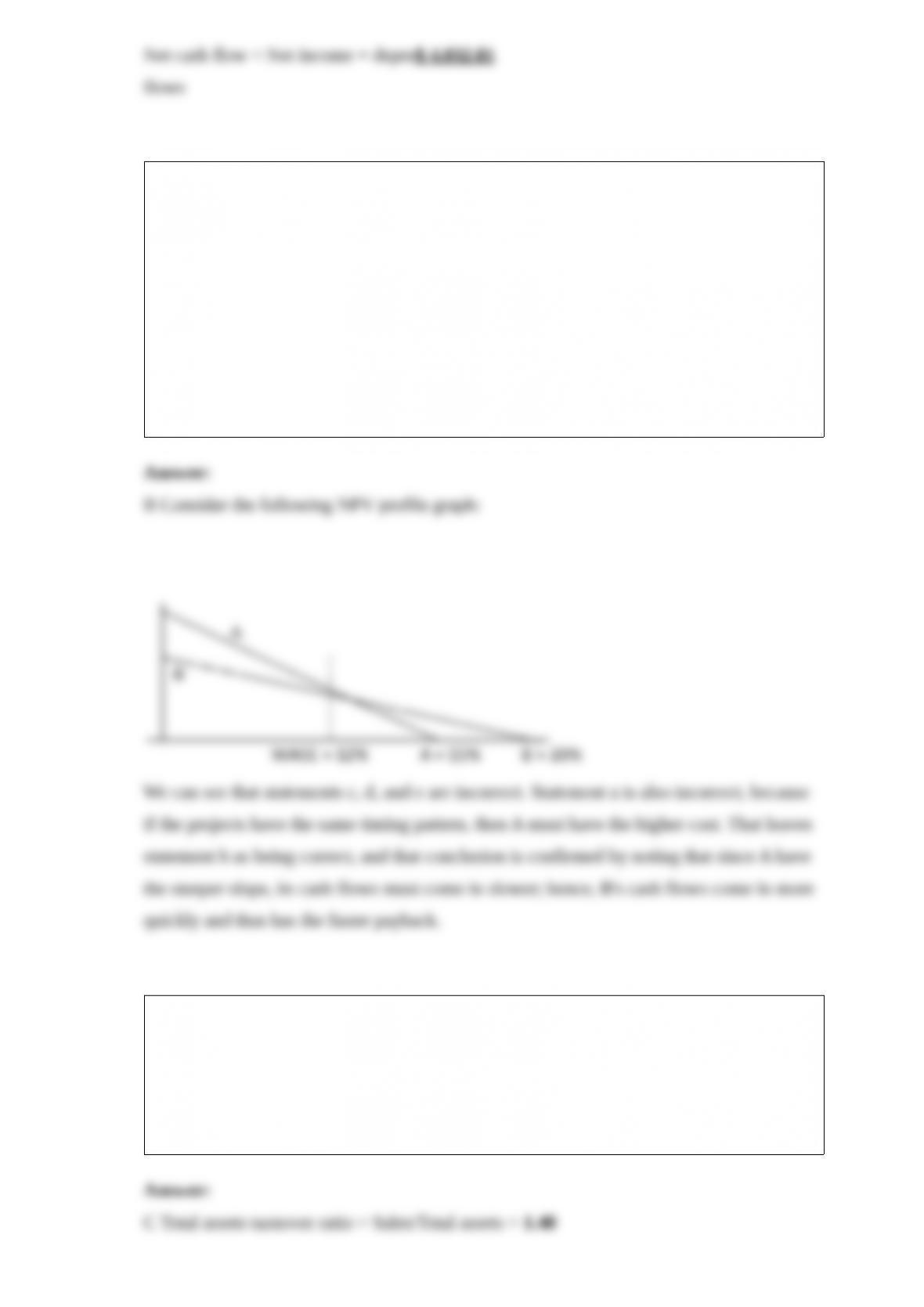
15) Projects A and B are mutually exclusive and have normal cash flows. Project A has
an IRR of 15% and B’s IRR is 20%. The company’s WACC is 12%, and at that rate
Project A has the higher NPV. Which of the following statements is CORRECT?
a.Assuming the timing pattern of the two projects’ cash flows is the same, Project B
probably has a higher cost (and larger scale)
b.Assuming the two projects have the same scale, Project B probably has a faster
payback than Project A
c.The crossover rate for the two projects must be 12%
d.Since B has the higher IRR, then it must also have the higher NPV if the crossover
rate is less than the WACC of 12%
e.The crossover rate for the two projects must be less than 12%
16) Refer to Exhibit 3.1. What is the firm’s total assets turnover?
a. 0.90
b. 1.12
c. 1.40
d. 1.68
e. 2.02

17) You are a finance intern at Chambers and Sons and they have asked you to help
estimate the company’s cost of common equity. You obtained the following data: D1 =
$1.25; P0 = $27.50; g = 5.00% (constant); and F = 6.00%. What is the cost of equity
raised by selling new common stock?
a.9.06%
b.9.44%
c.9.84%
d.10.23%
e.10.64%
18) Martin Ortner holds a $200,000 portfolio consisting of the following stocks:
StockInvestmentBeta
A $50,0000.95
B 50,0000.80
C 50,0001.00
D 50,0001.20
Total$200,000
What is the portfolio’s beta?
a.0.938
b.0.988
c.1.037
d.1.089
e.1.143

19) Bartling Energy Systems recently reported $9,250 of sales, $5,750 of operating
costs other than depreciation, and $700 of depreciation. The company had no
amortization charges, it had $3,200 of outstanding bonds that carry a 5% interest rate,
and its federal-plus-state income tax rate was 35%. In order to sustain its operations and
thus generate sales and cash flows in the future, the firm was required to make $1,250
of capital expenditures on new fixed assets and to invest $300 in net operating working
capital. By how much did the firm’s net income exceed its free cash flow?
a.$673.27
b.$708.70
c.$746.00
d.$783.30
e.$822.47
20) Consider two very different firms, M and N. Firm M is a mature firm in a mature
industry. Its annual net income and net cash flows are both consistently high and stable.
However, M’s growth prospects are quite limited, so its capital budget is small relative
to its net income. Firm N is a relatively new firm in a new and growing industry. Its
markets and products have not stabilized, so its annual operating income fluctuates
considerably. However, N has substantial growth opportunities, and its capital budget is
expected to be large relative to its net income for the foreseeable future. Which of the
following statements is correct?
a. Firm M probably has a higher dividend payout ratio than Firm N

b. If the corporate tax rate increases, the debt ratio of both firms is likely to decline
c. The two firms are equally likely to pay high dividends
d. Firm N is likely to have a clientele of shareholders who want to receive consistent,
stable dividend income
e. Firm M probably has a lower debt ratio than Firm N
21) Meacham Enterprises’ bonds currently sell for $1,280 and have a par value of
$1,000. They pay a $135 annual coupon and have a 15-year maturity, but they can be
called in 5 years at $1,050. What is their yield to call (YTC)?
a.6.39%
b.6.72%
c.7.08%
d.7.45%
e.7.82%
22) North Construction had $850 million of sales last year, and it had $425 million of
fixed assets that were used at only 60% of capacity. What is the maximum sales growth
rate North could achieve before it had to increase its fixed assets?
a.54.30%
b.57.16%
c.60.17%
d.63.33%
e.66.67%

23) Assume a project has normal cash flows. All else equal, which of the following
statements is CORRECT?
a.A project’s NPV increases as the WACC declines
b.A project’s MIRR is unaffected by changes in the WACC
c.A project’s regular payback increases as the WACC declines
d.A project’s discounted payback increases as the WACC declines
e.A project’s IRR increases as the WACC declines
24) Which of the following bonds has the greatest interest rate price risk?
a.A 10-year, $1,000 face value, zero coupon bond
b.A 10-year, $1,000 face value, 10% coupon bond with annual interest payments
c.All 10-year bonds have the same price risk since they have the same maturity
d.A 10-year, $1,000 face value, 10% coupon bond with semiannual interest payments
25) Alcott’s preferred stock pays a dividend of $1.00 per quarter. If the price of the
stock is $45.00, what is its nominal (not effective) annual rate of return?
a.8.03%
b.8.24%
c.8.45%
d.8.67%
e.8.89%
26) Bloom and Co. has no debt or preferred stockit uses only equity capital, and has
two equally-sized divisions. Division X’s cost of capital is 10.0%, Division Y’s cost is

14.0%, and the corporate (composite) WACC is 12.0%. All of Division X’s projects are
equally risky, as are all of Division Y’s projects. However, the projects of Division X
are less risky than those of Division Y. Which of the following projects should the firm
accept?
a.A Division Y project with a 12% return
b.A Division X project with an 11% return
c.A Division X project with a 9% return
d.A Division Y project with an 11% return
e.A Division Y project with a 13% return
27) Blueroot Inc. is considering a change in its financing policy. Currently, it uses
maximum trade credit by not taking discounts on its purchases. The standard industry
credit terms offered by all its suppliers are 2/10 net 30 days, and the firm pays on time.
The new CFO is considering borrowing from its bank, using short-term notes payable,
and then taking discounts. The firm wants to determine the effect of this policy change
on its net income. Its net purchases are $11,760 per day, using a 365-day year. The
interest rate on the notes payable is 10%, and the tax rate is 40%. If the firm implements
the plan, what is the expected change in net income?
a.$32,964
b.$34,699
c.$36,526
d.$38,448
e.$40,370

28) Refer to Exhibit 3.1. What is the firm’s cash flow per share?
a. $10.06
b. $10.59
c. $11.15
d. $11.74
e. $12.35
29) Burke Tires just paid a dividend of D0 = $1.32. Analysts expect the company’s
dividend to grow by 30% this year, by 10% in Year 2, and at a constant rate of 5% in
Year 3 and thereafter. The required return on this low-risk stock is 9.00%. What is the
best estimate of the stock’s current market value?
a.$41.59
b.$42.65
c.$43.75
d.$44.87
e.$45.99

30) Which of the following factors could explain why Regal Industrial Fixtures had a
negative net cash flow last year, even though the cash on its balance sheet increased?
a.The company repurchased 20% of its common stock
b.The company sold a new issue of bonds
c.The company made a large investment in new plant and equipment
d.The company paid a large dividend
e.The company had high amortization expenses
31) Even though Firm A’s current ratio exceeds that of Firm B, Firm B’s quick ratio
might exceed that of A. However, if A’s quick ratio exceeds B’s, then we can be certain
that A’s current ratio is also larger than that of B.

32) When estimating the cost of equity by use of the CAPM, three potential problems
are (1) whether to use long-term or short-term rates for rRF, (2) whether or not the
historical beta is the beta that investors use when evaluating the stock, and (3) how to
measure the market risk premium, RPM. These problems leave us unsure of the true
value of rs.
33) Market value ratios provide management with an indication of how investors view
the firm’s past performance and especially its future prospects.
34) Other things held constant, if a firm ‘stretches” (i.e., delays paying) its accounts
payable, this will lengthen its cash conversion cycle (CCC).
35) The NPV and IRR methods, when used to evaluate two equally risky but mutually
exclusive projects, will lead to different accept/reject decisions and thus capital budgets
if the cost of capital at which the projects’ NPV profiles cross is less than the projects’
cost of capital.
36) If the information content, or signaling, hypothesis is correct, then changes in
dividend policy can have an important effect on the firm’s value and capital costs.