
In a bank reconciliation, company errors are adjustments to ________. Bank errors are
adjustments to ________.
A) balance per bank; balance per bank
B) balance per company; balance per company
C) balance per bank; balance per company
D) balance per company; balance per bank
E) balance per company; balance per IRS
Wendy Walia owns 500 shares of Rhodes Water Company. The capital stock of Rhodes
Water Company has a par value of $3 per share. Wendy Walia sells her 500 shares of
Rhodes Water stock to Steve Matelski for $10 per share. The effect of this transaction
on Rhodes Water Company would be to
A) increase the cash account by $5,000 and increase the capital stock account by
$5,000.
B) increase the cash account by $5,000, increase the capital stock account by $1,500,
and increase the paid-in capital in excess of par account by $3,500.
C) increase the cash account by $5,000 and decrease the capital stock account by
$5,000.
D) increase the cash account by $5,000, decrease the capital stock account by $1,500,
and decrease the paid-in capital in excess of par account by $3,500.
E) Rhodes Water Company would not record this transaction but would note the change
in ownership.
The convention that gives financial statement users more timely information is the
A) stable monetary unit
B) materiality convention
C) going concern convention
D) periodicity convention
E) entity concept
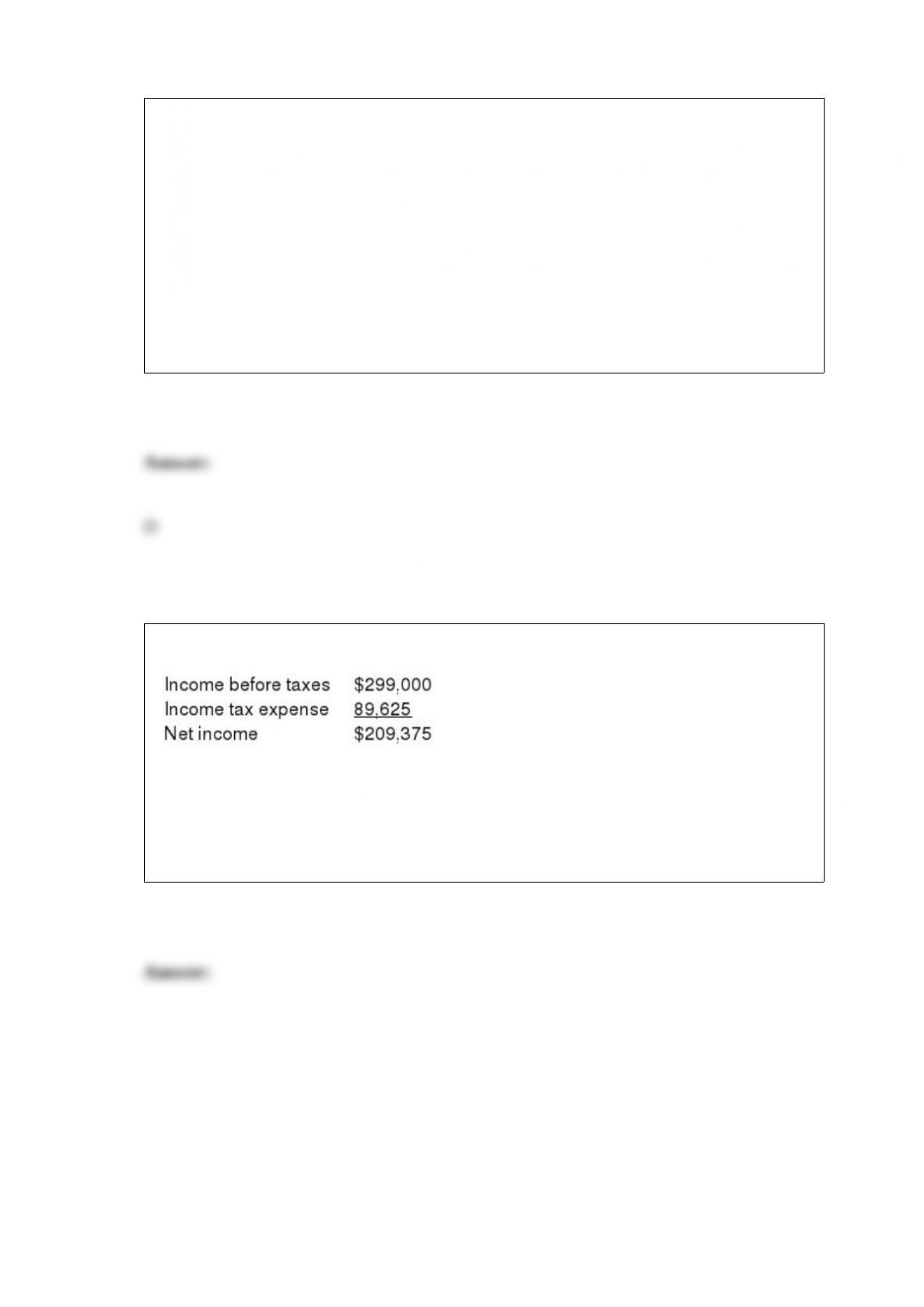
Furlough Company’s 20X3 income statement included the following:
As a result of 20X3 operations, the deferred tax liability account increased by $12,000.
a. Compute taxes paid to the government in 20X3.
b. Prepare the journal entry to record taxes on ordinary income for 20X3.

Which of the following statements about large stock dividends is true?
A) If the market price of the stock before a 50% stock dividend is $30, the market price
after the stock dividend will be $45.
B) If the market price of the stock before a 50% stock dividend is $30, the market price
after the stock dividend will be $60.
C) A stockholder who owned 50 shares of stock before the 50% stock dividend, will
own 100 shares of stock after the stock dividend.
D) With a 50% stock dividend, Retained Earnings is reduced by the par value of new
shares of stock issued.
E) With a 50% stock dividend, Retained Earnings is reduced by the market value of
new shares of stock issued.
Public accounting is
A) the field of accounting where accountants work for businesses, government
agencies, or other nonprofit organizations.
B) the field of accounting where services are offered to the general public on a fee
basis.
C) a field of accounting where no audits occur.
D) the field that provides management with internal company reports.
E) unregulated.
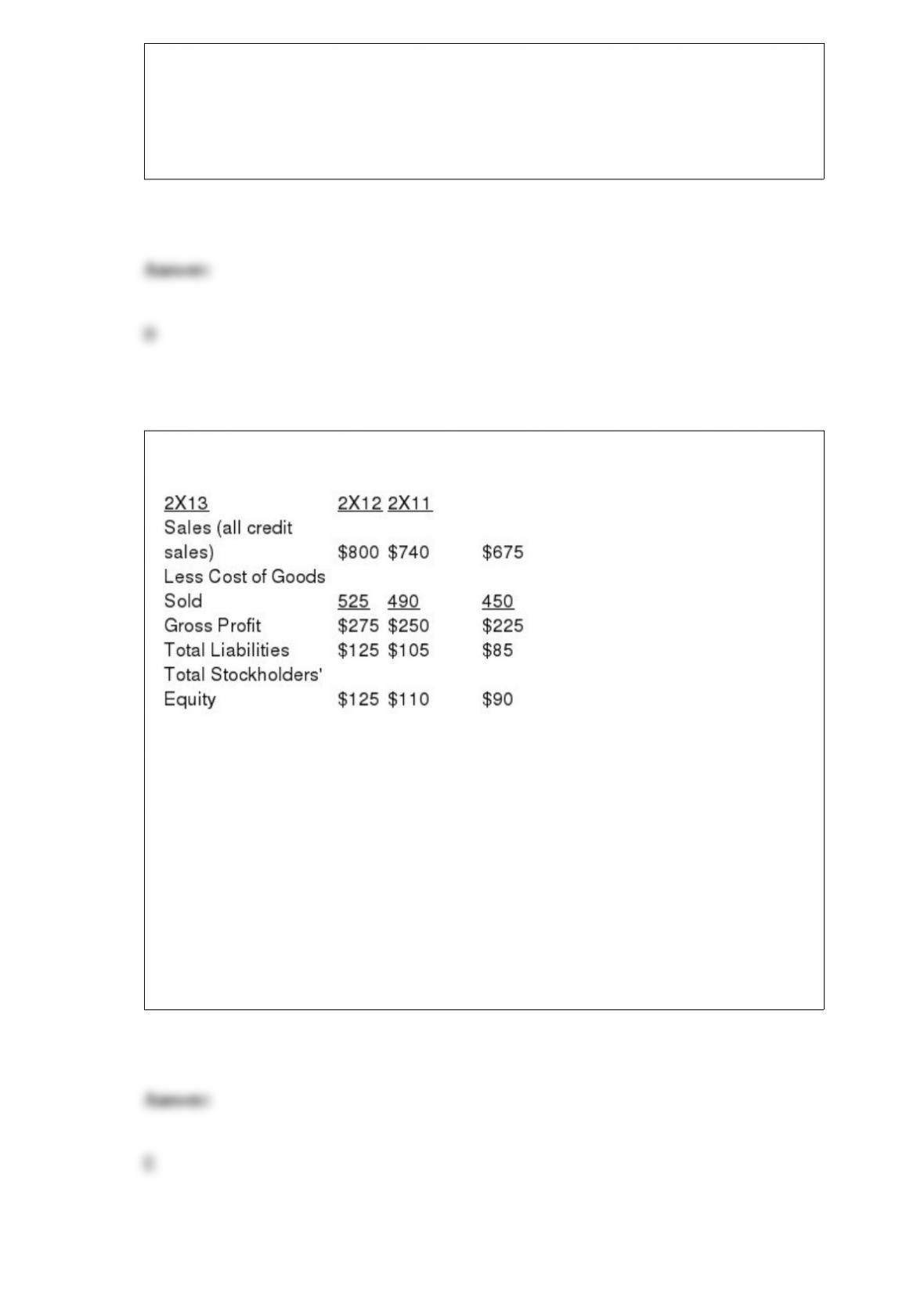
Tulip Company has the following data available:
What is the total asset turnover for Tulip Company in 2X13? Has the total asset
turnover improved or not improved since 2X12?
A) 1.2, improved
B) 1.2, not improved
C) 3.2, improved
D) 3.4, improved
E) 3.4, not improved

Which of the following would appear in the financing activities section of a statement
of cash flows?
A) Cash payments to employees
B) Cash payment of dividends
C) Cash purchase of equipment
D) Cash paid for income taxes
E) Cash purchase of land
Assuming inflation, which of the following statements incorrectly describes an attribute
of, or the relationship among, inventory valuation methods?
A) Specific identification is used primarily when ending inventory consists of a
relatively few but very expensive and distinctive items.
B) Given inflation and in order to minimize taxes, most firms have tended to switch to
LIFO if they had been using FIFO.
C) LIFO tends to provide ending inventory valuations that closely approximate the
actual market value of the inventory at the balance sheet date.
D) LIFO tends to report current acquisition costs of inventory through cost of goods
sold.
E) Weighted average provides less extreme balance sheet and income statement results
than either FIFO or LIFO.

Kolonial Township acquired a building and the 3 acres of land on which it is located.
The total purchase price was $2,500,000. For valuation purposes, the company
contacted three local commercial real estate agents, who gave the following valuation
estimates:
If Kolonial Township used the valuation made by M. Mulhan and assuming it paid cash
for the land and building, what journal entry would Kolonial Township make to record
the purchase?
A) Land 750,000
Building 1,750,000
Cash 2,500,000
B) Land 500,000
Building 2,000,000
Cash 2,500,000
C) Land 900,000
Building 2,100,000
Cash 3,000,000
D) Land 833,250
Building 830,750
Cash 2,500,000
E) Land 900,000
Building 2,100,000
Cash 2,500,000
Gain on Purchase of Assets 500,000

Which situation violates the matching principle?
A) Employees are paid for wages worked in a previous month. The wages expense was
recorded in the previous month.
B) Consulting fees incurred have been recorded as an expense even though a bill has
not yet been received.
C) Depreciation was recorded for equipment even though the equipment was purchased
on a date other than January 1.
D) A 1-year insurance policy was paid in full on January 1 and the total amount of the
bill was recorded as an expense in January.
E) Customers are billed for services even though the company knows a portion of the
customers will never pay.
The following data pertains to Greenwold Manufacturing. Total assets at January 1,
20X9, were $290,000; at December 31, 20X9, total assets were $334,000. During
20X9, sales were $995,000; cash dividends declared were $10,000; and operating
expenses (exclusive of cost of goods sold) were $545,000. Total liabilities at December
31, 20X9, were $128,000; at January 1, 20X9, total liabilities were $105,000. There was
no additional paid-in capital during 20X9. What was cost of goods sold for 20X9?
A) $450,000
B) $435,000
C) $429,000
D) $419,000
E) $440,000

A policy stating that the board of directors must approve all expenditures for capital
assets in excess of $50,000 is an example of
A) specific authorization.
B) general authorization.
C) adequate documentation.
D) proper procedures.
E) an independent check.
Liquidity is an entity’s ability
A) to meet its dividend obligations with cash and near-cash assets as those obligations
become due.
B) to pay its employees a bonus at year-end based on the success of the organization.
C) to meet its near-term financial obligations with cash and near-cash assets as those
obligations become due.
D) to liquidate its assets should a company decide to terminate operations.
E) to purchase fixed assets at a reduced loan percentage based on credit ratings.