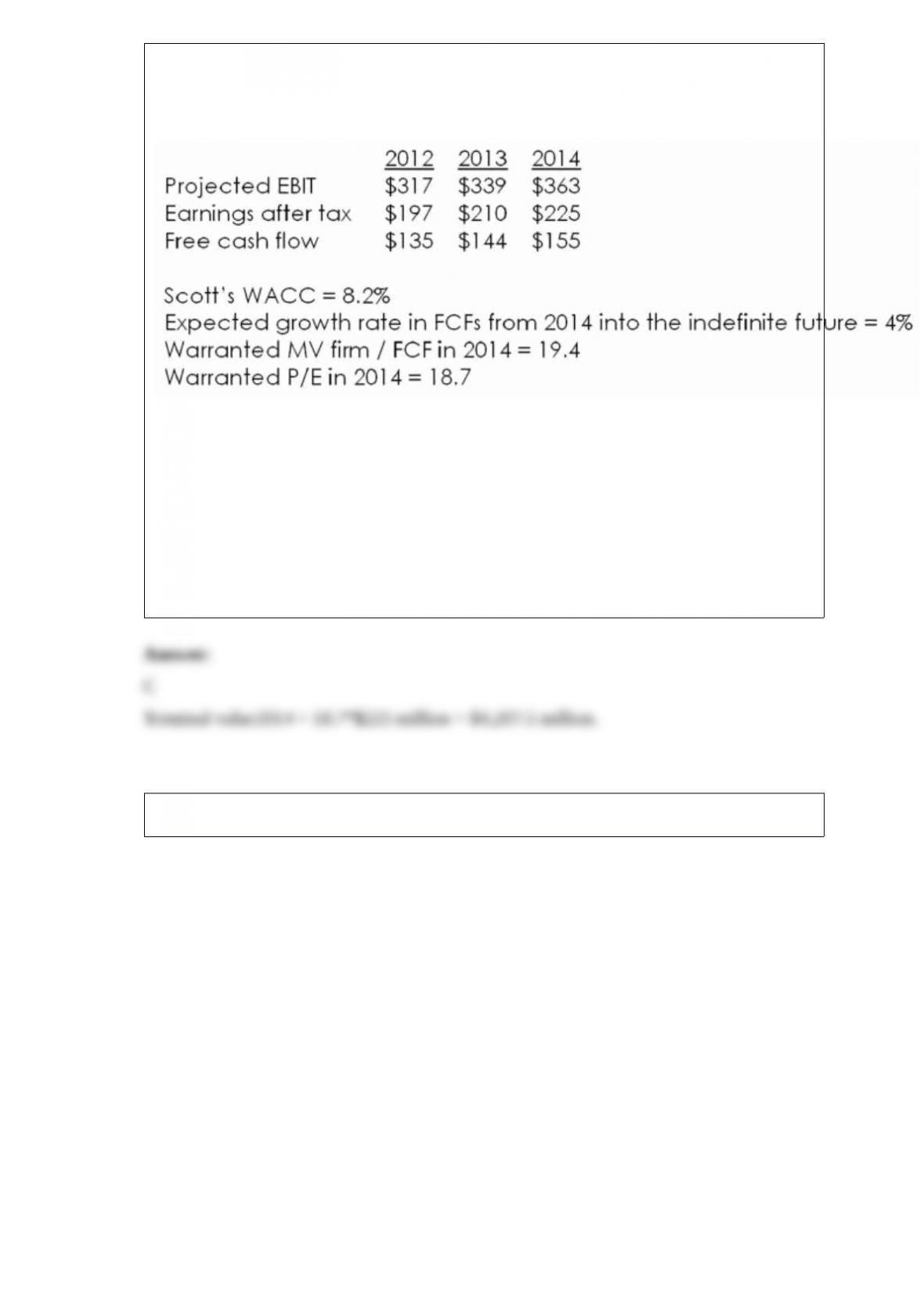
1) The following table presents forecasted financial and other information for Scott’s
Miracle-Gro Co.:
What is an appropriate estimate of Scott’s terminal value of equity as of the end of
2014?
A.$225 million
B.$3,833.0 million
C.$4,205 million
D.$4,365.0 million
E.$6,788.1 million
F.None of the above
2)
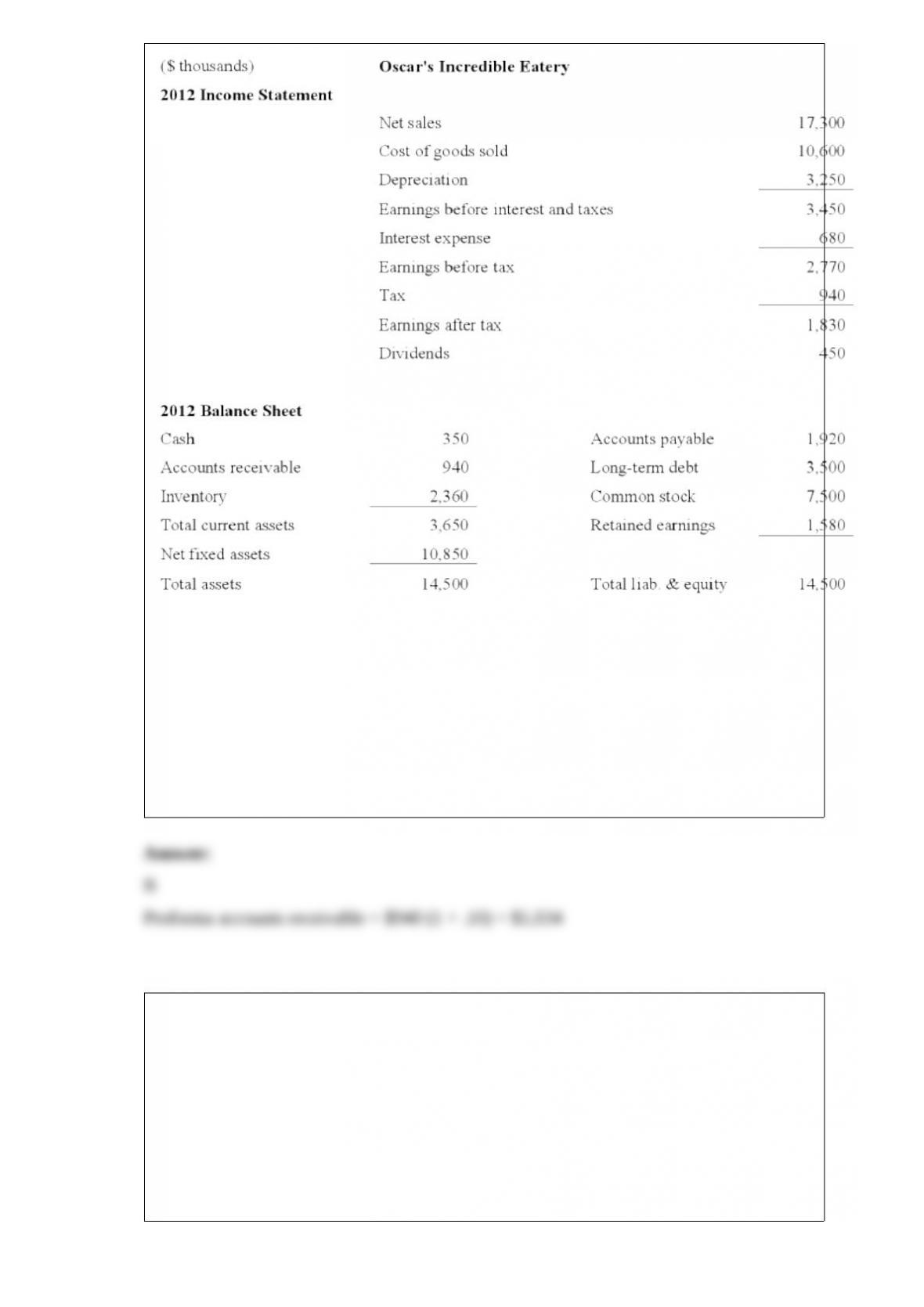
Please refer to Oscar’s financial statements. All of Oscar’s costs and net working capital
vary directly with sales. Sales are projected to increase by 10 percent. What is the pro
forma accounts receivable balance for next year?
A.$949
B.$1,034
C.$1,113
D.$1,730
E.$2,670
F.None of the above
3) Which of the following statements is true?
A.Rapid growth spurs increases in market share and profits and thus, is always a
blessing
B.Firms that grow rapidly only very rarely encounter financial problems
C.The cash flows generated in a given time period are equal to the profits reported
D.Profits provide assurance that cash flow will be sufficient to maintain solvency
E.Due to required cash investments in current assets, fast-growing and profitable
companies can literally “grow broke”
F.None of the above

4) You bought a yen-denominated corporate bond at the beginning of the year for
100,000. The bond paid 3 percent annual interest and was trading for 110,000 at
year-end. The exchange rate was $1 = 100 at the beginning of the year and $1 = 97 at
year-end. What would be your U.S. dollar holding return on the bond?
A.3.09%
B.6.09%
C.13%
D.16.49%
E.30%
F.None of the above
5) You bought a yen-denominated corporate bond at the beginning of the year for
100,000. The bond paid 3 percent annual interest and was trading for 110,000 at
year-end. The exchange rate was $1 = 100 at the beginning of the year and $1 = 122 at
year-end. What was your U.S. dollar holding period return on the bond?
A.3%
B.7%
C.10%
D.13%
E.30%
F.None of the above

6) Which one of the following ratios identifies the amount of assets a firm needs in
order to generate $1 in sales?
A.current ratio
B.debt-to-equity
C.retention
D.asset turnover
E.return on assets
7) Which of the following is/are helpful for evaluating the effect of leverage on a
company’s risk and potential returns?
I. Estimated pro forma coverage ratios
II. The recognition that financing decisions do not affect firm or shareholder value
III. A range of earnings chart and proximity of expected EBIT to the breakeven value
IV. A conservative debt policy that obviates the need to evaluate risk
A.I only
B.III only
C.I and III only
D.II and III only
E.IV only
F.None of the above
8) You believe interest rates will soon fall.
a. Would you rather own a three-year, 6 percent coupon, fixed-rate bond or an
equivalent-risk, three-year, floating-rate bond currently paying 6 percent interest?
b. Would your answer to (a) change if you were contemplating issuing a bond rather
than owning one? If so, how?
c. Would your answer to (a) change if, as an investor, you believed interest rates would
soon rise? If so, why?
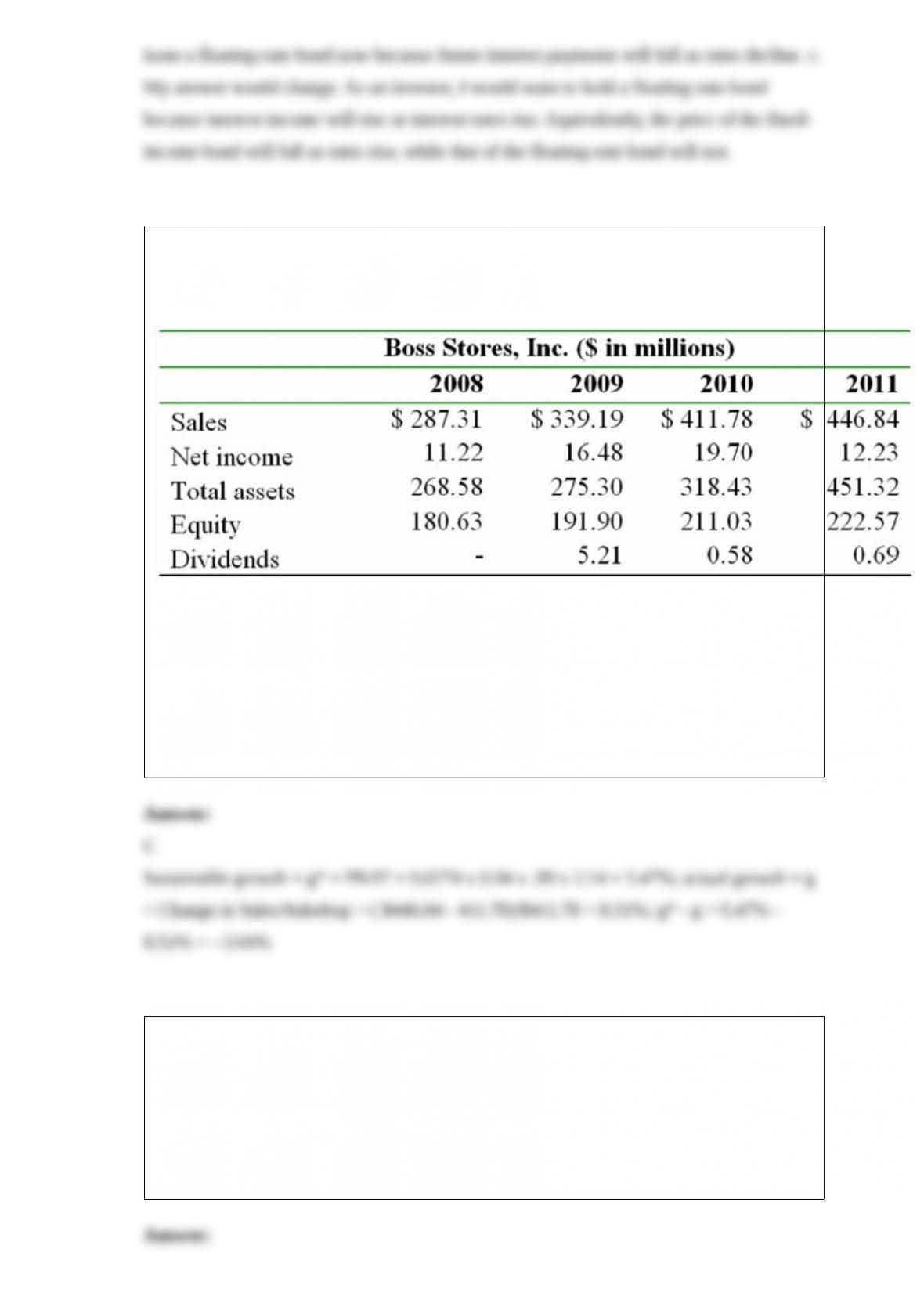
9) The following table presents financial information for Boss Stores, Inc., a retail chain
store in the U.S.
Use the information from Boss’s annual financial statements. What is the difference
between the sustainable growth and actual growth rates for 2011?
A.- 11.40%
B.- 7.09%
C.-3.04%
D.5.47%
E.13.98%
F.21.40%
10) Total risk is measured by _____ and systematic risk is measured by ____.
A.beta; alpha
B.beta; standard deviation
C.WACC; beta
D.standard deviation; beta
E.standard deviation; variance
F.None of the above

11) Which of the following statements related to the internal rate of return (IRR) are
correct?
I. The IRR is the discount rate at which an investment’s NPV equals zero.
II. An investment should be undertaken if the discount rate exceeds the IRR.
III. The IRR tends to be used more than net present value simply because its results are
easier to comprehend.
IV. The IRR is the best tool available for deciding between mutually exclusive
investments.
A.I and II only
B.I and III only
C.II and III only
D.I, II, and IV only
E.I, II, III, and IV
F.None of the above
12) When investment returns are less than perfectly positively correlated, the resulting
diversification effect means that:
A.making an investment in two or three large stocks will eliminate all of the
unsystematic risk
B.making an investment in three companies all within the same industry will greatly
reduce the systematic risk
C.spreading an investment across five diverse companies will not lower the total risk
D.spreading an investment across many diverse assets will eliminate all of the
systematic risk
E.spreading an investment across many diverse assets will eliminate some of the total
risk
F.None of the above
13) JM Case Inc. has a market value of $5 million with 500,000 shares outstanding. The
book value of its equity is $1,750,000. What is JM Case’s price per share?
A.$3.50
B.$5
C.$10
D.$25
E.$50
F.None of the above
14) Which of the following securities has a purely fixed claim against a firm’s cash
flows?
A.preferred stock
B.options
C.common stock
D.bonds
E.None of the above
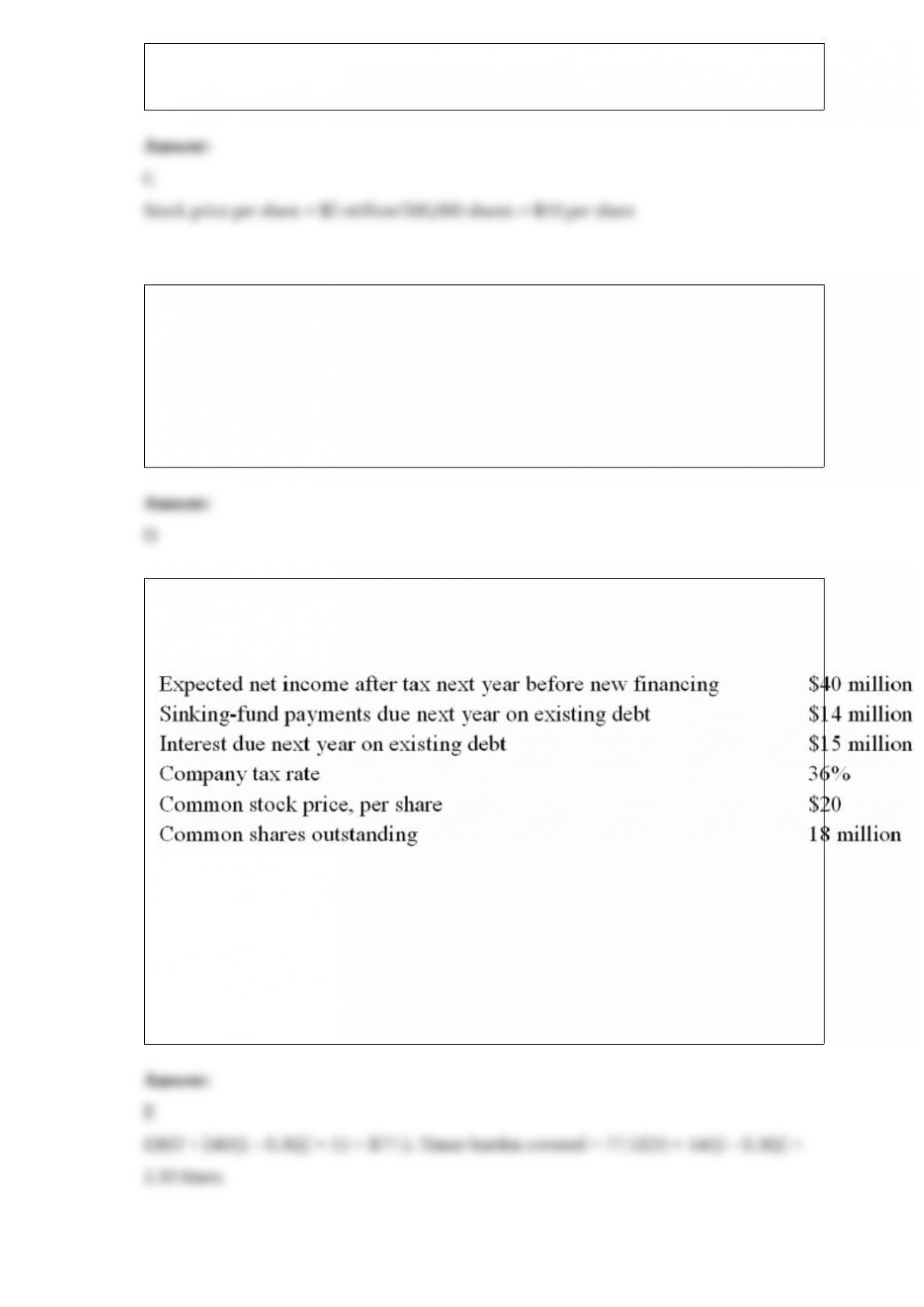
15) As the financial vice president for Squamish Equipment, you have the following
information:
For next year, calculate Squamish’s times burden covered ratio if Squamish sells 2
million new shares at $20 a share.
A.1.03
B.1.38
C.1.60
D.1.89
E.2.10
F.None of the above
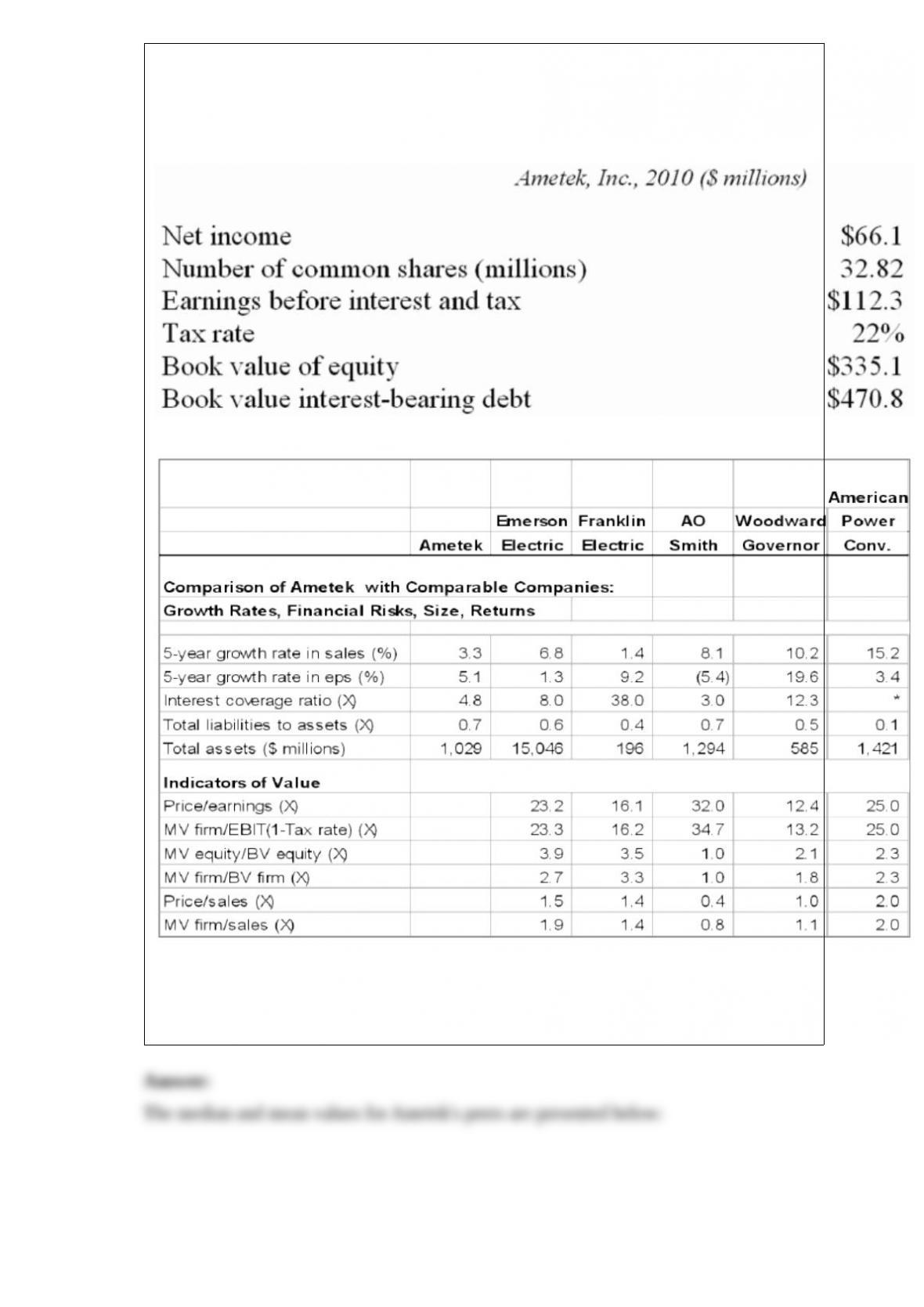
16) Ametek, Inc. is a billion dollar manufacturer of electronic instruments and motors
headquartered in Paoli, Pennsylvania. Use the following information on Ametek and
five other similar companies to value Ametek, Inc. on December 31, 2010.
*American Power Conversion has no interest-bearing debt outstanding.
MV = Market value; BV = Book value. Market value is estimated as book value of
interest-bearing debt + market value of equity. Earnings are fiscal year earnings.
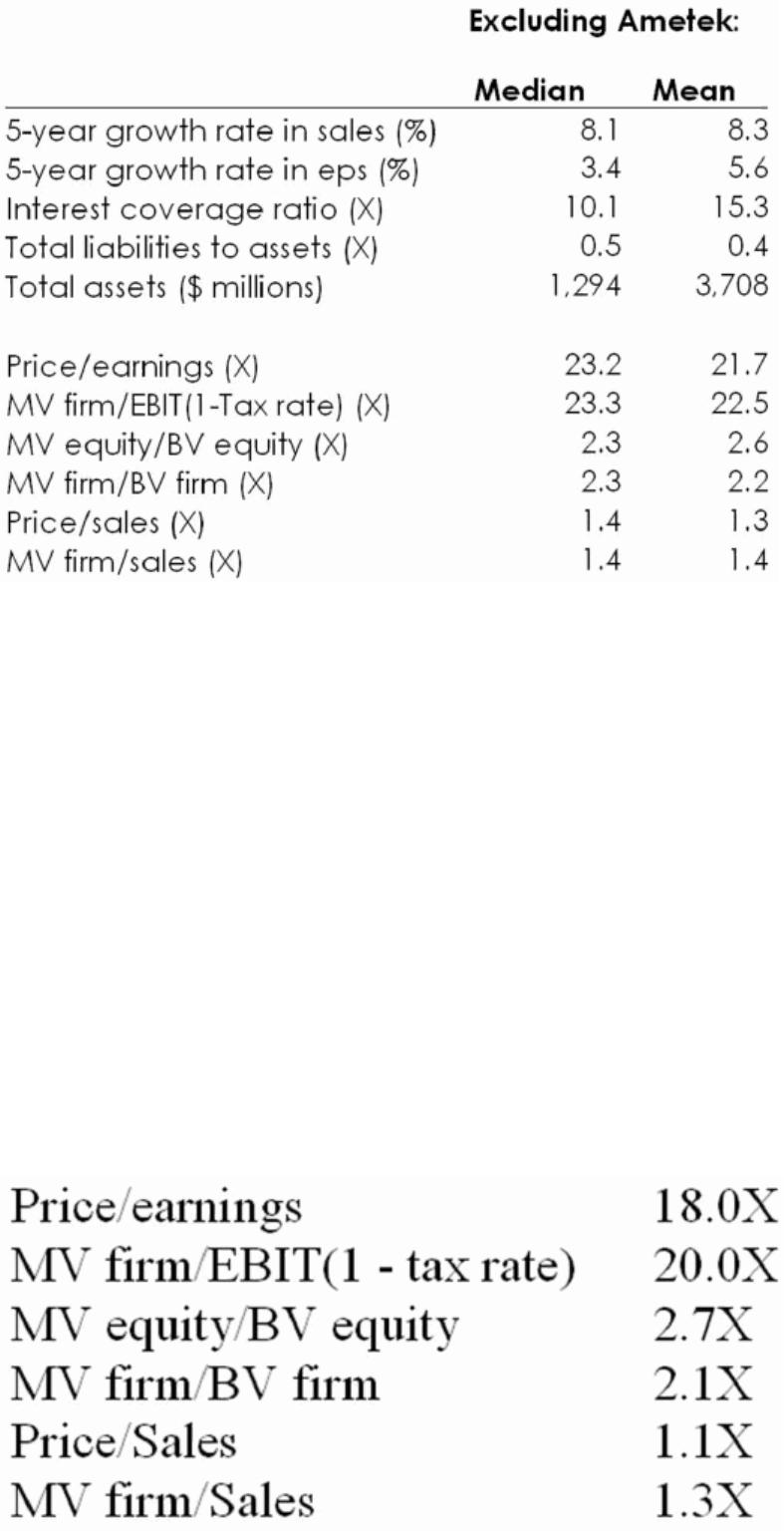

17) Which one of the following is the financial statement that summarizes changes in
the company’s cash balance over a period of time?
A.income statement
B.balance sheet
C.cash flow statement
D.shareholders’ equity statement
E.market value statement
18) Which one of the following statements is false?
A.Financial executives must design financial securities to meet the needs of the firm
and its investors
B.Financial instruments are subject to full disclosure requirements
C.Financial instruments are greatly constrained by law and regulation
D.Financial instruments are claims against a company’s cash flows and assets
E.None of the above
19) A firm has a retention ratio of 40 percent and a sustainable growth rate of 6.2

percent. The asset turnover ratio is 0.85 and the assets-to-equity ratio (using
beginning-of-period equity) is 1.80. What is the profit margin?
A.3.79 percent
B.5.69 percent
C.6.75 percent
D.10.13 percent
E.18.24 percent
20) Which of the following tends to cause differences between market values and book
values?
I. Accounting often creates a dichotomy between realized and unrealized income.
II. Accountants allocate goodwill when a firm is acquired for more than book value.
III. Many accounting values are transactions-based and hence backward-looking.
IV. The use of fair-value accounting.
V. Accountants refuse to assign a cost to equity capital.
A.I and II only
B.I and III only
C.II and IV only
D.I, III, and IV only
E.I, III, and V only
F.I, III, IV, and V only
21) Selected financial data for Link, Inc. follows: ($ in thousands)
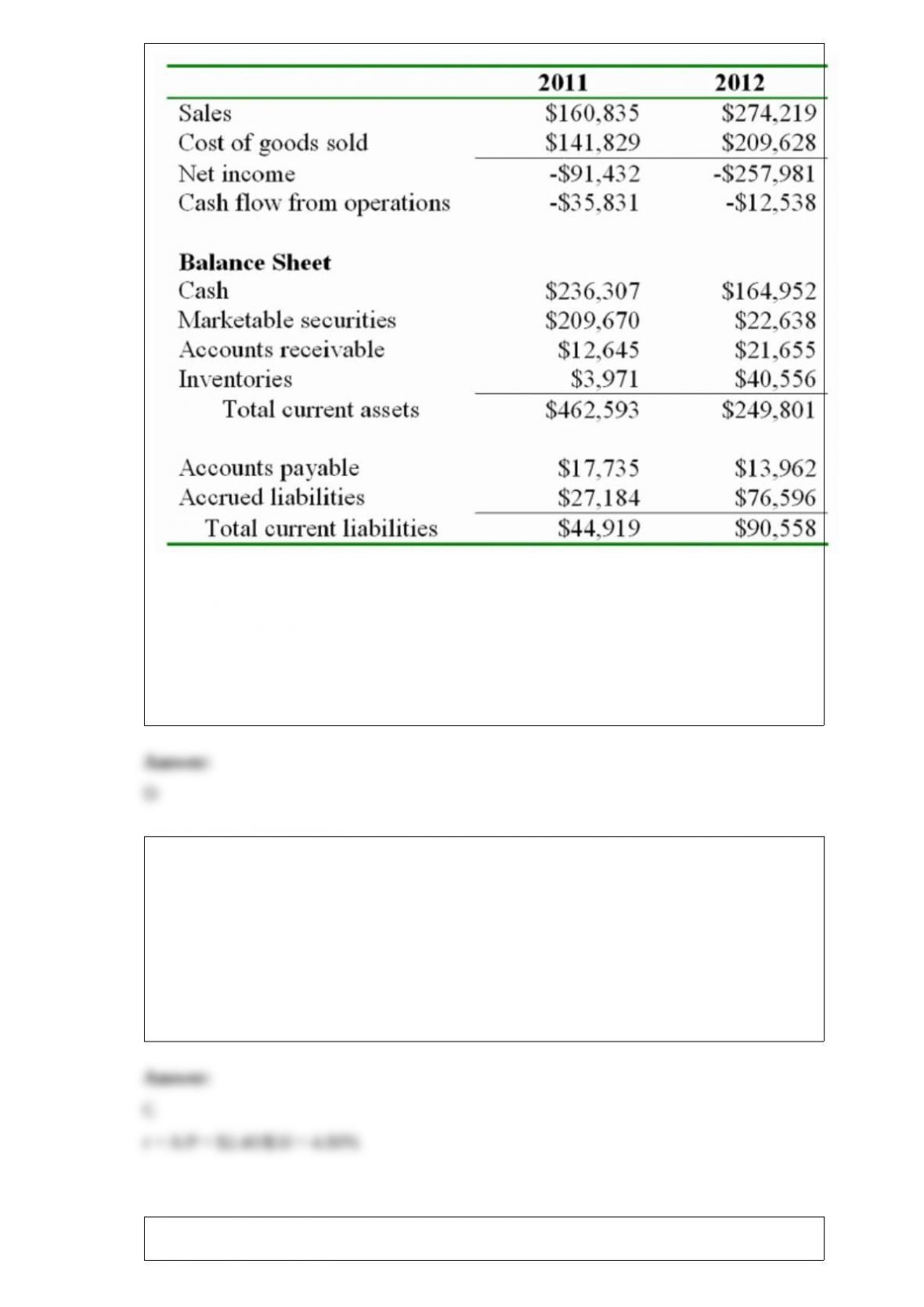
Assume a 365-day year for your calculations. The days’ sales in cash at the end of 2012
is:
A.24.3
B.28.8
C.35.7
D.219.6
E.None of the above
22) You plan to pay $50 for a share of preferred stock that pays a $2.40 dividend per
year forever. What annual rate of return will you realize?
A.0.48 percent
B.2.40 percent
C.4.80 percent
D.5.10 percent
E.20.83 percent
F.None of the above
23) JM Case Inc. has a market value of $5 million with 500,000 shares outstanding. The

book value of its equity is $1,750,000. If the company repurchases 20 percent of its
shares in the stock market and there are no taxes or transactions costs and all else
remains the same, what should the market value of the firm be after the repurchase?
A.$1,000,000
B.$1,750,000
C.$3,250,000
D.$4,000,000
E.$5,000,000
F.None of the above
24) Figure 9.1
In March of 2011, Macklemore Corp. considered an acquisition of Blue Scholar
Learning, Inc. (BSL), a privately-held educational software firm. As a first step in
deciding what price to bid for BSL, Macklemore’s CFO, Ryan Lewis, has prepared a
five-year financial projection for the company assuming the acquisition takes place.
Use this projection and BSL’s 2010 actual financial figures to answer the questions
below.
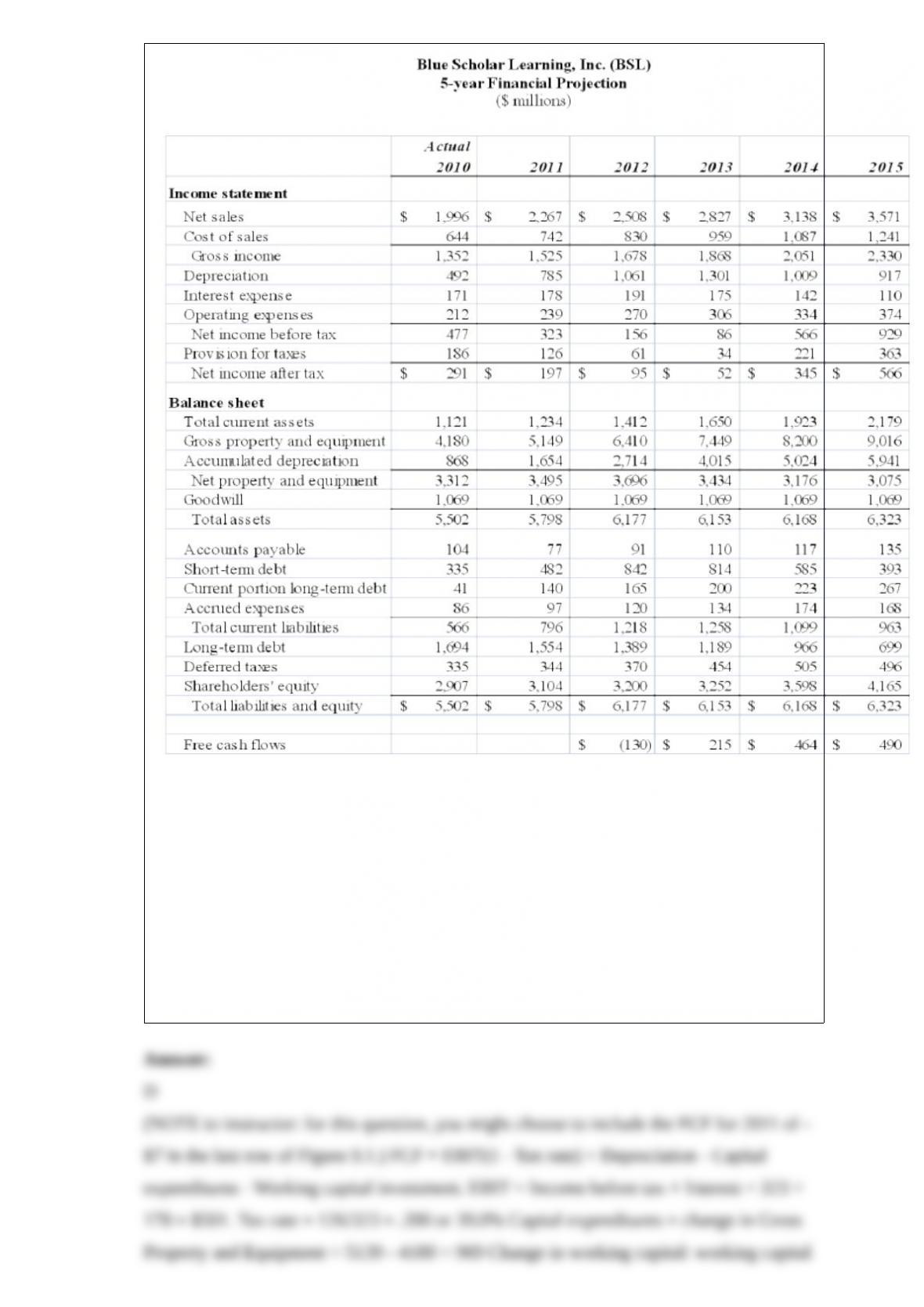
Estimate BSL’s value (in $ millions) at the end of 2010 assuming that at year-end 2015
the company’s equity is worth 15 times earnings after tax and its debt is worth book
value. Macklemore’s WACC is 8.0 percent. BSL’s WACC is 11.5 percent, and the
average of the two companies’ WACCs, weighted by sales, is 8.2 percent.
A.$628.24
B.$3,669.01
C.$7,429.74
D.$6,343.26
E.$6,755.83
F.$7,008.06
G.None of the above

25) The sources and uses of cash over a stated period of time are reflected on the:
A.income statement
B.balance sheet
C.shareholders’ equity statement
D.cash flow statement
E.statement of operating position
26) Which of the following figures of merit might not use all possible cash flows in its
calculations?
I. Payback period
II. Internal rate of return
III. Net present value (NPV)
IV. Accounting rate of return
A.III only
B.I & III only
C.II & III only
D.I & IV only
E.III & IV only
F.I, II, III, and IV
27) A company is considering two alternative methods of producing a new product. The
relevant data concerning the alternatives are presented below.
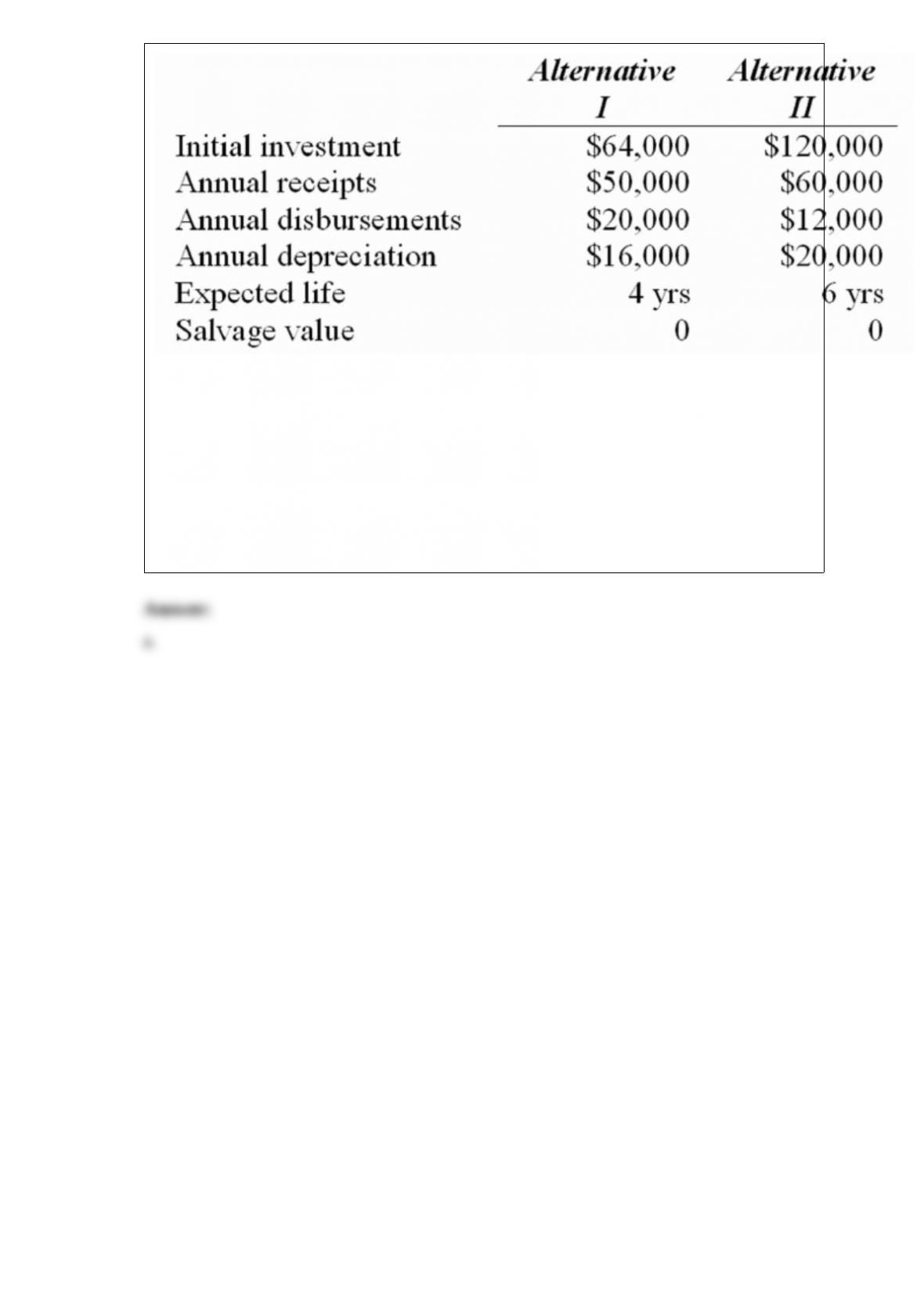
At the end of the useful life of whatever equipment is chosen the product will be
discontinued. The company’s tax rate is 50 percent and its cost of capital is 10 percent.
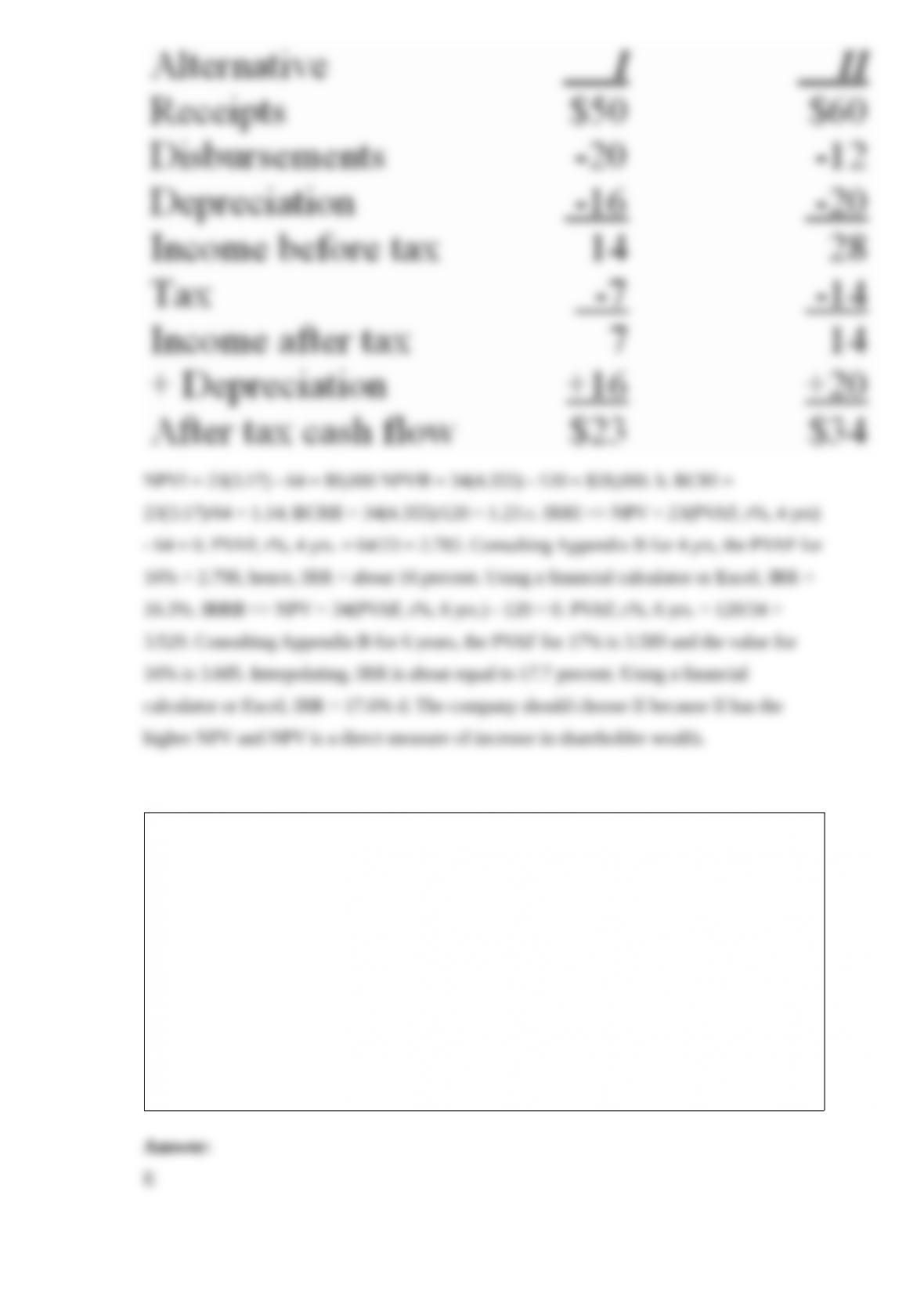
a. Calculate the net present value of each alternative.
b. Calculate the benefit cost ratio for each alternative.
c. Calculate the internal rate of return for each alternative.
d. If the company is not under capital rationing, which alternative should be chosen?
Why?
28) You are developing a financial plan for a corporation. Which of the following
questions will be considered as you develop this plan?
I. How much will our sales grow?
II. Will additional fixed assets be required?
III. Will dividends be paid to shareholders?
IV. How much new debt must be obtained?
A.I and IV only
B.II and III only
C.I, III, and IV only
D.II, III, and IV only
E.I, II, III, and IV

29) Westcomb, Inc. had equity of $150,000 at the beginning of the year. At the end of
the year, the company had total assets of $195,000. During the year, the company sold
no new equity. Net income for the year was $72,000 and dividends were $44,640. What
is the sustainable growth rate?
A.15.32 percent
B.15.79 percent
C.17.78 percent
D.18.01 percent
E.18.24 percent
30) Homemade leverage is:
A.the incurrence of debt by a corporation in order to pay dividends to shareholders
B.the exclusive use of debt to fund a corporate expansion project
C.the borrowing or lending of money by individual shareholders as a means of
adjusting their level of financial leverage
D.best defined as an increase in a firm’s debt-equity ratio
E.the term used to describe the capital structure of a levered firm
F.None of the above
31) Which one of the following is an example of systematic risk?
A.The Federal Reserve unexpectedly announces an increase in target interest rates
B.A flood washes away a firm’s warehouse
C.A city imposes an additional one percent sales tax on all products
D.A toymaker has to recall its top-selling toy
E.Corn prices increase due to increased demand for alternative fuels
F.None of the above
32) The best financing choice is the one that:
A.sets the debt-to-assets ratio equal to 1
B.trades off the tax disadvantage of debt against the signaling effects of equity
C.maximizes expected cash flows
D.ignores the false comfort of financial flexibility
E.results in the lowest possible financial distress costs
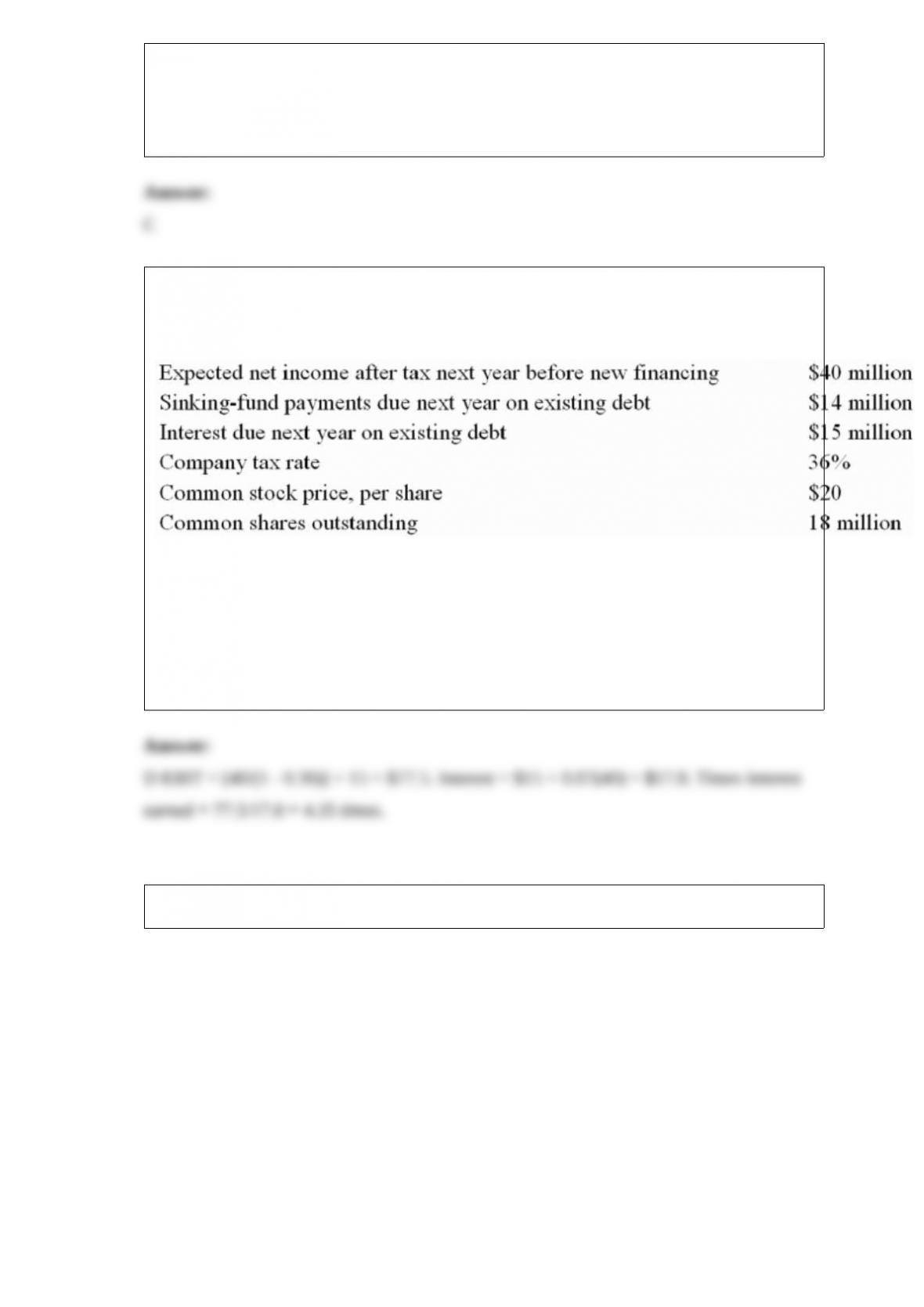
33) As the financial vice president for Squamish Equipment, you have the following
information:
Calculate Squamish’s times interest earned ratio for next year assuming the firm raises
$40 million of new debt at an interest rate of 7 percent.
A.2.00
B.3.09
C.3.66
D.4.35
E.None of the above
34)
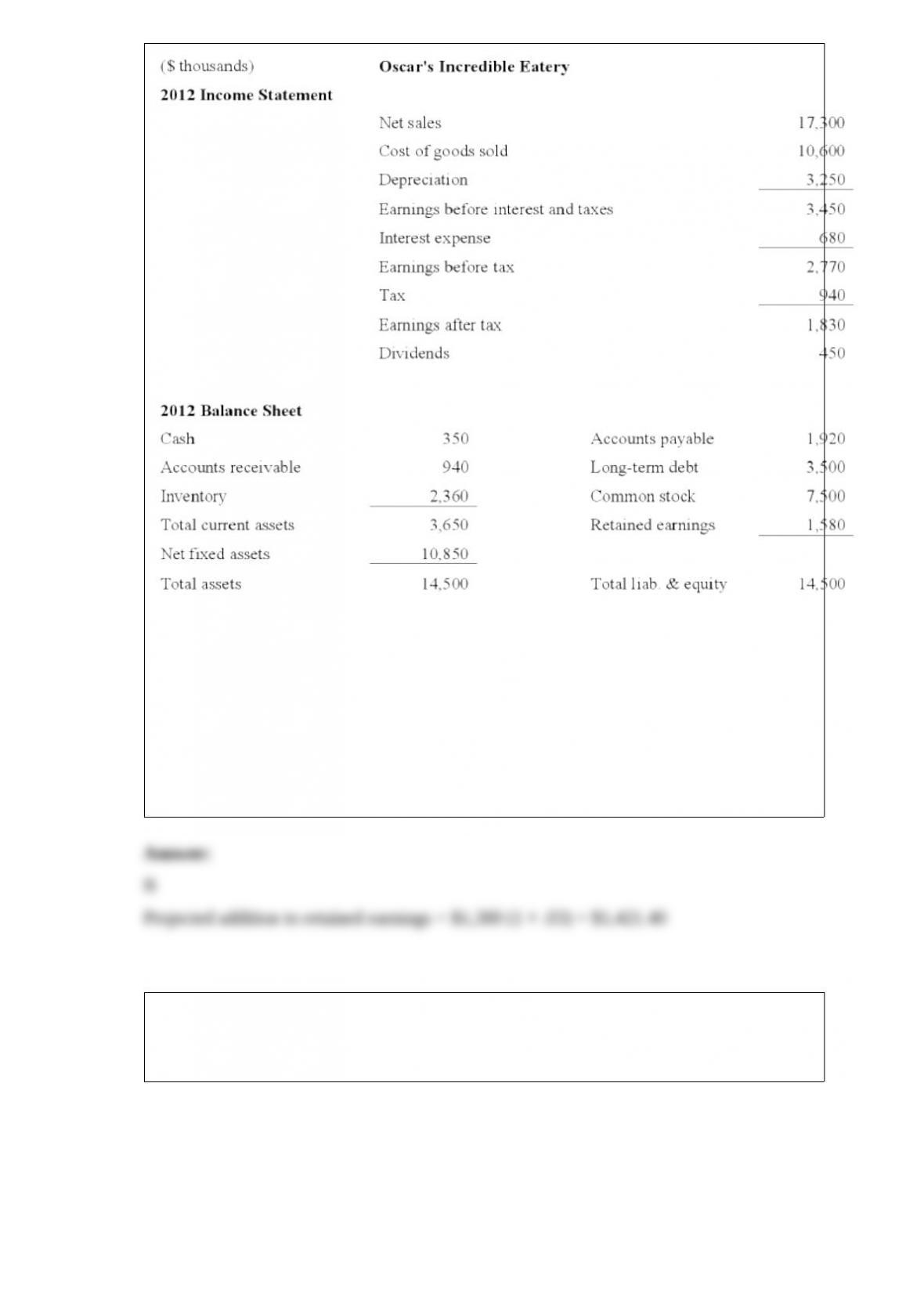
Please refer to Oscar’s financial statements. Sales are projected to increase by 3 percent
next year. The profit margin and the dividend payout ratio are projected to remain
constant. What is the projected addition to retained earnings for next year?
A.$1,309.19
B.$1,421.40
C.$1,884.90
D.$2,667.78
E.$3,001.40
F.None of the above
35) As the financial vice president for Squamish Equipment, you have the following
information:
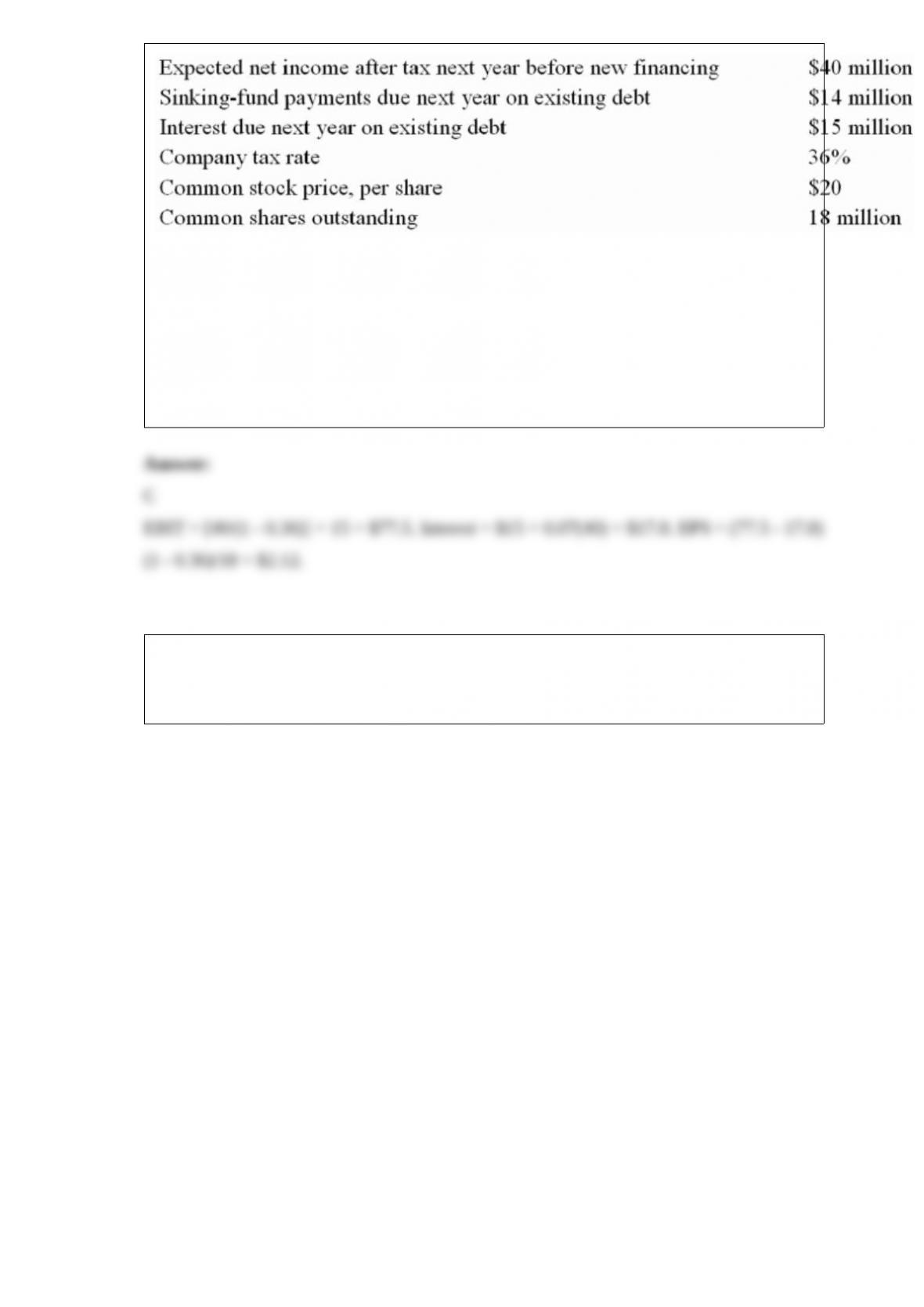
Calculate Squamish’s earnings per share next year assuming Squamish raises $40
million of new debt at an interest rate of 7 percent.
A.1.28
B.2.00
C.2.12
D.2.22
E.3.06
F.None of the above
36) The financial statements for Limited Brands, Inc. follow (fiscal years ending
January):
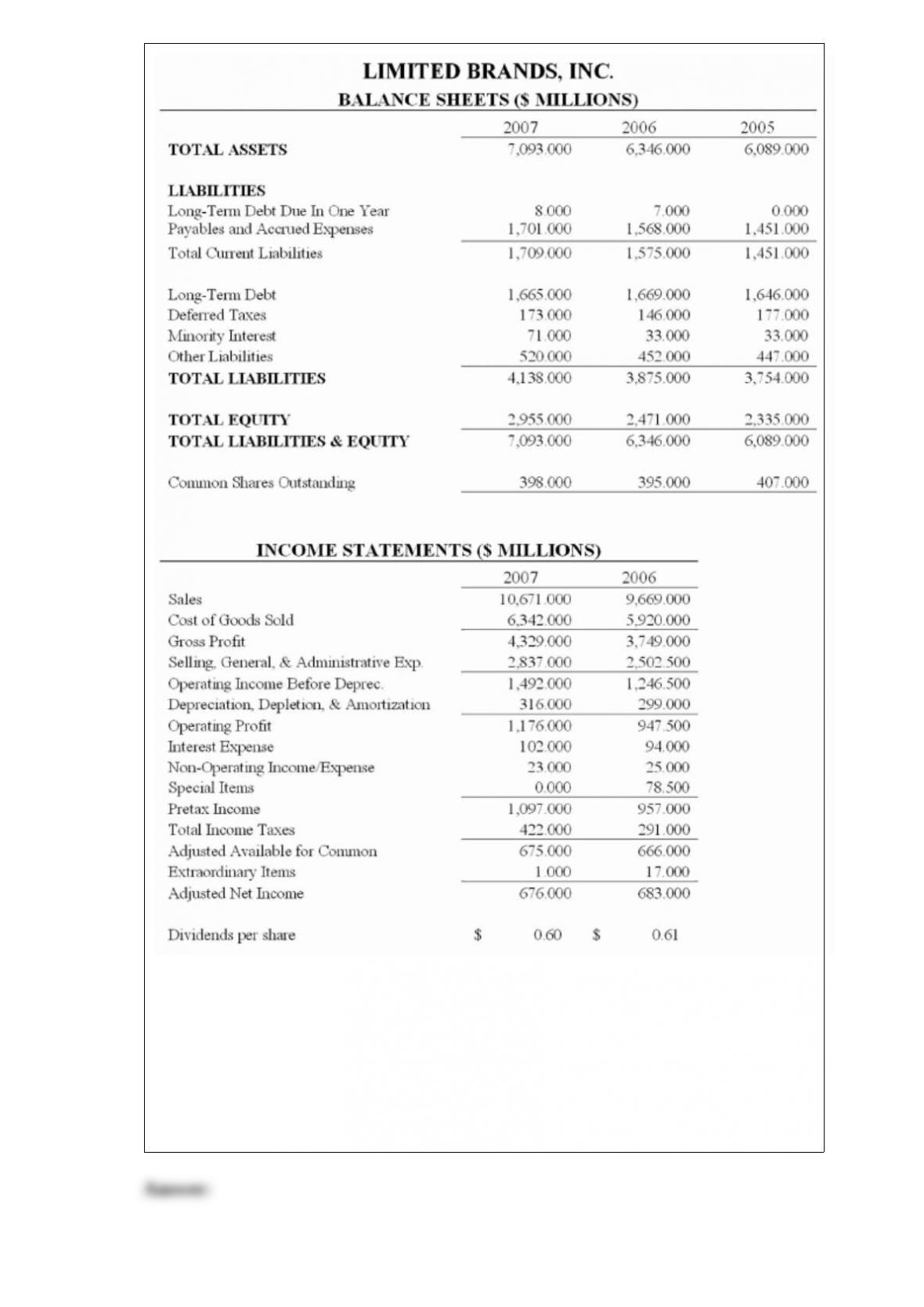
Use Limited Brands, Inc.’s financial statements, above, to answer the following
question. Use the company’s operating profit as an approximation of its EBIT, and
assume a 40% tax rate for your calculations. For the fiscal years ending in January of
2006 and 2007, calculate:
a) Limited Brands’ total liabilities-to-equity ratio;
b) Times interest earned ratio; and
c) Times burden covered.

37) Ruff Wear expects sales of $560, $650, $670, and $610 for the months of May
through August, respectively. The firm collects 20 percent of sales in the month of sale,
70 percent in the month following the month of sale, and 8 percent in the second month
following the month of sale. The remaining 2 percent of sales is never collected. How
much money does the firm expect to collect in the month of August?
A.$621
B.$628
C.$633
D.$639
E.$643
38) Which of the following statements is/are correct?
I. Going-concern value of a firm is equal to the present value of expected net income.
II. When a buyer values a target firm, the appropriate discount rate is the buyer’s
weighted-average cost of capital.
III. The liquidation value estimate of terminal value usually vastly understates a healthy
company’s terminal value.
IV. The value of a firm’s equity equals the discounted cash flow value of the firm minus
all liabilities.
A.II only
B.III only
C.I and II only
D.II and III only
E.II, III, and IV only
F.None of the above
39) Ginormous Oil entered into an agreement to purchase all of the outstanding shares
of Slick Company for $60 per share. The number of outstanding shares at the time of
the announcement was 82 million. The book value of liabilities on the balance sheet of
Slick Co. was $1.46 billion. What was the cost of this acquisition to the shareholders of
Ginormous Oil?
A.$1.46 billion
B.$3.46 billion
C.$4.92 billion
D.$6.38 billion
E.$8.38 billion
F.None of the above
40) Can a company incur costs of financial distress without ever going bankrupt?
Explain. What is the nature of these costs?
41) Empirical evidence indicates that the returns to shareholders of the target firm vary
significantly from the returns to the shareholders of the acquiring firm. Identify the
shareholders that tend to realize the smaller return. Does your answer depend on the
way the acquisition is financed?
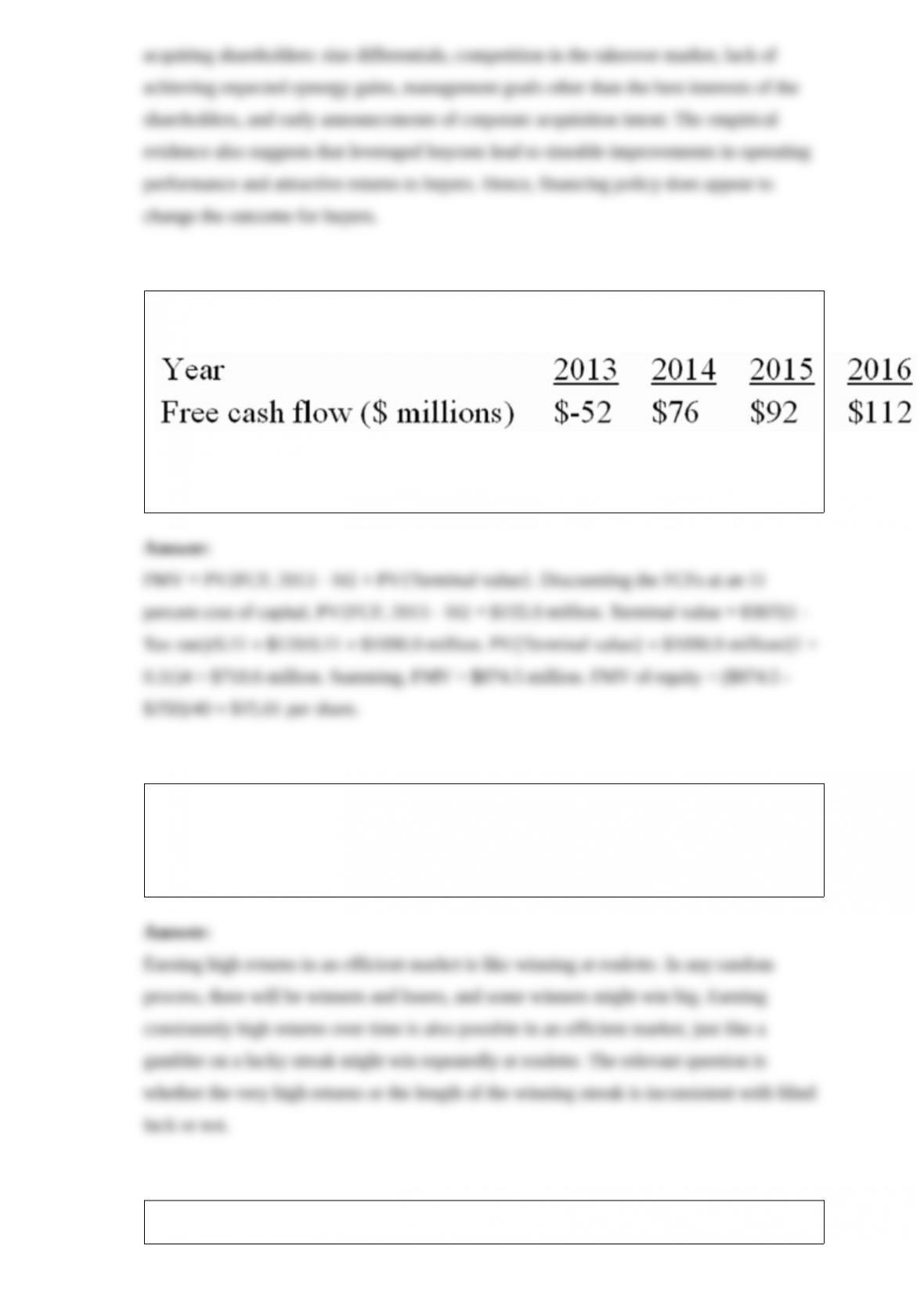
42) The following table presents a four-year forecast for Kenmore Air, Inc.:
Estimate the fair market value per share of Kenmore Air’s equity at the end of 2016 if
the company has 40 million shares outstanding and the market value of its
interest-bearing liabilities on the valuation date equals $250 million.
43) If the stock market in the United States is efficient, how do you explain the fact that
some people make very high returns? Would it be more difficult to reconcile very high
returns with efficient markets if the same people made extraordinary returns year after
year?
44) Suppose your colleague constructed a pro forma balance sheet and a cash budget
for your company for the same time period, and the external financing required from
the pro forma forecast exceeded the cash deficit estimated on the cash budget. How
would you interpret this result?
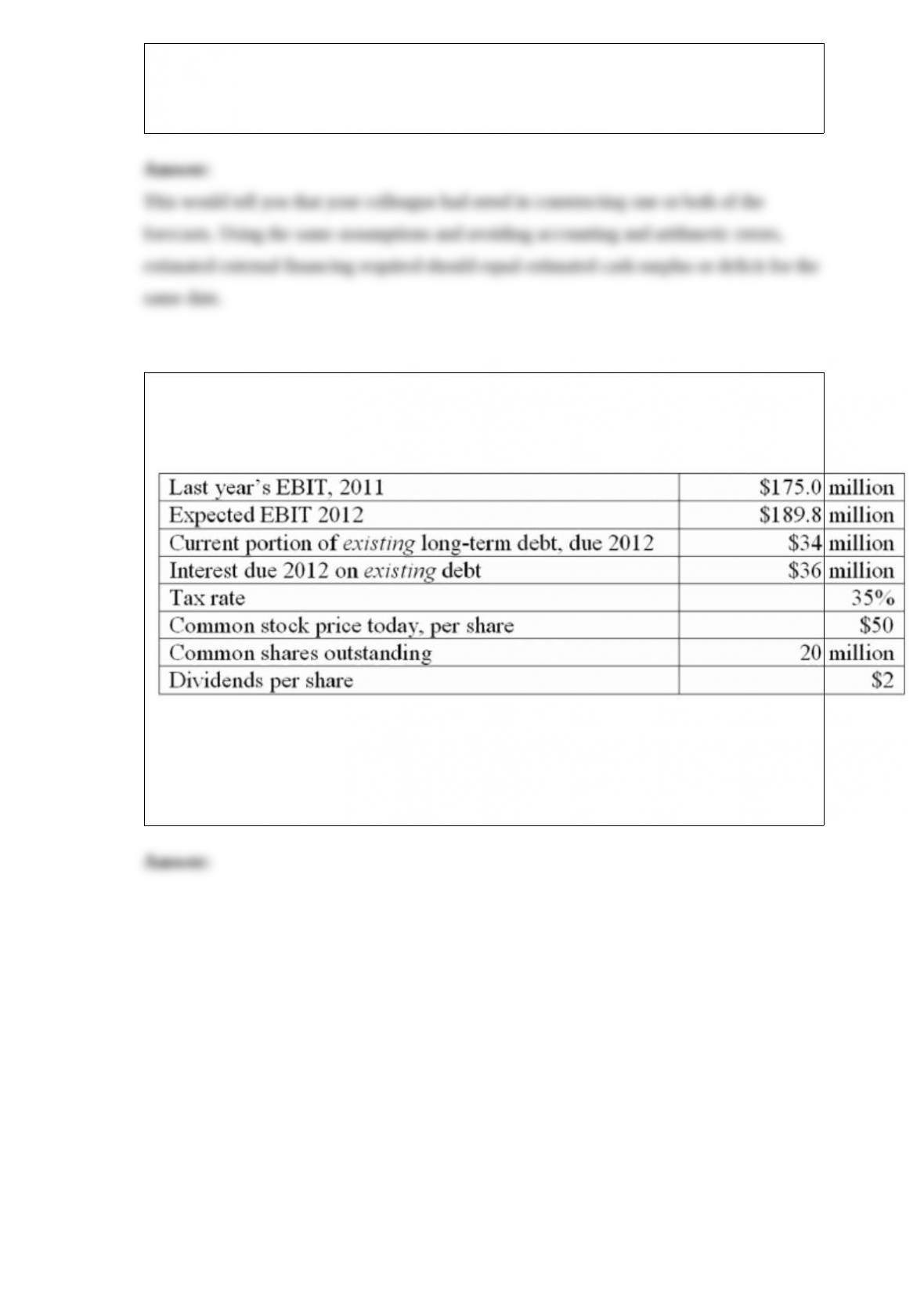
45) As CFO of Nile Holdings, a carpet wholesaler, you have the following information
as of December 2011:
Nile has an attractive investment opportunity, and to finance it, must decide whether to
issue $100 million in new debt or new equity.
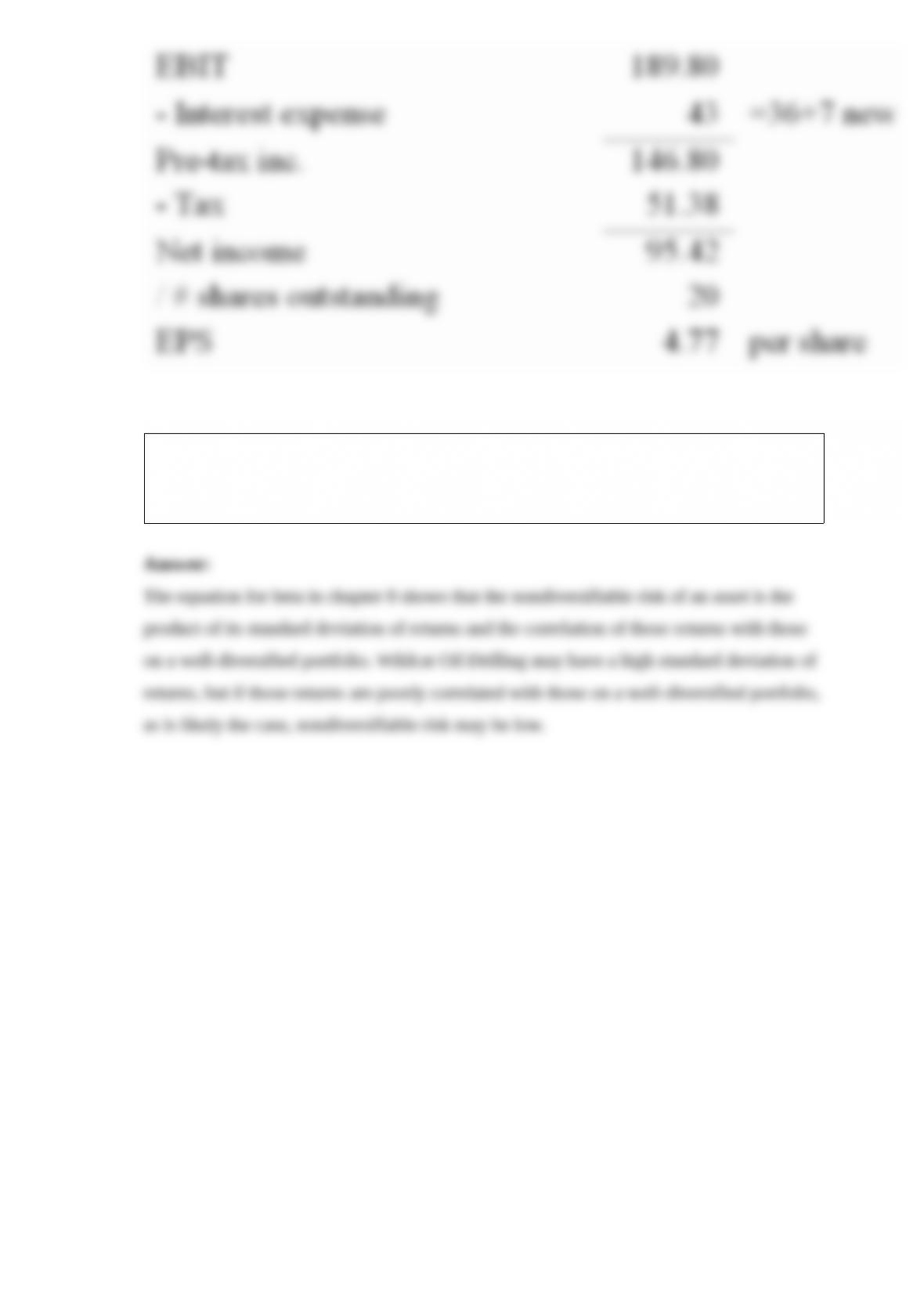
Calculate next year’s earnings per share assuming Nile raises the $100 million of new
debt.
46) The standard deviation of returns on Wildcat Oil Drilling is very high. Does this
necessarily imply that Wildcat Oil Drilling is a high-risk investment when investors
hold diversified portfolios? Explain why or why not.