
A firm acquires a competitor in a vertical merger.
Typically, firms with high operating leverage will have high debt.
The time value of money means that a dollar today is worth less than a dollar at any
time in the future.
A firm that goes public generally explains to potential investors how it intends to use
the proceeds from the stock issue.

The CFO is the person primarily responsible for judging the financial viability of
projects proposed by other executives.
Taxes play a subtle role in the irrelevance theory because dividends and capital gains
are taxed at different rates.
The longer the time to maturity, the smaller the maturity risk associated with a bond.
The late 1960’s werethe era of the conglomerate merger.

Companies generally create liabilities that exceed assets by:
A.borrowing money they cannot repay.
B.issuing additional stock.
C.losing a lawsuit.
D.a and c
Financial theory stems primarily from:
A.mathematics.
B.finance.
C.economics.
D.accounting.
If you invest money at 8% compounded monthly, what Effective Annual Rate (EAR)
are you receiving?
A.8.30%
B.8.00%
C.8.67%
D.None of the above

Richmond Graphics is a small company contemplating a project with a $5M initial
investment. A traditional capital budgeting analysis shows the project to have an NPV
of $3.3M. However, a simple decision tree analysis reveals that the project has a 90%
probability of an NPV of $4.0M and a 10 % chance of a ($3.0M) loss NPV.
Management should probably:
A.accept the project because its traditional NPV is positive.
B.accept the project even though there is some risk because the overwhelming
likelihood is that the outcome will be favorable.
C.reject the project because it has some risk.
D.reject the project because it entails a fairly good chance of a loss that could ruin a
small company coupled with a likely gain that isn’t very large.
Firms carry out share repurchase agreements in a number of ways, including all of the
following except:
A.buy from shareholders through a tender offer.
B.buy outstanding shares in the open market.
C.buy treasury shares.
D.negotiate a purchase privately from large holders, particularly institutions.

A beta value of 0.5 for a security indicates:
A.the security has average systematic risk.
B.the security has above-average systematic risk.
C.the security has no unsystematic risk.
D.the security has below-average systematic risk.
Ratios are used to analyze activities in the following areas:
A.asset management; liquidity; profitability; dividend use; debt management, market
value.
B.profitability; asset management; liquidity; debt management; growth, market value.
C.asset management; liquidity; profitability; debt management, market value.
D.asset utilization; liquidity; profitability; debt management; security analysis.
A firm’s price to earnings ratio is 8, and its market to book value ratio is 2. If its
earnings per share are $4.00, what is the book value per share?

A.$8.00
B.$32.00
C.$64.00
D.None of the above
Which of the following is true regarding fundamental analysis?
A.Involves research to discover everything about a firm, its business, and its industry
B.Uses data collected on the company to forecast future cash flows
C.Analysts are also referred to as chartists.
D.Both a & b
E.All of the above
If a firm has flotation costs of 20% and does not want to pay more than 17% return for a
particular security issue. What rate of return is the firm willing to offer the investor?
A.3.4%
B.13.6%
C.20.4%
D.21.25%

_____ stock is an equity security that has some of the characteristics of debt.
A.Common
B.Equity
C.Preferred
D.Capital
Which of the following is most correct?
A.Translation risk comes from exchange rate gains and losses on international
transactions as they occur.
B.Translation gains and losses are reflected on consolidated income statements.
C.Translation gains and losses are only realized if foreign investments are sold.
D.Both a. and c. are correct.
E.All of the above are correct.

The depreciation permitted for tax purposes is generally:
A.the same as economic depreciation.
B.different from economic depreciation.
C.not tax deductible.
D.tax deductible at the firm’s average tax rate.
E.b and d
When dealing with financial projections, which of the following generally links the
income statement to the balance sheet?
A.The amount paid in interest recorded as decrease in debt.
B.Equity being increased by the amount of net income.
C.Assets increasing by the amount of revenue.
D.Cash increasing by the amount of EBIT.
An investor’s goal can be described best as:
A.maximizing returns while minimizing risk.

B.maximizing returns.
C.capturing the high average returns of equity investing while limiting the associated
risk as much as possible.
D.avoiding risk regardless of the risk premium offered.
The market risk associated with an individual stock is most closely identified with the:
A.variance of the returns of the stock.
B.variance of the returns on the market.
C.beta of the stock.
D.beta of the market.
The provision in short-term credit agreements that require customers to be out of debt
for 30 to 45 days each year is referred to as a:
A.loan payoff requirement.
B.clean-up requirement.
C.debt free period requirement.
D.solvency period requirement.

Which of the following is not true with respect to operating leverage?
A.Higher operating leverage insulates a firm from losses in bad times.
B.Firms with higher operating leverage have a larger contribution from each sale, so
they accumulate profits or losses faster as they move away from the breakeven point in
sales.
C.Increased operating leverage increases business risk.
D.Virtually all firms have at least some operating leverage.
Company presidents and CEOs often come from marketing or engineering backgrounds
and don’t understand much about finance. When faced with cash flow problems it isn’t
unusual for them to demand across the board cuts in working capital assets while
stretching payables, all to conserve cash. If working capital management was
reasonably efficient beforehand such an order can be a disaster. Explain why.
Explain the economic reasons for holding cash.
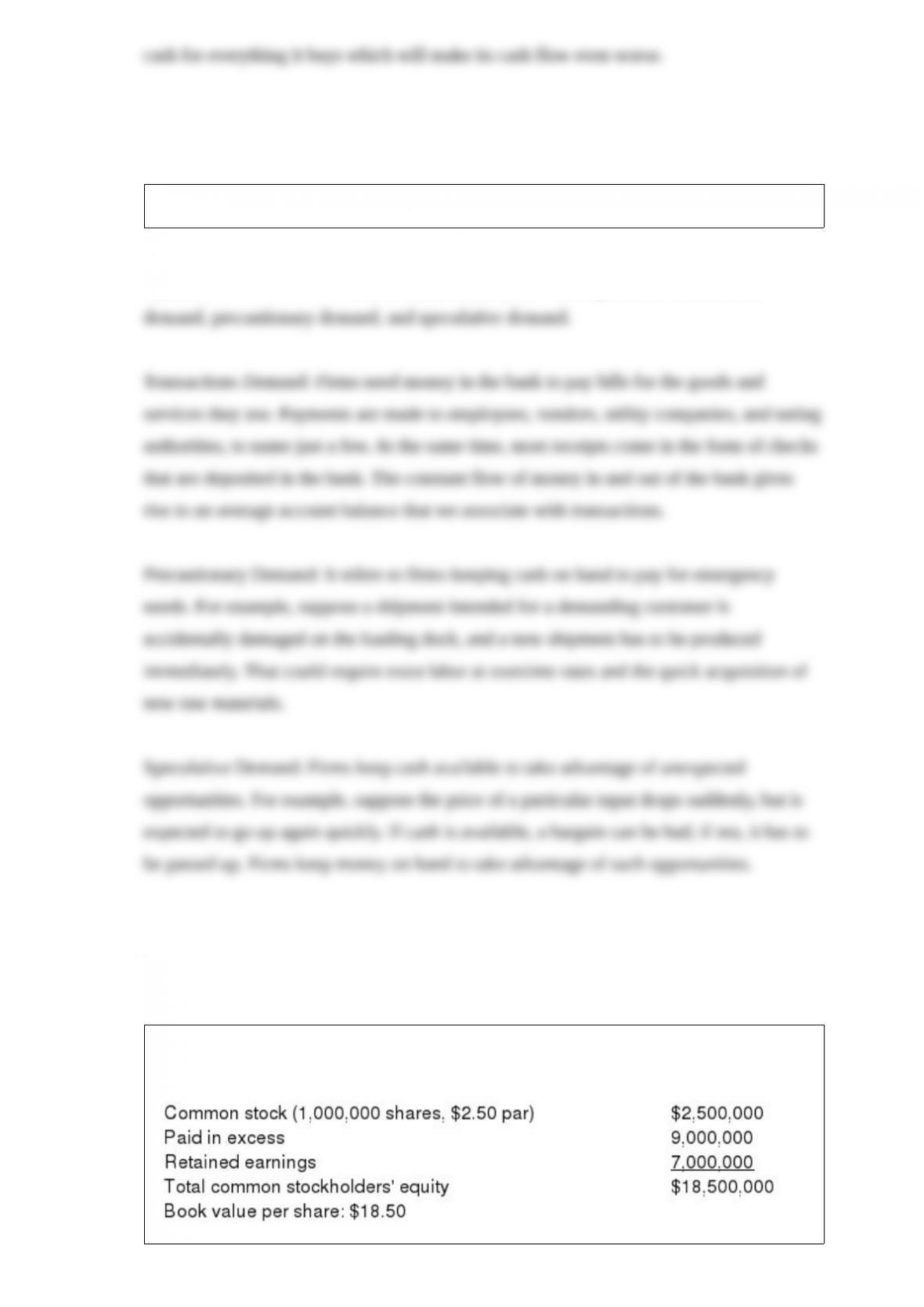
Carney Services, Inc., has just declared a 2-for-1 stock split. The company’s pre-split
common stockholders’ equity was as follows:

If the pre-split price of common stock was $28.50, what will the new common equity
section of the balance sheet look like?
A replacement project involves the purchase of a new machine for $100,000 that will be
depreciated over 10 years. The old machine was purchased six years ago for $60,000
and was depreciated using a 15 year life. Both machines use straight line depreciation,
including the half-year convention. What will the incremental depreciation expense be
in the first year of the project if the old machine is sold and the new machine is
purchased? What will it be in the second year of the project?
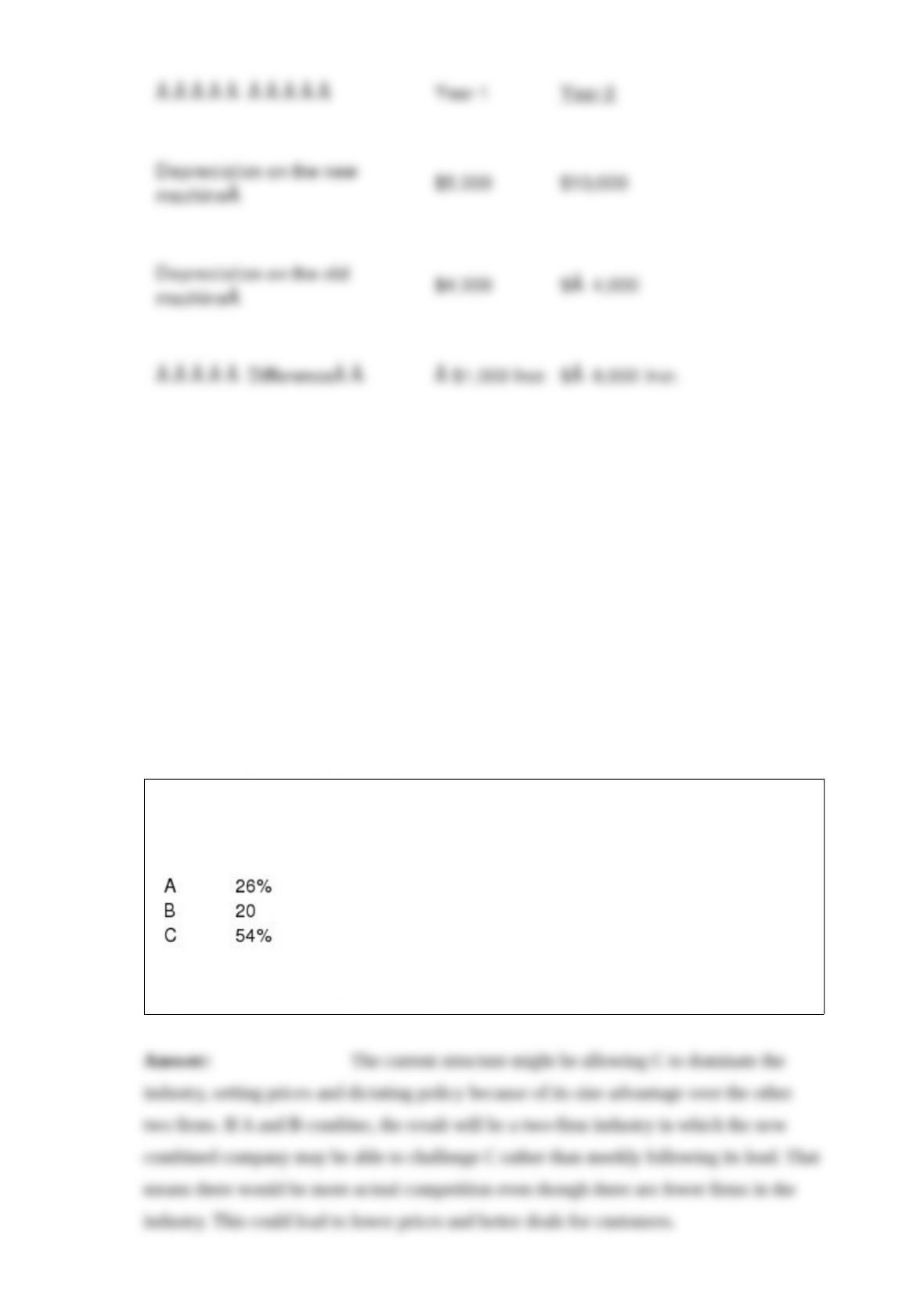
It is generally accepted that horizontal mergers (between competitors) decrease
competition. Imagine a three firm industry in which the competitors’ market shares are
as follows:
Is it possible that a merger between A and B would increase competition in the industry
to the benefit of customers?

The money paid to investors is a cost to the company and a return to the investor. Why
then aren’t component costs equal to investor returns?
Why do governments influence exchange rates from time to time? How do they do it?
Yahtze & Company projects next year’s after-tax earnings at $900,000 and proposes
spending $700,000 on new capital budgeting projects. The target capital structure is
40% debt and 60% equity. What dividend payout ratio would be appropriate to maintain
the target capital structure?