Subordination clauses in bond indentures
A. may restrict the amount of additional borrowing the firm can undertake.
B. are always bad for investors.
C. provide higher priority to senior creditors in the event of bankruptcy.
D. may restrict the amount of additional borrowing the firm can undertake and provide
higher priority to senior creditors in the event of bankruptcy.
E. All of the options are true.
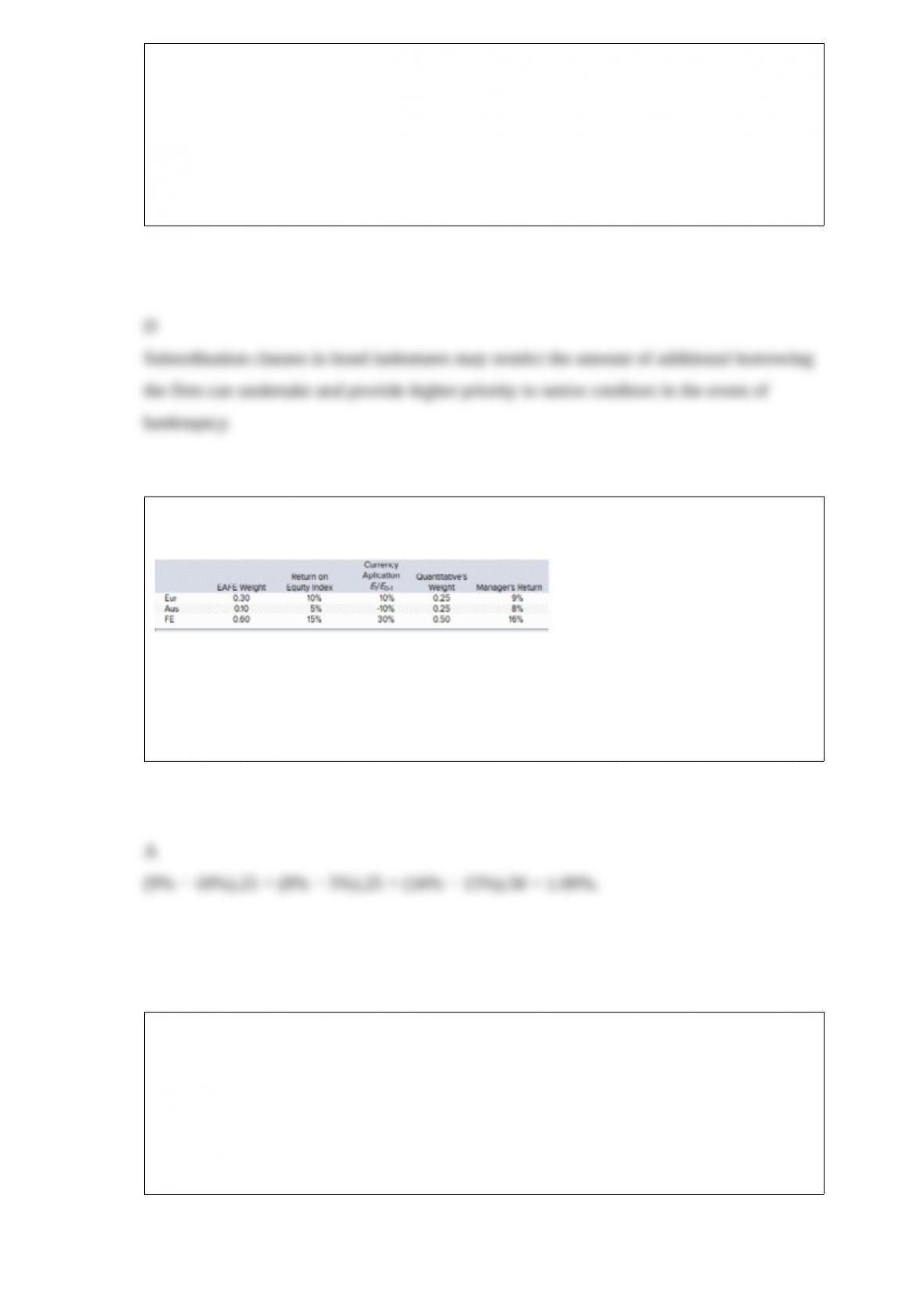
The manager of Quantitative International Fund uses EAFE as a benchmark. Last year’s
performance for the fund and the benchmark were as follows:
Calculate Quantitative’s stock selection return contribution.
A. 1.0%
B. 1.0%
C. 3.0%
D. 0.25%
The price that the writer of a call option receives for the underlying asset if the buyer
executes her option is called the
A. strike price.
B. exercise price.
C. execution price.
D. strike price or exercise price.
E. strike price or execution price.
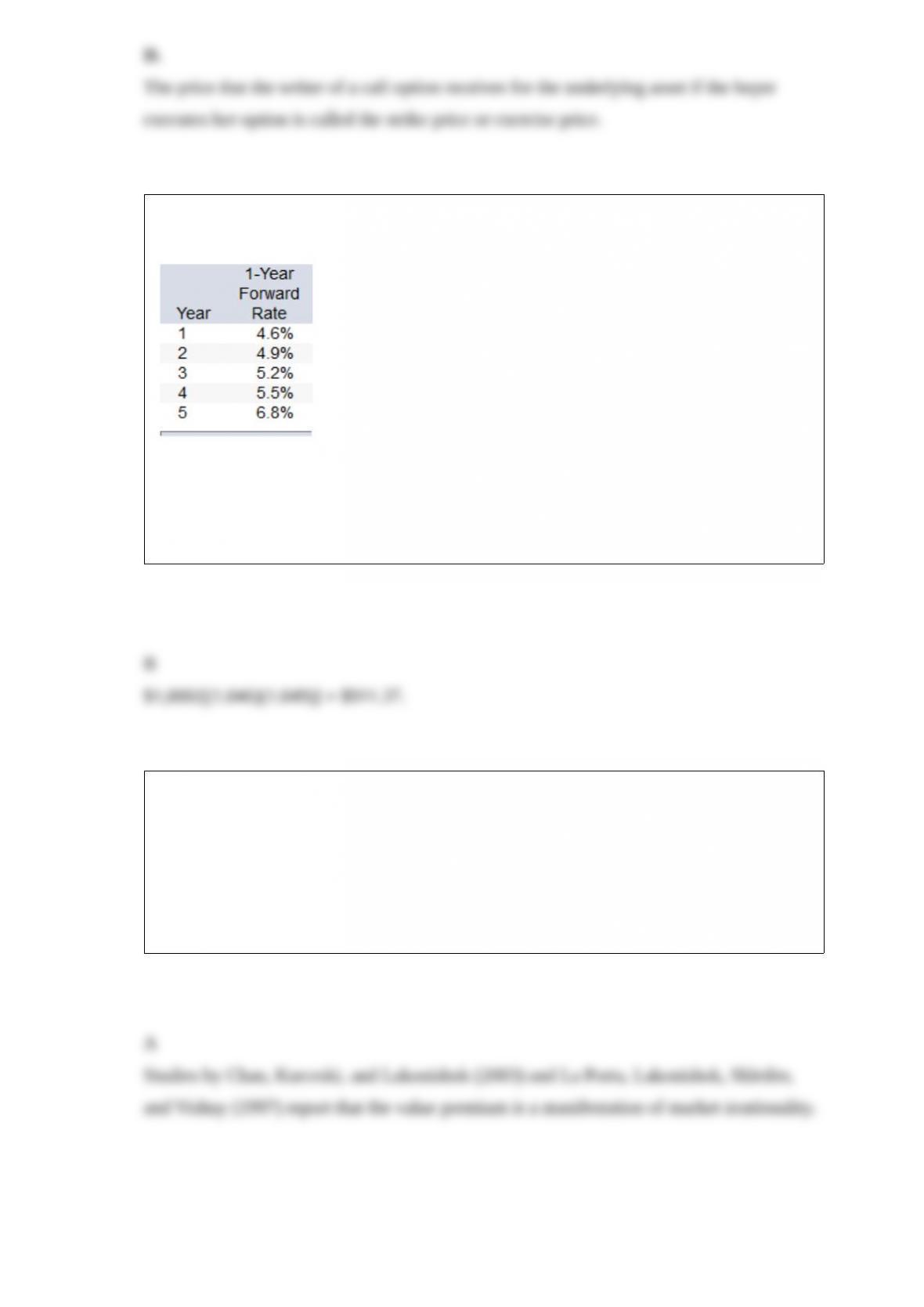
What should the purchase price of a 2-year zero-coupon bond be if it is purchased today
and has face value of $1,000?
A. $966.87
B. $911.37
C. $950.21
D. $956.02
E. $945.51
Studies by Chan, Karceski, and Lakonishok (2003) and La Porta, Lakonishok, Shleifer,
and Vishny (1997) report that
A. the value premium is a manifestation of market irrationality.
B. the value premium is a rational risk premia.
C. the value premium is a statistical artifact found only in the U.S.
D. All of the options are correct.
E. None of the options are correct.

The following is a list of prices for zero-coupon bonds with different maturities and par
values of $1,000.
What is the yield to maturity on a 3-year zero-coupon bond?
A. 6.37%
B. 9.00%
C. 7.33%
D. 10.00%
E. None of the options are correct.
A coupon bond is reported as having an ask price of 113% of the $1,000 par value in
the Wall Street Journal. If the last interest payment was made two months ago and the
coupon rate is 12%, the invoice price of the bond will be
A. $1,100.
B. $1,110.
C. $1,150.
D. $1,160.
E. None of the options are correct.
Suppose the following equation best describes the evolution of β over time:
βt = 0.30 + 0.70βt – 1
If a stock had a β of 0.82 last year, you would forecast the β to be _______ in the
coming year.
A. 0.91
B. 0.77
C. 0.63
D. 0.87

The dollar value of a firm’s return in excess of its opportunity costs is called its
A. profitability measure.
B. excess return.
C. economic value added.
D. prospective capacity.
E. return margin.
The elasticity of a stock put option is always
A. positive.
B. smaller than one.
C. negative.
D. infinite.
Contango
A. holds that the natural hedgers are the purchasers of a commodity, not the suppliers.
B. is a hypothesis polar to backwardation.
C. holds that FO must be less than (PT).
D. holds that the natural hedgers are the purchasers of a commodity, not the suppliers,
and holds that FO must be less than (PT).
E. holds that the natural hedgers are the purchasers of a commodity, not the suppliers,
and is a hypothesis polar to backwardation.

Suppose that the risk-free rates in the United States and in the United Kingdom are 6%
and 4%, respectively. The spot exchange rate between the dollar and the pound is
$1.60/BP. What should the futures price of the pound for a one-year contract be to
prevent arbitrage opportunities, ignoring transactions costs.
A. $1.60/BP
B. $1.70/BP
C. $1.66/BP
D. $1.63/BP
E. $1.57/BP
Kahneman and Tversky (1973) report that __________ and __________.
A. people give too little weight to recent experience compared to prior beliefs; tend to
make forecasts that are too extreme given the uncertainty of their information
B. people give too much weight to recent experience compared to prior beliefs; tend to
make forecasts that are too extreme given the uncertainty of their information
C. people give too little weight to recent experience compared to prior beliefs; tend to
make forecasts that are not extreme enough given the uncertainty of their information
D. people give too much weight to recent experience compared to prior beliefs; tend to
make forecasts that are not extreme enough given the uncertainty of their information

Which two indices had the highest correlation between them during the 2008-2012
period?
A. S&P and DJIA; the correlation was 0.979
B. S&P and Russell 2000; the correlation was 0.948
C. DJIA and Russell 2000; the correlation was 0.908
D. S&P and NASDAQ 100; the correlation was 0.928
E. NASDAQ 100 and DJIA; the correlation was 0.876
Diversified Portfolios had year-end assets of $279,000,000 and liabilities of
$43,000,000. If Diversified’s NAV was $42.13, how many shares must have been held
in the fund?
A. 43,000,000
B. 6,488,372
C. 5,601,709
D. 1,182,203
A bond with a 12% coupon, 10 years to maturity, and selling at $88.00 has a yield to
maturity of
A. over 14%.
B. between 13% and 14%.
C. between 12% and 13%.
D. between 10% and 12%.
E. less than 12%.
Hedge funds are ______ transparent than mutual funds because of ______ strict SEC
regulation on hedge funds.

A. more; more
B. more; less
C. less; less
D. less; more
TIPS are
A. securities formed from the coupon payments only of government bonds.
B. securities formed from the principal payments only of government bonds.
C. government bonds with par value linked to the general level of prices.
D. government bonds with coupon rates linked to the general level of prices.
E. zero-coupon government bonds.
Suppose on August 27, there were 1,455 stocks that advanced on the NYSE and 1,553
that declined. The volume in advancing issues was 852,581, and the volume in
declining issues was 1,058,312. The trin ratio for that day was ________, and technical
analysts were likely to be ________.
A. 0.87; bullish
B. 0.87; bearish
C. 1.15; bullish
D. 1.15; bearish

You purchased one AT&T March 50 put and sold one AT&T April 50 put. Your strategy
is known as
A. a vertical spread.
B. a straddle.
C.a time spread.
D. a collar.
The single-index model
A. greatly reduces the number of required calculations relative to those required by the
Markowitz model.
B. enhances the understanding of systematic versus nonsystematic risk.
C. greatly increases the number of required calculations relative to those required by the
Markowitz model.
D. greatly reduces the number of required calculations relative to those required by the
Markowitz model and enhances the understanding of systematic versus nonsystematic
risk.
E. enhances the understanding of systematic versus nonsystematic risk and greatly
increases the number of required calculations
relative to those required by the Markowitz model.
Assume that stock market returns do follow a single-index structure. An investment
fund analyzes 217 stocks in order to construct a mean-variance efficient portfolio
constrained by 217 investments. They will need to calculate ________ estimates of
expected returns and ________ estimates of sensitivity coefficients to the
macroeconomic factor.
A. 217; 47,089
B. 217; 217

C. 47,089; 217
D. 47,089; 47,089
E. None of the options are correct.
You sold a futures contract on oats at a futures price of 233.75, and at the time of
expiration, the price was 261.25. What was your profit or loss?
A. $1375.00
B. –$1375.00
C. –$27.50
D. $27.50
You purchased an annual interest coupon bond one year ago that had nine years
remaining to maturity at that time. The coupon interest rate was 10%, and the par value
was $1,000. At the time you purchased the bond, the yield to maturity was 8%. If you
sold the bond after receiving the first interest payment and the yield to maturity
continued to be 8%, your annual total rate of return on holding the bond for that year
would have been
A. 8.00%.
B. 7.82%.
C. 7.00%.
D. 11.95%.
E. None of the options are correct.

The risk-free rate is 5%. The expected market rate of return is 11%. If you expect stock
X with a beta of 2.1 to
offer a rate of return of 15%, you should
A. buy stock X because it is overpriced.
B. sell short stock X because it is overpriced.
C. sell short stock X because it is underpriced.
D. buy stock X because it is underpriced.
E. None of the options, as the stock is fairly priced.
The basic purpose of immunization is to
A. eliminate default risk.
B. produce a zero net-interest-rate risk.
C. offset price and reinvestment risk.
D. eliminate default risk and produce a zero net-interest-rate risk.
E. produce a zero net-interest-rate risk and offset price and reinvestment risk.
Volatility risk is
A. the volatility level for the stock that the option price implies.
B. the risk incurred from unpredictable changes in volatility.
C. the percentage change in the stock call-option price divided by the percentage
change in the stock price.
D. the sensitivity of the delta to the stock price.
A put option on the S&P 500 Index will best protect a portfolio
A. of 100 shares of IBM stock.
B. of 50 bonds.
C. that corresponds to the S&P 500.
D. of 50 shares of AT&T and 50 shares of Xerox stocks.
E. that replicates the Dow.
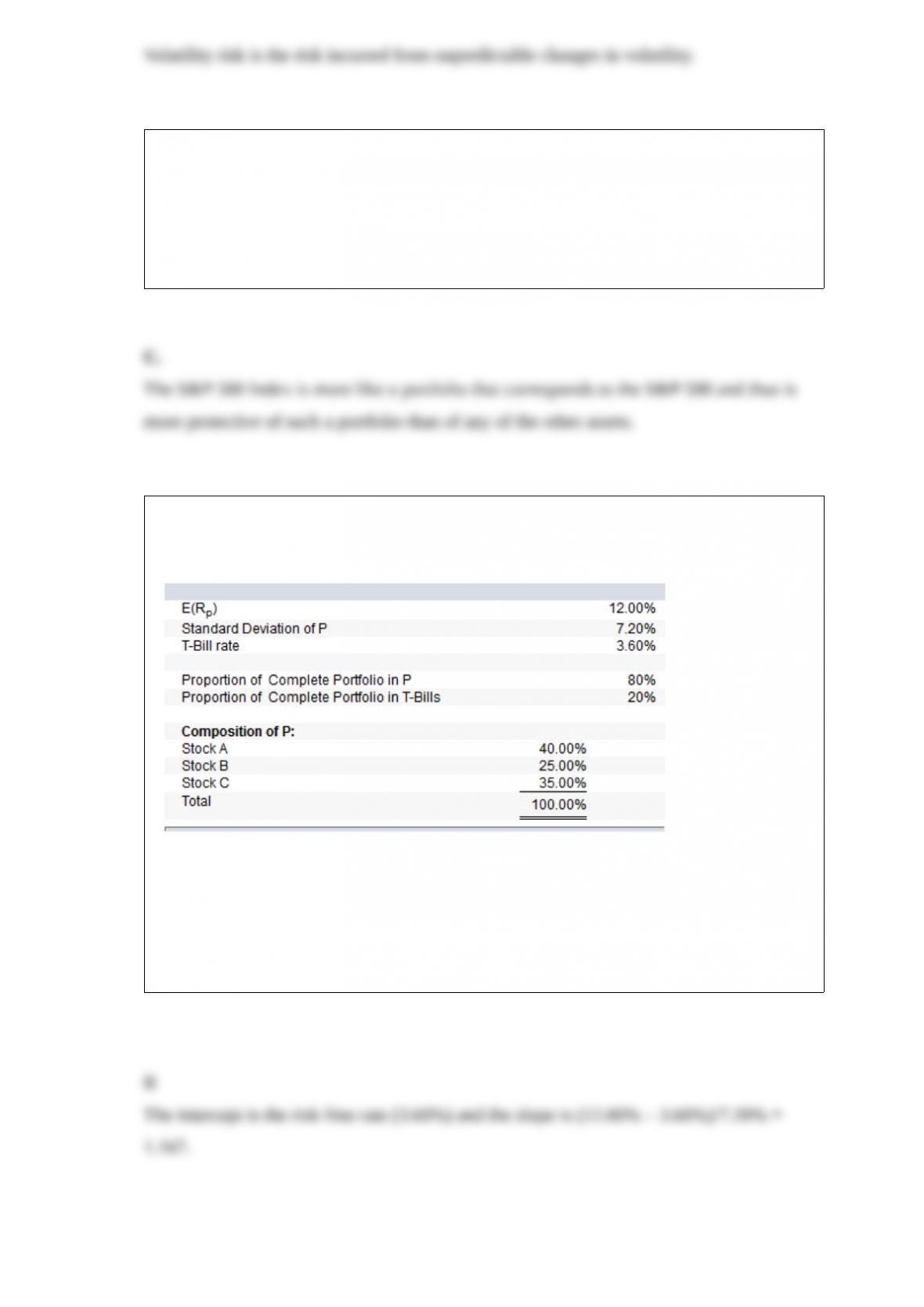
Your client, Bo Regard, holds a complete portfolio that consists of a portfolio of risky
assets (P) and T-Bills. The information below refers to these assets.
What is the equation of Bo’s capital allocation line?
A. E(rC) = 7.2 + 3.6 × Standard Deviation of P
B. E(rC) = 3.6 + 1.167 × Standard Deviation of P
C. E(rC) = 3.6 + 12.0 × Standard Deviation of P
D. E(rC) = 0.2 + 1.167 × Standard Deviation of P
E. E(rC) = 3.6 + 0.857 × Standard Deviation of P

You have just purchased a 10-year zero-coupon bond with a yield to maturity of 10%
and a par value of $1,000. What would your rate of return at the end of the year be if
you sell the bond? Assume the yield to maturity on the bond is 11% at the time you sell.
A. 10.00%
B. 20.42%
C. 13.8%
D. 1.4%
E. None of the options are correct.
As of 2016, which class of mutual funds had the largest amount of assets invested?
A. Equity funds
B. Bond funds
C. Mixed asset classes, such as asset allocation funds
D. Money market funds
E. Global funds
A call option on a stock is said to be out of the money if
A.the exercise price is higher than the stock price.
B.the exercise price is less than the stock price.
C. the exercise price is equal to the stock price.
D. the price of the put is higher than the price of the call.
E. the price of the call is higher than the price of the put.
A security has an expected rate of return of 0.10 and a beta of 1.1. The market expected
rate of return is 0.08,

and the risk-free rate is 0.05. The alpha of the stock is
A. 1.7%.
B. –1.7%.
C. 8.3%.
D. 5.5%.