Preferred stock is like common stock in that dividends are not a legal obligation until
the board of directors declares them.
A trial balance proves the equality of the total debits and total credits of the accounts
listed.
Recording an unrecorded expense will increase expenses and decrease revenues.
As the market value of trading securities changes, companies report the gains from
increases in market value and losses from decreases in market value on the income
statement.

Accrual accounting uses the matching principle.
When a corporation issues common stock on a preferred stock conversion, the common
stock account is credited for the fair market value of the preferred stock on the date of
conversion.
Since revenues and expenses are associated with stockholders’ equity, revenues and
expenses must have normal balances on the same side of a T-account.
Working capital is the difference between total assets and total liabilities.

Convertible bonds are bonds that may be redeemed before maturity date by the issuing
corporation.
The adjusting entry to record accrued interest revenue includes a debit to interest
payable.
Examples of a current liability include all of the following except:
A) Prepaid rent.
B) Accrued income taxes payable.
C) Accrued wages payable.
D) Current portion of long-term debt.
E) Accounts payable.

Which of the following transactions do not affect cash?
1. Convert debt to common stock
2. Credit sales
3. Purchase a fixed asset by issuing debt
4. Accept rental deposit
5. Write-off of prepaid expenses
A) 1 and 2
B) 4 and 5
C) 1, 2, and 3
D) 3, 4, and 5
E) 1, 2, 3, and 5
Solar Communications had the following balances in its stockholders’ equity accounts
as of December 31, 20X9:
Paid-in Capital $53,000
Retained Earnings $31,000
During the year ended December 31, 20X9, Solar Communications generated $36,000
in net income, and declared and paid $16,000 in dividends. The ending balance in the
retained earnings account at December 31, 20X8, was
A) $11,000.
B) $26,000.
C) $13,000.
D) $67,000.

E) $40,000.
Which of the following statements regarding adjusting entries is true?
A) Accountants use adjusting entries to record explicit transactions at the end of each
reporting period.
B) Adjusting entries are made on a daily basis as cash is exchanged between parties.
C) Adjusting entries have nothing to do with accrual accounting.
D) Adjusting entries are made at periodic intervals, usually when the financial
statements are about to be prepared.
E) The recording of cash receipts from customers is an example of an adjusting entry.
Materials Handling Company sold merchandise inventory costing $7,000 for $12,000 in
cash. How should Materials Handling Company record this transaction?
A) debit Cash for $12,000, credit Sales for $7,000, and credit Merchandise Inventory
for $7,000
B) debit Cash for $12,000, debit Cost of Goods Sold for $7,000, credit Sales for
$12,000, and credit Merchandise Inventory for $7,000
C) debit Cash for $12,000, debit Merchandise Inventory for $7,000, credit Sales for
$12,000, and credit Cost of Goods Sold for $7,000
D) debit Sales for $12,000, debit Merchandise Inventory for $7,000, credit Cash for
$12,000, and credit Cost of Goods Sold for $7,000

E) debit Sales for $12,000, debit Cost of Goods Sold for $7,000, credit Cash for
$12,000, and credit Merchandise Inventory for $7,000
The journal entry to sell merchandise on account under a periodic inventory system
includes a
A) debit to Cost of Goods Sold.
B) debit to Inventory.
C) credit to Purchases.
D) credit to Sales.
E) credit to Accounts Receivable.
If the fair value of pension plan assets exceeds the present value of the pension
obligation, a company reports
A) a net pension liability on the balance sheet.
B) a net pension asset on the balance sheet.
C) nothing on the balance sheet.
D) a long footnote only.
E) both B and D

Which of the following situations does NOT involve an adjusting entry?
A) Recording the expiration of prepaid insurance.
B) Recording depreciation on equipment.
C) Recording wages owed to employees.
D) Recording revenue earned when cash was received in advance.
E) Recognizing sales when they occur.
A contingent liability’s dollar amount does not get reported on the balance sheet if
A) the probability that the event will occur is low and if the amount cannot be
reasonably estimated.
B) the probability that the event will occur is high and if the amount cannot be
reasonably estimated.
C) the probability that the event will occur is low or if the amount cannot be reasonably
estimated.
D) the probability that the event will occur is high only.
E) the amount cannot be reasonably estimated only.
Useful Organizing began operations on January 1, 20X3, when the owners invested
$80,000 cash in the company. Also on January 1, the company paid for a $30,000
machine. The machine has a useful life of 4 years and a $2,000 residual value. During
its first year of operations, the company had sales of $96,000 and operating expenses
except depreciation of $67,000. All sales were cash sales and all non-depreciation
operating expenses were paid in cash. Useful Organizing has a 30% tax rate and pays
all taxes on December 31. What is the net cash provided by operating activities before
taxes for 20X3, if Useful Organizing uses straight-line depreciation?
A) $(74,000)
B) $(67,000)
C) $ 22,000
D) $ 25,000
E) $ 29,000
Eleston Printing acquired the following short-term equity securities on January 1,
2X12:
The quarter-end prices per share were as follows:
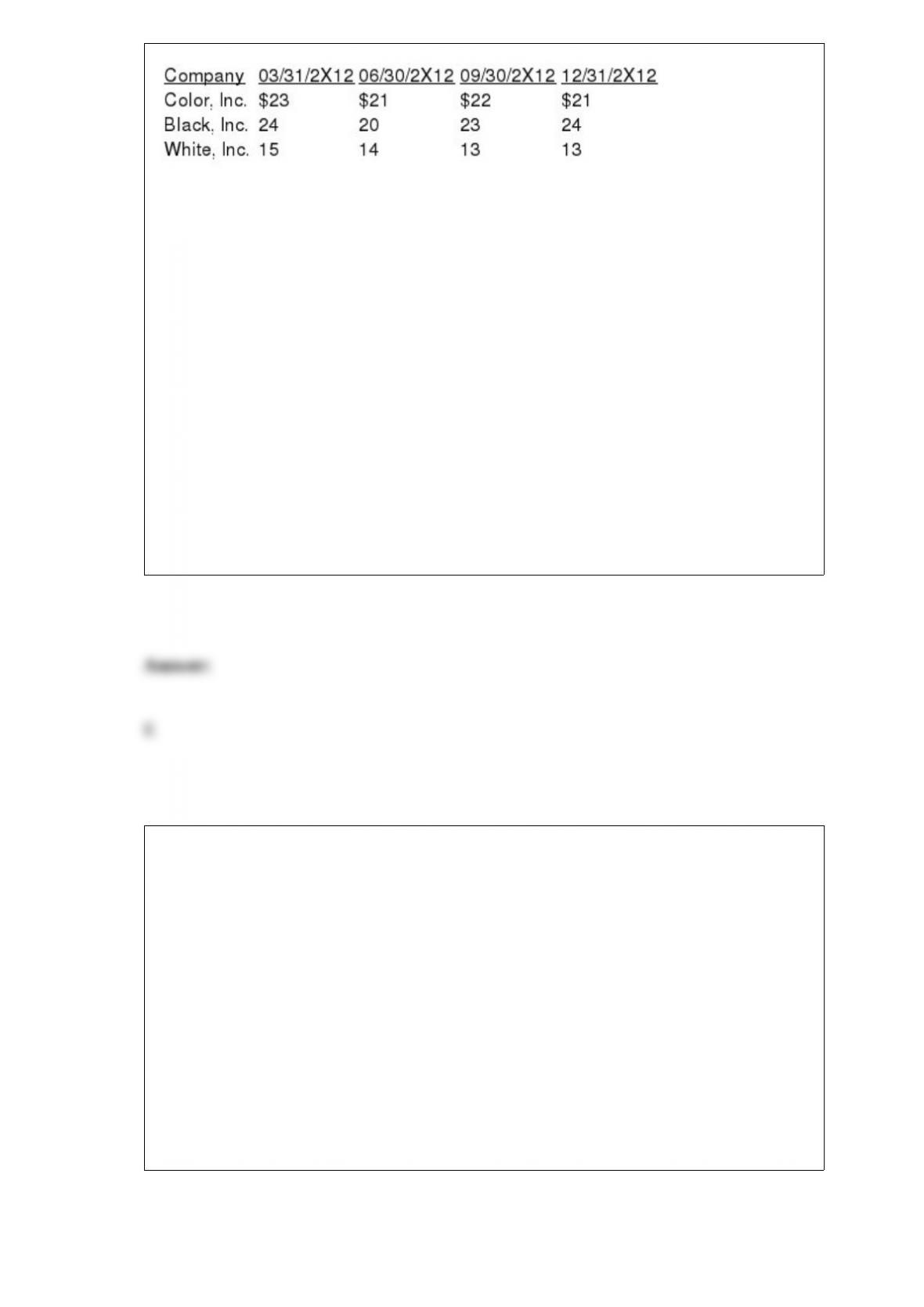
Eleston Printing considers Color, Inc. stock to be a trading security and Black, Inc. and
White, Inc. to be available-for-sale securities.
What will be the net increase or decrease included in Accumulated Other
Comprehensive Income in the stockholders’ equity section of the balance sheet for the
three month period ending September 30, 2X12?
A) $-0-
B) $(200)
C) $(400)
D) $200
E) $400
Mason Manufacturing had 2012 earnings of $850,000. Cash dividends per share were
$1.25. The company had an average of 350,000 shares of common stock outstanding.
The market price of the stock at the end of the year was $30 per share. What was the
dividend-yield for Mason Manufacturing?
A) 4.17%
B) 1.25%
C) 4.80%
D) 15.0%
E) Cannot be determined from the information provided

A classified balance sheet
A) can only be viewed by upper management.
B) classifies assets as “current” if possessed at the end of the current month and as
“deferred” if they are expected to be owned at the end of the following month.
C) classifies accounts as either assets, liabilities, or owners’ equity.
D) groups accounts into subcategories to help readers quickly gain a perspective on the
company’s financial position.
E) is always used when making organizational strategicdecisions.
The recording process has a sequence of five steps. What is the specific order of the
steps?
A) Journal, trial balance, financial statements, ledger, transaction documentation
B) Transaction documentation, journal, ledger, trial balance, financial statements
C) Transaction documentation, ledger, journal, trial balance, financial statements
D) Ledger, journal, transaction documentation, trial balance, financial statements
E) Trial balance, financial statements, ledger, journal, transaction documentation


Referring to Exhibit 5-1, what was the cash paid to suppliers of inventory by Cartell
Paper Products in 2012?
A) $63,800
B) $61,500
C) $63,700
D) $63,900
E) $66,100
Useful Organizing began operations on January 1, 20X3, when the owners invested
$80,000 cash in the company. Also on January 1, the company paid for a $30,000
machine. The machine has a useful life of 4 years and a $2,000 residual value. During
its first year of operations, the company had sales of $96,000 and operating expenses
except depreciation of $67,000. All sales were cash sales and all non-depreciation
operating expenses were paid in cash. Useful Organizing has a 30% tax rate and pays
all taxes on December 31. What is the cash balance before taxes on December 31,
20X3, if Useful Organizing uses double-declining- balance depreciation?
A) $64,000
B) $74,500
C) $79,000
D) $83,500
E) $94,000
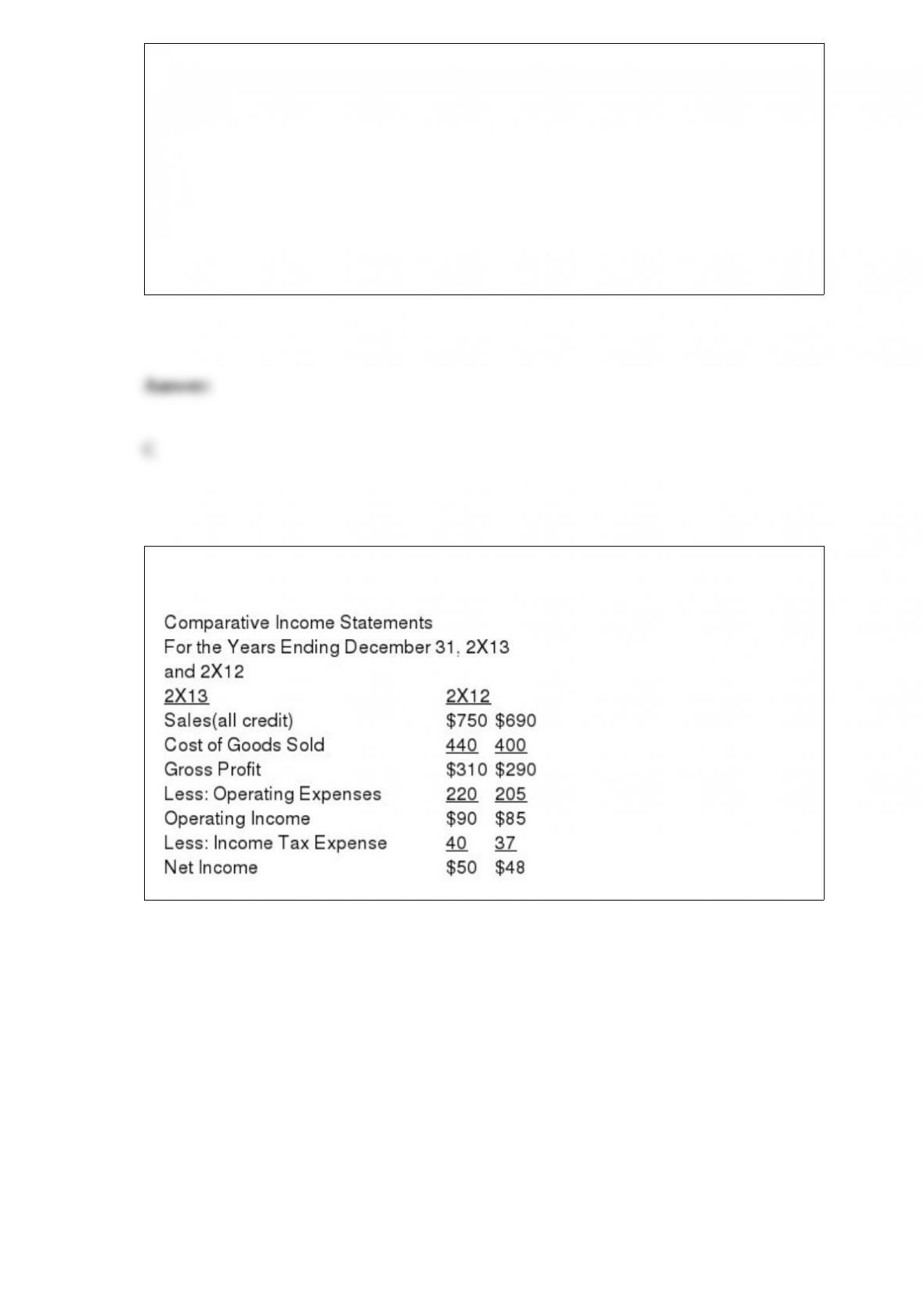
The following financial statements are available for Jerry Company:
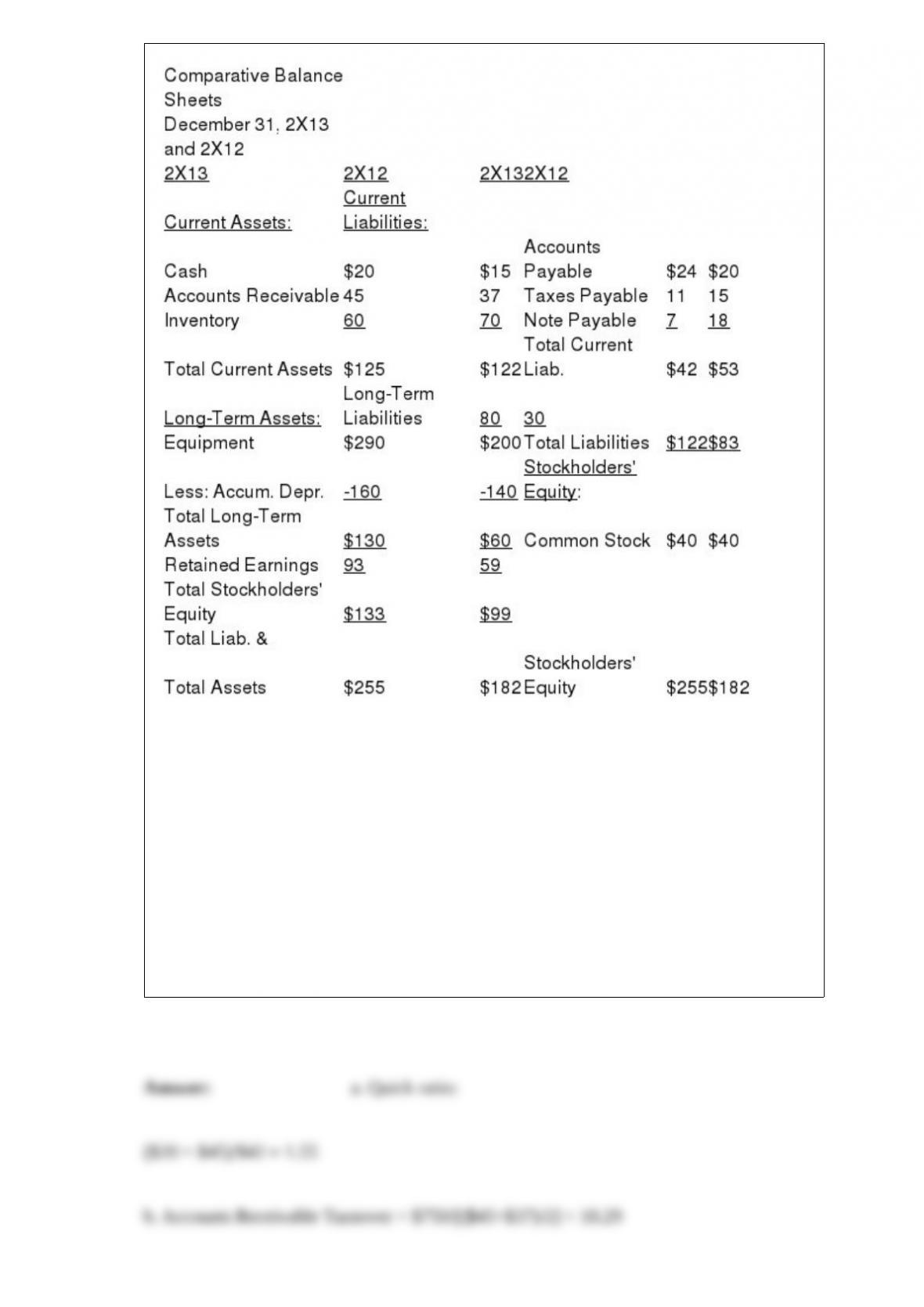
Use the above information to determine the following ratios for 2X13:
a. Quick ratio
b. Average collection period in days
c. Total-debt-to-total-equity
d. Pretax return on assets (ROA)
e. Return on common stockholder’s equity (ROE)
Using the balance sheet equation as a starting point, determine the missing amounts:
(1), (2), (3), and (4) above.
On September 1, 2X12, Tundra Greenhouses purchased available-for-sale securities
consisting of common and preferred stocks. The portfolio consists of 100 shares of
Blooming Company (purchased at $37 per share) and 305 shares of Leaf Company
(purchased at $29 per share). The market value of the securities on a per share basis on
September 30 were $35 for Blooming and $26 for Leaf. Prepare the journal entry that
will need to be made on September 30, 20X12.
Soxlette Company has 700,000 shares authorized and 250,000 shares issued and
outstanding of its $4 par value common stock. The stock is currently selling for $60 per
share. If Soxlette Company declared and issued a 70% stock dividend, what would be
the effect on the following items after the stock dividend?
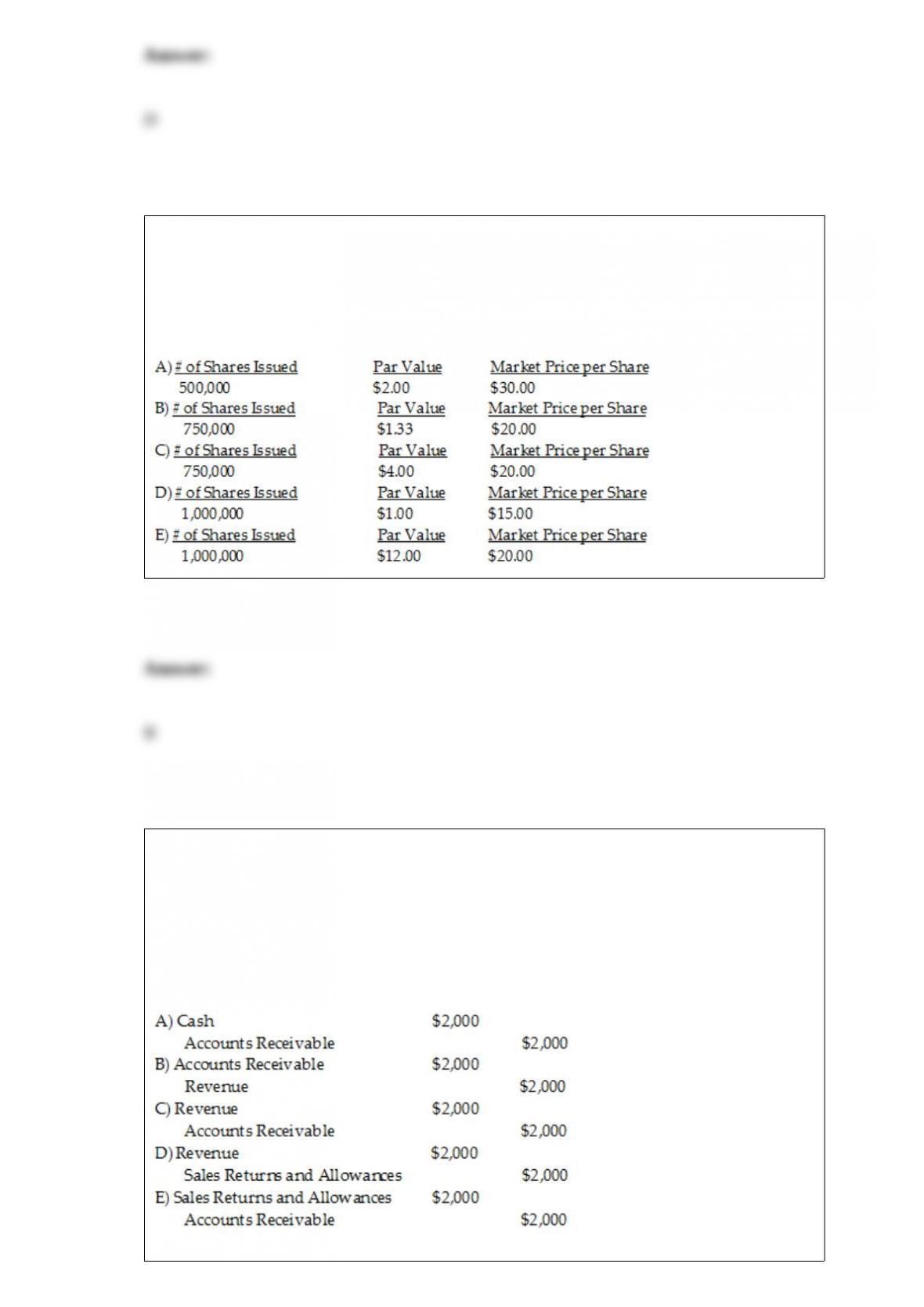
Alexander Pools has 700,000 shares authorized and 250,000 shares issued and
outstanding of its $4 par value common stock. The stock is currently selling for $60 per
share. If Alexander Pools declared and issued a three-for-one stock split adjusting its
par value, what would be the effect on the following items after the stock split? Assume
the old shares were exchanged for 750,000 new shares.
Ganes Computing sold $70,000 of inventory on account to Markel Company on April 1,
20X3. The company uses a periodic inventory system. Markel Company returned
$2,000 of the inventory on April 20, 20X3 because it did not fit the company’s needs.
Which of the following is the journal entry to be made by Ganes Computing for the
return of inventory?
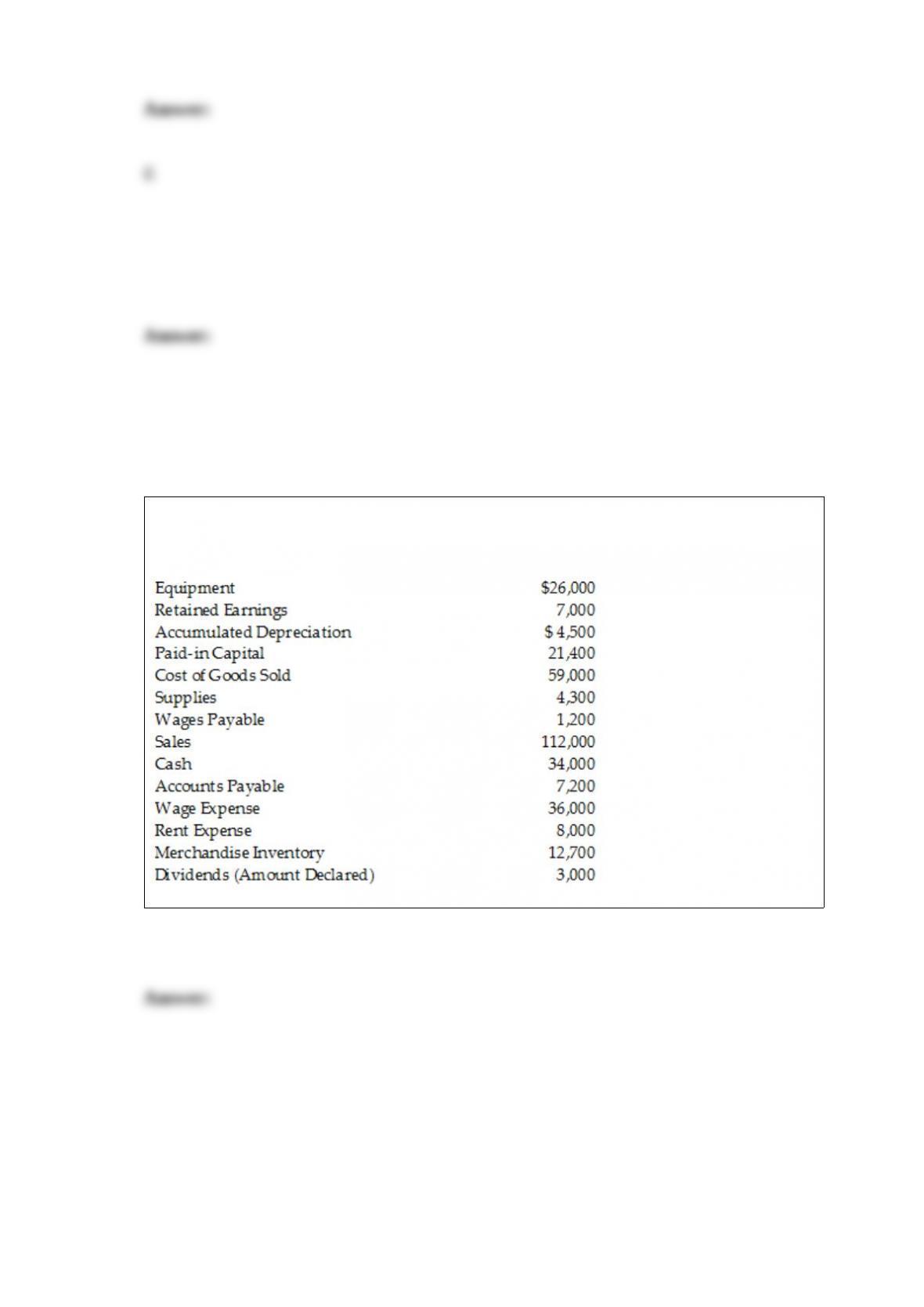
Formation, Inc. had the following balances as of December 31, 2012. Prepare closing
entries based on these balances.