
Which one of the following represents the amount of compensation an investor should
expect to receive for accepting the unsystematic risk associated with an individual
security?
A. Security beta multiplied by the market rate of return
B. Market risk premium
C. Security beta multiplied by the market risk premium
D. Risk-free rate of return
E. Zero
Answer:
Pete’s Warehouse has net working capital of $2,400, total assets of $19,300, and net
fixed assets of $10,200. What is the value of the current liabilities?
A. -$6,700
B. -$2,900
C. $2,900
D. $6,700
E. $11,500
Answer:

A firm has net working capital of $3,800 and current assets of $11,700. What is the
current ratio?
A. 0.34
B. 0.60
C. 1.48
D. 1.65
E. 2.92
Answer:
You have $5,000 you want to invest for the next 45 years. You are offered an
investment plan that will pay you 6 percent per year for the next 15 years and 10
percent per year for the last 30 years. How much will you have at the end of the 45
years? How much will you have if the investment plan pays you 10 percent per year for
the first 15 years and 6 percent per year for the next 30 years?
A. $201,516.38; $201,516.38
B. $209,092.54; $201,516.38
C. $209,092.54; $119,959.94
D. $209,092.54; $209,092.52
E. $221,408.97; $119,949.94

Answer:
The opportunities that a manager has to modify a project once it has started are called:
A. sensitivity choices.
B. managerial options.
C. scenario adjustments.
D. restructuring options.
E. erosion control measures.
Answer:
The R in the Fisher effect formula represents the:
A. current yield.
B. real return.
C. coupon rate.
D. inflation rate.
Answer:
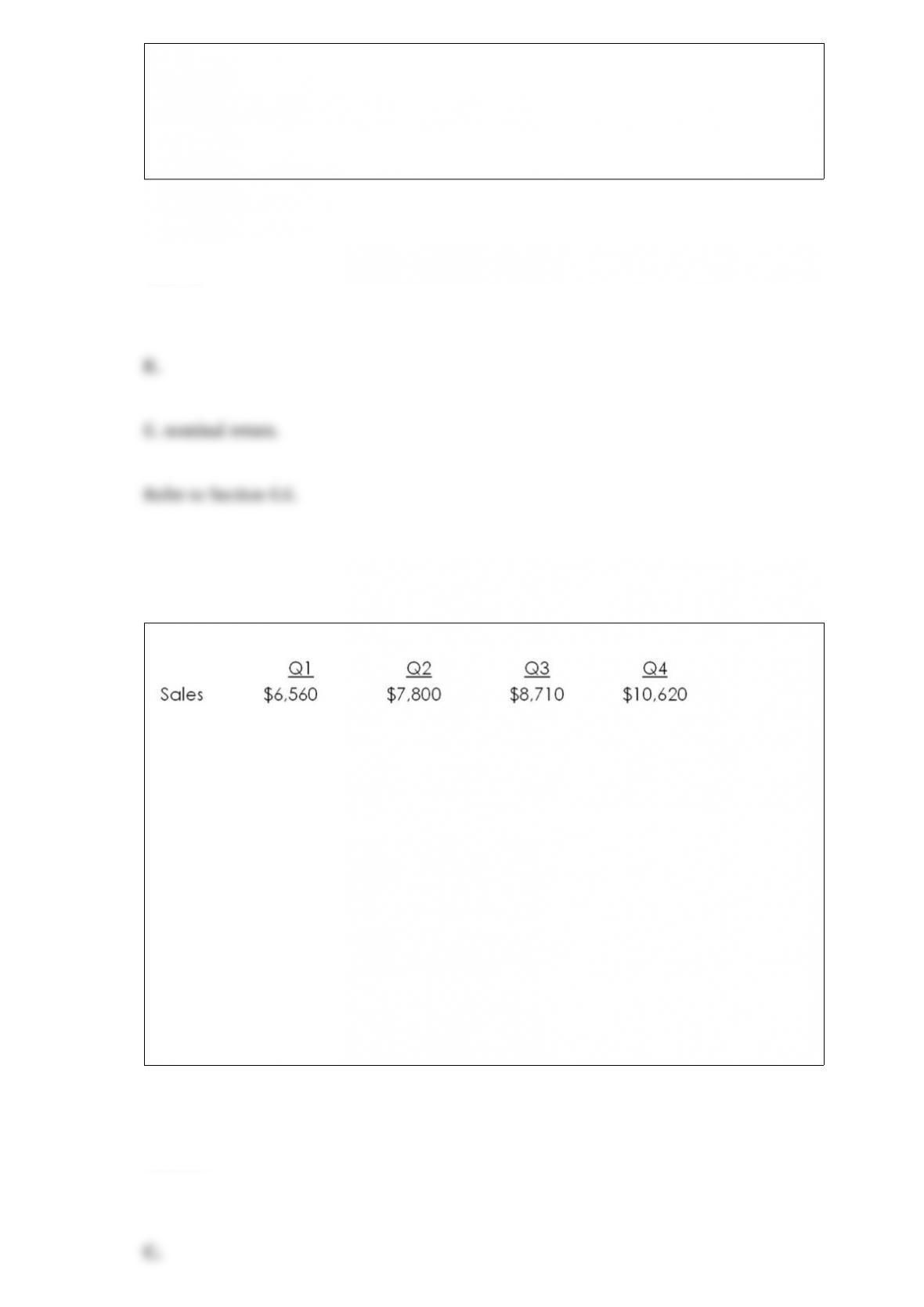
Greenbriar Grain and Feed has the following estimated sales.
Purchases are equal to 75 percent of the following quarter’s sales. The accounts
receivable period is 30 days and the accounts payable period is 60 days. Assume there
are 30 days in each month. How much will the firm owe its suppliers at the end of
quarter 2?
A. $3,692
B. $3,807
C. $4,355
D. $4,550
E. $5,027
Answer:

International Traders has common stock outstanding at a market price of $53 per share.
The total market value of the firm is $6,603,800. The firm plans on liquidating one of
its divisions for $550,000 in cash and distributing the proceeds to the shareholders in
the form of a liquidating dividend. What will be the amount per share of that dividend?
A. $3.197
B. $4.414
C. $4.620
D. $4.714
E. $4.782
Answer:
Eric & Jared’s Department Store has current liabilities of $7,630, net working capital of
$2,180, inventory of $2,750, and sales of $51,800. What is the quick ratio?
A. 0.79
B. 0.84
C. 0.93
D. 1.09

E. 3.50
Answer:
Which one of the following transactions will increase the liquidity of a firm?
A. Cash purchase of new production equipment
B. Payment of an account payable
C. Cash purchase of inventory
D. Credit sale of inventory at cost
E. Cash payment of employee wages
Answer:
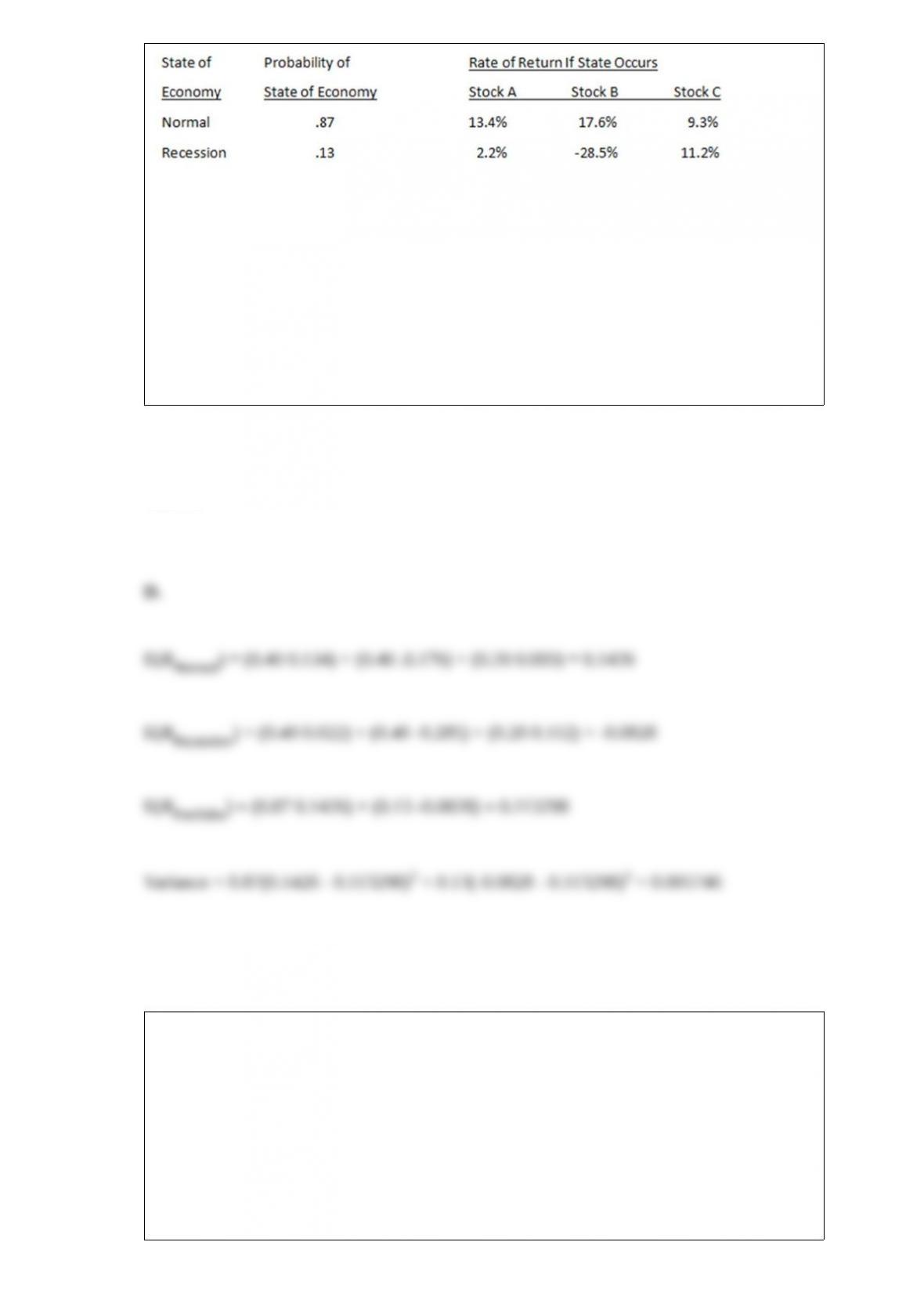
Given the following information, what is the variance of the returns on a portfolio that
is invested 40 percent in both Stocks A and B, and 20 percent in Stock C?
A. 0.002102
B. 0.002490
C. 0.002513
D. 0.005746
E. 0.006143
Answer:
Which one of the following statements is correct?
A. The internal rate of return is the most reliable method of analysis for any type of
investment decision.
B. The payback method is biased toward short-term projects.
C. The modified internal rate of return is most useful when projects are mutually
exclusive.

D. The average accounting return is the most difficult method of analysis to compute.
Answer:
Which one of the following is the price that an investor pays to purchase an outstanding
bond?
A. Dirty price
B. Face value
C. Call price
D. Bid price
E. Clean price
Answer:

Which one of the following is an example of the political risks associated with foreign
operations?
A. Technological changes
B. Exchange rate fluctuations
C. Translation exposure to exchange rate risk
D. Changes in foreign tax laws
E. Changes in relative wage rates between the home country and the foreign country
Answer:
Which one of the following characteristics generally applies to commercial paper?
A. Issued only by financial institutions
B. Issued only by corporations
C. Maturities limited to 90 days or less
D. Unsecured
E. Secured by accounts receivable
Answer:

Precision Manufacturing had the following operating results for 2014: sales = $38,900;
cost of goods sold = $24,600; depreciation expense = $1,700; interest expense =
$1,400; dividends paid = $1,000. At the beginning of the year, net fixed assets were
$14,300, current assets were $8,700, and current liabilities were $6,600. At the end of
the year, net fixed assets were $13,900, current assets were $9,200, and current
liabilities were $7,400. The tax rate for 2014 was 34 percent. What is the cash flow
from assets for 2014?
A. $8,047
B. $8,292
C. $8,658
D. $9,492
E. $9,964
Answer:
Ted currently owns 100 shares of a publicly traded stock that he would like to sell.
Which one of the following provides the most efficient means for Ted to sell his shares?
A. Issuer-sponsored Dutch auction
B. Proxy statement
C. Private placement transaction
D. Stakeholder purchase

E. Secondary market transaction
Answer:
Which one of the following statements is correct?
A. Bonds are generally called at par value.
B. A current list of all bondholders is maintained whenever a firm issues bearer bonds.
C. An indenture is a contract between a bond’s issuer and its holders.
D. Collateralized bonds are called debentures.
E. A bondholder has the right to determine when his or her bond is called.
Answer:
When are funds generally transferred into zero-balance accounts?
A. Monthly

B. Weekly
C. Daily
D. As needed
E. Never
Answer:
Which one of the following is a noncash payment made by a firm to its shareholders
and is a payment that lessens the value of each outstanding share?
A. Reverse stock split
B. Cash distribution
C. Stock dividend
D. Regular dividend
E. Liquidating dividend
Answer:

Jesse just won the state lottery. He has been given the option of receiving either $62.9
million today or $5 million a year for the next 35 years, with the first payment paid
today. Describe the process that Jesse should use to determine which payment option he
prefers. Ignore all taxes and assume that Jesse will live for at least 40 more years.
Answer:
What is LIBOR and what role does it play in international finance?
Answer:
Explain the concept of the subjective approach to assigning a required return to a
project.
Answer:
Identify three managerial options that relate to project analysis and explain how those
options affect the net present value of a project.
Answer:
Assume a firm has both a controller and a treasurer. Identify the types of responsibilities
each should have and explain why their duties should be separated as you suggest.
Answer:

List three decisions that a financial manager makes that would fall under the category
of working capital management.
Answer:
Miller Tool is a successful manufacturer of both consumer and industrial hand tools and
is publicly owned. The firm has several positive net present value projects that it would
like to pursue and thus decided to issue additional shares of common stock. As a result
of this stock issue, the firm’s stock price declined. Explain why this occurred when the
proceeds of the issue are being used to fund positive net present value projects.
Answer:

What does it mean when a loan is amortized? Explain how amortization methods can
vary from one loan to another.
Answer:
Explain why a firm might prefer a stock repurchase rather than an increase in the firm’s
regular dividend.
Answer:
Explain how the selection of a method of depreciation can affect the net present value
of an investment for a tax-paying firm.
Answer: