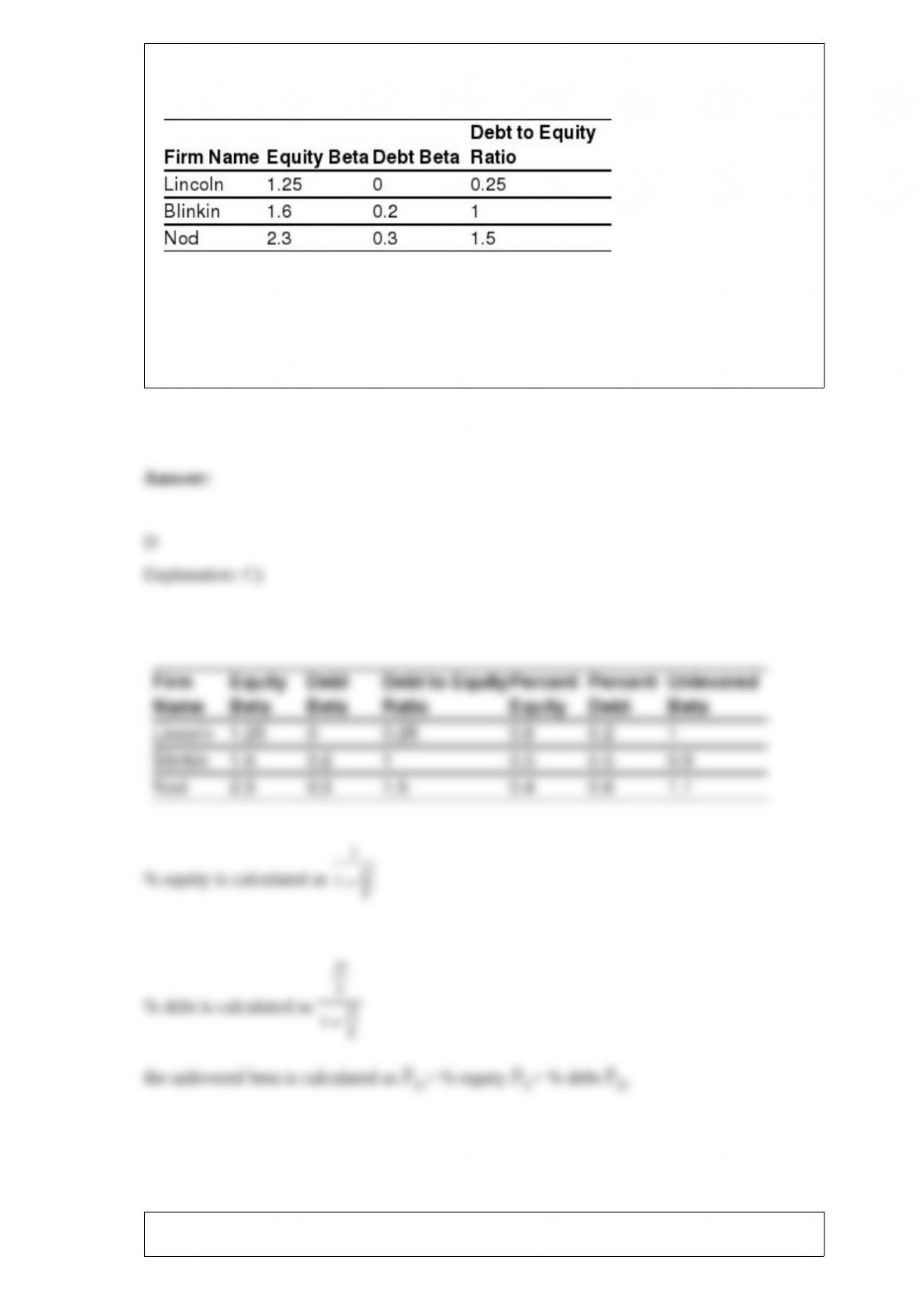
You are evaluating a new project and need an estimate for your project’s beta. You have
identified the following information about three firms with comparable projects:
The unlevered beta for Blinkin is closest to:
A) 0.95
B) 1.10
C) 1.00
D) 0.90
Which of the following statements is correct?

A) You should invest in project Beta since NPVBeta> 0.
B) You should invest in project Alpha since IRRAlpha> IRRBeta.
C) Your should invest in project Alpha since NPVAlpha< 0.
D) You should invest in project Beta since IRRBeta> 0.
Consider the following two projects:
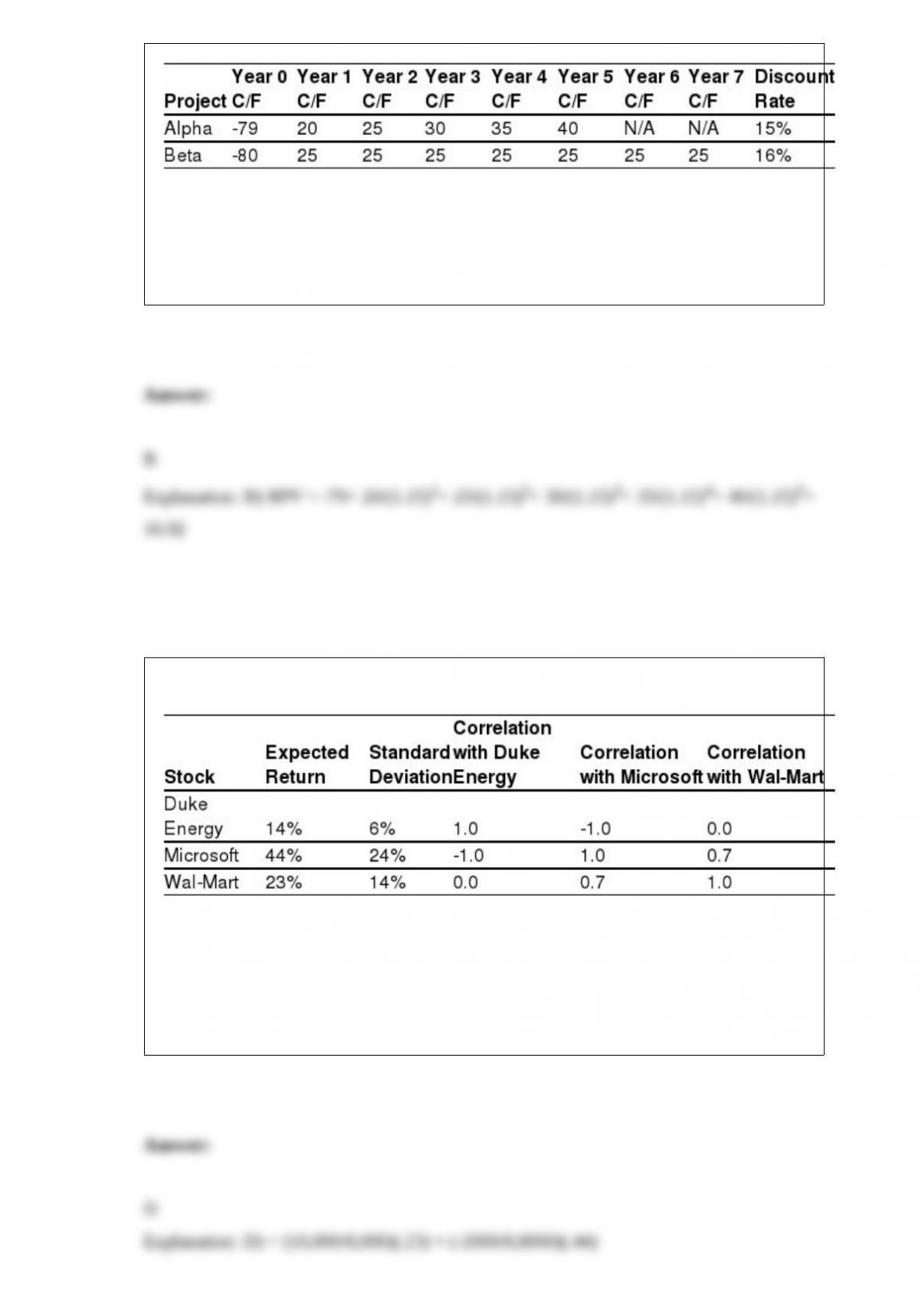
The NPV for project alpha is closest to:
A) $20.96
B) $16.92
C) $24.01
D) $14.41
Consider the following expected returns, volatilities, and correlations:
The expected return of a portfolio that is consists of a long position of $10000 in
Wal-Mart and a short position of $2000 in Microsoft is closest to:
A) 21%
B) 12%
C) 27%
D) 18%
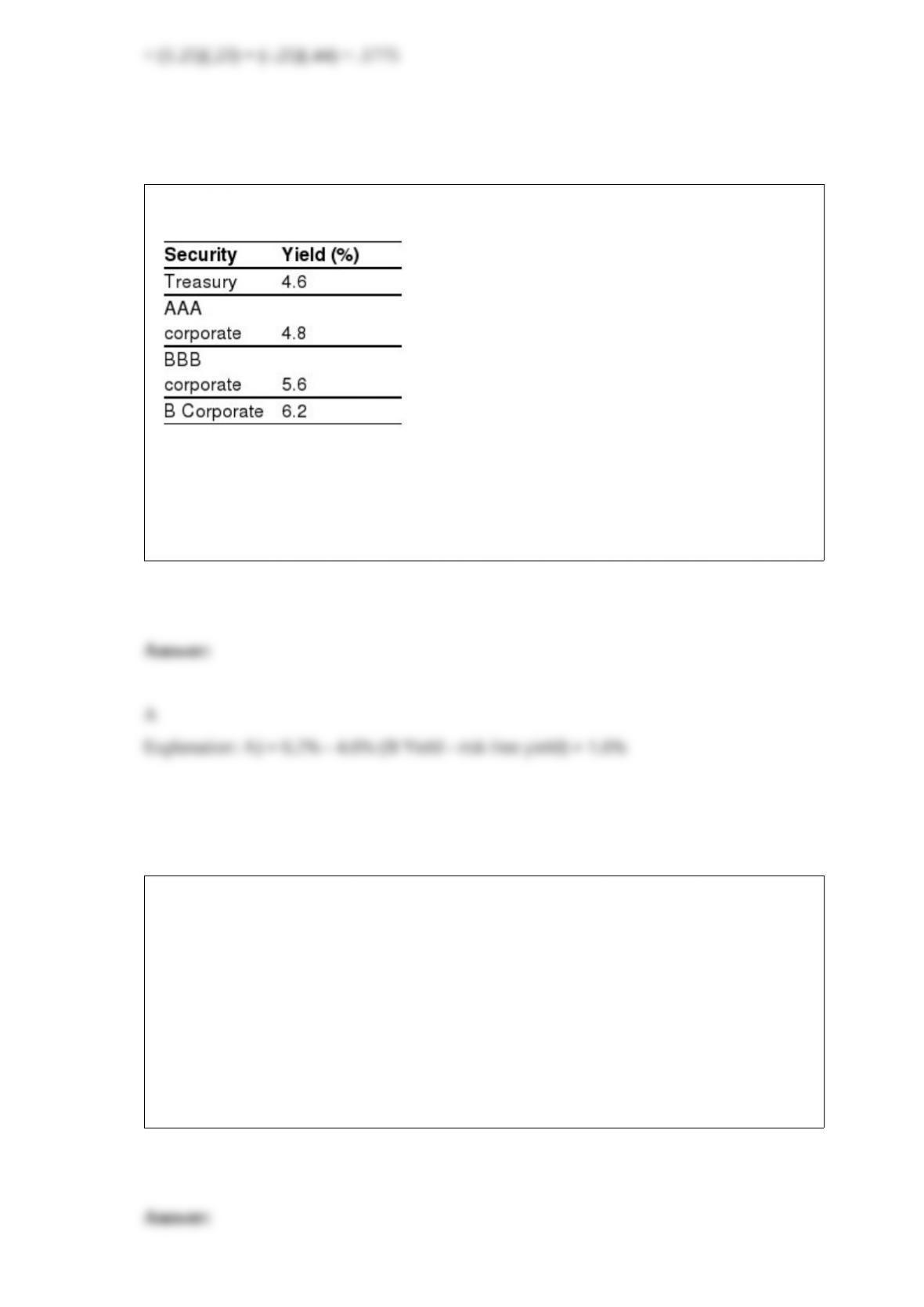
Consider the following yields to maturity on various one-year zero-coupon securities:
The credit spread of the B corporate bond is closest to:
A) 1.6%
B) 0.8%
C) 1.0%
D) 1.4%
Which of the following statements is FALSE?
A) As a practical matter, it is extremely difficult to identify portfolios that are efficient
because we cannot measure the expected return and the standard deviation of a portfolio
with great accuracy.
B) The portfolios in a multifactor model can be thought of as either risk factors
themselves or portfolios of stocks correlated with unobservable risk factors.
C) Each factor beta is the expected percent change in the excess return of a security for
a 1% change in the excess return of the factor portfolio.
D) Even if the market portfolio is not efficient, it still must capture all components of
systematic risk.

Which of the following balance sheet equations is INCORRECT?
A) Assets – Liabilities = Shareholders’ Equity
B) Assets = Liabilities + Shareholders’ Equity
C) Assets – Current Liabilities = Long Term Liabilities
D) Assets – Current Liabilities = Long Term Liabilities + Shareholders’ Equity
Monsters Incorporated (MI) in ready to launch a new product. Depending upon the
success of this product, MI will have a value of either $100 million, $150 million, or
$191 million, with each outcome being equally likely. The cash flows are unrelated to
the state of the economy (i.e. risk from the project is diversifiable) so that the project
has a beta of 0 and a cost of capital equal to the risk-free rate, which is currently 5%.
Assume that the capital markets are perfect.
Suppose that MI has zero-coupon debt with a $125 million face value due next year.
The expected return of MI’s debt is closest to:
A) 25.0%
B) 12.5%
C) 5.0%
D) 7.8%

Which of the following statements is FALSE?
A) Because all other risk is diversifiable, it is an investment’s beta with respect to the
efficient portfolio that measures its sensitivity to systematic risk, and therefore
determines its cost of capital.
B) If a security’s expected return exceeds its required return given our current portfolio,
then we can improve the performance of our portfolio by adding more of the security.
C) The appropriate risk premium for an investment can be determined from its beta
with the efficient portfolio.
D) As we buy shares of a security i, its correlation with our portfolio P will increase,
ultimately raising its required return until E[Ri] = Rp.
Which of the following equations is INCORRECT?
A) Expected future spot interest rate = forward interest rate + risk premium
B) (1 + f1) × (1 + f2) × (1 + f3) × … × (1 + fn) = (1 + YTMn)n
C) fn= – 1
D) (1 + YTMn)n= (1 + YTMn– 1)n– 1(1 + fn)

Consider the following factor model:
E[Rs] – rf= (E[RMkt] – rf) + E[RSMB] + E[RHML] + E[RPR1
YR]
The term measures the sensitivity of the securities returns to:
A) the overall market.
B) book to market.
C) size.
D) momentum.
Suppose that the market portfolio is equally likely to increase by 24% or decrease by
8%. Security “X” goes up on average by 29% when the market goes up and goes down
by 11% when the market goes down. Security “Y” goes down on average by 16% when
the market goes up and goes up by 16% when the market goes down. Security “Z” goes
up on average by 4% when the market goes up and goes up by 4% when the market
goes down.
The beta for security “Z” is closest to:
A) -1.00
B) -0.25
C) 0.00
D) 0.25
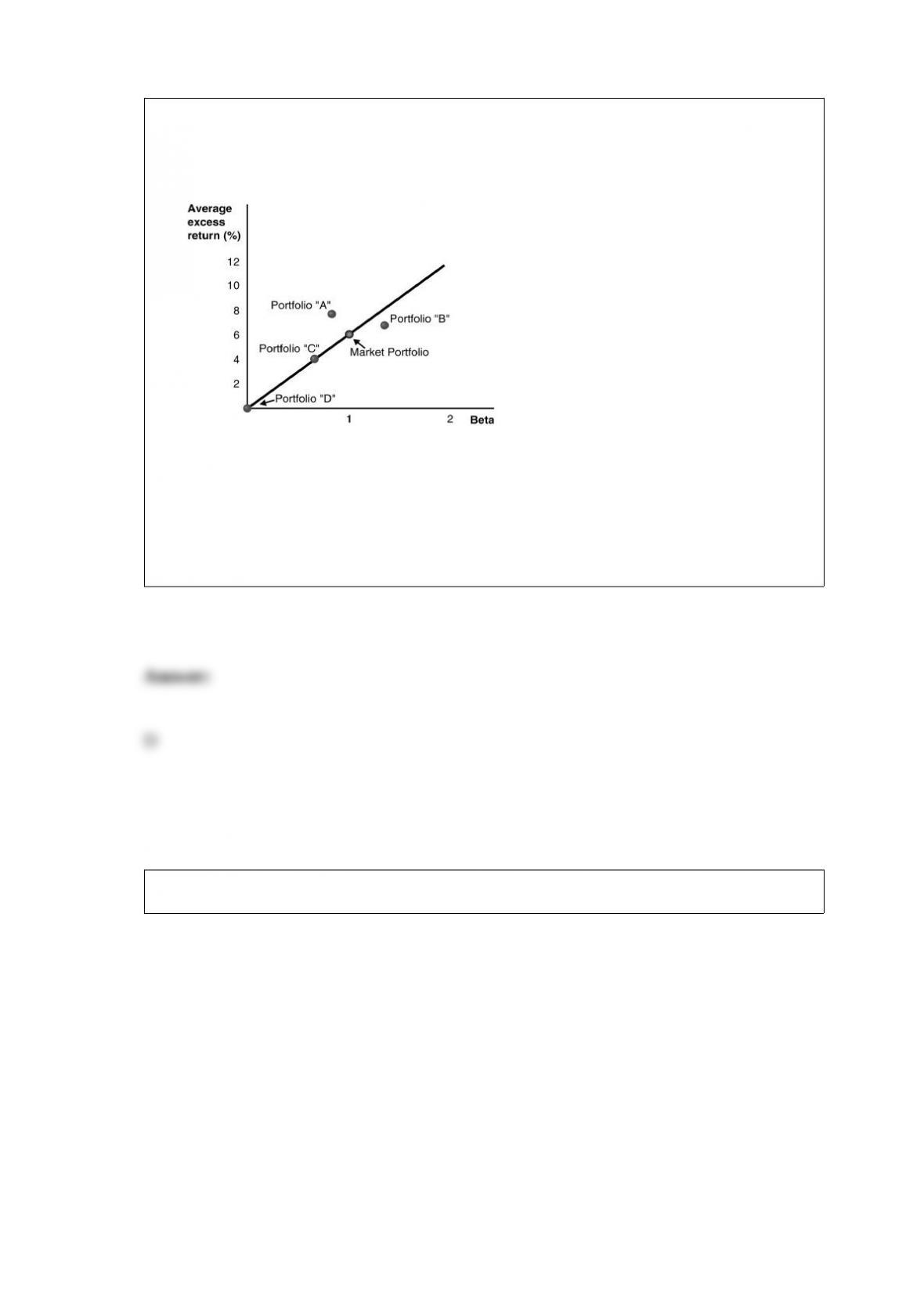
Consider the following graph of the security market line:
Portfolio “D”:
A) falls below the SML.
B) has a negative alpha.
C) is overpriced.
D) offers an expected return equal to the risk-free rate.
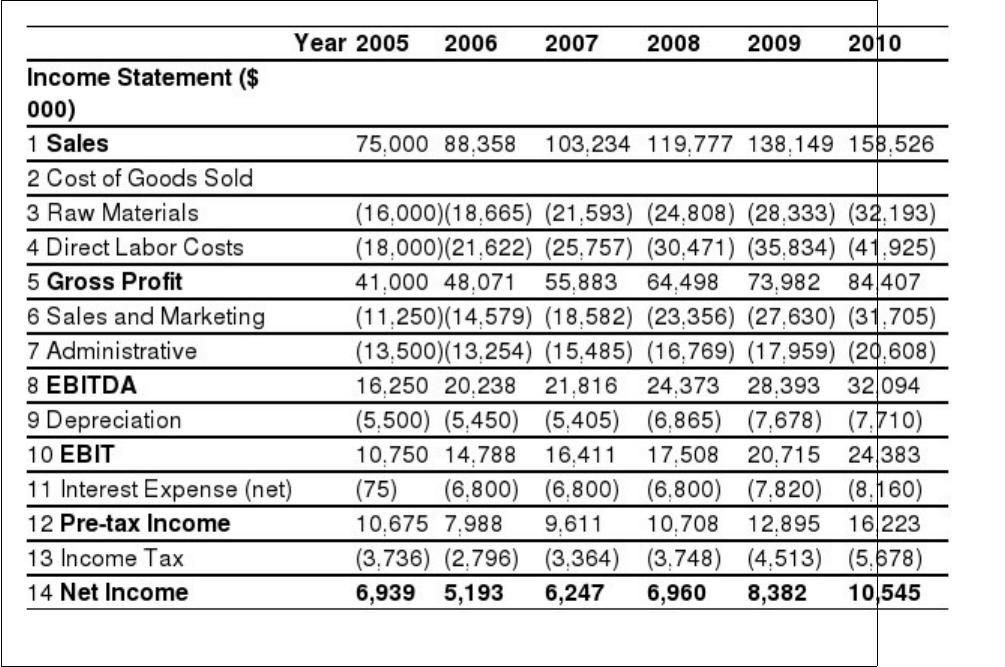
Pro Forma Income Statement for Ideko, 2005-2010
Pro Forma Balance Sheet for Ideko, 2005-2010
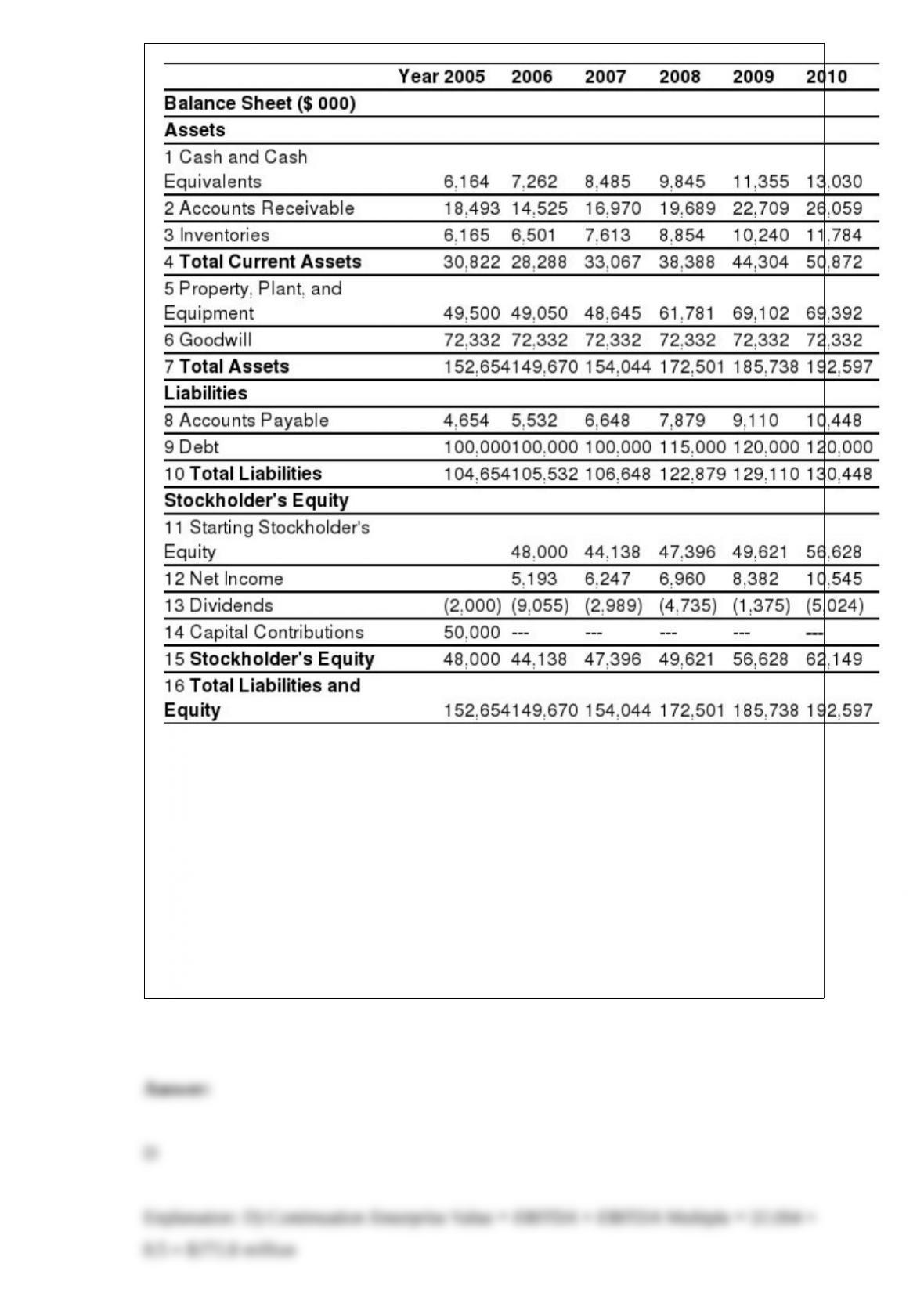
Assuming that Ideko has a EBITDA multiple of 8.5, then the continuation levered P/E
ratio of Ideko in 2010 is closest to:
A) 19.0
B) 17.2
C) 16.4
D) 14.5

Rockwood Industries has 100 million shares outstanding, a current share price of $25,
and no debt. Rockwood’s management believes that the shares are under-priced, and
that the true value is $30 per share. Rockwood plans to pay $250 million in cash to its
shareholders by repurchasing shares. Management expects that very soon new
information will come out that will cause investors to revise their opinion of the firm
and agree with Rockwood’s assessment of the firm’s true value.
If Rockwood is able to repurchase shares prior to the market becoming aware of the
new information regarding Rockwood’s true value, then the number of shares
outstanding following the repurchase is closest to:
A) 92 million
B) 10 million
C) 75 million
D) 90 million
Iota Industries is an all-equity firm with 50 million shares outstanding. Iota has $200
million in cash and expects future free cash flows of $75 million per year. Management
plans to use the cash to expand the firm’s operations, which in turn will increase future
free cash flows by 12%. Iota’s cost of capital is 10% and assume that capital markets are
perfect.
Suppose that Iota is able to invest the $200 million in excess cash into a project that will
increase future free cash flows by 30%. If you were advising the board, what course of
action would you recommend, investing the $200 million in an expansion project that
will raise future free cash flows by 30% or use the $200 million to repurchase shares?
Which provides the higher stock price?

KAHR Incorporated will have EBIT this coming year of $45 million. It will also spend
$18 million on total capital expenditures and increases in net working capital, and have
$9 million in depreciation expenses. KAHR is currently an all-equity firm with a
corporate tax rate of 35% and a cost of capital of 10%. If the interest rate on new
KAHR debt is 8%, how much should KAHR borrow today if they want to maximize
there interest tax shield?
Joe just inherited the family business, and having no desire to run the family business,
he has decided to sell it to an entrepreneur. In exchange for the family business, Joe has
been offered an immediate payment of $100,000. Joe will also receive payments of
$50,000 in one year, $50,000 in two years, and $75,000 in three years. The current
market rate of interest for Joe is 6%.
Draw a timeline detailing Joe’s cash flows from the sale of the family business.
Consider the following realized annual returns:
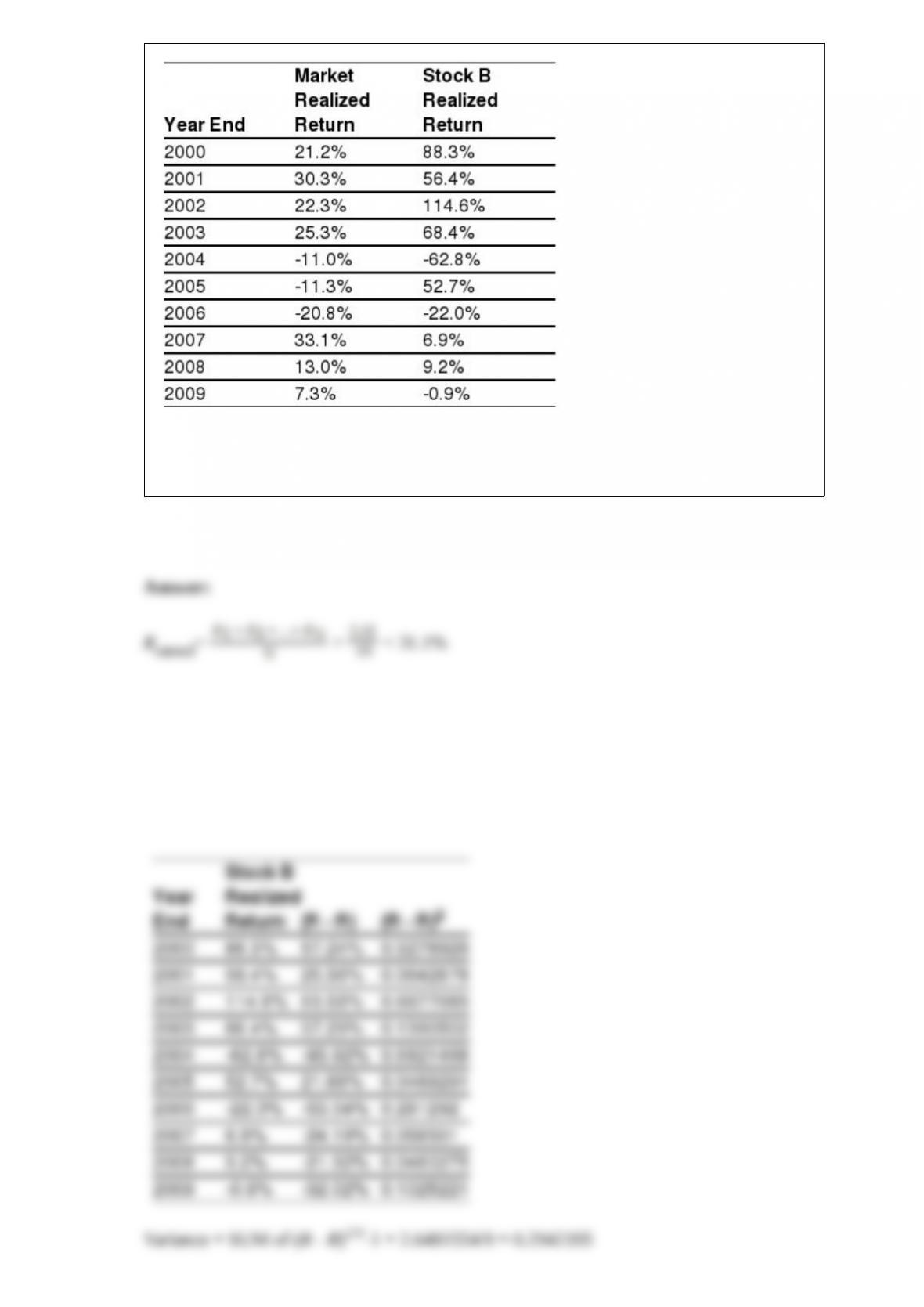
Using the data provided in the table, calculate the average annual return, the variance of
the annual returns, and the standard deviation of the average returns for Stock B from
2000 to 2009.

What is the role of an auditor in financial statement analysis?
Do expected returns for individual stocks increase proportionately with volatility?