
Held-to-maturity securities are always classified as noncurrent assets.
The higher the cash to current liabilities ratio of a company, the more liquid is the
company.
A decrease in the growth rate of the future compensation will cause an increase in
pension cost.
A decrease in provision for doubtful accounts relative to gross accounts receivable
could indicate improved collection of accounts receivable or it could indicate that
management has failed to make adequate provisions for non-collectible accounts.

Prospective analysis is the forecasting of future payoffstypically earnings, cash flows,
or both.
There is only one way to measure invested capital.
An increasing accounts receivables balance is always a good sign as it means the
company has more current assets and is more liquid.

All other things equal, a company that capitalizes rather than expenses software
development costs, will have a less volatile net income.
Return on equity is the return stockholders have realized during the past year.
If future expected return on common stockholders’ equity is less than expected required
return by equity holders then the market value of a company’s stock should be less than
book value.
Software costs may be capitalized once a company can show that the product is
technologically feasible.

Practice requires separate disclosure of cash flows in the statement of cash flows.
If a company sells its receivables, this is an indication that it has very high quality
receivables.
Determination of short-term liquidity is important to both investors and creditors.

In a common-size balance sheet, total assets are expressed as 100 percent.
FASB has recognized the conceptual superiority of the historical value concept and has,
in principle, decided to eventually move to a model where all asset and liability values
are recorded at fair value.
Companies report the funded status of pension plans as a separate line item on the
balance sheet.
The SEC has issued “safe harbor” rules to encourage forecasts by registrants, but it has
had limited success.

Pension risk arises to the extent to which plan assets have a different risk profile than
the pension obligation.
If a company switches from FIFO to LIFO during a period of rising prices, inventory
turnover will probably increase.
The fair value of an asset is the hypothetical price at which a business can sell the asset
(exit price).

Audits are designed and implemented with the objective of detecting fraud.
A decrease in liabilities would usually show as an outflow in the statement of cash
flows.
If a company has rapidly growing earnings per share, their return on net operating
assets must be increasing too.
Net cash flow is not affected by a company’s choice of accounting principles for
financial reporting purposes.

Accounts receivable are usually not classified as a current asset.
The major use of cash for declining companies is repurchasing of equity.
If two companies both increase their net income by 25% over the prior year this means
they have both been equally profitable this year.

When purchase accounting is used for acquisitions, prior year financial statements
presented for comparative purposes should be restated as if the companies had always
been combined.
Under long-term performance contractssuch as product warranty contracts and software
maintenance contractsrevenues are often collected in advance and are recognized
proportionally over the entire period of the contract.
The SEC requires only quarterly financial reports to be filed (Form 10-Q).
Company A acquires 40% of Company B in a stock-for-stock exchange. With respect to
preparing financial statements, which of the following statements is correct?
A. Company A will most likely use pooling-of-interest accounting for consolidation
purposes.

B. Company A will most likely use purchase accounting.
C. Company A will most likely use the cost method.
D. Company A will most likely use the equity method.
If a company is to successfully remain in business over the long haul, which of the
following statements is most correct?
A. Total cash flow from operations, measured over an extended period, must be
positive.
B. Total cash flow from investing, measured over an extended period, must be positive.
C. Total cash flow from financing, measured over an extended period, should be
negative.
D. Total cash flow from financing plus total cash flow from investing, measured over an
extended period, must be positive.
Horace Corporation has $200,000 of convertible 5% bonds. Each $500 bond is
convertible into 50 shares of common stock. The bonds were sold at par and are
currently trading at par, and the required return on nonconvertible bonds of similar risk
is 11%. Common stock is trading at $23 per share.
The total leverage ratio of a company will:
A. increase if leases are capitalized.
B. increase if a company sells its receivables.
C. increase if a company sells more equity.
D. increase if a company pays suppliers more quickly.
Adjusting from LIFO to FIFO
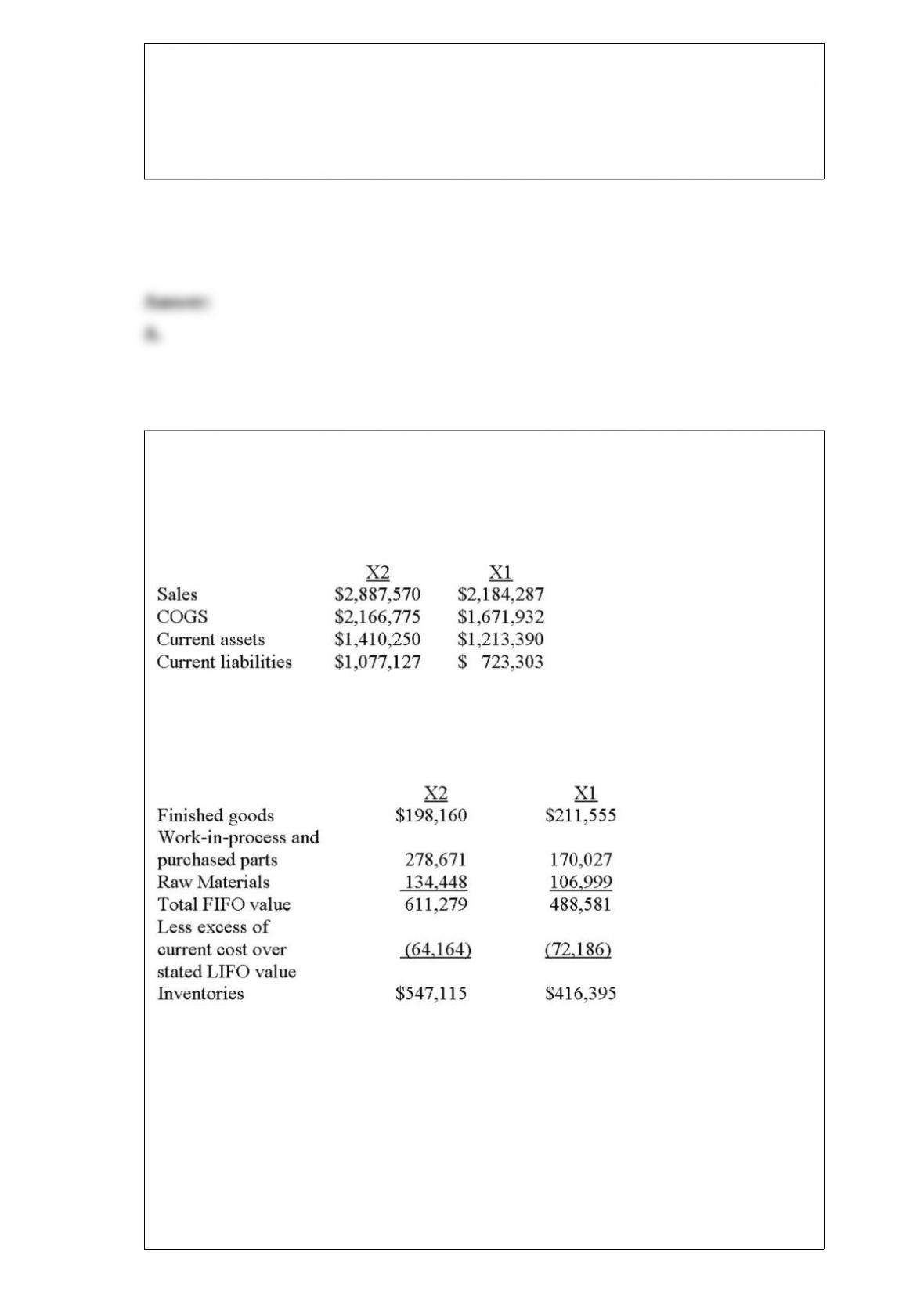
Below are selected numbers extracted from Harnischfeger’s Year X2 financial
statements (numbers are in thousands).
Harnischfeger’s Footnote on inventories is as follows (numbers in thousands):
Inventories at October 31 consisted of the following:
Inventories valued using the LIFO method represented approximately 56% and 80% of
consolidated inventories at October 31, X2 and X1, respectively.
a. Calculate for Year X2:
i) the gross margin percentage
ii) the current ratio

iii) inventory turnover
b. Estimate the following numbers if Harnischfeger used FIFO for all inventories:
i) the gross margin
ii) the current ratio
iii) inventory turnover
c. Compare your answers in part a) and b) and comment.
Which of the following statements is incorrect?
A. Current assets are expected to be converted into cash sooner than noncurrent assets.
B. Equity investors have unlimited downside exposure if the company declares
bankruptcy.
C. Paid-in capital of company is not affected by the payment of dividends.
D. Retained earnings at the inception of a company equals zero.

Users sometimes compute net income plus depreciation and amortization (for example
EBITDA) as a crude proxy for operating cash flows.
Which of the following is not a primary motivation for a company financing its
business activities through debt?
A. Trading on the equity
B. Reducing earnings variability
C. Tax deductibility of interest
D. Avoiding earnings dilution
The average age of Huy’s depreciable assets as of 2006 is:
A. 2 years.
B. 7 years.
C. 14 years.
D. 34 years.

If a company uses the purchase method to account for a merger, which of the following
is true?
I. Prior year’s statements must be restated as if merged companies had always been one
company.
II. Net income of combined companies will probably be lower than net income of two
separate companies added together.
III. Goodwill is never recorded.
IV. Assets of acquired company will be recorded on acquirer’s books at their fair value.
A. II, III, and IV
B. I, II, and III
C. II and IV
D. I and III
Which of the following is not a reason for economic income and accounting income to
differ?
A. Transaction basis
B. The monetary assumption
C. Conservatism
D. Earnings management

Which of the following is not an actuarial assumption underlying the computation of
the pension obligation?
A. Employee turnover
B. Life expectancy
C. Interest rate
D. Service cost
Which of the following statements is incorrect?
A. It is possible for a profitable company to go out of business because of short-term
liquidity problems.
B. If a company has a current ratio greater than 1, it will never go out of business
because of liquidity problems.
C. The current ratio is always greater than or equal to the quick ratio.
D. The accuracy of a cash flow forecast is inversely related to the forecast horizon.

______ are secondary qualities of accounting information that make it useful for
decision making.
A. Consistency and comparability
B. Relevance and reliability
C. Materiality and comparability
D. Full disclosure and relevance
Purchases divided by accounts payable provides information about:
A. capital structure.
B. management of working capital.
C. gross profit margin.
D. profitability.

Which of the following is an example of off-balance sheet financing?
A. Operating leases
B. Capital leases
C. Issuance of convertible bonds
D. Issuance of common stock
A plan is said to be underfunded, if:
A. the pension obligation is more than the asset value.
B. the pension obligation is less than the asset value.
C. the pension obligation is equal to the asset value.
D. None of the above
Goodwill is:
A. the excess of the purchase price of net assets over the book value of net assets.
B. the excess of the appraised value of net assets over the book value of net assets.
C. the excess of the purchase price of net assets over the fair value of net assets.

D. the excess of the appraised value of net assets over the fair value of net assets.
What will be the basic EPS if average stock price during the year is $15 and treasury
shares that can be purchased are 6,000?
A. $3
B. $6
C. $5
D. $4.17
In-process R&D:
A. is written-off immediately to retained earnings.
B. is only an issue when purchase accounting is used.
C. is capitalized on the balance sheet and never amortized.
D. is expensed immediately under pooling of interests.

The classification of marketable equity securities as trading or available-for-sale is
determined:
A. by management’s intent regarding the disposition of the securities.
B. when the securities mature.
C. whether the current assets are greater or less than the current liabilities.
D. whether management wants to mark them to market or not.
Which of the following will give rise to off-balance sheet financing?
I. Take-or-pay arrangements
II. Sale of receivables without recourse
III. Through-put agreements
IV. Purchase commitments
A. I, II, III, and IV
B. I, II, and IV
C. II, III, and IV
D. I, III, and IV

All other things being equal, if a company issues a 1% stock dividend, what is the effect
on the following ratios?
A. Option A
B. Option B
C. Option C
D. Option D
Which of the following is a change in an accounting estimate?
I. A change from straight-line depreciation to declining balance method
II. A change in estimated salvage value of depreciable asset
III. A change in estimated useful life of an asset
IV. Recording depreciation for the first time on machinery purchased five years ago
A. I, II, III, and IV
B. II, III, and IV
C. I, III, and IV
D. II and III

Under the accrual basis of accounting, which of the following statements is true?
I. Reported net income provides a measure of operating performance.
II. Revenue is recognized when cash is received, and expenses are recognized when
payment is made.
III. Cash inflows are recognized when they are received, and cash outflows are
recognized when they are made.
A. I only
B. III only
C. I and III
D. I, II, and III
On January 1, 2005, Systil Corporation issues $50 million, 10-year bonds with a
coupon rate of 10%. Interest is payable annually at the end of the year. If the required
return on bonds of similar risk at January 1, 2006, is 8%, what will be the price of the
bonds be at this date?
A. $56.71 million
B. $56.25 million
C. $44.24 million
D. $43.86 million

Which of the following is least likely to affect analysis of earnings persistence?
A. Managerial compensation
B. Changes in accounting principle
C. Cyclicality of business
D. Seasonality of business
Which of the following items is not included in the calculation of net income but is
included in the calculation of comprehensive income?
A. Unrealized holding gain on available-for-sale marketable securities
B. Unrealized holding gain on trading marketable securities
C. Gain from early extinguishments of bonds
D. Gain arising from sale of available-for-sale marketable securities
You are analyzing a stock. You expect that earnings will grow quickly relative to its
current level, but the expected return on common stockholders’ equity is low. Assuming
price to be constant, what levels of the price-to-earnings ratio (PE) and the
price-to-book ratio (PB) would you expect to see?

A. Option A
B. Option B
C. Option C
D. Option D
When accounting for an investment under the equity method, what situations may
reduce the carrying value of the investment?
I. Investee experiences significant losses.
II. Investee distributes dividends in excess of earnings.
III. Investee sells additional shares for less than book value.
IV. Investee engages in a stock split.
A. I and II
B. II and IV
C. I, II, and III
D. I, III, and IV

Return on common equity for 2005 is:
A. 11.42%.
B. 10.0%.
C. 11.0%.
D. 10.47%.
Both consolidation and equity method accounting assume a dollar earned by a
subsidiary is equivalent to a dollar earned for a parent, even if not received in cash. The
limitations of this assumption of dollar-for-dollar equivalence include which of the
following?
I. Dividends restricted by law and loan covenants
II. Risks due to political and economic factors

III. Tax liabilities from remittance of earnings
IV. Minority interests that limit parent’s discretion
A. II and III
B. II
C. I and III
D. I, II, III, and IV
Analyzing Earnings
Earnings are extremely important to a publicly traded company and the creditors and
investors of that company. However, looking at earnings without regard to the quality of
those earnings is hazardous to the health of creditors and investors.
a. Why is the determination of earnings quality and persistence important?
b. Explain recasting of the income statement, and give three examples of items that are
recasted.
c. Explain adjusting of the income statement, and give three examples of items that are
recasted.
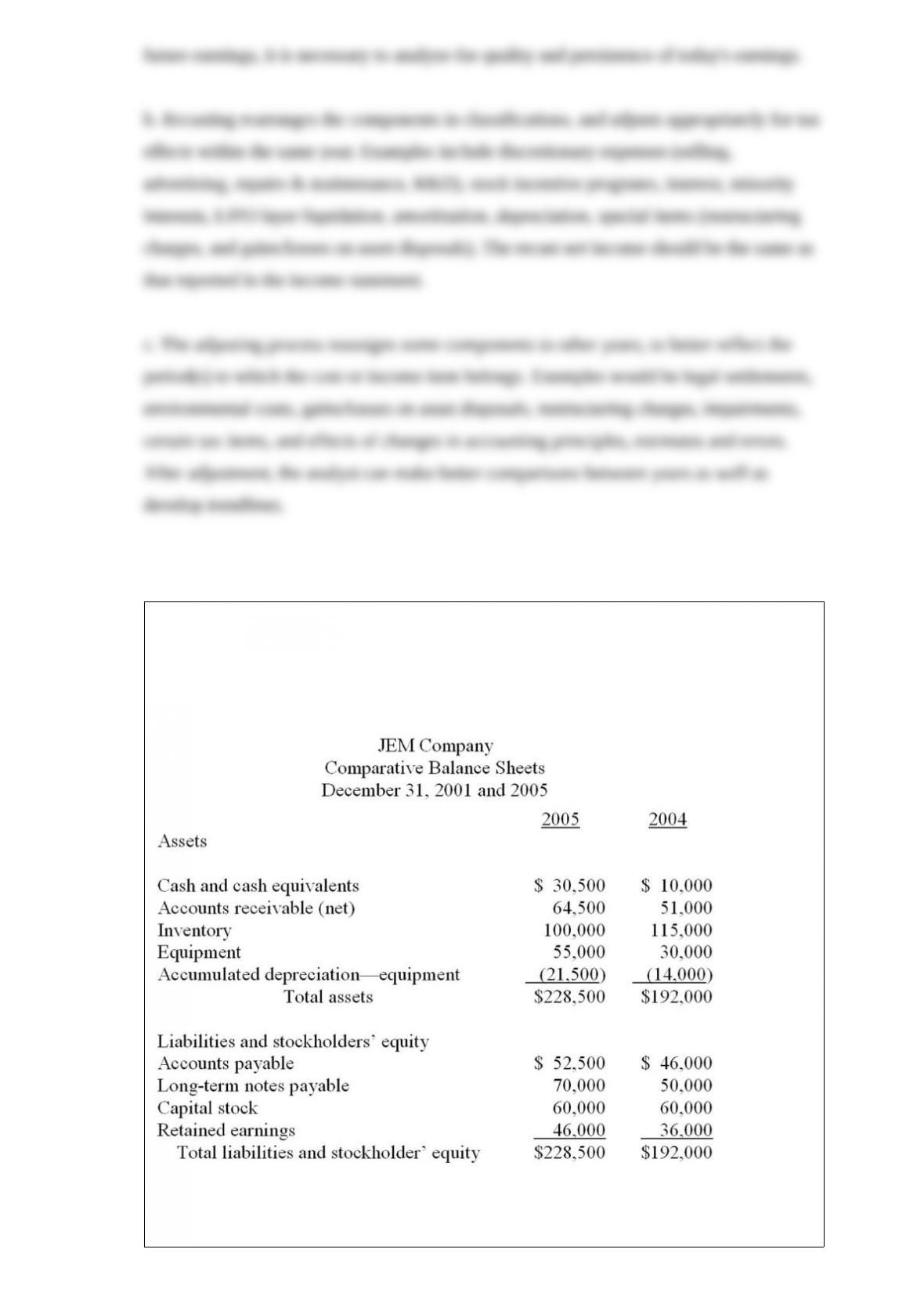
Preparation of Statement of Cash Flow Components
JEM Company’s comparative balance sheets for 2004 and 2005 appear below.
The following additional information is available: net income for the year 2005 (as
reported on the income statement) was $50,000; dividends of $40,000 were declared

and paid; and equipment that cost $8,000 and had a book value of $1,000 was sold
during the year for $2,500.
Based on the information provided, answer the following:
a. What was cash provided by operations?
b. What was cash provided by investing activity?
c. How much was cash provided by financing activity?
d. What is the total change in cash for 2005?
Liabilities not recorded on balance sheet
You are considering purchasing a company. You are aware that sometimes liabilities do
not always show up on the balance sheet. Give five examples of liabilities that may not
be explicitly recognized on the balance sheet, being sure to explain why they are
liabilities.
Equity method versus cost method
Wilde Corporation owns 30% of the outstanding stock of Bernie Inc. Bernie recorded
net income of $10 million and paid dividends of $3 million in 2006. For each of the
following ratios, state the effect (higher, lower, or no effect) that the use of the equity
method would have on Wilde’s financial ratios compared to the use of the cost method
in 2006. Explain your answers.
i. Gross margin
ii. Total asset turnover
iii. Cash flow from operations to current liabilities
iv. Debt-to-equity
Employee Stock Options
XYZ Company issued 10,000 options to its CEO on January 1, 2006, at the prevailing
market price of $5 per share. The options were expected to vest over a 2-year period.
The Black-Scholes value of the option was valued at $2 per share. On December 31,
2007, the CEO exercised all options. Market price on that day was $9 per share.
Assume a 35% tax rate.
1. What will be the cumulative effect on the balance sheet as of December 31, 2007
before the exercise of option?
2. What will be the cumulative effect on the balance sheet as of December 31, 2007
after the exercise of option?

Goodwill/Cash flows
The table below shows the differences in accounting treatments for goodwill in three
selected countries.
*Goodwill is tax deductible in the United States under limited circumstances, for the
purposes of this question, assume it is not.
Given a company that has recognized significant acquisition goodwill, identify the
country whose accounting and tax rules for goodwill would likely result in the highest
valuation of the company. Justify and explain your answer.
Special Purpose Entities
What are the four important requirements when structuring a valid SPE? How were
they abused by Enron?

Hurtal Corporation
Selected ratios for Hurtal Corporation for year ended Year 1 are:
Below is a set of transactions that are not reflected in the ratios above. Consider each
transaction independently and indicate its effect on the above ratios. Explain your
answer.
1. Decrease in tax rate for Year 1
2. Issued $1,000 in common stock to repay $1,000 of long-term debt at beginning of
Year 1.
3. Useful life of depreciable assets was increased at beginning of Year 1.

Balance Sheet Reconstruction
You want to prepare the balance sheet for Usher Inc. as of December 31, 2005. Use the
following information. All information pertains to fiscal 2005 unless otherwise stated.
Identifying red flags
One step in assessing the quality of earnings is to look for red flags. An example of a
red flag is a significant increase in accounts receivable without commensurate growth
in sales (that is, accounts receivable turnover decreases). List five other red flags an
astute analyst might look for. Also, provide the reason for it being a red flag, and
identify where the analyst might find this information.
Need for External Financing
Yeats Corporation is trying to determine its short-term cash needs. Given the following
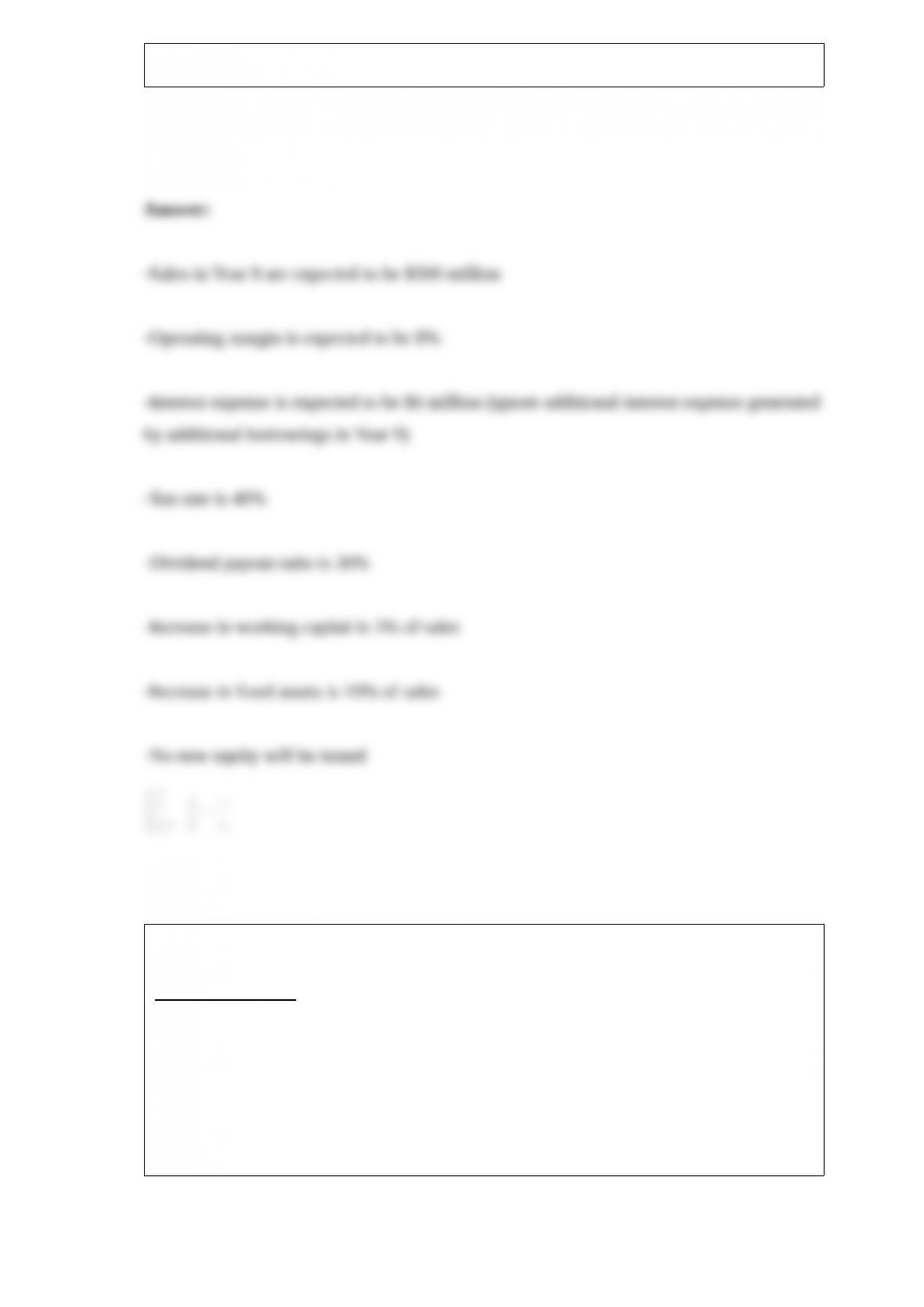
information, how much money will Yeats need to borrow next year?
External Funding
You are an analyst examining a Real Estate Investment Trust (REIT) stock. REITs
acquire and manage income-producing properties, such as offices, malls, apartment
blocks, etc. They are unique in that they do not have to pay corporate taxes. However,
they must distribute 90% of their income as dividends. What is the effect of this
distribution requirement going to mean to REITs in terms of their need for external
funding, growth and leverage?
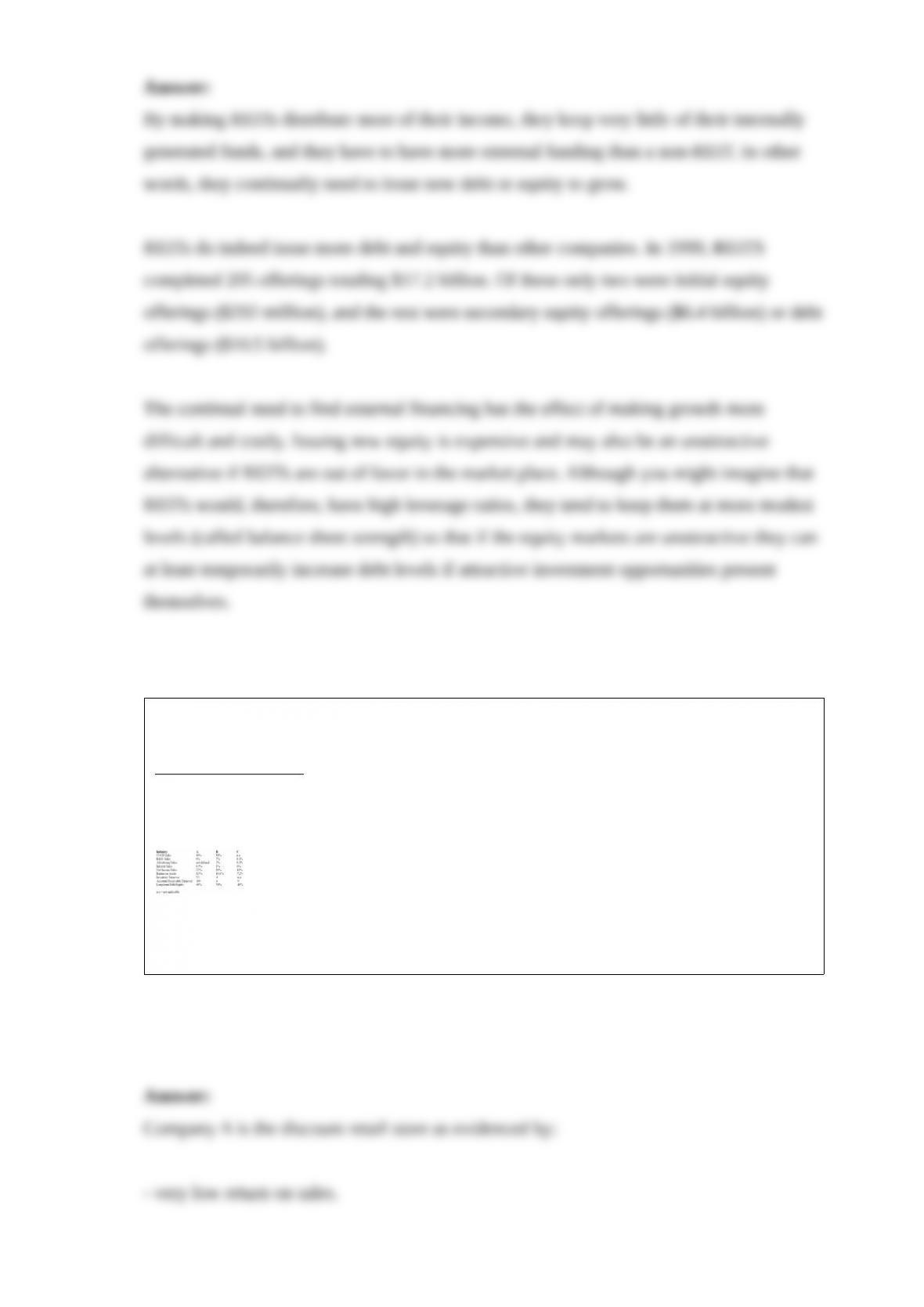
Identify Industries
Below are selected ratios for three companies which operate in three different
industries: Discount Retail Store, Drug, and Utility.
Identify which industry each of the companies A, B, and C operate in. Give two reasons
for each of your selections.

Reasonableness Checks
You have just prepared pro forma income statements and balance sheets for your
company for the next three years. Describe three procedures you might perform to
check the reasonableness of your projections, explaining how and why they are
reasonableness checks.

Deferred taxes
Many companies have significant deferred taxes. Deferred taxes are not always
long-term liabilities. For the categories below, state whether deferred taxes can arise in
this category and provide an example.
i. Current liabilities
ii. Long-term liabilities
iii. Stockholders’ equity
iv. Current assets
v. Long-term assets

Adjusting Financial Statements
You are examining the financial statements of ABC Corporation for Year 2. ABC
Corporation manufactures widgets and has a unionized workforce. You are trying to
assess the earnings persistence of the company. To aid you in this endeavor, you are
adjusting earnings for nonrecurring and non-sustainable items.
Below is a list of items you believe might affect earnings persistence. Indicate why the
item may affect earnings persistence, and how each item might affect net income?