1) Which of the following figures of merit does not directly take into consideration the
time value of money?
I. Payback period
II. Internal rate of return
III. Net present value (NPV)
IV. Accounting rate of return
A.IV only
B.I & III only
C.II & III only
D.I & II only
E.I & IV only
F.I, II, III, and IV
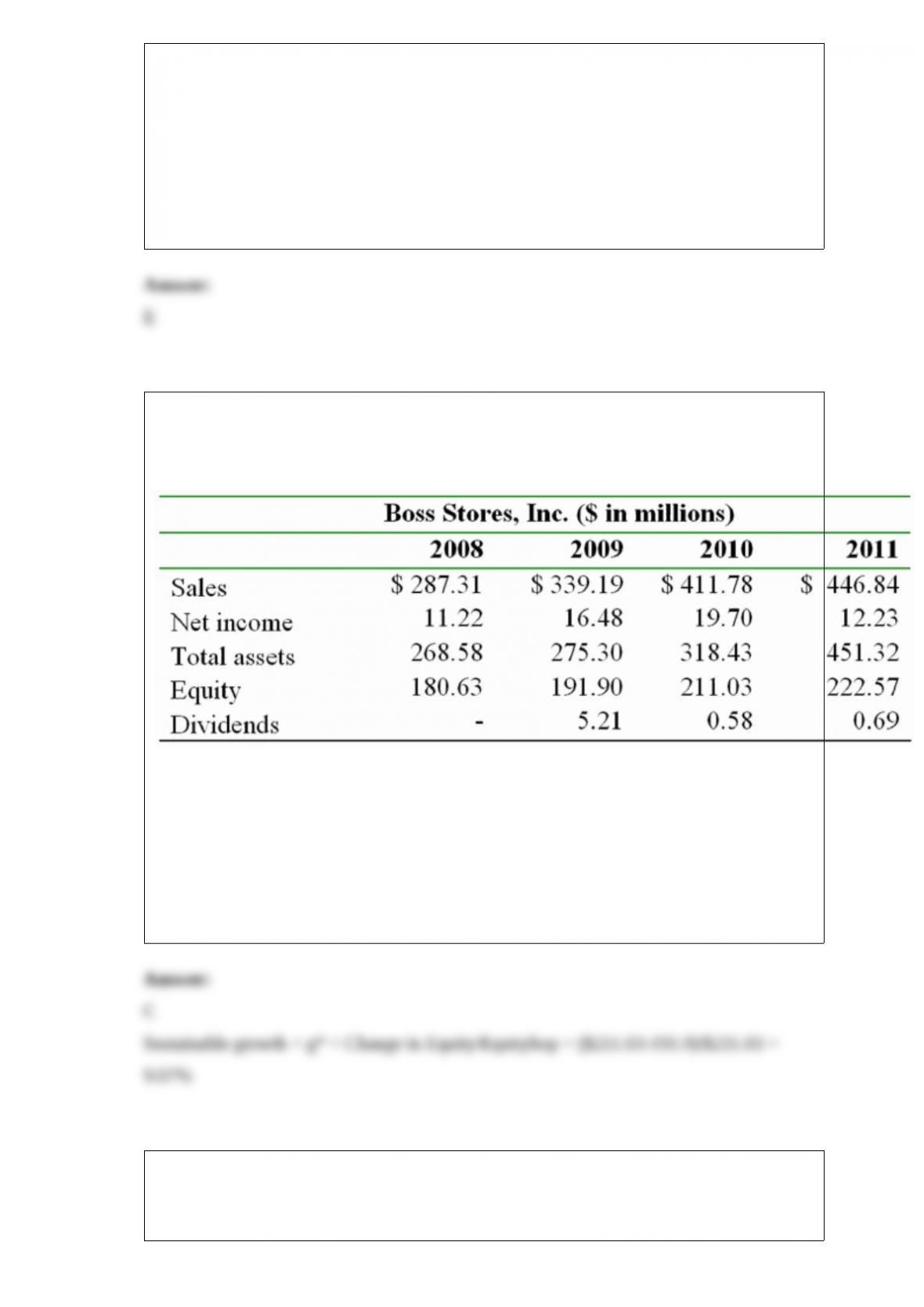
2) The following table presents financial information for Boss Stores, Inc., a retail chain
store in the U.S.
Use the information from Boss’s annual financial statements. What is the retention ratio
for 2009?
A.0.32
B.0.68
C.0.97
D.1.00
E.None of the above
3) Which of the following are viable techniques to cope with the uncertainty inherent in
realistic financial projections?
I. Simulation

II. Ad hoc adjustments
III. Scenario analysis
IV. Sensitivity analysis
A.II and IV only
B.III and IV only
C.II, III, and IV only
D.I, II, and III only
E.I, III, and IV only
F.I, II, III, and IV
4) Unsystematic risk:
A.can be effectively eliminated by portfolio diversification
B.is compensated for by the risk premium
C.is measured by beta
D.is measured by standard deviation
E.is related to the overall economy
F.None of the above
5) Which one of the following statements is correct?
A.If the debt-to-assets ratio is greater than 0.50, then the debt-to-equity ratio must be
less than 1.0
B.Long-term creditors would prefer the times interest earned ratio be 1.4 rather than 1.5
C.The assets-to-equity ratio can be computed as 1 plus the debt-to-equity ratio
D.To realize the best risk and reward profile, financial leverage should be maximized
E.None of the above is correct
6) Sol’s Sporting Goods is expanding, and as a result expects additional operating cash
flows of $26,000 a year for 4 years. This expansion requires $39,000 in new fixed
assets. These assets will be worthless at the end of the project. In addition, the project
requires an additional $3,000 of net working capital throughout the life of the project;
Sol expects to recover this amount at the end of the project. What is the net present
value of this expansion project at a 16 percent required rate of return?
A.$18,477.29
B.$21,033.33
C.$28,288.70
D.$29,408
E.$32,409.57
F.None of the above
7) Komatsu has a 4.5 percent profit margin and a 15 percent dividend payout ratio. The
asset turnover ratio is 1.6 and the assets-to-equity ratio (using beginning-of-period
equity) is 1.77. What is the sustainable rate of growth?
A.1.91 percent
B.6.12 percent
C.10.83 percent
D.11.26 percent
E.74 percent
F.None of the above
8) As the financial vice president for Squamish Equipment, you have the following
information:
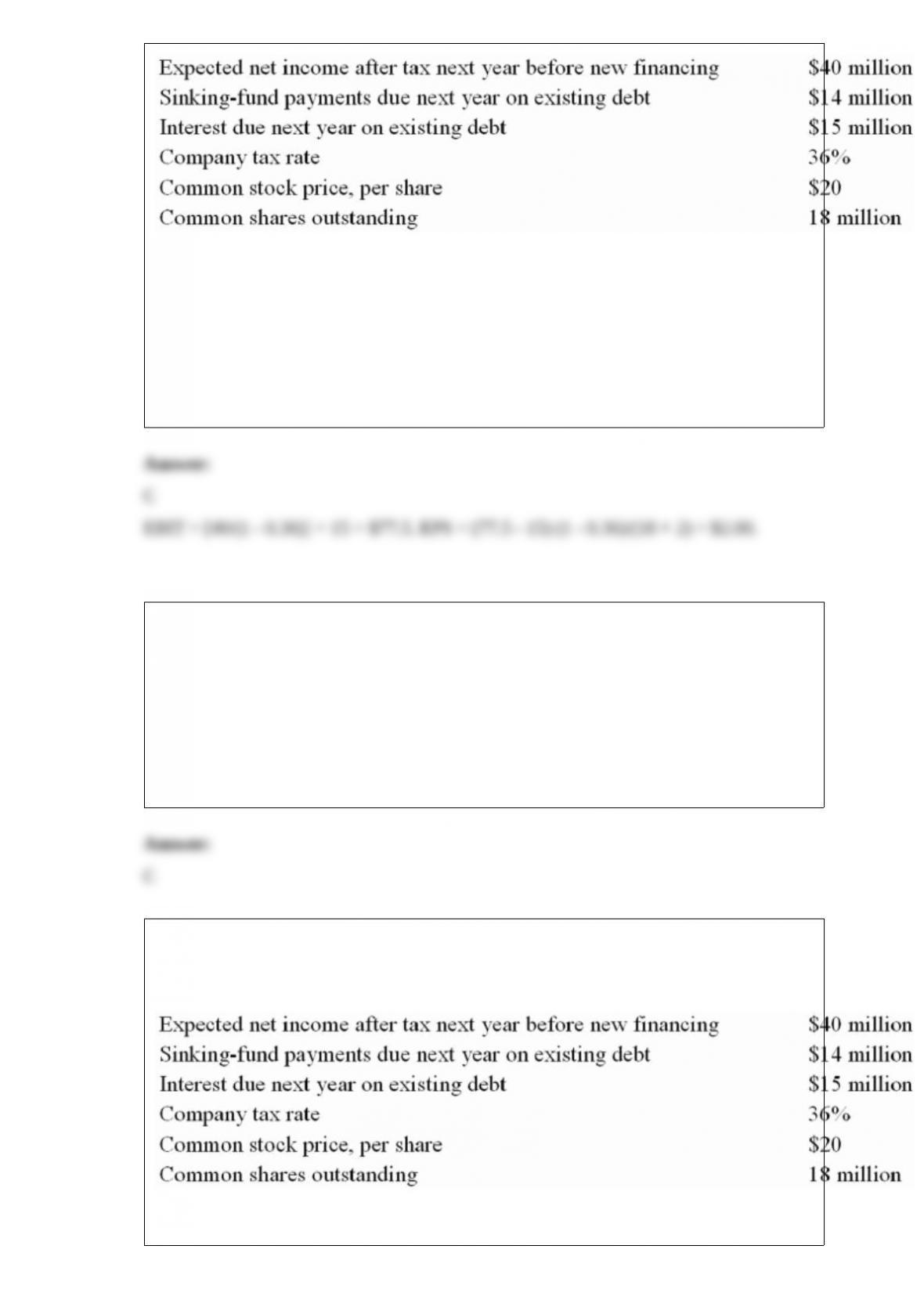
For next year, calculate Squamish’s earnings per share if Squamish sells 2 million new
shares at $20 a share.
A.1.28
B.1.39
C.2.00
D.2.22
E.4.00
F.None of the above
9) Which one of the following is the financial statement that shows a financial snapshot,
taken at a point in time, of all the assets the company owns and all the claims against
those assets?
A.income statement
B.creditor’s statement
C.balance sheet
D.cash flow statement
E.sources and uses statement
10) As the financial vice president for Squamish Equipment, you have the following
information:
Calculate Squamish’s times burden covered ratio for the next year assuming annual
sinking fund payments on the new debt will equal $8 million.
A.1.01
B.1.08
C.1.38
D.1.49
E.1.95
F.None of the above
11) The following table presents a four-year forecast for Kenmore Air, Inc.:
Estimate the fair market value of Kenmore Air’s equity per share at the end of 2012
under the following assumptions:
a. EBIT in year 2016 is $200 million, and then grows at 5 percent per year forever.
b. To support the perpetual growth in EBIT, capital expenditures in year 2017 exceed
depreciation by $30 million, and this difference grows 5 percent per year forever.
c. Similarly, working capital investments are $15 million in 2017, and this amount
grows 5 percent per year forever.
12) Which one of the following will increase the sustainable rate of growth a
corporation can achieve?
A.avoidance of external equity financing
B.increase in corporate tax rates
C.reduction in the retention ratio
D.decrease in the dividend payout ratio

E.decrease in sales given a positive profit margin
F.None of the above
13) The discount rate assigned to an individual project should be based on:
A.the firm’s weighted average cost of capital
B.the actual sources of funding used for the project
C.an average of the firm’s overall cost of capital for the past five years
D.the current risk level of the overall firm
E.the risks associated with the use of the funds required by the project
F.None of the above
14) The basic lesson of the M&M theory is that the value of a firm is dependent upon:
A.the firm’s capital structure
B.the total cash flow of the firm
C.minimizing the marketed claims
D.the amount of marketed claims to that firm
E.the size of the stockholders’ claims
F.None of the above
15) The cost of equity for a firm:
A.tends to remain static for firms with increasing levels of risk
B.increases as the unsystematic risk of the firm increases
C.ignores the firm’s risks when that cost is based on the dividend growth model
D.equals the risk-free rate plus the market risk premium
E.equals the firm’s pretax weighted average cost of capital
F.None of the above

16) Which of the following can affect a firm’s sustainable rate of growth?
I. Asset turnover ratio
II. Profit margin
III. Dividend policy
IV. Financial leverage
A.III only
B.I and III only
C.II, III, and IV only
D.I, II, and IV only
E.I, II, III, and IV
F.None of the above
17) Which one of the following is a source of cash?
A.decrease in accounts receivable
B.decrease in common stock
C.decrease in long-term debt
D.decrease in accounts payable
E.increase in inventory
18) Which of the following ratios are measures of a firm’s liquidity?
I. fixed asset turnover ratio
II. current ratio
III. debt-equity ratio
IV. acid test
A.I and III only
B.II and IV only
C.III and IV only
D.I, II, and III only
E.I, III, and IV only
19) The pre-tax cost of debt:
A.is based on the current yield to maturity of the firm’s outstanding bonds
B.is equal to the coupon rate on the latest bonds issued by a firm
C.is equivalent to the average current yield on all of a firm’s outstanding bonds

D.is based on the original yield to maturity on the latest bonds issued by a firm
E.has to be estimated as it cannot be directly observed in the market
F.None of the above
20) JM Case Inc. has a market value of $5 million with 500,000 shares outstanding. The
book value of its equity is $1,750,000. What is JM Case’s book value per share?
A.$3.50
B.$5
C.$10
D.$25
E.$50
F.None of the above
21) Which one of the following statements is correct concerning the cash balance of a
firm?
A.Most firms attempt to maintain a zero cash balance at all times
B.The cumulative cash surplus shown on a cash budget is equal to the ending cash
balance plus the minimum desired cash balance
C.Most firms attempt to maximize the cash balance at all times
D.A cumulative cash deficit indicates a borrowing need
E.The ending cash balance must equal the minimum desired cash balance
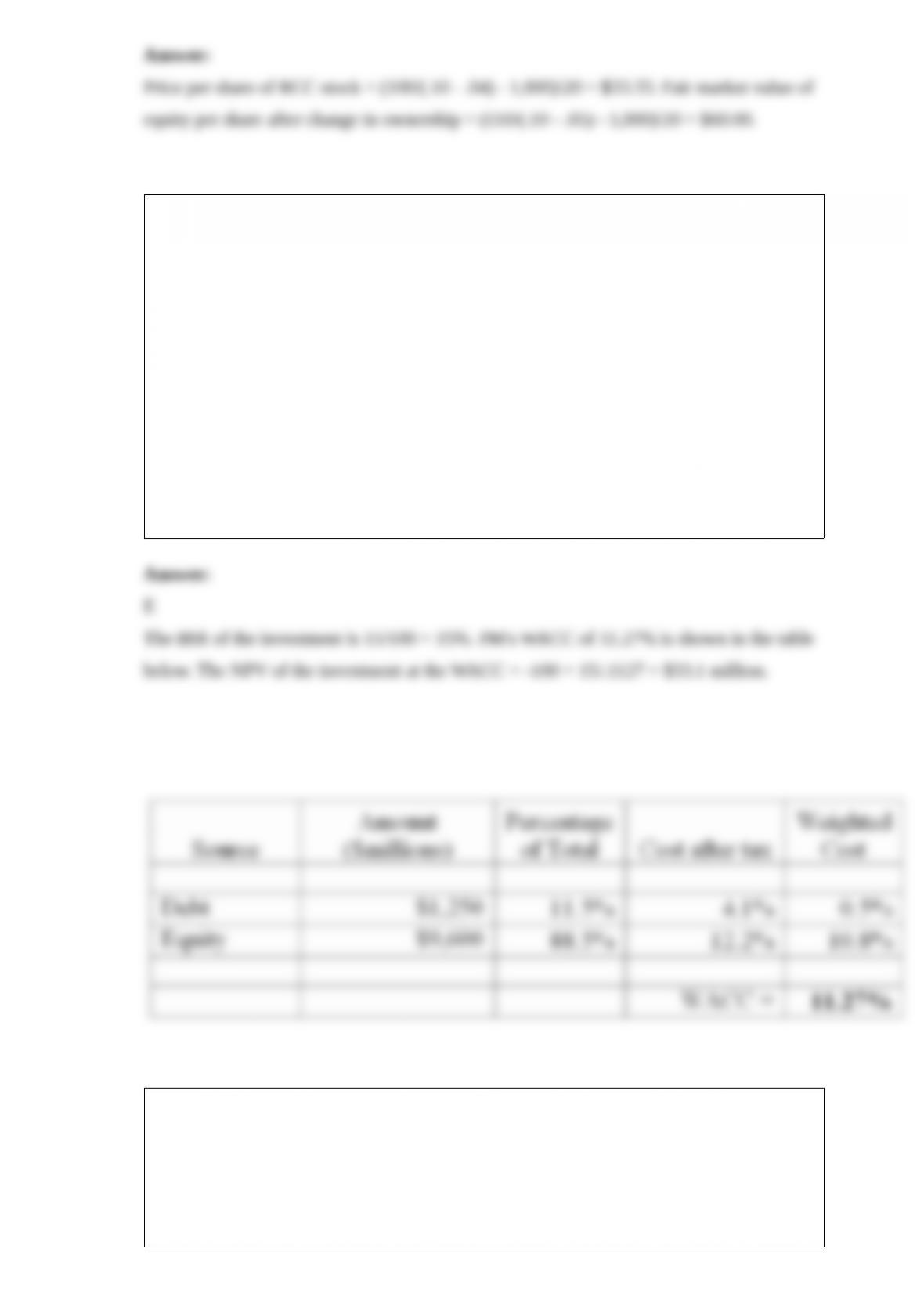
22) Rainy City Coffee’s (RCC) free cash flow next year will be $100 million and it is
expected to grow at a 4 percent annual rate indefinitely. The company’s weighted
average cost of capital is 10 percent, the market value of its liabilities is $1 billion, and
it has 20 million shares outstanding.
a. Estimate the price per share of RCC’s common stock.
b. A hedge fund believes that by selling the company’s private jet and instituting other
cost savings, it can increase RCC’s free cash flow next year to $110 million and can add
a full percentage point to RCC’s growth rate without affecting its cost of capital. What
is the maximum price per share the hedge fund can justify bidding for control of RCC?
23) FM is contemplating an average-risk investment costing $100 million and
promising an annual after-tax cash flow of $15 million in perpetuity. Which of the
following statements is/are correct?
I. FM should reject the project because the IRR is greater than the firm’s WACC.
II. FM should accept the project because the IRR is greater than the firm’s WACC.
III. FM should accept the project because the NPV is greater than zero.
IV. FM should reject the project because the NPV is less than zero.
A.I only
B.II only
C.IV only
D.I and IV only
E.II and III only
F.None of the above
24) Which of the following statements are true?
I. Underwriters help private companies access public stock markets through IPOs.
II. Shelf registrations and private placements are examples of seasoned security issues.
III. Issue costs for debt are typically greater than issue costs for equity.
IV. Private equity financing is a common source of financing for startup firms.
A.I and II only
B.I and III only
C.I, II, and IV only
D.I, III, and IV only
E.I, II, III, and IV
F.None of the above
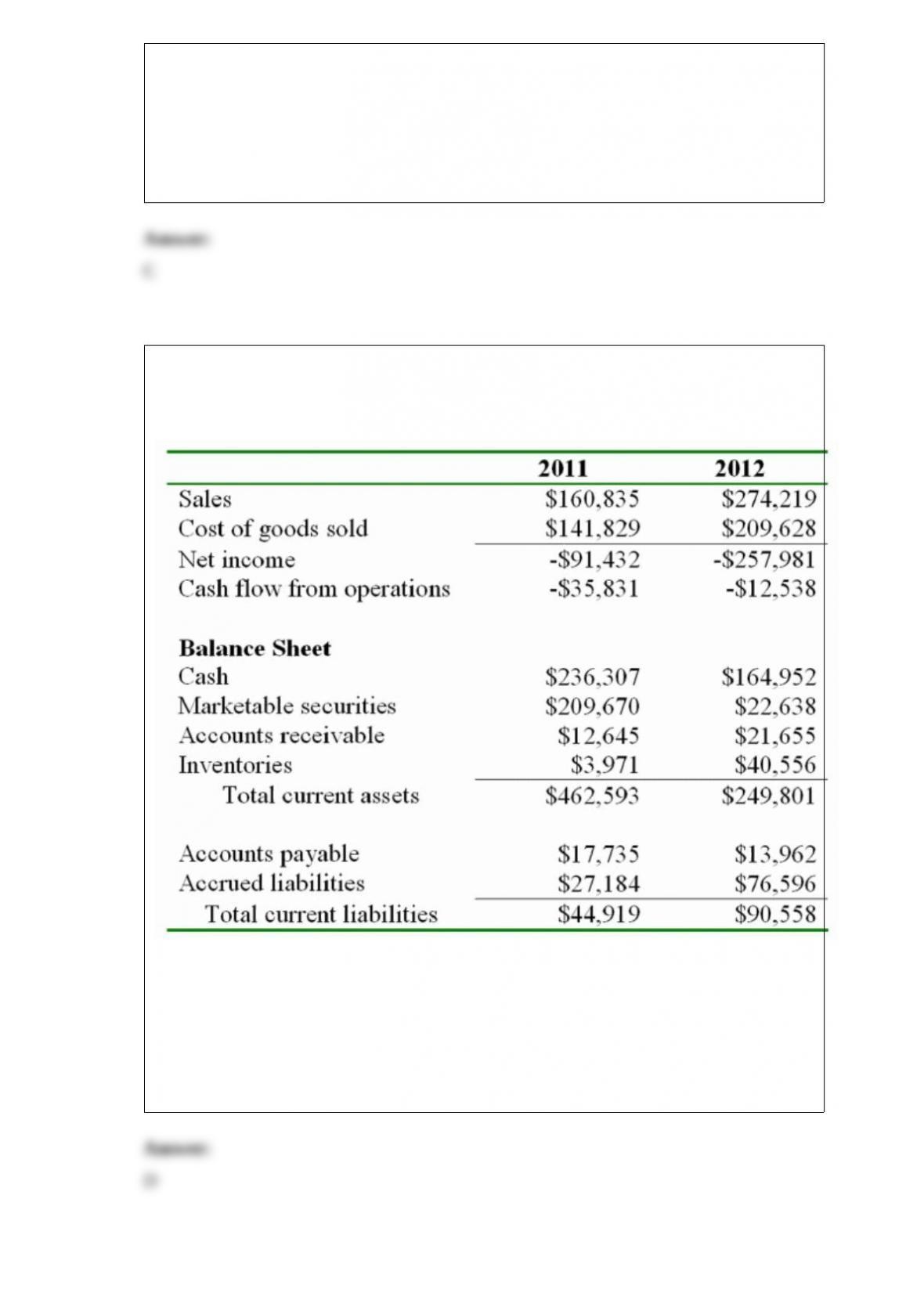
25) Selected financial data for Link, Inc. follows: ($ in thousands)
Which of the following statements best describes how the company’s short-term
liquidity changed from 2011 to 2012?
A.Link’s short-run liquidity has improved modestly
B.Link’s short-run liquidity has deteriorated very little, but from a low initial base
C.Link’s short-run liquidity has improved considerably, but from a low initial base
D.Link’s short-run liquidity has deteriorated considerably, but from a high initial base
E.None of the above
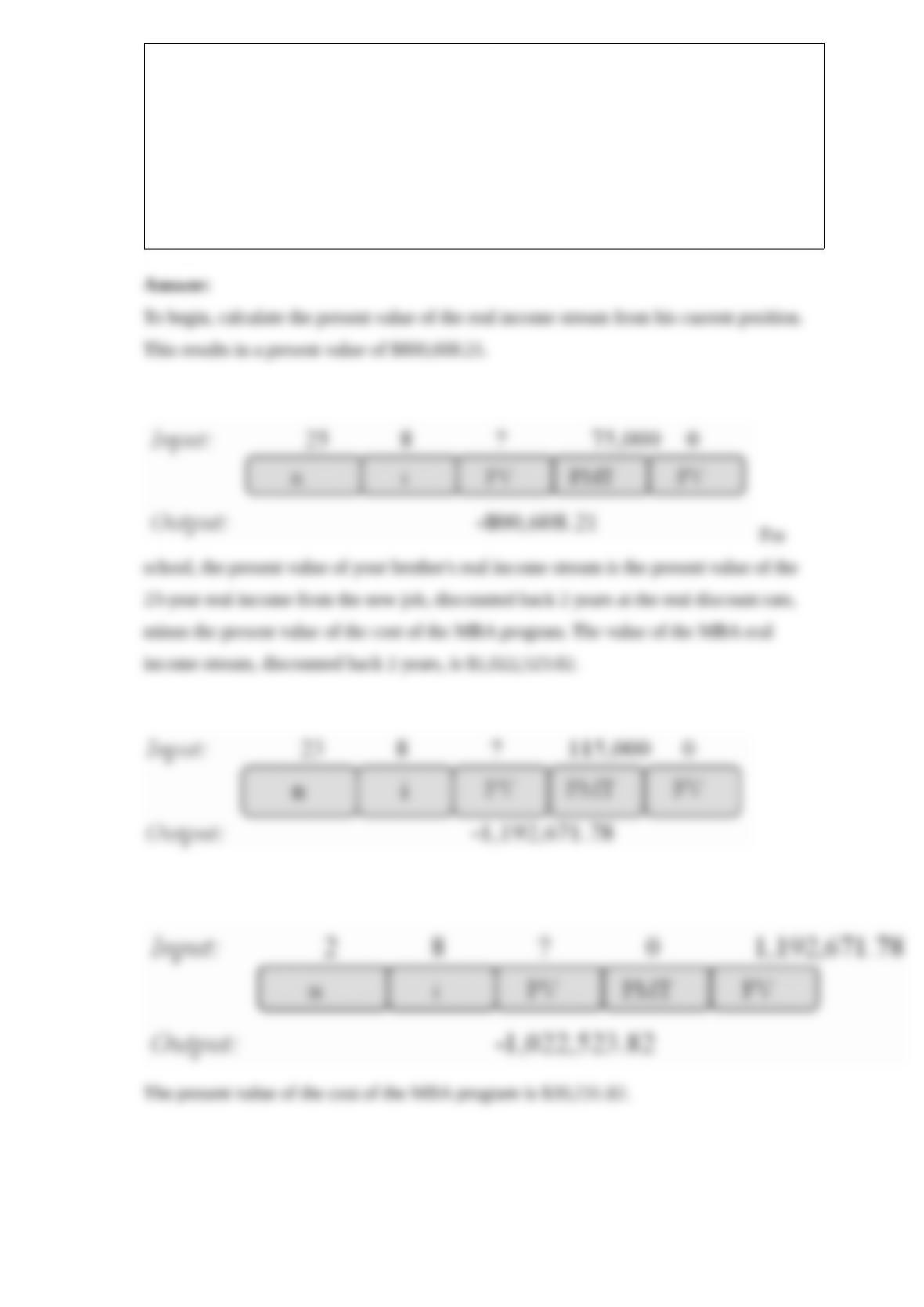
26) Your brother, age 40, is the regional manager at an office supply company. He
thinks he might want to leave his job to go back to school for an MBA. He expects that
his current job, if he were to stay at it, would pay him a real income stream of $75,000
per year until retirement at age 65. If he goes back to school, he would forego two years
of income, but his real income after graduation would be $110,000 per year until
retirement at age 65. He has been accepted to an MBA program that costs a real
$22,000 per year. If his real opportunity cost is 8 percent, would leaving his job to get
an MBA be a smart financial decision?

27) Which one of the following policies most directly affects the projection of the
retained earnings balance to be used on a pro forma statement?
A.net working capital policy
B.capital structure policy
C.dividend policy
D.capital budgeting policy
E.capacity utilization policy
F.None of the above
28) Which of the following factors favor the issuance of debt in the financing decision?
I. Market signaling
II. Distress costs
III. Tax benefits
IV. Financial flexibility
A.I and II only
B.I and III only
C.II and IV only
D.I, II, and III only
E.I, II, and IV only
F.None of the above
29) Which of the following statements are correct?
I. Going-concern value of a firm is equal to the present value of expected future cash
flows to owners and creditors.

II. When an acquiring firm purchases a target firm’s equity, the acquirer need not
assume the target’s liabilities.
III. The market value of a public company reflects the worth of the business to minority
investors.
IV. The fair market value of a business is usually the lower of its liquidation value and
its going-concern value.
A.I and III only
B.II and IV only
C.II and III only
D.I, II, and III only
E.II, III, and IV only
F.None of the above
30) Assume each month has 30 days and AmDocs has a 60-day accounts receivable
period. During the second calendar quarter of the year (April, May and June), AmDocs
will collect payment for the sales it made during which of the months listed below?
A.October, November, and December
B.November, December, and January
C.December, January, and February
D.January, February, and March
E.February, March, and April
31) Ptarmigan Travelers had sales of $420,000 in 2010 and $480,000 in 2011. The
firm’s current accounts remained constant. Given this information, which one of the
following statements must be true?
A.The total asset turnover rate increased
B.The days’ sales in receivables increased
C.The inventory turnover rate increased
D.The fixed asset turnover decreased
E.The collection period decreased
32) Which of the following questions are appropriate to address upon conducting
sustainable growth analysis and the financial planning process?
I. Should the firm merge with a competitor?
II. Should additional equity be sold?
III. Should a particular division be sold?
IV. Should a new product be introduced?
A.I, II, and III only
B.I, II, and IV only
C.I, III, and IV only
D.II, III, and IV only
E.I, II, III, and IV
F.None of the above
33) The following table presents financial information for Boss Stores, Inc., a retail
chain store in the U.S.
Use the above information from Boss’s annual financial statements. What is the
sustainable sales growth rate for 2010?
A.- 17.6%
B.- 7.9%
C.9.07%
D.10.27%
E.12.23%
F.21.4%
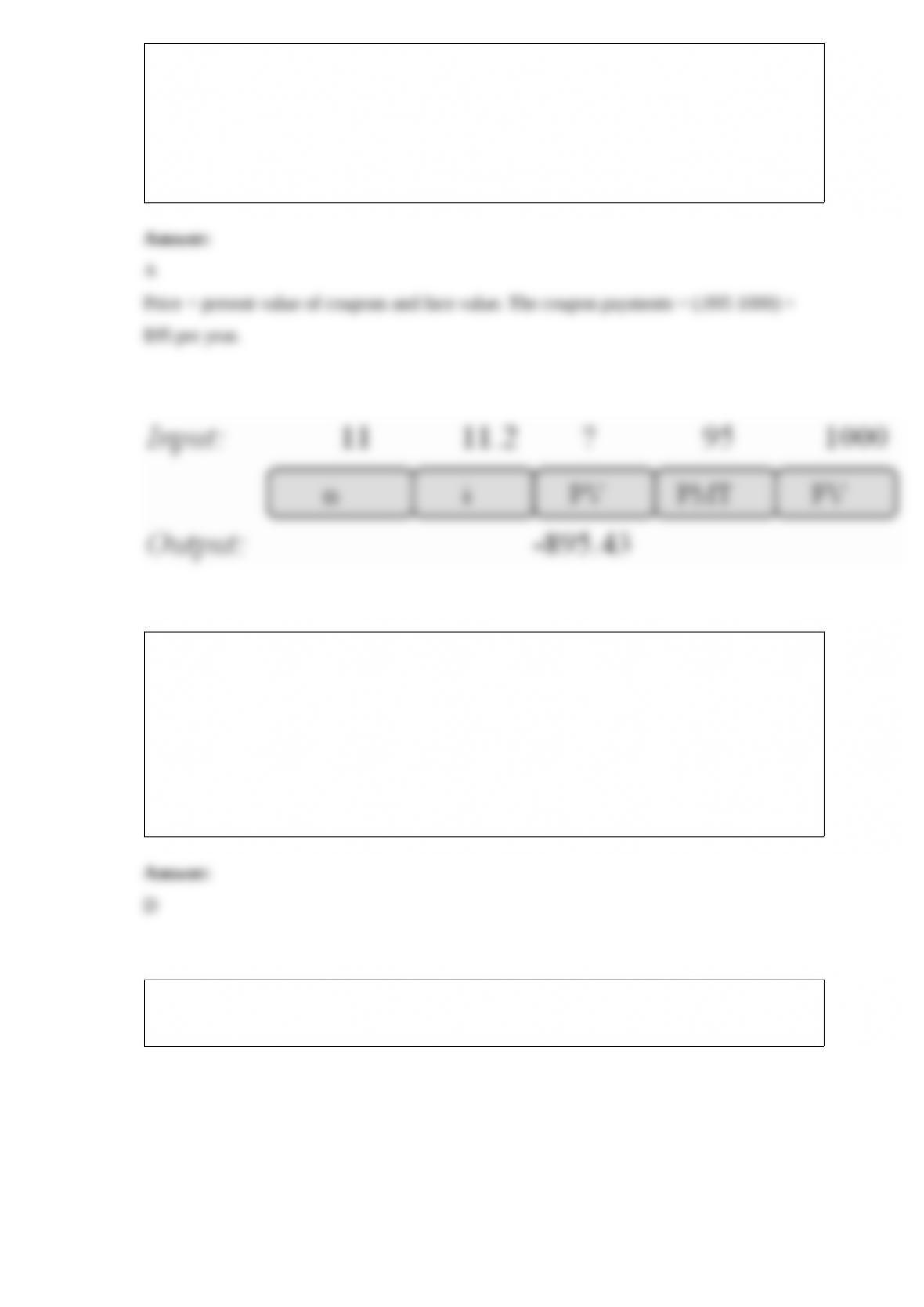
34) EAC Nutrition offers a 9.5 percent coupon bond with annual payments, maturing 11
years from today. Your required return is 11.2 percent. What price are you willing to
pay for this bond if the face (or par) value is $1,000?
A.$895.43
B.$896.67
C.$941.20
D.$946.18
E.$953.30
F.None of the above
35) The sustainable growth rate of a firm is best described as the:
A.minimum growth rate achievable assuming a 100 percent retention ratio
B.minimum growth rate achievable if the firm maintains a constant equity multiplier
C.maximum growth rate achievable excluding external financing of any kind
D.maximum growth rate achievable excluding any external equity financing while
maintaining a constant debt-equity ratio
E.maximum growth rate achievable with unlimited debt financing
F.None of the above
36) Selected financial data for Link, Inc. follows: ($ in thousands)
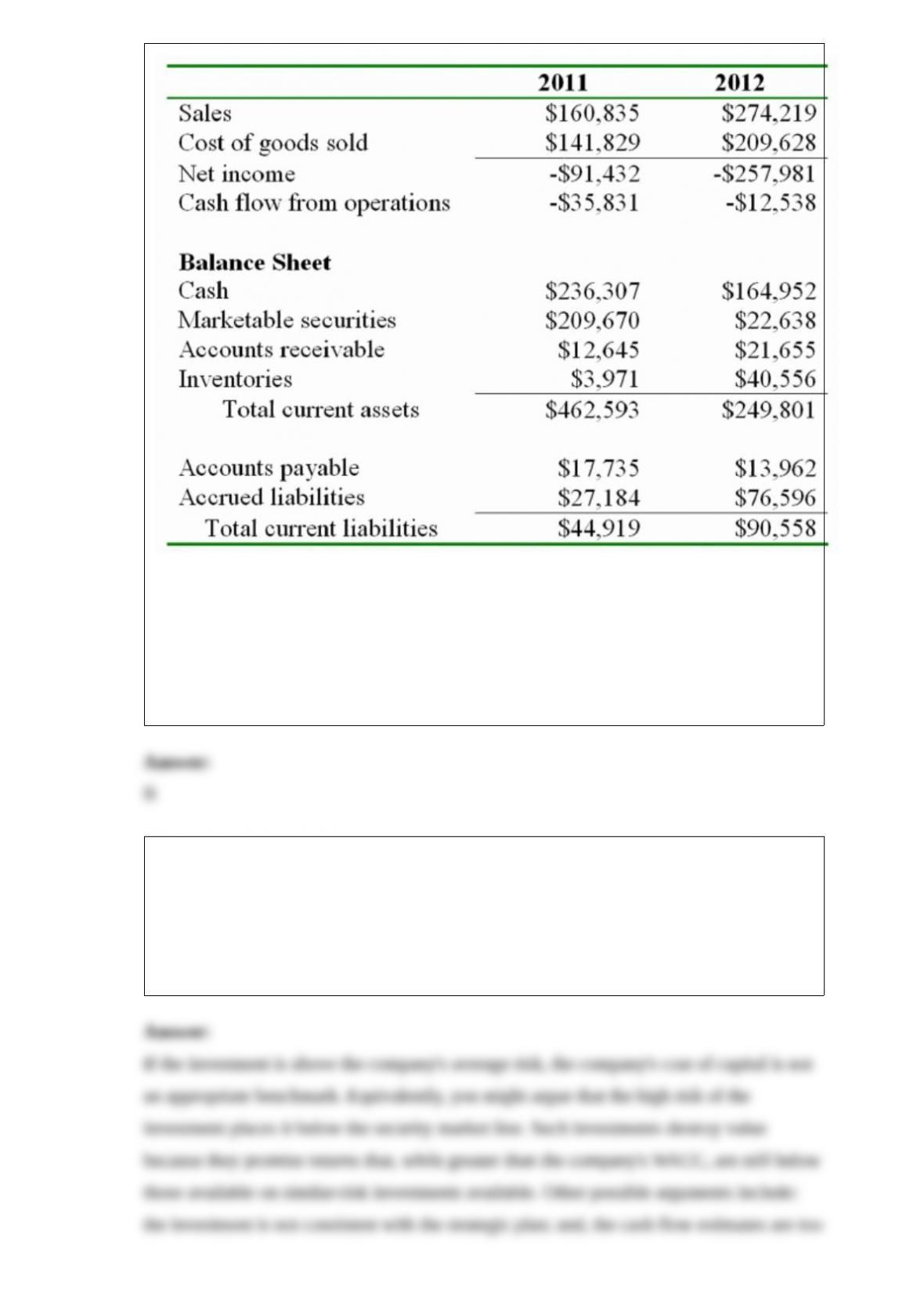
Assume a 365-day year for your calculations. The payables period in days, based on
cost of goods sold, at the end of 2012 is:
A.5.2
B.24.3
C.28.8
D.35.7
E.None of the above
37) Suppose that your company’s weighted-average cost of capital is 9 percent. Your
company is planning to undertake a project with an internal rate of return of 12%, but
you believe that this project is not a good investment for the firm. What logical
arguments might you use to convince your boss to forego the project despite its high
rate of return? Is it possible that making investments with expected returns higher than
your company’s cost of capital will destroy value? If so, how?
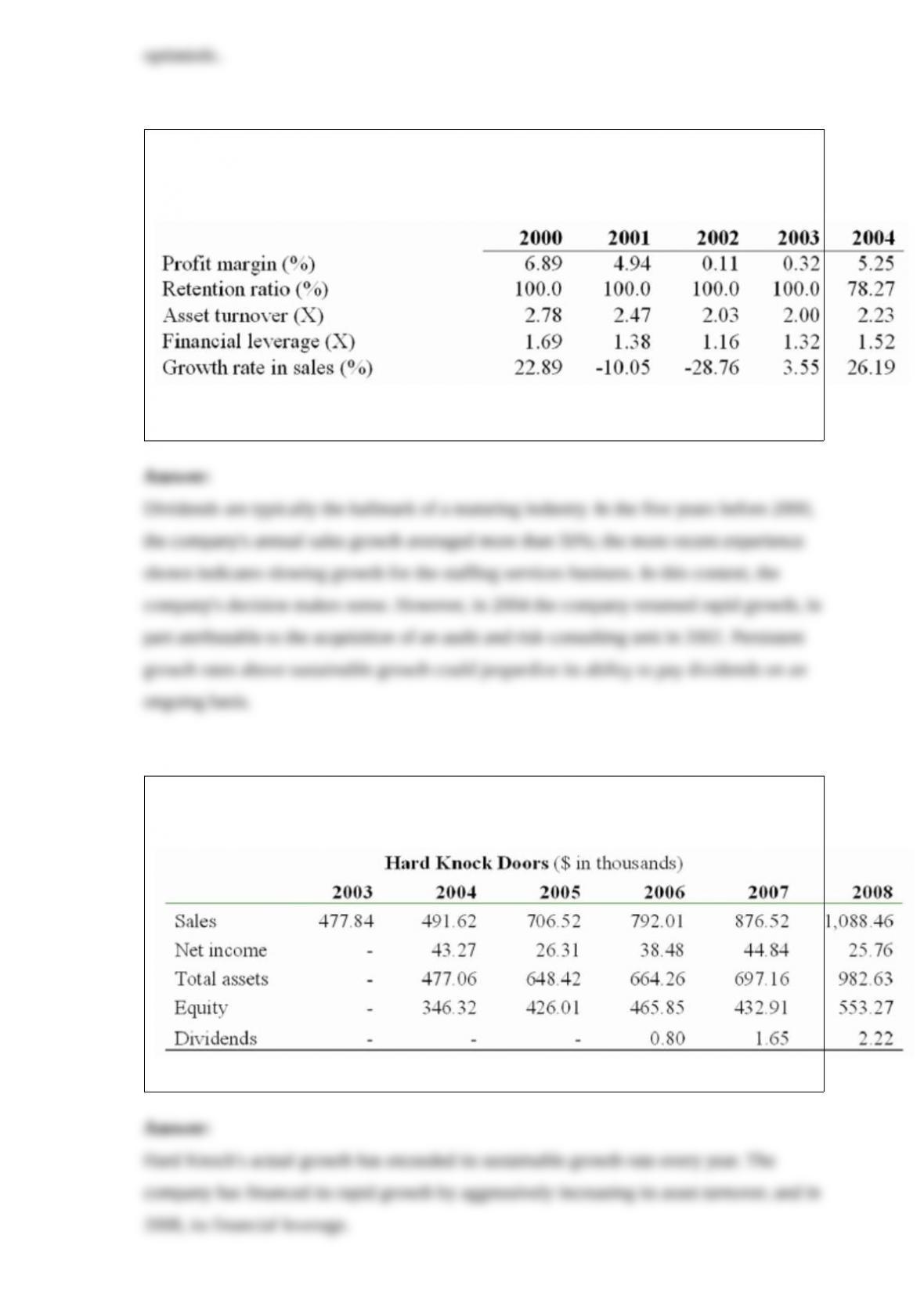
38) Law Dog, Inc. is a provider of temporary and permanent personnel in legal services.
The following are selected financial data for the company for the period 2000 – 2004.
Law Dog paid its first dividends in 2004. As an analyst, assess the company’s decision
to pay dividends.
39) Selected financial information for Hard Knock Doors is presented below:
Do you think Hard Knock Doors is having a problem financing its growth?
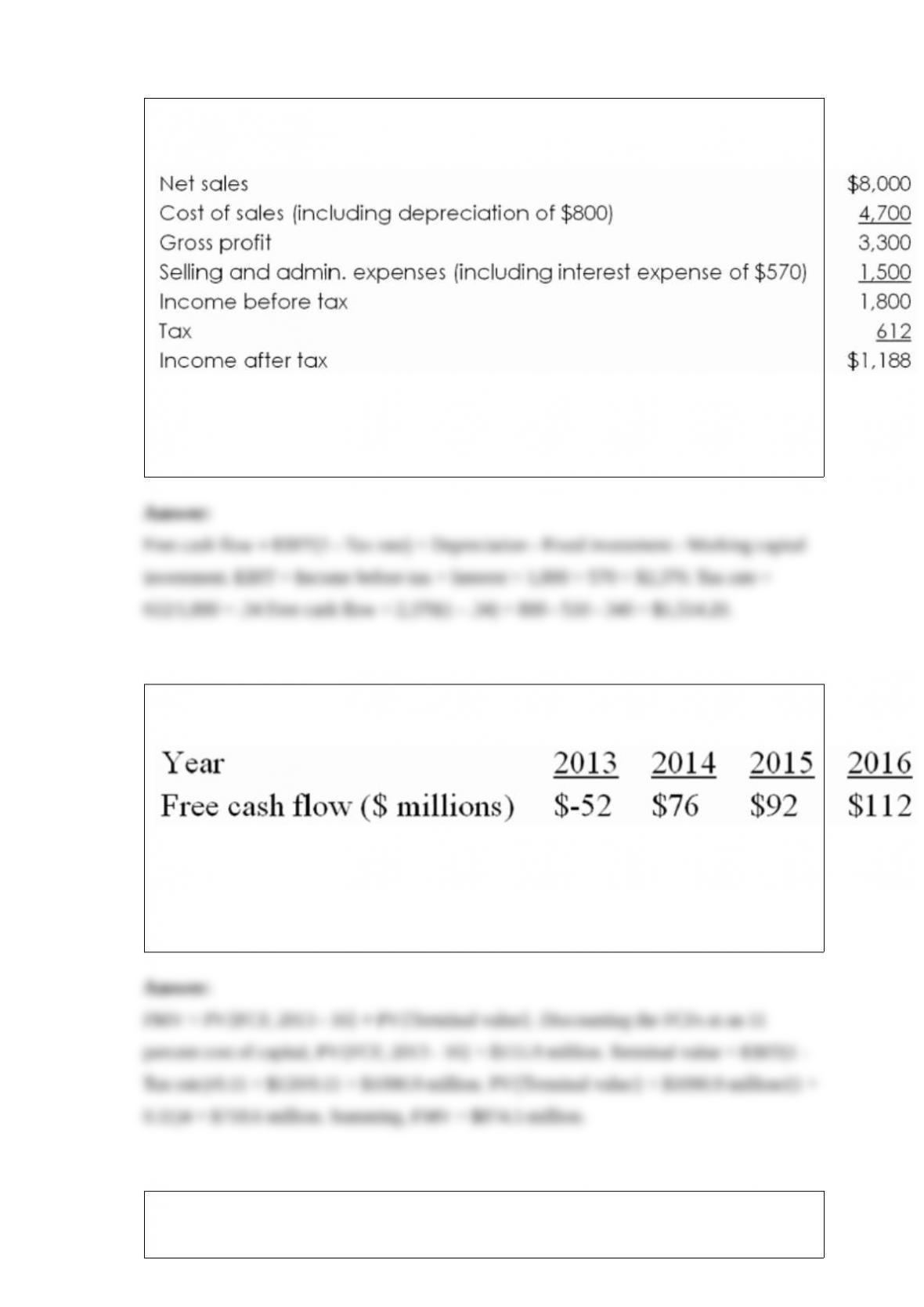
40) Below is a recent income statement for Gatlin Camera:
Calculate Gatlin’s free cash flow in this year assuming it spent $510 on new capital
equipment and increased current assets net of noninterest-bearing current liabilities
$340.
41) The following table presents a four-year forecast for Kenmore Air, Inc.:
Estimate the fair market value of Kenmore Air at the end of 2012. Assume that after
2016, earnings before interest and tax will remain constant at $200 million, depreciation
will equal capital expenditures in each year, and working capital will not change.
Kenmore Air’s weighted-average cost of capital is 11 percent and its tax rate is 40
percent.
42) Chapter 5 presents evidence that the average annual rate of return on common
stocks over many years has exceeded the return on government bonds in the United
States, while returns on common stocks have also exhibited more volatility than returns
on U.S. government bonds. Suppose that last year, the realized rate of return on
government bonds exceeded the return on common stocks. Your colleague suggests that
“last year shows us that investors are now willing to settle for lower returns on stocks
than on bonds.” How would you interpret this result?
43) Explain the difference between systematic and unsystematic risk, and why one of
these types of risks is rewarded with a risk premium while the other type is not.
44) Pro forma financial statements, by definition, are predictions of a company’s
financial statements at a future point in time. So, why is it important to analyze the
historical performance of the company before constructing pro forma financial
statements?