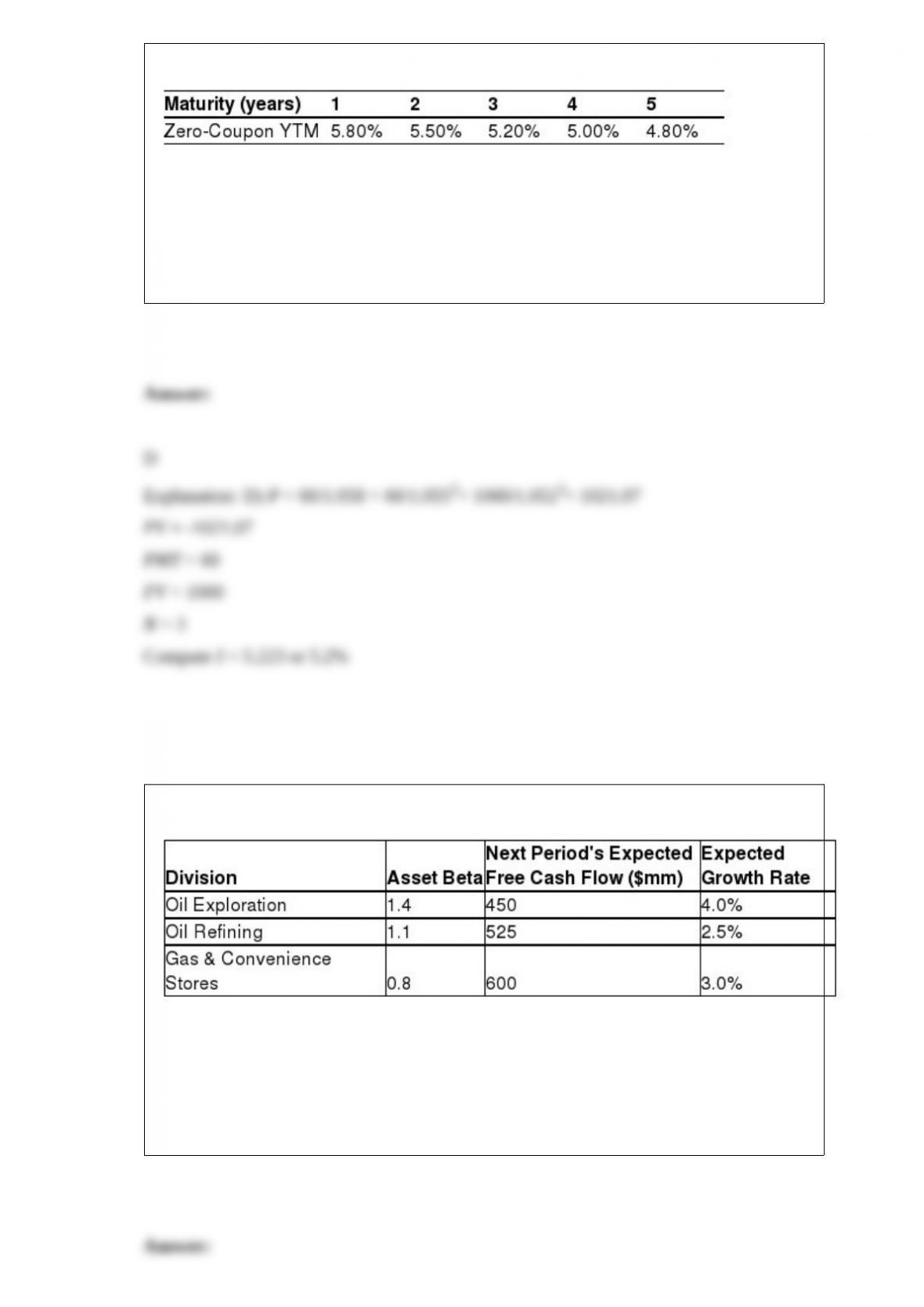
Consider the following zero-coupon yields on default free securities:
The YTM of a 3 year default free security with a face value of $1000 and an annual
coupon rate of 6% is closest to:
A) 5.5%
B) 5.8%
C) 5.7%
D) 5.2%
The risk-free rate of interest is 3% and the market risk premium is 5%.
The cost of capital for the oil refining division is closest to:
A) 6.5%
B) 7.0%
C) 8.5%
D) 10.0%

Which of the following statements is FALSE?
A) The presence of financial distress costs can explain why firms choose debt levels
that are too high to fully exploit the interest tax shield.
B) With higher costs of financial distress, it is optimal for the firm to choose lower
leverage.
C) Differences in the magnitude of financial distress costs and the volatility of cash
flows can explain the differences in the use of leverage across industries.
D) At the point D*, where VL is maximized, the tax savings that result from increasing
leverage are just offset by the increased probability of incurring the costs of financial
distress.
Consider a corporate bond with a $1000 face value, 10% coupon with semiannual
coupon payments, 5 years until maturity, and currently is selling for (has a cash price
of) $1,113.80. The next coupon payment will be made in 63 days and there are 182 days
in the current coupon period. The clean price for this bond is closest to:
A) $1146.50
B) $1065.70
C) $1113.80
D) $1081.10

Forward interest rates:
A) accurately predict future spots rates because of the law of one price.
B) tend not to be good predictors of future spot rates.
C) tend to be biased downward as predictors of future spot rates when the yield curve is
upward sloping.
D) tend to be biased upward as predictors of future spot rates when the yield curve is
downward sloping.
Which of the following questions is FALSE?
A) Sometimes management may believe that the securities they are issuing are priced at
less than (or more than) their true value. If so, the NPV of the transaction, which is the
difference between the actual money raised and the true value of the securities sold,
should not be included in the value of the project.
B) An alternative method of incorporating financial distress and agency costs is to first
value the project ignoring these costs, and then value the incremental cash flows
associated with financial distress and agency problems separately.
C) When the debt level’”and, therefore, the probability of financial distress’”is high, the
expected free cash flow will be reduced by the expected costs associated with financial
distress and agency problems.
D) If the financing of the project involves an equity issue, and if management believes
that the equity will sell at a price that is less than its true value, this mispricing is a cost
of the project for the existing shareholders.
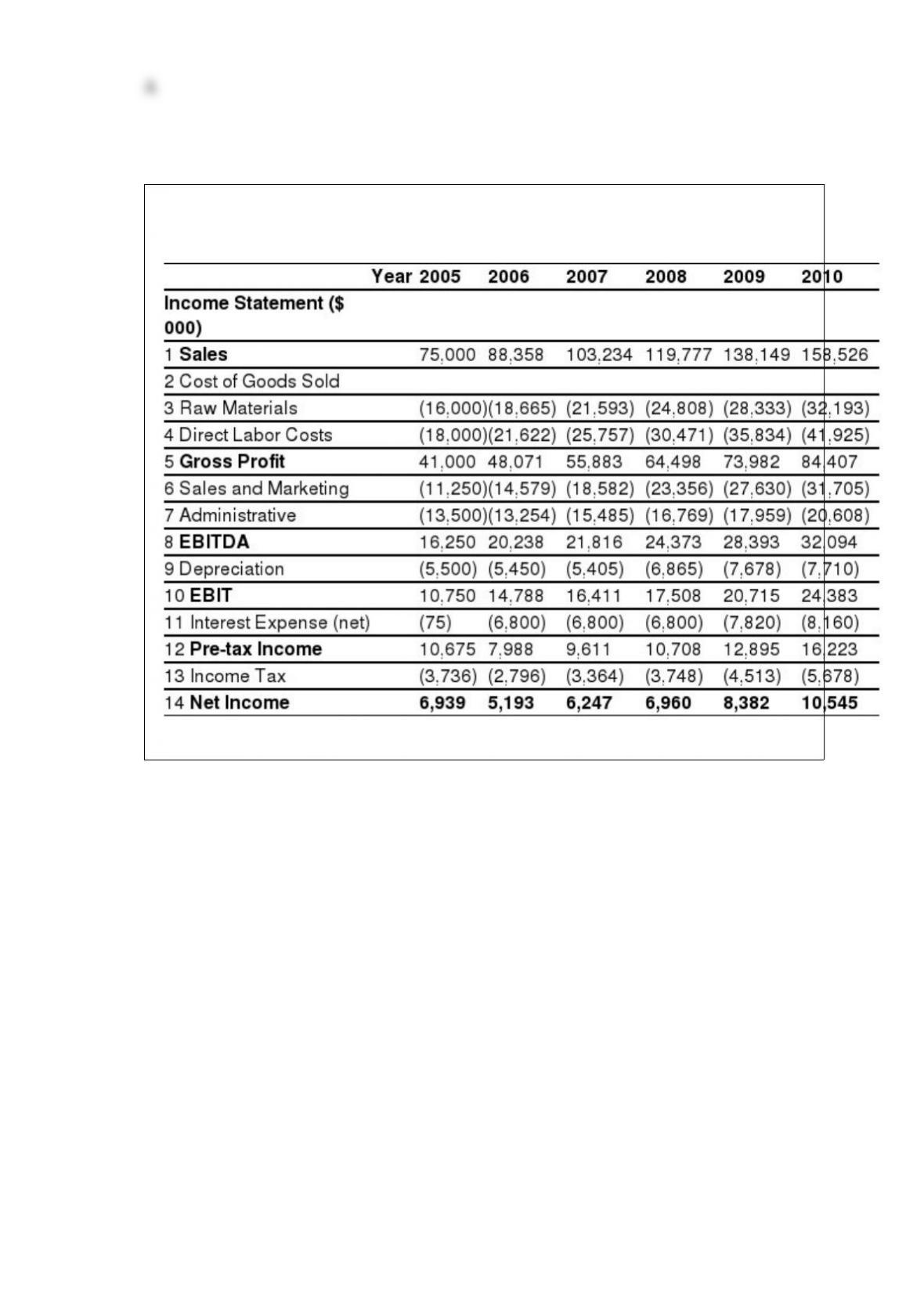
Pro Forma Income Statement for Ideko, 2005-2010
Pro Forma Balance Sheet for Ideko, 2005-2010
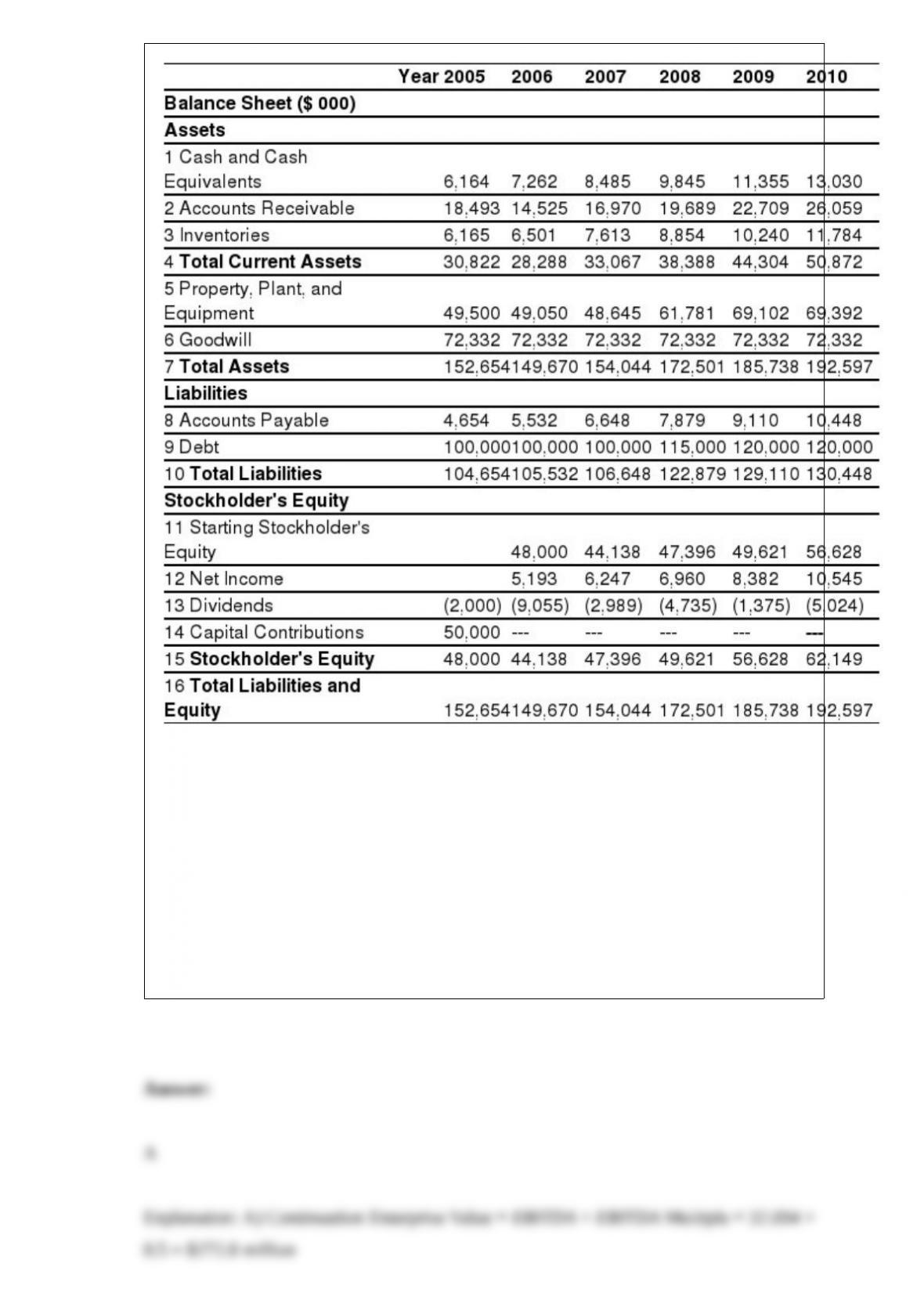
Assuming that Ideko has a EBITDA multiple of 8.5, then the continuation EV/Sales
ratio of Ideko in 2010 is closest to:
A) 1.7
B) 1.9
C) 1.6
D) 1.8
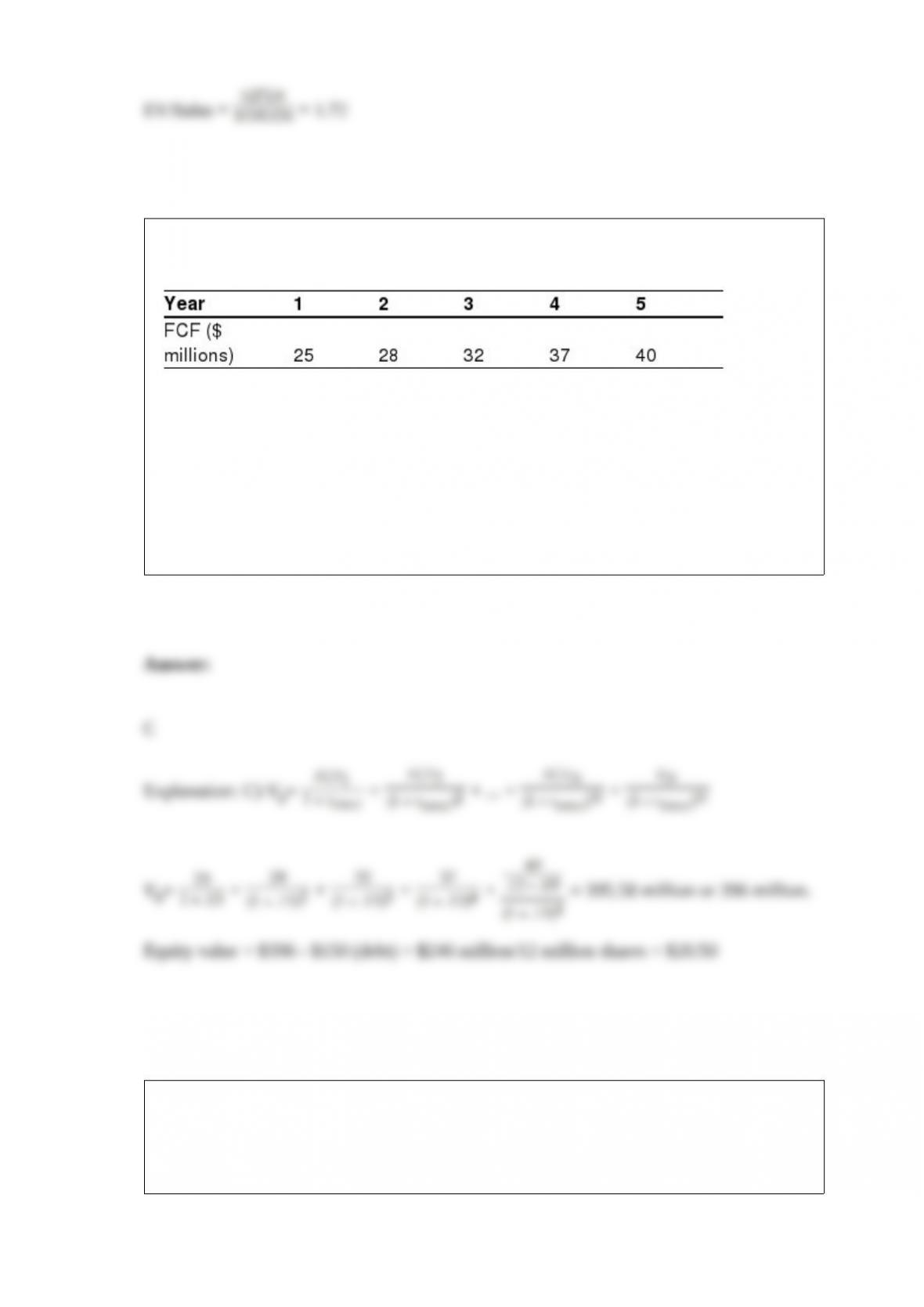
You expect CCM Corporation to generate the following free cash flows over the next
five years:
Following year five, you estimate that CCM’s free cash flows will grow at 5% per year
and that CCM’s weighted average cost of capital is 13%.
If CCM has $150 million of debt and 12 million shares of stock outstanding, then the
share price for CCM is closest to:
A) $49.50
B) $11.25
C) $20.50
D) $22.75
Assume that the CAPM is a good description of stock price returns. The market
expected return is 8% with 12% volatility and the risk-free rate is 3%. New news
arrives that does not change any of these numbers, but it does change the expected
returns of the following stocks:
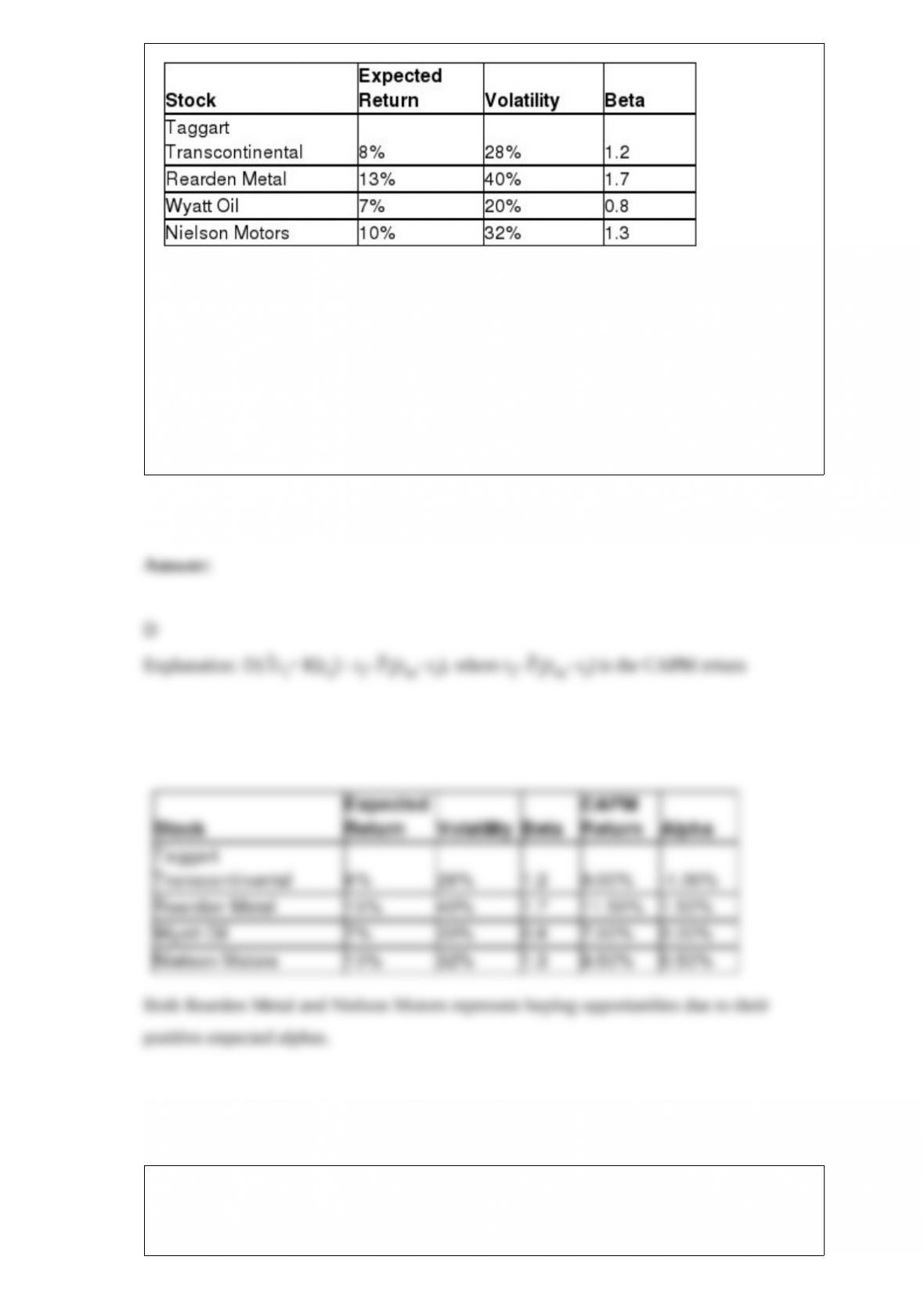
Which of the following stocks represent buying opportunities?
1. Taggart Transcontinental
2. Rearden Metal
3. Wyatt Oil
4. Nielson Motors
A) 1 only
B) 1 and 2 only
C) 2 and 3 only
D) 2 and 4 only
Galt Industries has no debt, total equity capitalization of $600 million, and an equity
beta of 1.2. Included in Galt’s assets is $90 million in cash and risk-free securities.
Assume the risk-free rate is 4% and the market risk premium is 6%.

Galt’s WACC is closest to:
A) 10.6%
B) 11.2%
C) 11.8%
D) 12.5%
Since your first birthday, your grandparents have been depositing $1000 into a savings
account on every one of your birthdays. The account pays 4% interest annually.
Immediately after your grandparents make the deposit on your 18th birthday, the
amount of money in your savings account will be closest to:
A) $25,645
B) $36,465
C) $12,659
D) $18,000
Which of the following statements is FALSE?
A) The covariance and correlation allow us to measure the co-movement of returns.
B) Correlation is the expected product of the deviations of two returns.
C) Because the prices of the stocks do not move identically, some of the risk is
averaged out in a portfolio.
D) The amount of risk that is eliminated in a portfolio depends on the degree to which
the stocks face common risks and their prices move together.
Which of the following statements is FALSE?
A) Real estate firms are likely to have low costs of financial distress, as much of their
value derives from assets that can be sold relatively easily.
B) For low levels of debt, the risk of default remains low and the main effect of an
increase in leverage is an increase in the interest tax shield, which has present value
Ï„*D, where Ï„* is the effective tax advantage of debt.
C) Firms whose value and cash flows are very volatile (for example, semiconductor
firms) must have much higher levels of debt to avoid a significant risk of default.
D) The probability of financial distress depends on the likelihood that a firm will be
unable to meet its debt commitments and therefore default.
As an oil refiner, you are able to produce $76 worth of unleaded gasoline from one
barrel of Alaska North Slope (ANS) crude oil. Because of its lower sulfur content, you
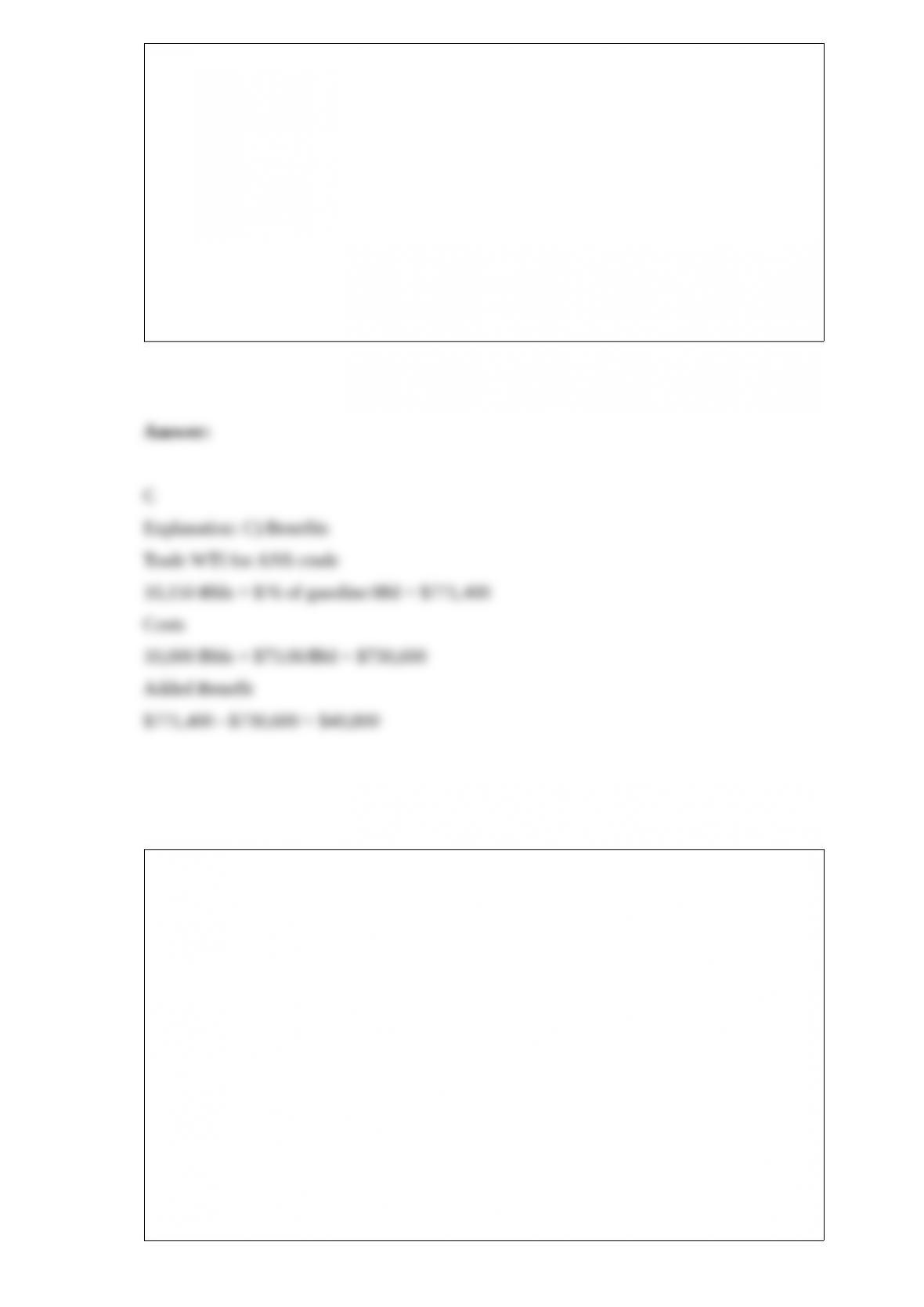
can produce $77 worth of unleaded gasoline from one barrel of West Texas
Intermediate (WTI) crude.
Another oil refiner is offering to trade you 10,150 Bbls of Alaska North Slope (ANS)
crude oil for 10,000 Bbls of West Texas Intermediate (WTI) crude oil. Another oil
refiner is offering to trade you 10,150 Bbls of Alaska North Slope (ANS) crude oil for
10,000 Bbls of West Texas Intermediate (WTI) crude oil. Assuming you just purchased
10,000 Bbls of WTI crude at the current market price, the added benefit (cost) to you if
you take the trade is closest to:
A) $730,600
B) $771,400
C) $40,800
D) $43,308
If managed effectively, Rearden Metal will have assets with a market value of $200
million, $300 million, or $400 million next year, with each outcome being equally
likely. Managers, however, may decided to engage in wasteful empire building, which
will reduce Rearden’s market value by $20 million in all cases. Managers may also
increase the risk of the firm, changing the probability of each outcome to 50%, 5%, and
45% respectively.
Suppose that the managers at Rearden Metal will engage in empire building unless that
behavior increases the likelihood of bankruptcy. If Rearden has $190 million in debt
due in one year, then the expected value of Rearden’s assets is closest to:
A) $265 million
B) $280 million
C) $295 million
D) $300 million
Which of the following is NOT an operating expense?
A) Interest expense
B) Depreciation and amortization
C) Selling, general and administrative expenses
D) Research and development
Which of the following statements is FALSE?
A) The costs of selling assets below their value are greatest for firms with assets that
lack competitive, liquid markets.

B) Firms in financial distress tend to have difficulty collecting money that is owed to
them.
C) Suppliers may be unwilling to provide a firm with inventory if they fear they will
not be paid.
D) The loss of customers is likely to be large for producers of raw materials (such as
sugar or aluminum), as the value of these goods, once delivered, depends on the seller’s
continued success.