1) Cash markets are often referred to as spot markets.
2) While many factors contributed to the financial crisis of 2007 and beyond, it is safe
to say that real estate loans were NOT much of a contributing factor.
3) Two factors that go into the determination of the appropriate order point are the
deliver-time stock and the safety stock required.
4) A company’s market capitalization is generally greater than its book value, in part
due to its reputation for being able to deliver growth, attract top talent, and avoid ethical
mistakes.
5) Junk bonds typically have an interest rate of between 3 and 5 percent more than
AAA-rated long-term debt.
6) The market value weights are preferred when calculating a firm’s weighted average
cost of capital.
7) The goal of most financial managers is to reduce the amount of long-term debt to
zero, thus maximizing shareholder wealth.

8) Changes in depreciation expense do not affect operating income because
depreciation is a non-cash expense.
9) Companies that sell basic necessities face the highest levels of business risk because
consumers will price shop aggressively for items they purchase on a regular basis.
10) The implicit cost of debt takes into consideration the change in the cost of common
equity brought on by using additional debt.
11) Other things equal, if a firm increases its dividend payout ratio, its discretionary
financing needed will also increase.
12) Tim has $100 in a bank account paying 2% interest per year. At the end of 5 years,
Tim’s bank account balance will be $110 if interest is not compounded, but will be
greater than $110 if interest is compounded.
13) Interest Rate Parity theory states that interest rates must be the same in all countries
using floating exchange rates or else international markets will not be in equilibrium.
14) One problem with maximization of shareholder wealth as a goal is that it ignores

risk taken by the firm’s financial decisions.
15) For a given stated interest rate, an investor would receive a greater future value with
daily compounding as opposed to monthly compounding.
16) Break-even analysis is a short-term concept because, in the long run, all costs are
variable.
17) The internal rate of return is the discount rate that equates the present value of the
project’s free cash flows with the project’s initial cash outlay.
18) Shareholders may prefer a share repurchase program to dividends because
dividends are subject to taxation and increasing value per share due to repurchase
programs is tax deferred.
19) A call provision entitles a company to repurchase its preferred stock from holders at
stated prices over a given time period.
20) When solving a problem involving an annuity due, you must select the “beg” or
beginning mode on your financial calculator.

21) Money market instruments include
A) common stock
B) preferred stock
C) T-bonds
D) T-bills
22) Bill’s BikeShop has a return on assets of 12%. Anton’s assets = $100 while Anton’s
owner’s equity = $40 and its debt equals $60. What is Bill’s return on equity?
A) 18%
B) 20%
C) 30%
D) 12%
23) Buying and selling in more than one market to make a riskless profit is called
A) profit-maximization
B) arbitrage
C) international trading
D) cannot be determined from the above information
24) According to the hedging principle, fixed assets should NOT be financed with
A) permanent financing
B) temporary financing
C) permanent plus spontaneous financing
D) equity financing
25) The primary advantage that pledging accounts receivable provides is
A) the flexibility it gives to the borrower
B) that the financial institution bears the risk of collection
C) the low cost as compared with other sources of short-term financing
D) that the financial institution services the accounts

26) You are going to add one of the following three projects to your already
well-diversified portfolio.
PROJECT 1PROJECT 2
StandardStandard
ProbabilityReturnDeviationBetaProbabilityReturnDeviationBeta
50% Chance22%12%1.130% Chance36%19.5%0.8
50% Chance-4%40% Chance10.5%
30% Chance-20%
PROJECT 3
Standard
ProbabilityReturnDeviationBeta
10% Chance28%12%2.0
70% Chance18%
20% Chance-8%
Assume the risk-free rate of return is 2% and the market risk premium is 8%. If you are
a risk averse investor, which project should you choose?
A) Project 1
B) Project 2
C) Project 3
D) Either Project 2 or Project 3 because the higher expected return on project 3 offsets
its higher risk
27) John Box Inc. has an annual interest expense of $30,000 and pays income tax equal
to 40 percent of taxable income (EBT). John Box’s times-interest-earned ratio is 4.2 .
What is John Box’s net income?
A) $96,000
B) $57,000
C) $126,000
D) $57,600
28) You are going to invest all of your funds in one of three projects with the following
distribution of possible returns:
PROJECT 1PROJECT 2
StandardStandard
ProbabilityReturnDeviationBetaProbabilityReturnDeviationBeta
50% Chance22%12%1.130% Chance36%19.5%1.0
50% Chance-4%40% Chance10.5%
30% Chance-20%
PROJECT 3
Standard

ProbabilityReturnDeviationBeta
10% Chance28%12%1.2
70% Chance18%
20% Chance-8%
If you are a risk averse investor, which one should you choose?
A) Project 1
B) Project 2
C) Project 3
D) either Project 1 or Project 2 because they have the same expected return
29) According to the residual theory of dividends
A) dividends are a residual after investment financing needs have been met
B) earnings remaining after payment of preferred stock dividends should be paid to
common stockholders
C) dividend payments are a constant percentage of earnings per share
D) a dividend is the residual above the payout ratio
30) Which of the following represents an attempt to measure the net results of the firm’s
operations (revenues versus expenses) over a given time period?
A) balance sheet
B) statement of cash flows
C) income statement
D) sources and uses of funds statement
31) The investment banker performs what three basic functions?
A) underwriting, distributing, and regulating
B) underwriting, advising, and price-pegging
C) underwriting, distributing, and advising
D) underwriting, distributing, and negotiating
32) The percent of sales method does not accurately estimate the balances for lumpy
assets. Which of the following statements best describes the possible errors?
A) If excess capacity exists, the percent of sales method will overestimate asset

requirements
B) The percent of sales method consistently underestimates the forecasted balances of
lumpy assets
C) The percent of sales method consistently overestimates the forecasted balances of
lumpy assets
D) If fixed assets are utilized at full capacity currently, the percent of sales method will
underestimate the forecasted fixed asset balance
33) IMXP Corp. enters into a 30-day forward exchange contract to buy 113,540,000 yen
for $100,000. Which of the following statements is TRUE concerning this transaction?
A) IMXP will pay $100,000 and receive 113,540,000 yen 30 days from now
B) IMXP will pay $100,000 today and receive 113,540,000 yen 30 days from now
C) The spot exchange rate in 30 days will be 113.54 yen per dollar
D) IMXP will receive 113,540,000 yen today and pay $100,000 30 days from now
34) The spot exchange rate is 1.57 dollars per pound. The 30-day forward exchange rate
is .6211 pounds per dollar. The percent-per-year discount on the 30-day pound is
A) 32.77%
B) 30.57%
C) 48.00%
D) 45.93%
35) Assume that a firm has a steady record of paying high dividends for years. A new
management team decided to cut the current year’s dividend in half without disclosing
why. The market value of the stock fell 35% on the day the dividend cut was
announced. Which of the following would best explain the stock market’s reaction to
the announcement?
A) empirical theory
B) dividend irrelevance theory
C) residual dividend theory
D) information effect
36) Table 4-3
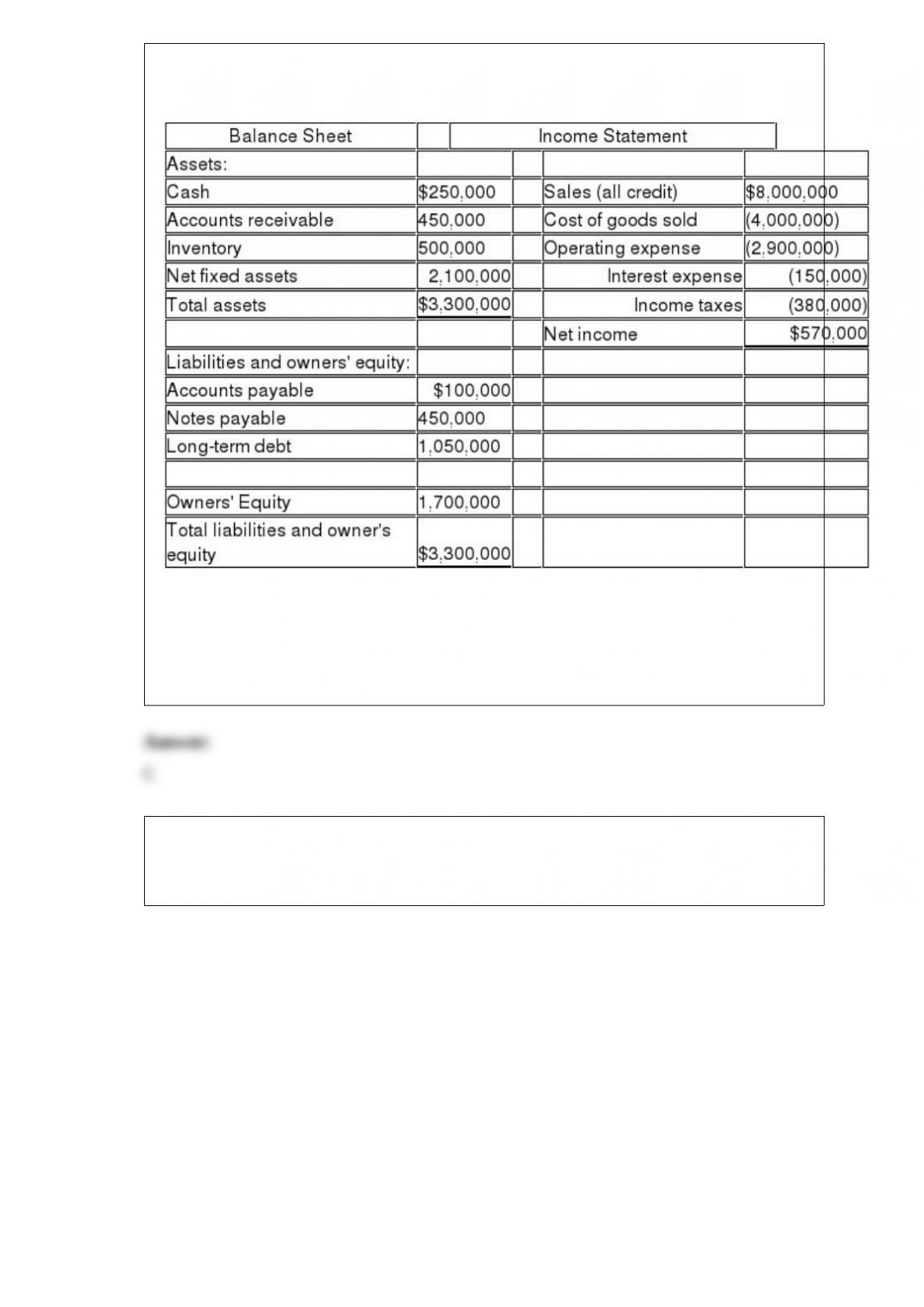
Emery Corporation
The average collection period is
A) 38.01 days
B) 27.36 days
C) 20.53 days
D) 17.49 days
37) Table 4-4
Wes Donnell, Inc.
Balance Sheet
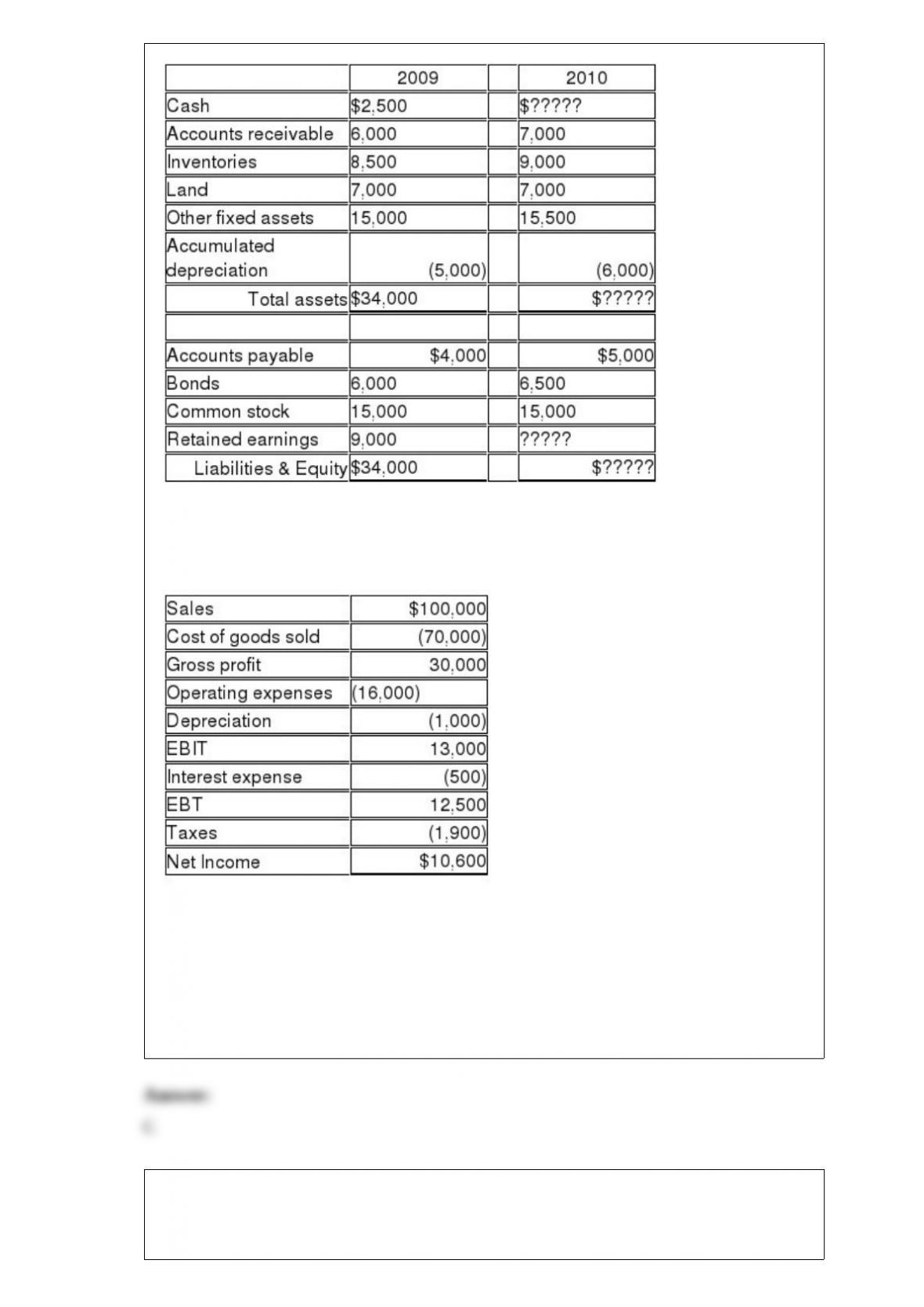
Wes Donnell, Inc.
Income Statement
For the year ended December 31, 2010
In addition to the information contained in Table 4-4, you know that the current ratio for
2010 is 4 and that the corporation paid $11,600 in dividends in 2010 . What is Wes
Donnell’s cash balance for 2010?
A) $2,500
B) $13,600
C) $4,000
D) $6,500
38) P.D. Corporation is considering the purchase of a high-speed lathe that has an
invoice price of $250,000. The cost to ship the lathe to P.D.’s factory is $10,000, and the
existing facilities will require modifications that are expected to cost $20,000. The

machine will be depreciated on a straight-line basis over its useful life of 10 years,
assuming no salvage value. P.D. Corporation is planning on paying for the lathe using a
line of credit at the bank that has an interest rate of 6 percent per year. The lathe is
expected to increase production and sales. Sales are expected to increase by $100,000
per year. Inventory and accounts receivable balances are expected to increase by
$10,000 and $20,000 respectively. Expenses to operate the lathe are $25,000 per year.
P.D.’s marginal tax rate is 40%.
a.Calculate the initial outlay required to fund this project.
b.Calculate the incremental after-tax cash flow in year one of the project.
39) All of the following are useful purposes of pro forma financial statements EXCEPT
A) they provide a useful tool for analyzing the effects of a firm’s forecasts on its
financial performance
B) they satisfy the SEC requirement for audited financial disclosure
C) they can be used to control, or monitor a firm’s progress for a planning period
D) they serve as a benchmark to compare actual results to planned activities
40) A company has preferred stock that can be sold for $21 per share. The preferred
stock pays an annual dividend of 3.5% based on a par value of $100. Flotation costs
associated with the sale of preferred stock equal $1.25 per share. The company’s
marginal tax rate is 35%. Therefore, the cost of preferred stock is
A) 18.87%
B) 17.72%
C) 14.26%
D) 12.94%
41) Flashbinder Guitars, Inc. is considering a lockbox system that will increase its
check processing cost by $.15 per check. The company estimates an average check size
of $1,700 and expects the lockbox to reduce check collection time by 3 days. What
annual before-tax yield must Flashbinder Guitars, Inc. earn on its marketable securities
for the lockbox system to be beneficial?
A) 1.825%

B) 1.118%
C) 1.074%
D) 0.735%
42) The payment of dividends may indirectly result in closer monitoring of
management’s investment activities, thus increasing shareholder value by
A) reducing agency costs
B) increasing information asymmetry
C) increasing a company’s amount of free cash flow
D) reducing auditing fees
43) A corporate manager decides to build a new store on a lot owned by the corporation
that could be sold to a local developer for $250,000. The lot was purchased for $50,000
twenty years ago. When determining the value of the new store project
A) the cost of the lot is zero since the corporation already owns it
B) the opportunity cost of the lot is $250,000 and should be included in calculating the
value of the project
C) the cost of the lot for valuation purposes is $50,000 because land does not depreciate
D) the incremental cash flow should be the $50,000 original cost less accumulated
amortization
44) Which of the following ratios would be the most useful to assess the risk associated
with a firm being able to pay off its short-term line of credit?
A) return on equity
B) the acid test ratio
C) the operating profit margin
D) the fixed asset turnover
45) Stock W has the following returns for various states of the economy:
State of the EconomyProbabilityStock W’s Return
Recession9%-72%
Below Average16%-15%
Average51%16%

Above Average14%35%
Boom10%85%
Stock W’s standard deviation of returns is
A) 12%
B) 29%
C) 37%
D) 43%
46) Financial analysis
A) uses historical financial statements and is thus useful only to assess past
performance
B) relies on generally accepted accounting principles to make comparisons between
companies valid
C) uses historical financial statements to measure a company’s performance and in
making financial projections of future performance
D) is accounting record-keeping using generally accepted accounting principles
47) Which of the following is used to manage a firm’s cash disbursements?
A) lockbox system
B) bankers’ acceptances
C) repurchase agreements
D) zero balance accounts
48) Based on the data contained in Table A, what is the break-even point in sales
dollars?
TABLE A
Average selling price per unit$18.00
Variable cost per unit$13.00
Units sold400,000
Fixed costs$650,000
Interest expense$ 50,000
A) $2,340,000
B) $1,850,000
C) $1,775,500
D) $700,000

49) Newtown Manufacturing, Inc. uses semi-hex joints in its manufacturing process. If
Stein’s total demand for the joints for next year is estimated to be 57,000 units, and if
the cost per order is $225, what is Newtown’s economic order quantity of semi-hex
joints? Assume that carrying costs for semi-hex joints are $0.75 per unit.
A) 3,729
B) 3,987
C) 4,944
D) 5,848
50) Green Company stock has a beta of 2 and a required return of 23%, while Gold
Company stock has a beta of 1.0 and a required return of 14%. The standard deviation
of returns for Green Company is 10% more than the standard deviation for Gold
Company. The expected return on the market portfolio according to the CAPM is
A) 9%
B) 10%
C) 12%
D) 14%
51) A significant disadvantage of the payback period is that it
A) is complicated to explain
B) increases firm risk
C) does not properly consider the time value of money
D) provides a measure of liquidity
52) All of the following are potential disadvantages of short-term debt EXCEPT
A) short-term debt must be paid back more quickly than long-term debt
B) uncertainty of interest costs because short-term debt must be replaced often
C) a greater risk of illiquidity than long-term debt
D) short-term debt generally has a higher interest cost than long-term debt

53) The CEO of JLI Corp. decided to expand into a new market in 2010. At the end of
2010, JLI’s stock price had decreased 5% since the beginning of the year. Which of the
following statements is MOST correct?
A) The CEO made a poor decision to expand because the stock price decreased during
the year
B) The CEO made a poor decision to expand because the company’s profits for the year
obviously decreased, causing the drop in stock price
C) The CEO’s decision may have been optimal, keeping the stock price from falling
more than 5% for the year
D) CEO decisions are irrelevant because the efficient market determines the value of a
company’s stock
54) Which of the following is the most valid reason to split a stock that has a market
price of $110 per share?
A) conserve cash
B) reduce the market price to a more popular trading range
C) obtain additional capital
D) increase investor’s net worth
55) AFB, Inc. purchases a new delivery van which is expected to increase cash flows
for the next 10 years. AFB can finance the purchase with a standard 48 month vehicle
loan, or by getting a 10 year loan from the bank. According to the hedging principle,
AFB should
A) use the 10-year financing in order to match the cash flow stream from the asset with
the financing repayments
B) use the 48 month loan since it matches the type of asset with the type of loan
C) use either type of financing, but hedge the risk in the options market
D) avoid using either loan and finance the truck with current cash reserves to avoid
interest expense
56) DYI Construction Co. is considering a new inventory system that will cost
$750,000. The system is expected to generate positive cash flows over the next four
years in the amounts of $350,000 in year one, $325,000 in year two, $150,000 in year
three, and $180,000 in year four. DYI’s required rate of return is 8%. What is the net
present value of this project?
A) $104,089
B) $100,328

C) $96,320
D) $87,417
57) Bill, a local inventor, developed a diet pill that he believes will solve the obesity
problem in the United States. Bill wants to create a new company, 50% owned by Bill
and 50% owned by a major drug company. Although he believes the pills are safe, Bill
is concerned about liability if someone becomes sick or dies. The best form of business
organization for the new company is ________.
A) sole proprietorship with Bill as owner and the drug company as creditor
B) general partnership with Bill and the drug company as equal partners
C) S-type corporation with Bill and the drug company owning equal shares
D) limited liability company with Bill and the drug company owning equal shares
58) Which of the following is NOT a category of inventory?
A) raw materials
B) work-in-process
C) purchases
D) finished goods
59) The primary weakness of EBIT-EPS analysis is that
A) it ignores the implicit cost of debt financing
B) it double counts the cost of debt financing
C) it applies only to firms with large amounts of debt in their capital structure
D) it may only be used by firms that are profitable this year