
Consider the following timeline:
If the current market rate of interest is 7%, then the future value of this timeline as of
year 3 is closest to:
A) $1720
B) $1500
C) $1404
D) $1717
When using the internal rate of return (IRR) investment rule, we compare:
A) the average return on the investment opportunity to returns on all other investment
opportunities in the market.
B) the average return on the investment opportunity to returns on other alternatives in
the market with equivalent risk and maturity.
C) the NPV of the investment opportunity to the average return on the investment
opportunity.
D) the average return on the investment opportunity to the risk-free rate of return.
Nielson Motors is considering an opportunity that requires an investment of $1,000,000
today and will provide $250,000 one year from now, $450,000 two years from now, and
$650,000 three years from now.
If the appropriate interest rate is 10%, then the NPV of this opportunity is closest to:
A) ($88,000)
B) $88,000
C) $300,000
D) $1,300,000
The CAPM does not require investors have homogeneous expectations, but rather that
they have:
A) rational biases.
B) no biases.
C) heterogenous expectations.
D) rational expectations.
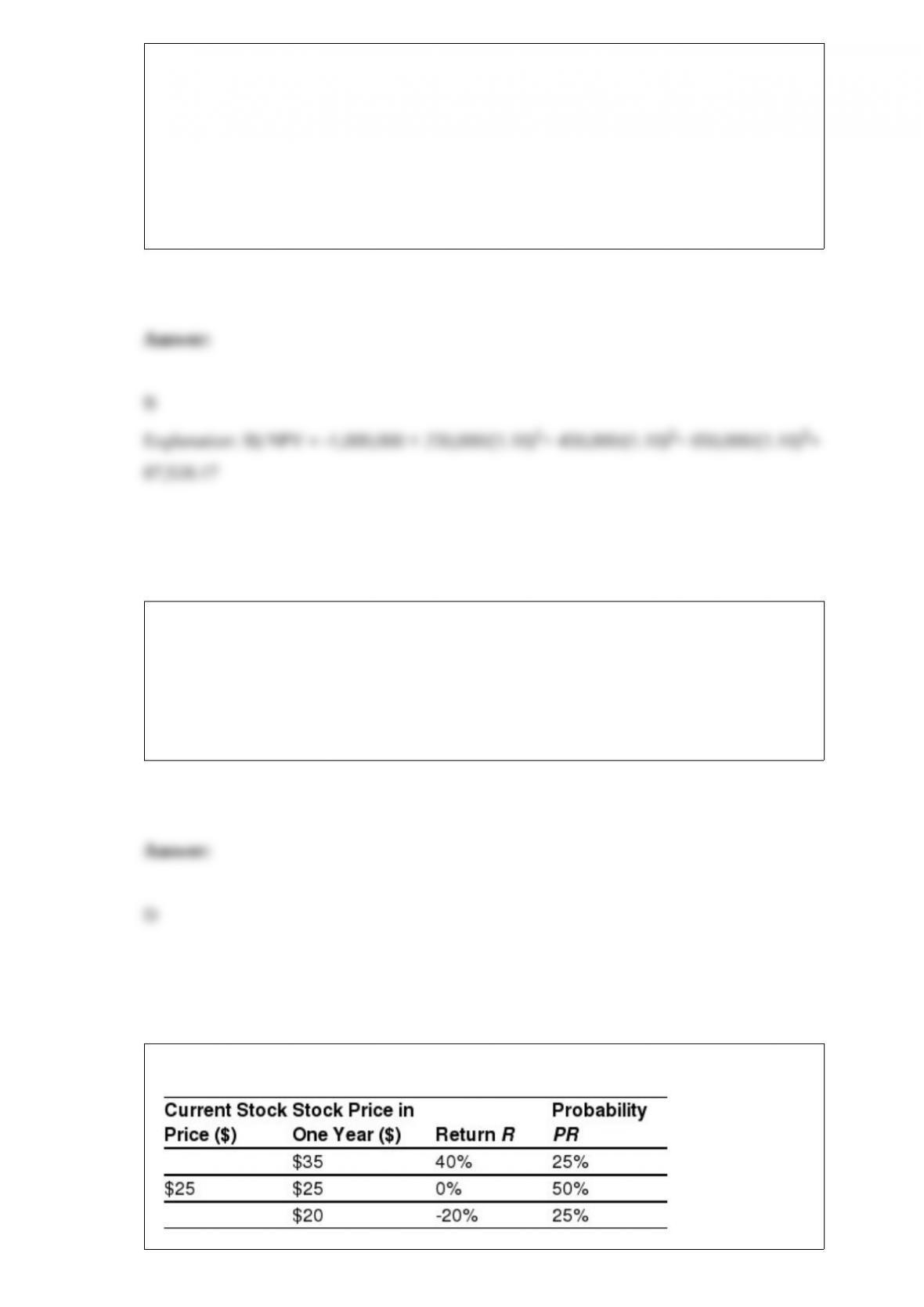
Consider the following probability distribution of returns for Alpha Corporation:

The variance of the return on Alpha Corporation is closest to:
A) 5.00%
B) 4.75%
C) 3.625%
D) 3.75%
Suppose that the market portfolio is equally likely to increase by 24% or decrease by
8%. Security “X” goes up on average by 29% when the market goes up and goes down
by 11% when the market goes down. Security “Y” goes down on average by 16% when
the market goes up and goes up by 16% when the market goes down. Security “Z” goes
up on average by 4% when the market goes up and goes up by 4% when the market
goes down.
The risk-free rate is closest to:
A) 0%
B) 4%
C) 8%
D) 16%
Von Bora Corporation is expected pay a dividend of $1.40 per share at the end of this
year and a $1.50 per share at the end of the second year. You expect Von Bora’s stock

price to be $25.00 at the end of two years. Von Bora’s equity cost of capital is 10%.
Suppose you plan on purchasing Von Bora stock in one year, right after the $1.40
dividend is paid. You then plan on selling your stock at the end of year two, right after
the $1.50 dividend is paid. The total return that you will receive on your investment is
closest to:
A) 9.50%
B) 10.75%
C) 10.25%
D) 10.00%
Which of the following statements is FALSE?
A) As long as the firm’s choice of securities does not change the cash flows generated
by its assets, the capital structure decision will not change the total value of the firm or
the amount of capital it can raise.
B) If securities are fairly priced, then buying or selling securities has an NPV of zero
and, therefore, should not change the value of a firm.
C) The future repayments that the firm must make on its debt are equal in value to the
amount of the loan it receives up front.
D) An investor who would like more leverage than the firm has chosen can lend and
add leverage to his or her own portfolio.
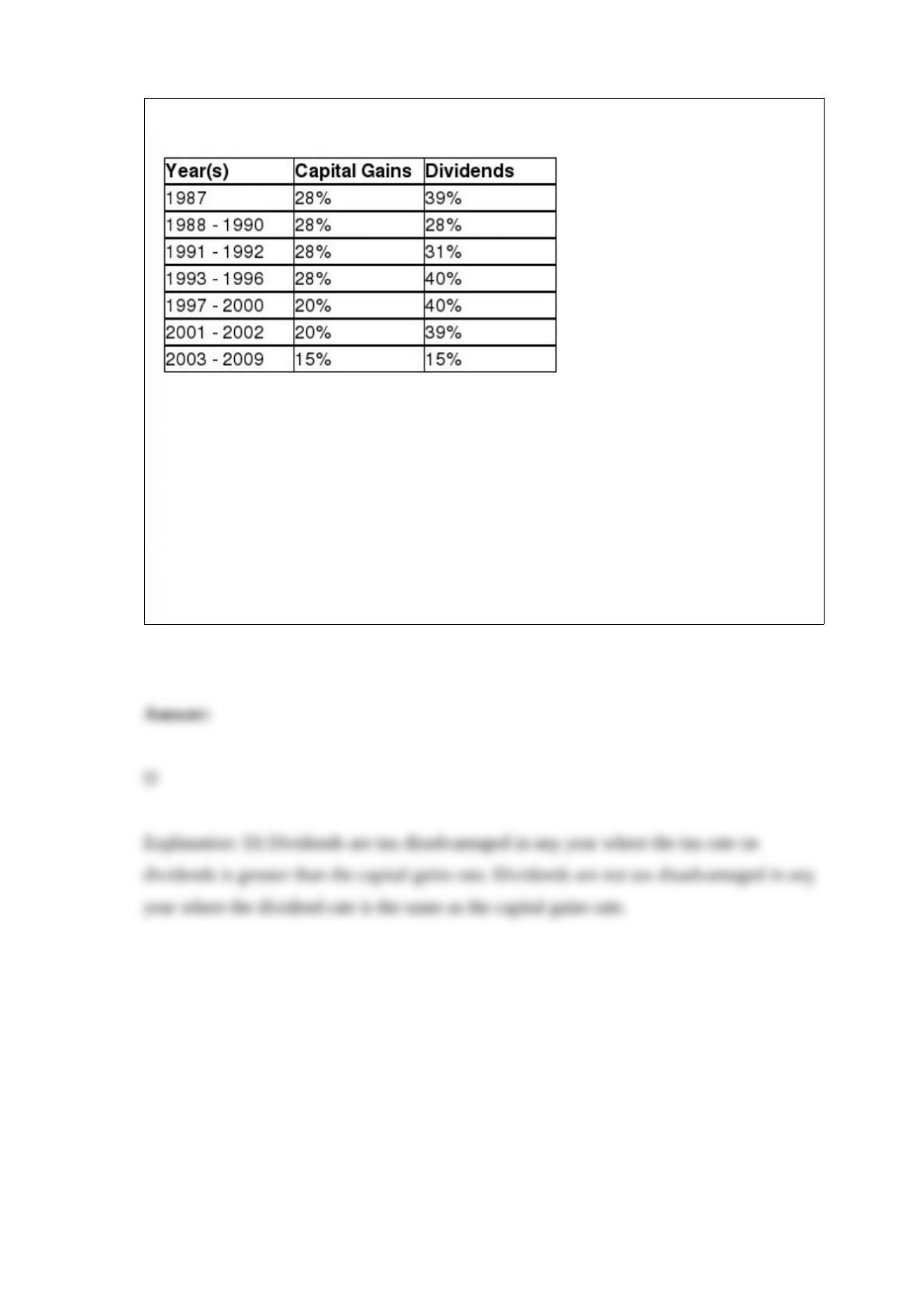
In which years were dividends NOT tax disadvantaged?
A) 1987 – 2002
B) 1987, 1993 – 2002
C) 1987, 1991 – 2002
D) 1988 – 1990, 2003 – 2009

Your firm needs to invest in a new delivery truck. The life expectancy of the delivery
truck is five years. You can purchase a new delivery truck for an upfront cost of
$200,000, or you can lease a truck from the manufacturer for five years for a monthly
lease payment of $4000 (paid at the end of each month). Your firm can borrow at 6%
APR with quarterly compounding.
The effective annual rate for a certificate of deposit that pays 3.9% APR compounded
monthly is closest to:
A) 3.83%
B) 3.90%
C) 3.97%
D) 4.04%
A corporate bond which receives a BBB rating from Standard and Poor’s is considered
A) a junk bond.
B) an investment grade bond.
C) a defaulted bond.
D) a high-yield bond.

Google Corporation has no debt on its balance sheet in 2008, but paid $1.6 billion in
taxes. Assume that Google’s marginal tax rate is 35% and Google’s borrowing cost is
7%.
Assume that investors hold Google stock in retirement accounts that are free from
personal taxes. If Google were to issue sufficient debt to reduce its taxes by $1 billion
per year permanently, then the amount that Google needs to borrow is closest to:
A) $14.25 billion
B) $22.00 billion
C) $24.50 billion
D) $40.75 billion
Which of the following statements is FALSE?
A) A firm must balance the tax costs of holding cash with the potential benefits of
having to raise external funds in the future.
B) Paying out excess cash through dividends or share repurchases can boost the stock
price by reducing managers’ ability and temptation to waste resources.
C) If there is a reasonable likelihood that future earnings will be insufficient to fund
future positive-NPV investment opportunities, a firm may start accumulating cash to
make up the difference.
D) According to the managerial entrenchment theory of payout policy, managers pay
out cash only when pressured to do so by the firm’s investors.
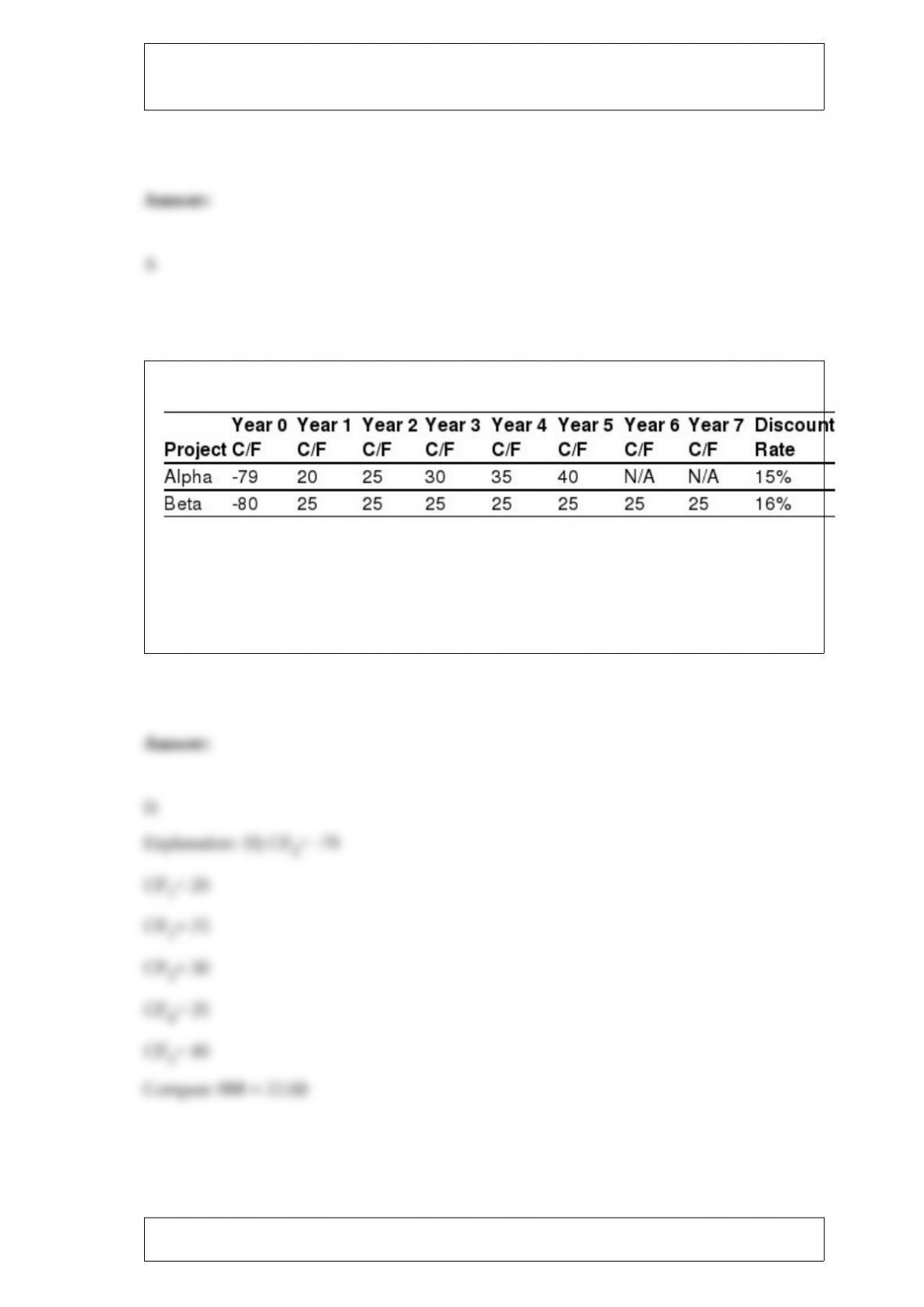
Consider the following two projects:
The internal rate of return (IRR) for project Alpha is closest to:
A) 25.0%
B) 22.2%
C) 24.5%
D) 22.7%
If shareholders are unhappy with a CEO’s performance, they are most likely to:

A) buy more shares in an effort to gain control of the firm.
B) file a shareholder resolution.
C) replace the CEO through a grassroots shareholder uprising.
D) sell their shares.
Consider a project with free cash flows in one year of $90,000 in a weak economy or
$117,000 in a strong economy, with each outcome being equally likely. The initial
investment required for the project is $80,000, and the project’s cost of capital is 15%.
The risk-free interest rate is 5%.
Suppose that you borrow $60,000 in financing the project. According to MM
proposition II, the firm’s equity cost of capital will be closest to:
A) 45%
B) 30%
C) 25%
D) 35%
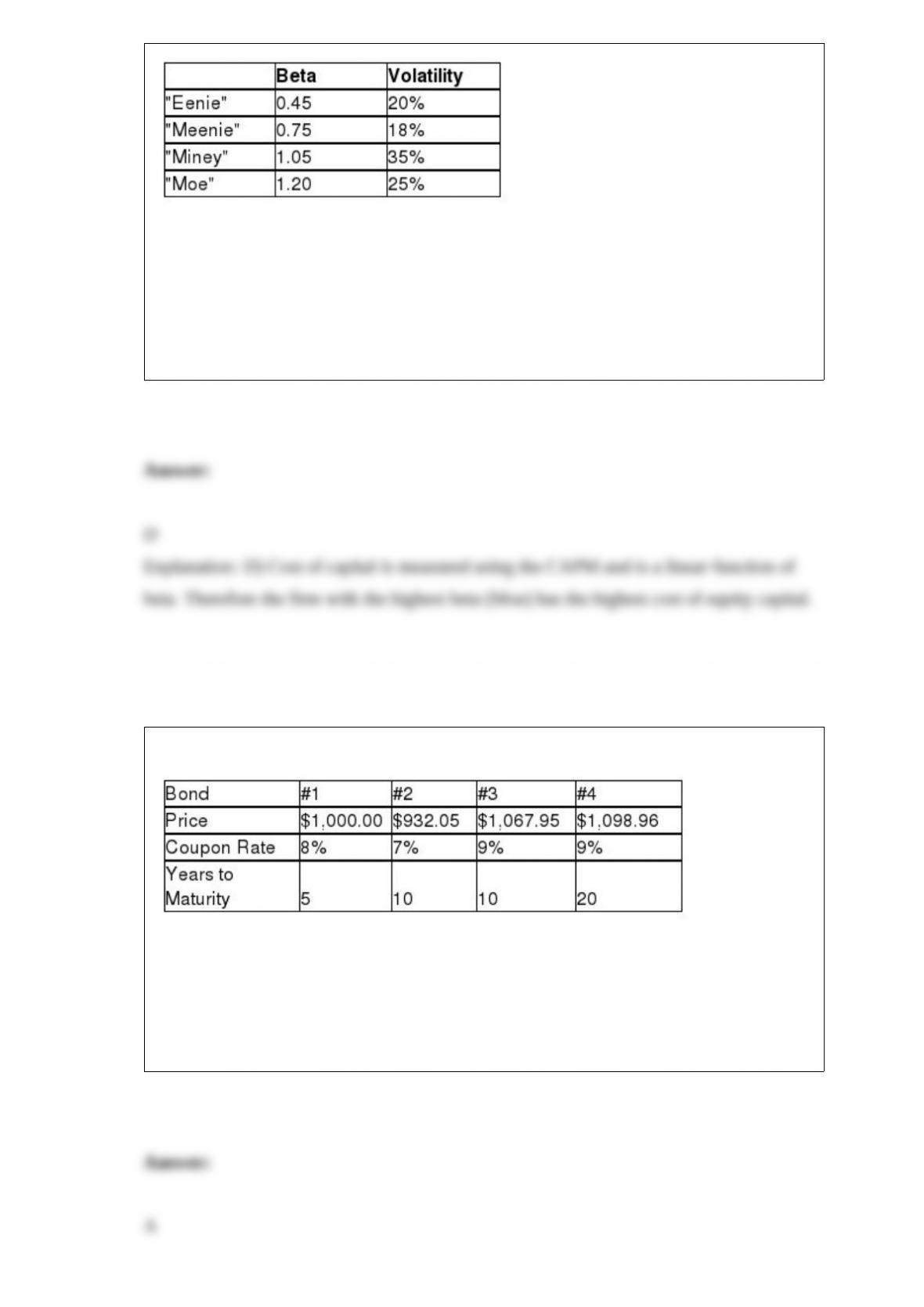
Assume that the risk-free rate of interest is 3% and you estimate the market’s expected
return to be 9%.
Which firm has the highest cost of equity capital?
A) Eenie
B) Meenie
C) Miney
D) Moe
Consider the following four corporate bonds that have semiannual compounding:
Consider a zero coupon bond with 20 years to maturity. The amount that the price of the
bond will change if its yield to maturity decreases from 7% to 5% is closest to:
A) $120
B) -$53
C) $53
D) $673

Consider a project with free cash flows in one year of $90,000 in a weak economy or
$117,000 in a strong economy, with each outcome being equally likely. The initial
investment required for the project is $80,000, and the project’s cost of capital is 15%.
The risk-free interest rate is 5%.
The NPV for this project is closest to:
A) $6,250
B) $14,100
C) $10,000
D) $18,600
Which of the following statements is FALSE?
A) An important consequence of leverage is the risk of bankruptcy.
B) Whether default occurs depends on the cash flows, not on the relative values of the
firm’s assets and liabilities.

C) Economic distress is a significant decline in the value of a firm’s assets, whether or
not it experiences financial distress due to leverage.
D) Modigliani and Miller’s results continue to hold in a perfect market even when debt
is risky and the firm may default.
In an agency problem known as asset substitution, the agency cost is paid by:
A) the debt holders, since if the risky project is not successful debt holders will lose all
their money.
B) the debt holders, since if the risky project is successful debt holders will receive less
money.
C) the equity holders, since the strategy has a negative expected payoff.
D) the equity holders, since they will lose all their money whether or not the project is
successful.
Which of the following statements is FALSE?
A) A portfolio costs nothing to construct is called a self-financing portfolio.
B) The most obvious portfolio to use in a multifactor model is the market portfolio
itself.
C) In general, a self-financing portfolio is any portfolio with portfolio weights that sum
to one rather than zero.
D) We can construct a self-financing portfolio by going long some stocks, and going
short other stocks with equal market value.
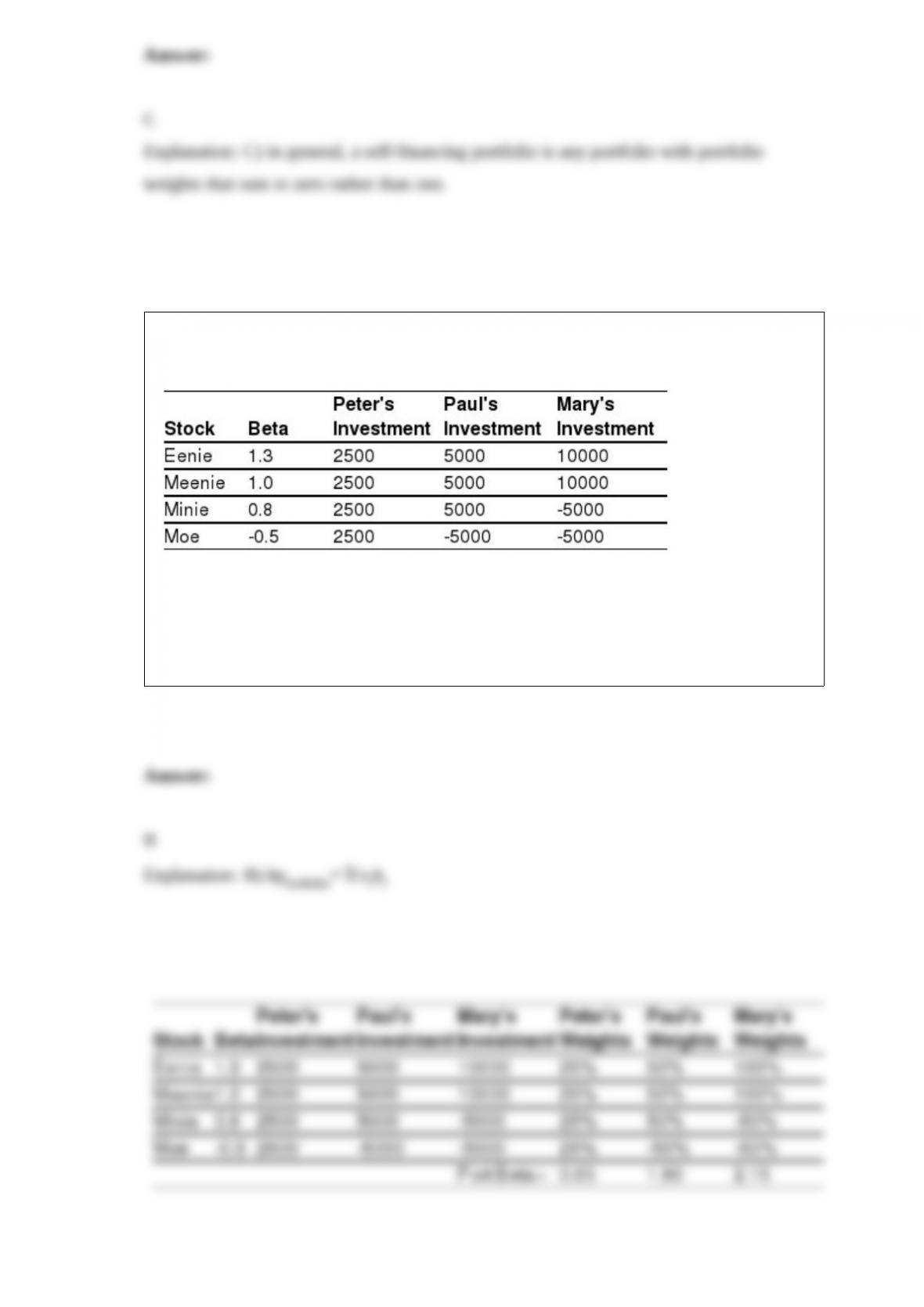
Consider the following three individuals portfolios consisting of investments in four
stocks:
The beta on Paul’s Portfolio is closest to:
A) 1.5
B) 1.8
C) 1.3
D) 1.0
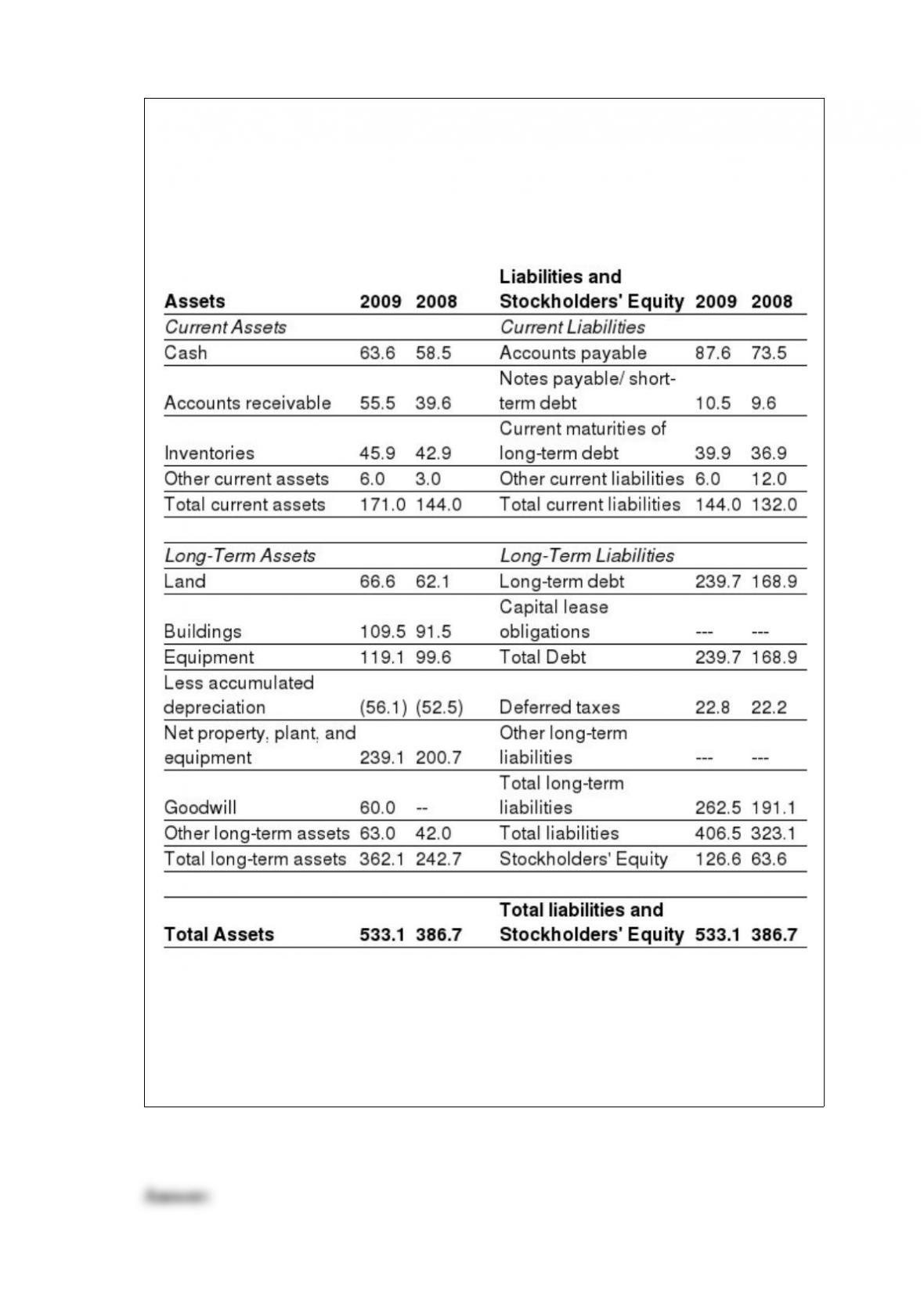
Luther Corporation
Consolidated Balance Sheet
December 31, 2009 and 2008 (in $ millions)
If in 2009 Luther has 10.2 million shares outstanding and these shares are trading at $16
per share, then Luther’s Market-to-book ratio would be closest to:
A) 0.39
B) 0.76
C) 1.29
D) 2.57

Suppose that a young couple has just had their first baby and they wish to ensure that
enough money will be available to pay for their child’s college education. Currently,
college tuition, books, fees, and other costs, average $12,500 per year. On average,
tuition and other costs have historically increased at a rate of 4% per year. Assuming
that college costs continue to increase an average of 4% per year and that all her college
savings are invested in an account paying 7% interest, then the amount of money she
will need to have available at age 18 to pay for all four years of her undergraduate
education is closest to:
A) $97,110
B) $107,532
C) $101,291
D) $50,000
With its current leverage, WELS Corporation will have Free Cash Flow of $4 million.
If WELS corporate tax rate is 35% and it pays 8% interest on its debt, how much
additional debt can WELS issue this year and still receive the benefit of the interest tax

shield next year?
Assume that you are 30 years old today, and that you are planning on retiring at age 65.
Your current salary is $45,000 and you expect your salary to increase at a rate of 5% per
year as long as you work. To save for your retirement, you plan on making annual
contributions to a retirement account. Your first contribution will be made on your
31stbirthday and will be 8% of this year’s salary. Likewise, you expect to deposit 8% of
your salary each year until you reach age 65. At retirement (age 65) you will begin
withdrawing equal annual payments to pay for your living expenses during retirement
(on your 65th birthday). If you expect to die one day before your 101st birthday (Your
last withdraw will be on your 100th birthday) and if the annual rate of return is 7%,
then how much money will you have to spend in each of your golden years of
retirement?

*The current tax rates are set to expire in 2008 unless Congress extends them. The tax
rates shown are for financial assets held for one year. For assets held less than one year,
capital gains are taxed at the ordinary income tax rate (currently 35% for the highest
bracket); the same is true for dividends if the assets are held for less than 61 days.
Using the available tax information for 2002, calculate the effective dividend tax rate
for a:
[1] one-year individual investor
[2] buy and hold individual investor
[3] pension fund
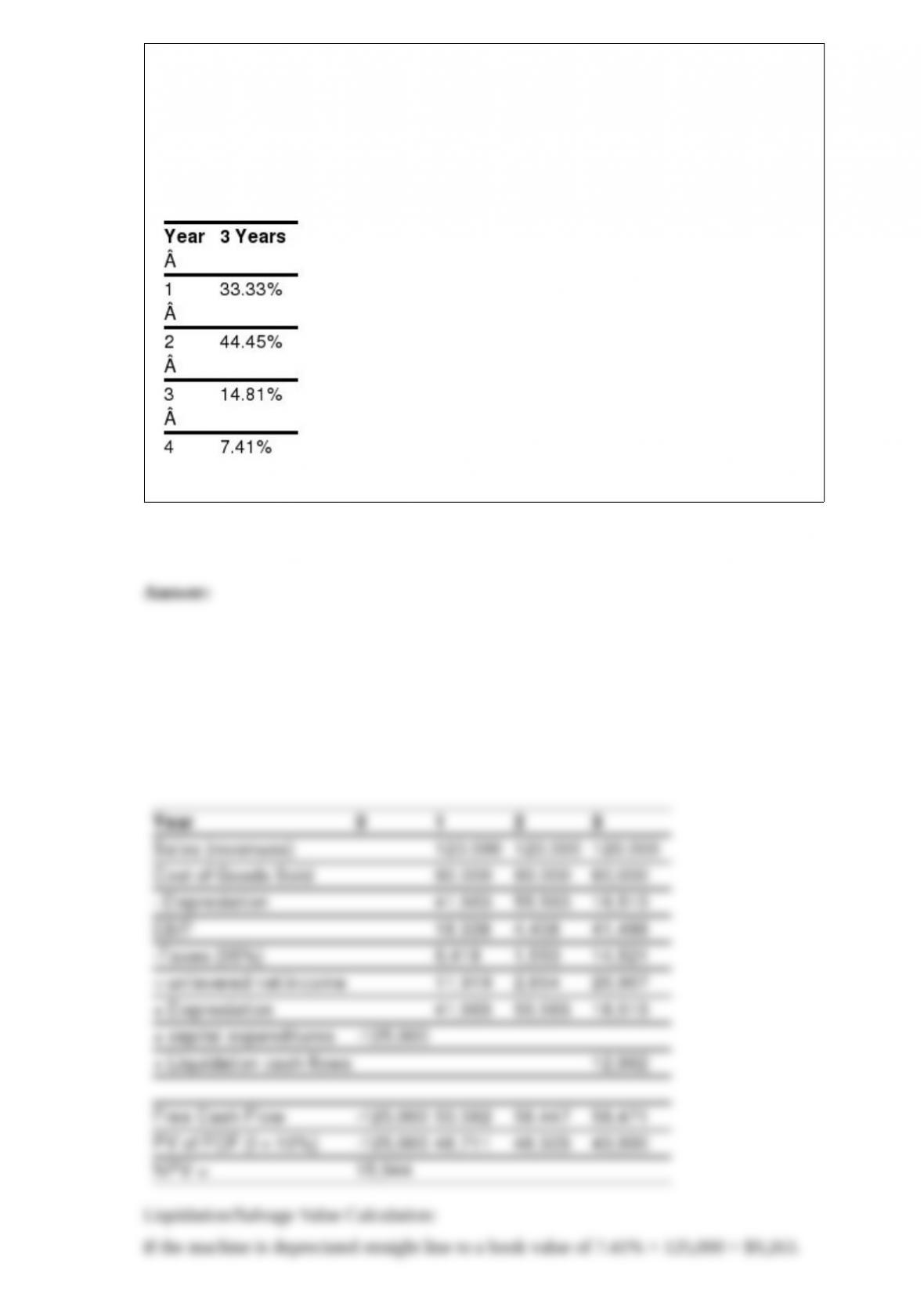
Kinston Industries is considering investing in a machine that will cost $125,000 and
will last for three years. The machine will generate revenues of $120,000 each year and
the cost of goods sold will be 50% of sales. At the end of year three the machine will be
sold for $15,000. The appropriate cost of capital is 10% and Kinston is in the 35% tax
bracket.Assume that Kinston’s new machine will be depreciated using MACRS
according to the following schedule:
What is the NPV of this project?
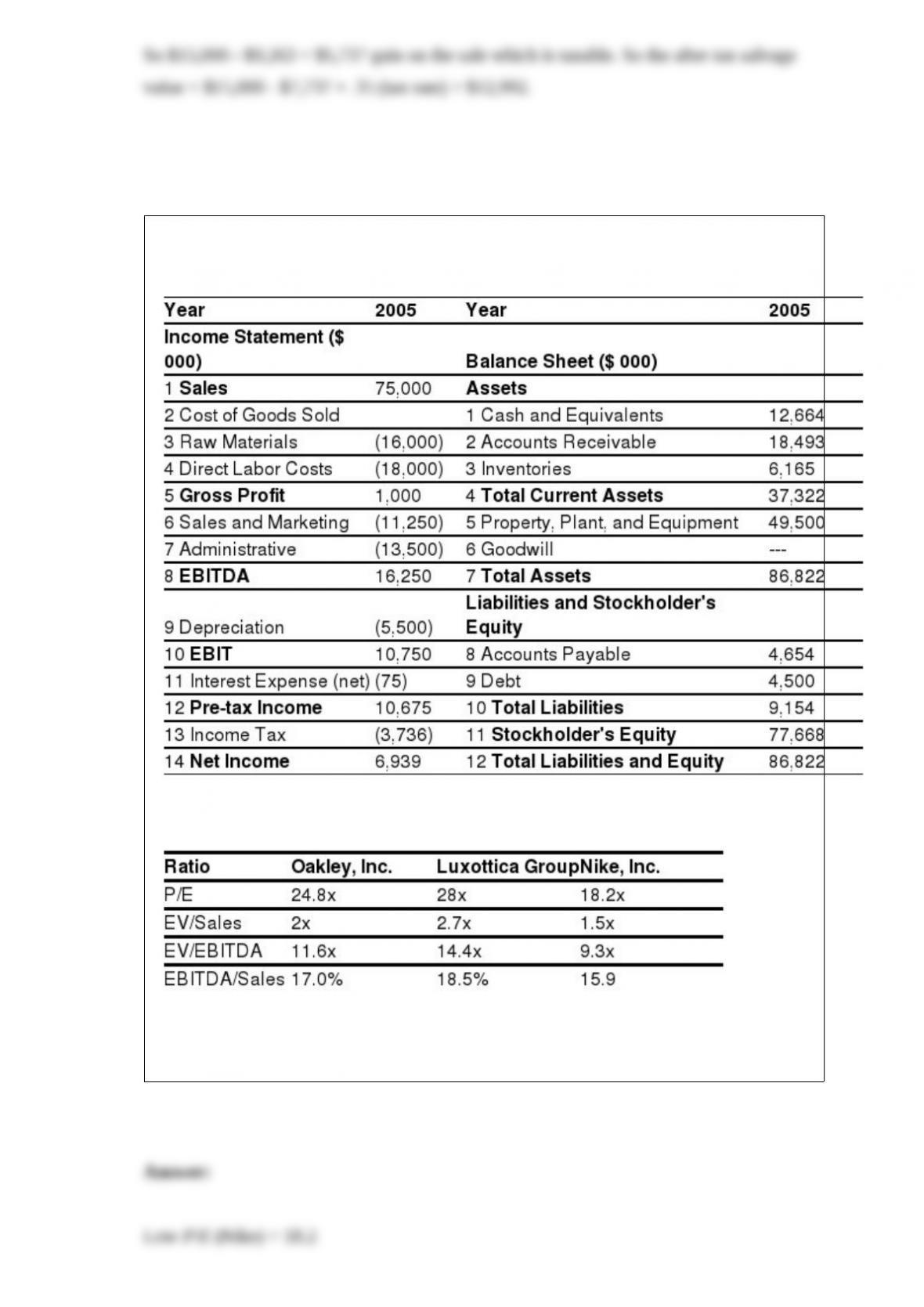
Estimated 2005 Income Statement and Balance Sheet Data for Ideko Corporation
The following are financial ratios for three comparable companies:
What range for the market value of equity for Ideko is implied by the range of P/E
multiples for the comparable firms?
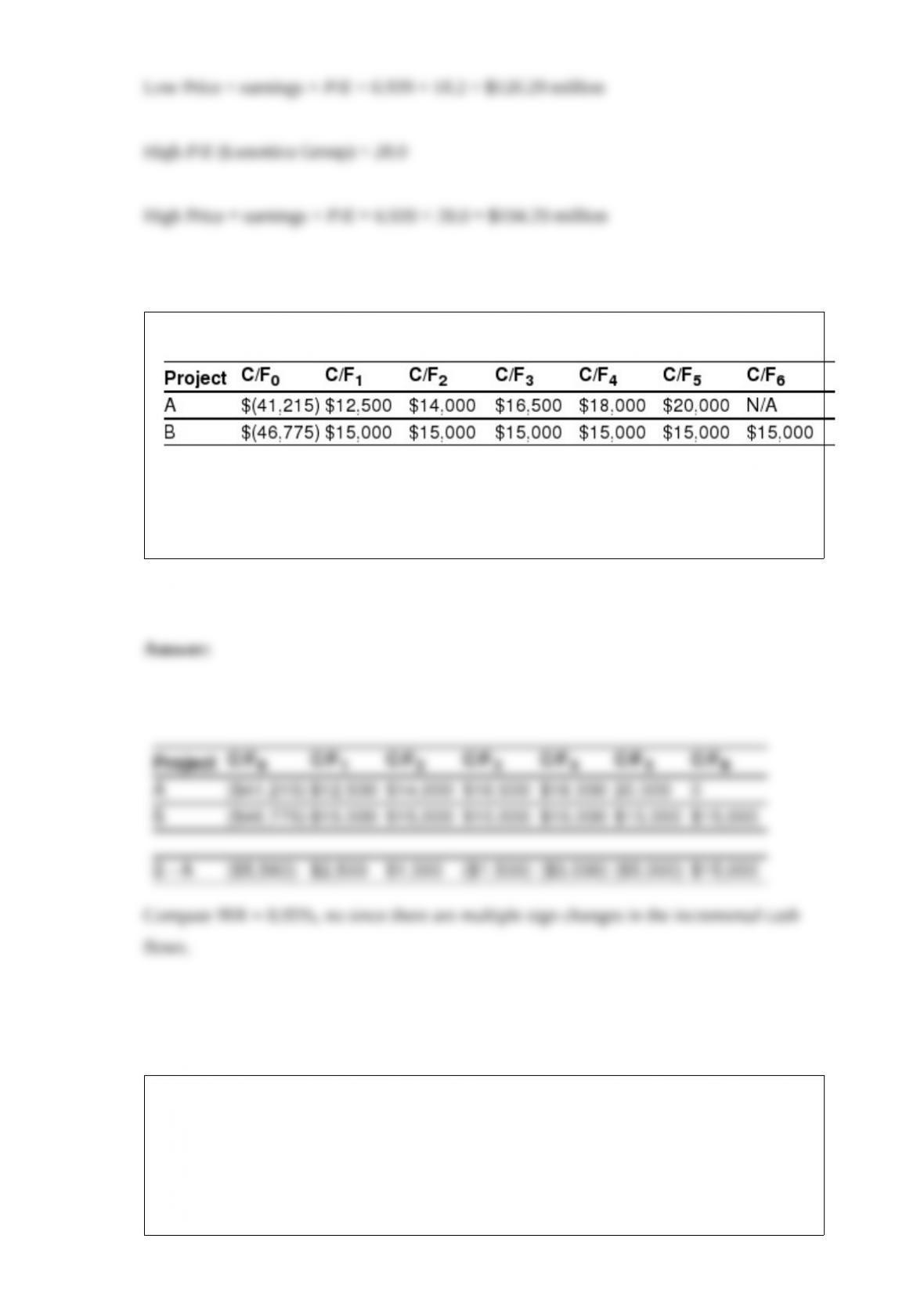
Consider two mutually exclusive projects with the following cash flows:
You are considering using the incremental IRR approach to decide between the two
mutually exclusive projects A & B. What is one of the incremental IRRs for project B
over project A? Would you feel comfortable basing your decision on the incremental
IRR?
You are in the process of purchasing a new automobile that will cost you $25,000. The
dealership is offering you either a $1,000 rebate (applied toward the purchase price) or
3.9% financing for 60 months (with payments made at the end of the month). You have
been pre-approved for an auto loan through your local credit union at an interest rate of
7.5% for 60 months. Should you take the $2000 rebate and finance through your credit
union or forgo the rebate and finance through the dealership at the lower 3.9% APR?
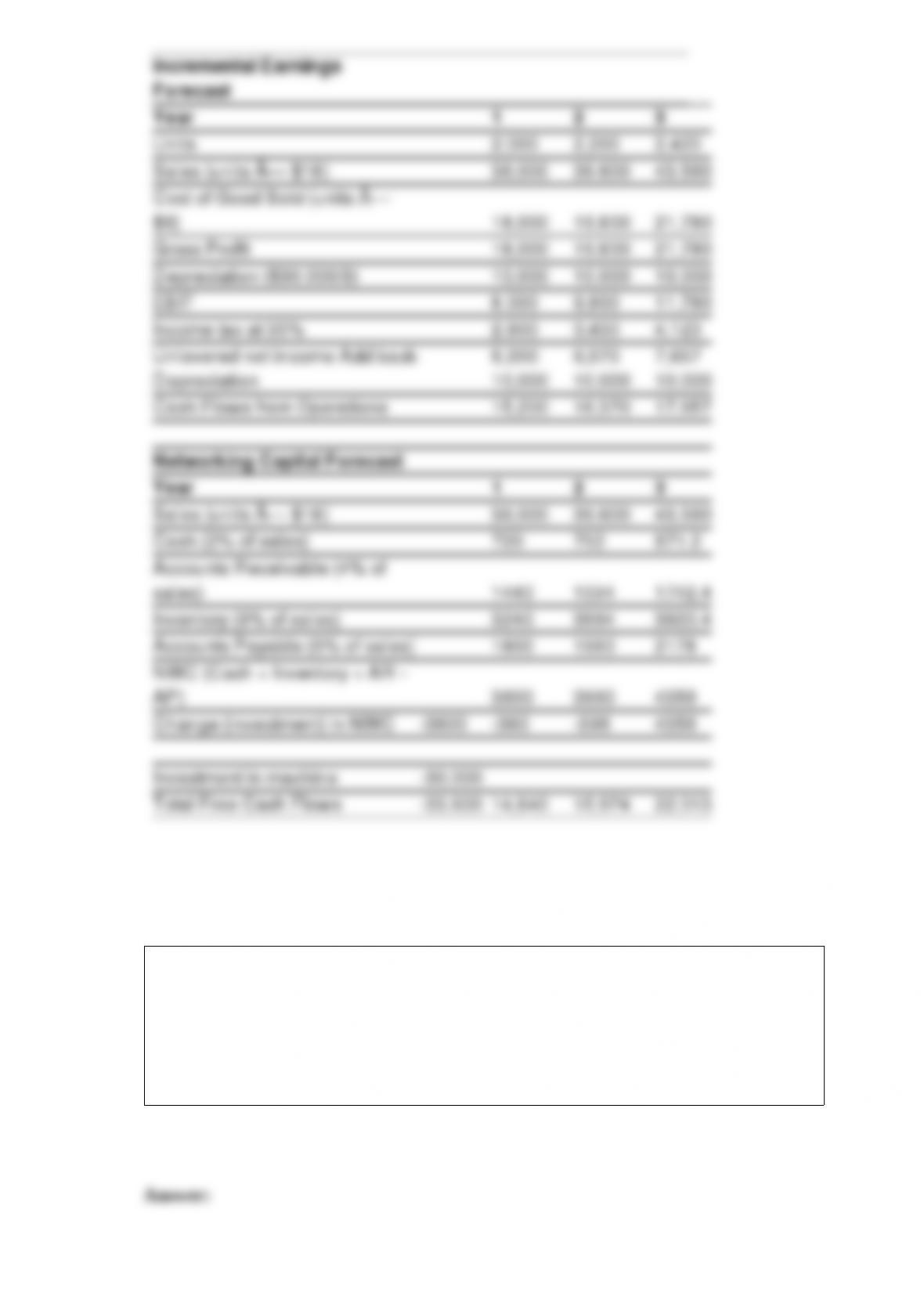
The Sisyphean Corporation is considering investing in a new cane manufacturing
machine that has an estimated life of three years. The cost of the machine is $30,000
and the machine will be depreciated straight line over its three-year life to a residual
value of $0.
The cane manufacturing machine will result in sales of 2,000 canes in year 1. Sales are
estimated to grow by 10% per year each year through year three. The price per cane that
Sisyphean will charge its customers is $18 each and is to remain constant. The canes
have a cost per unit to manufacture of $9 each.
Installation of the machine and the resulting increase in manufacturing capacity will
require an increase in various net working capital accounts. It is estimated that the
Sisyphean Corporation needs to hold 2% of its annual sales in cash, 4% of its annual
sales in accounts receivable, 9% of its annual sales in inventory, and 6% of its annual
sales in accounts payable. The firm is in the 35% tax bracket, and has a cost of capital
of 10%.
Calculate the total Free Cash Flows for each of the three years for the Sisyphean
Corporation’s new project.
You are up late watching TV one night and see an ad from Ronco for the Dial-o-matic
food slicer. You learn that the Dial-o-matic sells for $29.95. But wait, there is more.
Ronco is also including in this deal a set of Ginsu steak knives worth $10.95 and
another free gift worth $7.95. Assuming that there is a competitive market for Ronco
items, at what price must Ronco be selling this three item Dial-o-matic deal to insure
the absence of an arbitrage opportunity and uphold the law of one price?
Should the nominal interest rate ever be negative? Can the real interest rate ever be
negative? Explain.