
1) Lenders monitor financial statement data to ascertain whether borrowers are adhering
to, or violating, loan covenants.
2) Seasonal lines of credit are used by companies with seasonal sales cycles and
provide the cash needed to support increases in current assets during the peak selling
period.
3) Unrealized gains and losses on available-for-sale securities are reported as a
component of other comprehensive income.
4) The gain or loss on the extinguishment of debt is usually categorized on the income
statement as part of continuing operations.
5) Asset substitution occurs when a company borrows to engage in a low-risk
investment project, but instead invests in a higher risk project.
6) Operating and administrative efficiencies that result in lower expenses per dollar of
sales possibly explain a trend where income grows faster than sales.
7) Investors who follow a fundamental analysis approach determine the value the
company’s assets would yield if sold individually.

8) When it’s highly uncertain whether customers will make the cash payments called for
in a contract, then the sale itself is not the critical event in creating value.
9) Both IFRS and U.S. GAAP require firms to classify deferred tax assets and liabilities
as current or noncurrent depending on the classification of the asset or liability giving
rise to the temporary difference.
10) Financial leverage is beneficial when the company earns more than the incremental
after-tax cost of debt.
11) Producers of commodities have well-organized markets for their products, thus an
established price is available for as many units as they choose to sell.
12) The book value of owners’ equity gives an accurate picture of potentially legal asset
distributions in states that have adopted the 1984 Revised Model Business Corporation
Act.
13) Both IFRS and U.S. GAAP require a numerical reconciliation that explains the
differences between statutory and effective tax rates.
14) In a periodic inventory system the ending inventory must be determined by physical

count.
15) The Wheat Company has used the LIFO method for inventory valuation since the
start of business 15 years ago. The current year ending inventory is $375,000. If the
FIFO method of inventory had been used, the inventory would be $450,000. If Wheat
Company had used the FIFO inventory method, income before income taxes would
have been
A.$75,000 higher over the 15 year period
B.$75,000 lower over the 15 year period
C.$75,000 higher in the current year
D.$75,000 lower in the current year
16) When losses occur on long-term contracts using the percentage-of-completion
method, they are recognized
A.in their entirety as soon as it becomes known that a loss will be suffered
B.at the completion of the project
C.proportionately over the contract period using costs incurred as a base
D.evenly over the contract period
17) Condensed financial data are presented below for the Phoenix Corporation:
The inventory turnover for 2012 is (rounded):
A.2.61 times
B.3.12 times
C.3.45 times
D.3.80 times

18) Which of the following statements does not accurately reflect the financial
accounting for compensatory stock option plans?
A.Compensation expensed is allocated equally over the service (vesting) period
B.The compensation expense is not adjusted for changes in the market value of the
stock options during the service (vesting) period
C.The paid-in capital stock options account is credited when compensation expense is
recorded each year
D.Total owners’ equity is increased by the par value of the common stock issued when
the options are converted
19) When the change in the balance sheet account for property, plant, and equipment
does not reconcile with the account change included in the statement of cash flows
because of a write-off due to impairments, the analyst would most likely learn of this
through examination of the
A.notes to the financial statements
B.balance sheet
C.capital stock account
D.investments account
20) When accounting for funded postretirement benefit plans, which one of the
following is subtracted in the calculation of postretirement benefit expense?
A.Interest cost
B.Actual return on plan assets
C.Expected return on plan assets
D.Service cost
21) At December 31, 2011, the Rare Corporation reported a $40,000 deferred tax
liability pertaining to a $100,000 temporary difference which will reverse equally
during the next four years. On December 31, 2011, after determining the deferred tax
liability, Rare’s management was informed that the income tax rate for years subsequent
to 2011 had been changed to 42%. As a result of the tax rate change, Rare’s 2011
income tax expense will
A.not change
B.increase $800
C.increase $2,000
D.increase $1,200
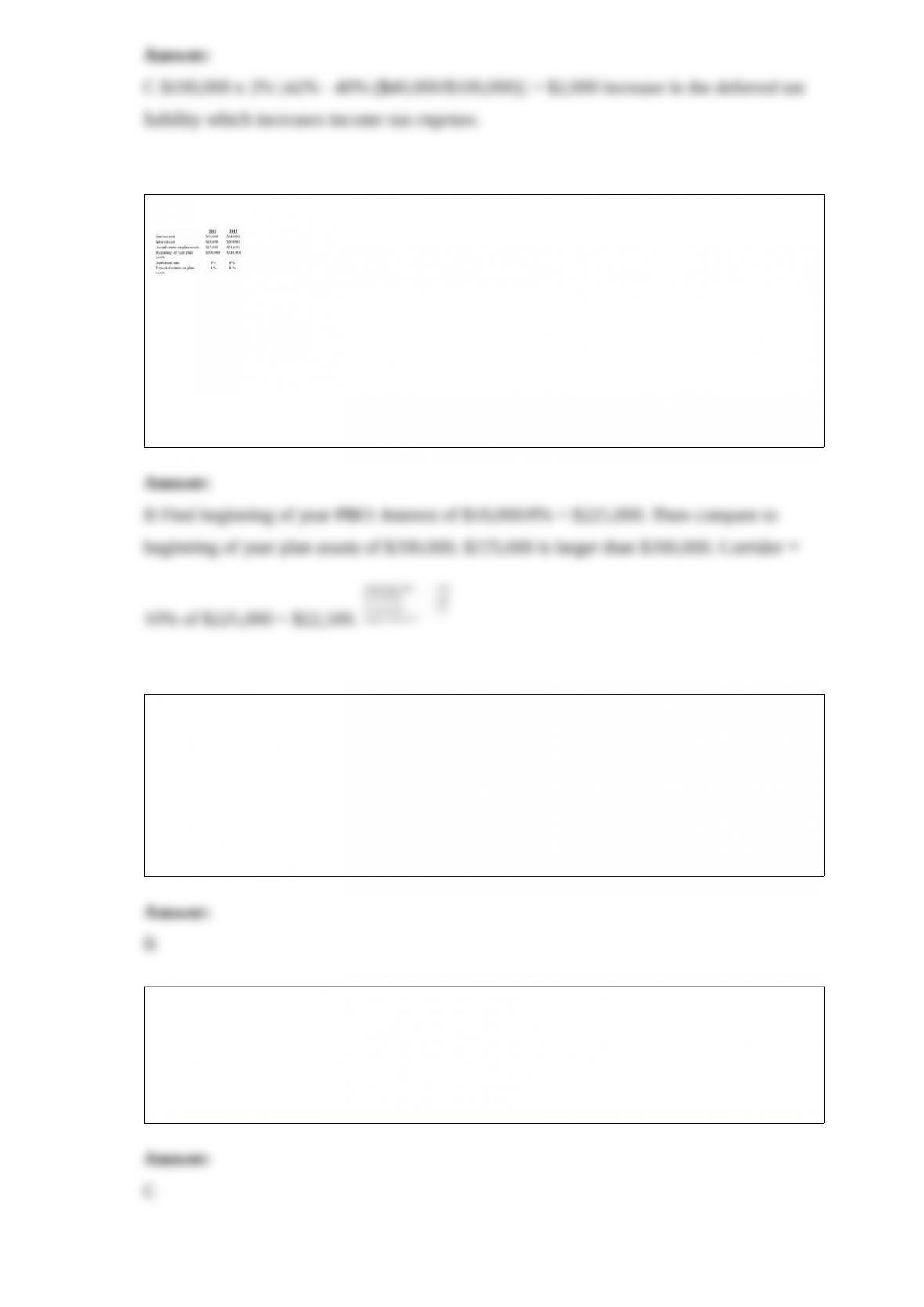
22) Smith, Inc. has a pension plan with the following data available for 2011 and 2012:
If the beginning unrecognized gains are $30,000, the market value of the plan assets is
$200,000 at the beginning of 2011, and the average remaining service period of active
employees is 10 years, the amortization of accumulated unrecognized gains for 2011 is
A.$0
B.$750
C.$1,000
D.$2,000
23) Investors who follow a fundamental analysis approach
A.determine the value the company’s assets would yield if sold individually
B.estimate the value of a stock by assessing the amount, timing, and uncertainty of
future cash flows that will accrue to the issuing company
C.assess the company’s ability to meet its debt-related financial obligations
D.assess the company’s ability to raise additional cash by selling assets, issuing stock,
or borrowing more
24) The dominant method under GAAP for measuring long-lived assets is the
A.expected benefit approach
B.discounted present value approach
C.historical cost approach
D.replacement cost approach

25) Playworld, Inc. sells playground equipment to schools and municipalities. Invoices
are mailed at the end of each month for all goods shipped during that month; credit
terms are net 30 days. Sales and accounts receivable data for 2011, 2012, and 2013
were as follows:
Required:
a. Calculate the growth rates in sales and receivables during 2012 and 2013 .
b. Do your calculations indicate any potential problems with Playworld’s receivables? If
so, suggest a possible explanation for your findings.
26) The inventory accounts of a manufacturer would include all of the following
accounts except
A.raw materials inventory
B.work-in-process inventory
C.finished goods inventory
D.sold goods awaiting shipment inventory
27) When a debt covenant is violated, the related debt must be classified as current if it
is
A.probable that the borrower will not be able to cure the default within the next twelve
months
B.probable that the borrower will not be able to cure the default within the next fifteen
months

C.probable that the borrower will be able to cure the default in the next twelve months
D.probable that the borrower will be able to cure the default in the next fifteen months
28) Adjusting entries must be made
A.to correct errors in the accounts
B.to reconcile the accounts to the budget
C.because auditing standards require them
D.because certain types of events will otherwise not be recorded in the accounts
29) The GAAP solution for avoiding distortions that would result from setting income
tax expense equal to taxes owed is called
A.intraperiod tax allocation
B.interperiod tax allocation
C.book income allocation
D.intraperiod book allocation of income
30) The “market” value for item N-05 is
A.$20
B.$24
C.$28
D.$30
31) Retained earnings are reported on the balance sheet at
A.historical cost
B.current market value
C.net realizable value
D.a mixture of different measurement bases

32) Banking regulators have a powerful weapon to encourage compliance with
minimum capital guidelines as they can impose costs on noncomplying banks by doing
any or all of the following except
A.require the bank to increase the number of outside directors on its board
B.require the bank to submit a plan describing how and when its capital will be
increased
C.subject the bank to more frequent examinations by the regulator
D.deny a request to merge, open new branches, or expand services
33) The trustee for the Bronson Corporation pension sent a report to the CEO with the
following information for the fiscal year:
At the end of the year, the pension plan is
A.underfunded by $20,000
B.overfunded by $20,000
C.underfunded by $24,000
D.overfunded by $24,000
34) Investing activities include the cash effects of
A.producing and delivering goods and services
B.purchasing and disposing of fixed assets used in production of revenue
C.borrowing and repaying loans used to purchase fixed assets
D.selling stocks and bonds to raise capital to purchase fixed assets
35) The carrying value of the Lite investment at the end of 2012 is
A.$200,000
B.$290,000
C.$272,000
D.$263,000

36) If a car dealership leases cars for four years with guaranteed purchase options,
guaranteed residual values, and insured financing agreements, these leases are treated as
A.operating leases
B.capital leases
C.sales-type leases
D.direct-financing leases
37) The FASB addressed simultaneous financing and investing activities by requiring
they be
A.ignored
B.reported separately on a supplemental schedule to the cash flow statement
C.reported on the retained earnings statement
D.reported separately on the income statement
38) A company instituted an IRS approved plan to fund a percentage of each employee’s
salary to a plan that would pay benefits to the employee after termination of services.
This plan is a
A.defined benefit pension plan
B.defined contribution pension plan
C.government sponsored pension plan
D.postretirement benefit plan
39) During its first year of operations a company recorded accrued warranty expense
totaling $75,000 for book purposes. For tax purposes, $25,000 of the expenses are
deductible during the first year of operations and $50,000 are deductible during the
second year of operations. Book income from operations during the first year was
$750,000. The income tax rate was 40% during the first year of operations and 45%
during the second year of operations. The income tax expense to be reported in the
income statement for the first year of operations is
A.$297,500
B.$300,000
C.$277,500
D.$280,000

40) Which of the following statements concerning IFRS and the statement of cash flows
is correct?
A.When large foreign companies that follow IFRS prepare the statement of cash flows
they overwhelmingly use the direct method to prepare the cash flow from operating
activities section
B.IFRS permits companies to classify interest paid, interest received, and dividends
received as part of either investing or operating activities
C.IFRS rules permit firms that use bank overdrafts repayable on demand as part of their
normal cash management activities to include those amounts as a component of cash
and cash equivalents
D.IFRS rules require firms that use the direct method to also provide a reconciliation of
net income to cash flows from operating activities (essentially the indirect method)
41) The denominator used in the calculation of basic earnings per share is the
A.number of common shares outstanding at the end of the year
B.number of preferred shares outstanding at the end of the year
C.weighted average number of common shares outstanding during the year
D.weighted average number of common shares and preferred shares outstanding during
the year
42) What indication for the following firm behavior can be found in the statement of
cash flows?
a. Difficulties in cash collections
b. Decrease in investments in long term assets
43) Dot Company issued $200,000 of bonds on January 1, 2011 with interest payable
each year. The bonds had a stated rate of 8%. The bonds were set up as floating-rate

debt with the rated pegged to LIBOR plus 3%. Which of the following will be the
interest expense for year 1 if LIBOR is 5%?
A.$6,000
B.$10,000
C.$16,000
D.$18,000
44) Long-term debt is reported on the balance sheet at
A.current market value
B.net realizable value
C.discounted present value
D.future value
45) An analytical tool that measures a company’s performance against a predetermined
standard is a/an
A.benchmark comparison analysis
B.profitability analysis
C.time-series analysis
D.common size statement
46) Shareholders who sell back shares of the company stock as treasury stock are
A.not taxed
B.taxed at ordinary rates
C.taxed at capital gains rates
D.subject to tax penalties
47) The following information has been provided to you by the Smith Corporation for
the year ending December 31, 2011:
The numerator used in the calculation of basic earnings per share was $797,000.
Cash dividends were paid to the common shareholders.
8% convertible bonds with a par value of $1,000,000 were issued on July 1, 2011 .

The corporation’s marginal income tax rate is 40%.
6% convertible preferred stock with a par value of $800,000 were outstanding during
the entire year.
Assuming that both the bonds and preferred stock are dilutive, what is the numerator
that should be used in the calculation of diluted earnings per share?
A.$893,000
B.$869,000
C.$773,000
D.$821,000
48)
Using the market price (production) method, how much net revenue should Sarver
recognize in Year 2?
A.$4,000
B.$12,000
C.$24,000
D.$42,000
49) Corona Industries purchased a stamping machine on January 2, 2008, for $100,000.
It paid $20,000 down and financed the balance over 5 years at State Bank. Terms of the
loan were 10% interest payable on December 31 each year with a required $16,000
principal payment. 2011 proves to be a difficult year and on December 1, Corona
negotiates a debt restructuring with State Bank. The settlement calls for cash payment
of accrued interest plus $4,000 on December 1 and the transfer of 200 acres of land held
by Corona that cost $15,000. The land has a current market value of $22,000.
What is the amount of the receivable restructuring gain or loss to State Bank?
A.$6,000 loss
B.$6,000 gain
C.$13,000 loss
D.$8,933 gain

50) GAAP specifies that for a seller to record revenue at time of sale when right of
return exists the following conditions must be met except:
A.The seller’s price to the buyer is substantially fixed or determinable at the date of sale
B.The buyer has paid the seller, or the buyer is obligated to pay the seller and the
obligation is not contingent on resale of the product
C.The buyer’s obligation to the seller changes in the event of theft or physical
destruction or damage of the product
D.The amount of future returns can be reasonably estimated
51) On December 15, 2012 Ace Industries repurchased 200,000 shares of its common
stock for $10 per share. Based on its shareholders’ equity accounts, what can be inferred
about this purchase?
A.Ace is holding $2,000,000 of treasury stock which is being disclosed in the notes to
the financial statements.
B.Ace retired the shares by reducing the common stock and paid-in capital accounts.
C.Ace is reporting the shares as a $2,000,000 investment on the asset side of the
balance sheet.
D.Not enough information is provided to determine how Ace recorded the purchase.
52) Perry Investments bought 2,000 shares of Able, Inc. common stock on January 1,
2012, for $20,000 and 2,000 shares of Baker, Inc. common stock on July 1, 2012 for
$24,000. Baker paid $2,400 of previously declared dividends to Perry on December 31,
2012 . At the end of 2012, the market value of the Able stock was $18,000 and the
market value of the Baker stock was $28,000. The stocks were purchased for short-term
speculation. Perry owns 10% of each company.
Perry should record the receipt of the Baker dividend as
A.Option a
B.Option b
C.Option c
D.Option d
53) On December 31, 2011, the Lilly Corporation reported a deferred tax liability
totaling $12,000, resulting from depreciation timing differences pertaining to a
depreciable asset purchased during 2011 . Lilly uses straight-line depreciation over four
years for GAAP (book) purposes; for tax purposes, the depreciation deduction is 40%

of cost during 2011, 30% of cost during 2012, 20% of cost during 2013, and 10% of
cost during 2014 . During 2012, Lilly expensed $75,000 of warranty costs that will be
deducted for tax purposes in future years. Lilly also accrued revenue totaling $150,000
which is taxable in 2013. Lilly’s GAAP (book) income before taxes during 2012 totaled
$397,700. The marginal income tax rate is 40% for all years.
Requirement:
Prepare the journal entry to record income tax expense for the year ended December 31,
2012 .
54) On July 1, 2012, Colby Company sold equipment to Cheddar Corporation and
simultaneously leased it back for five years. The equipment’s fair market value on July
1, 2012 was $875,000 and its book value was $700,000. Colby and Cheddar agreed to
an 8% interest rate with respect to the lease transaction. The equipment has a remaining
life of five years and an estimated salvage value of zero after five years. Colby is
required to make annual payments of $202,916 beginning July 1, 2012 .
Required:
Prepare the necessary journal entries for Colby Company to record the sale-leaseback
for the year ended December 31, 2012 . Assume that the lease qualifies as a capital
lease from Colby’s perspective.
55) For sale of receivables with recourse, what is, if any, the required disclosure?
Explain the importance of this point.

56) A pr
57) The following information was obtained from the Warrior Corporation’s financial
statements for the year ending December 31, 2012:
Bonds with a maturity value of $600,000 were issued for cash.
The premium on bonds payable account increased $12,500 during the year.
Bond interest expense was $30,500.
There was $500 of amortization of premium on newly issued bonds payable.
Retained earnings increased $119,300 during the year.
A 5% common stock dividend resulted in 5,000 shares of $5 par value common stock
being issued at a time when the market price per share was $17.
Common stock was sold in exchange for cash.
The common stock account increased $70,000 during the year.
The additional paid-in capital account increased $210,000 during the year.
Net income for the year was $217,400.
Required: Determine the cash flow from financing activities for the year ending
December 31, 2012 .
58) On January 1, 2011, when the market rate of interest was 12%, Habs Company
issued five-year bonds with a maturity value of $750,000. The bonds have a 10% stated
rate and pay interest semi-annually on July 1 and December 31 .
Requirements:
1> Calculate the bond discount as of the date of issue.
2> Calculate the bond discount balance as of January 1, 2012 .
59) Describe the role of accounting numbers in corporate valuation.