
The annual percentage rate considers the effects of periodic compounding.
The Securities and Exchange Commission was established to give the investor the
support of a state regulatory agency that enforces both reporting and disclosure
requirements of companies whose stocks are publicly traded.
Money market securities have maturities ranging from one month to two years.
When the NPV and IRR methods conflict, for the most part, IRR is preferred over NPV.

Proceeds from the sale of old equipment are generally not considered when estimating
cash flows.
A firm should evaluate a project according to the incremental cash flow principle and
should incorporate only negative effects on other existing projects.
When a nation expropriates a multinational firm’s property, it must compensate the
firm, but the payment is usually less than the true value of the property taken.
A business plan is a picture or model of what management expects a business to
become in the future expressed in words and numbers. The numbers are mainly
financial projections.

The present value of the cash flows that come from an investment is the minimum price
an investor should be willing to pay for the investment.
Expansion projects tend to require the same elements as new ventures, but generally
require less new equipment and facilities.
Ratios are typically compared with similar figures from history, the competition, and
budget.
The cost of capital components to companies is exactly the return received by investors
who buy those securities.

It is a basic truth that financial leverage magnifies changes in operating income (EBIT)
into larger changes in ROE and EPS. The greater the degree of financial leverage
(DFL), the larger the magnification.
If karepresents the average cost of capital, there is a positive correlation between an
increase in kaand an increase in the value of the firm.
By foregoing the prompt payment discount offered in terms of 2/10, net 30, the
customer is effectively borrowing at rate of 36.5%.
Management is prone to overstate:
A.accounts receivable and inventory.

B.accounts receivable, but not inventory.
C.inventory, but not accounts receivable.
D.neither accounts receivable nor inventory.
If three seats on the board of directors are up for election, cumulative voting on
common stock allow stockholders to:
A.cast one vote per share owned for three different candidates.
B.cast up to three votes per share owned for any one candidate.
C.save votes from a prior board of directors’ election and cast them in the current
election.
D.cumulative voting only applies to preferred stock.
E.None of the above are true
Under which of the following inventory financing arrangements does the borrower
remain in physical control of the inventory?
A.Blanket liens and chattel mortgage agreements
B.Field warehousing
C.Public warehousing
D.The borrower doesn’t remain in complete physical control of the inventory under any

of these arrangements.
Preferred stock is paying an annual dividend of $9.50 and is currently trading at $79.16.
Assume floatation costs of 12%. What is the cost of preferred stock?
A.8.33%
B.9.47%
C.10.56%
D.12.00%
E.13.64%
If a firm is losing money, the after-tax cost of debt is:
A.equal to kd(1 – T).
B.found by trial and error.
C.equal to the pretax cost of debt.
D.None of the above

A firm has decided to increase the time it takes to pay suppliers from 45 days to 55
days. The industry average is 30 days. Holding all other variables constant, which of the
following statement(s) is/are true?
A.The firm is stretching payables
B.Current liabilities will increase
C.The current ratio will decrease
D.Both a & b
E.All of the above (a, b, and c) are correct.
Which class of investors do not have claims on the income and assets of the firm prior
to preferred shareholders?
A.Bondholders
B.Creditors
C.Lenders such as banks
D.Common shareholders

Assume the following selected financial information about a firm that is about to
restructure capital by exchanging equity for debt:
Which of following would be true as a result of the restructuring according to the
Modigliani-Miller model with taxes but without bankruptcy costs?
A.The new debt would contribute $600,000 to the value of equity due to its tax effect.
B.The market value of the remaining equity would be $1,500,000.
C.The total value of the firm would increase to $3,000,000.
D.All of the above.
Credit policy consists of:
A.the period over which credit is granted.
B.procedures undertaken to collect overdue accounts.
C.the length of the credit period and the discount offered.
D.the guidelines used to decide which customers get credit.

The Antitrust Laws:
A.may prevent mergers.
B.have been enforced with varying strictness at different times by the Justice Dept. and
the FTC.
C.are aimed at keeping the economy competitive.
D.All of the above
Considering that a firm has a PE ratio of 71.4 and an EPS of 0.1, what is the price of a
stock that pays an annual dividend of $1.00?
A.7.14
B.71.4
C.0.714
D.0.0714
TNT, Inc. is considering making a tender offer for Blasting Caps Corp. (BCC), one of
their primary suppliers. The equity section of BCC’s balance sheet totals $4.95 million,
and BCC stock is currently selling 20% above book value. TNT is planning to offer a
15% premium to make the offer attractive. If BCC has 200,000 shares outstanding,
calculate the per share price of the tender offer.
A.$24.75
B.$29.70
C.$54.45
D.$34.16
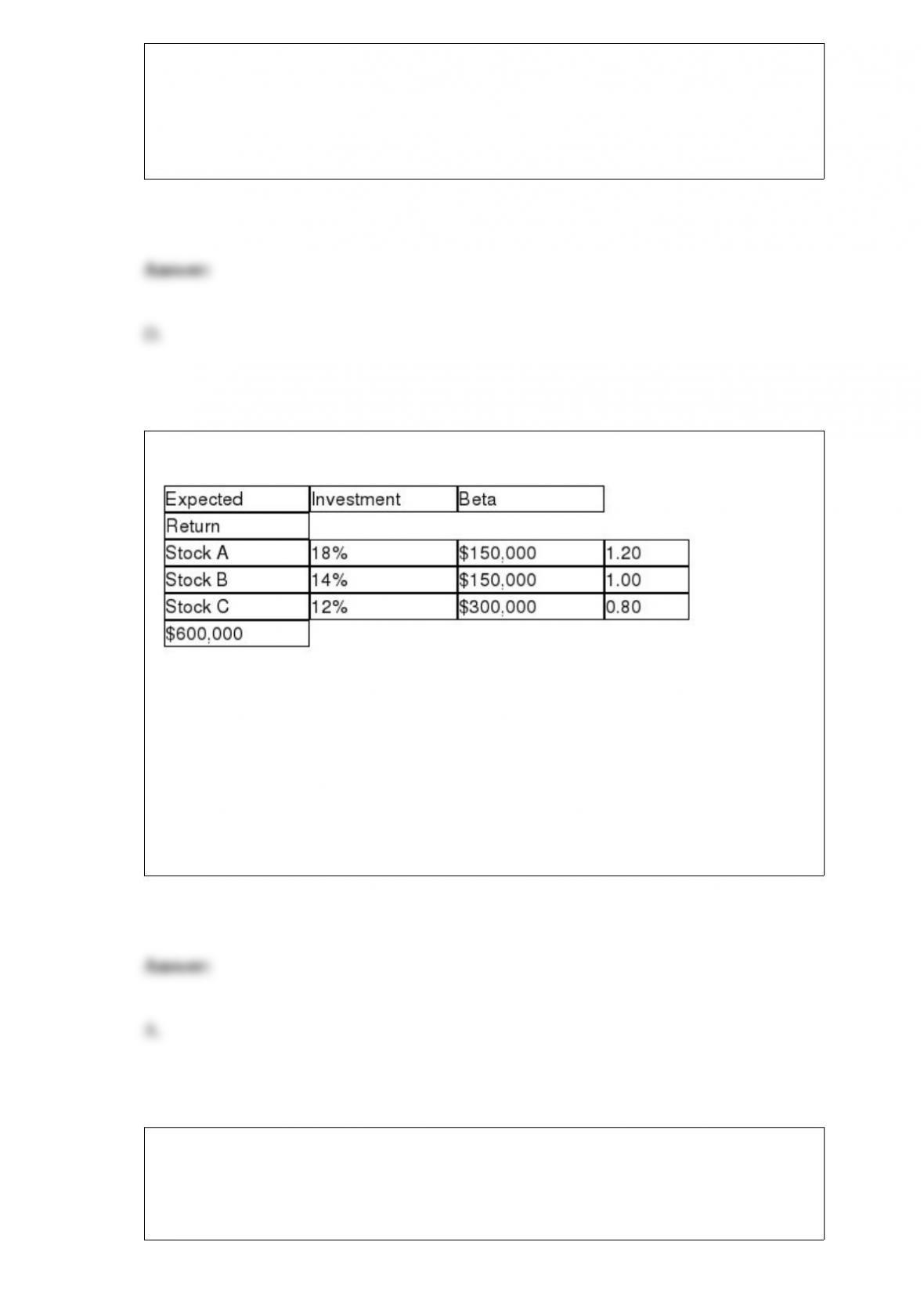
Assume a portfolio is made up of three stocks:
The portfolio’s beta is:
A.0.95.
B.1.15.
C.1.00.
D.None of the above
Maturity risk exists because the prices of longer-term bonds fluctuate more in response
to:
A.government policy changes.

B.company policy changes.
C.industry changes.
D.interest rate changes.
A stock has an expected return of 10% and a variance of 25%. Its coefficient of
variation is:
A.2.5.
B.0.4.
C.5.0.
D.2.0.