1) Most business loans today are __________________.
A.Pre-negotiated lines of credit
B.Spot loans
C.Collateralized lines of credit
D.None of these
2) Balance Sheet You are evaluating the balance sheet for Campus Corporation. From
the balance sheet you find the following balances: Cash and marketable securities =
$400,000, Accounts receivable = $200,000, Inventory = $100,000, Accrued wages and
taxes = $10,000, Accounts payable = $300,000, and Notes payable = $600,000. What is
Campus’s net working capital?
A.-$210,000
B.$700,000
C.$910,000
D.$1,610,000
3) The asset pricing theory based on a beta, a measure of market risk.
A.Behavioral Asset Pricing Model
B.Capital Asset Pricing Model
C.Efficient Markets Asset Pricing Model
D.Efficient Market Hypothesis
4) Suppose your firm is considering two independent projects with the cash flows
shown below. The required rate of return on projects of both of their risk class is 12
percent, and the maximum allowable payback and discounted payback statistic for the
projects are 2.5 and 3 years, respectively.
Use the PI decision rule to evaluate these projects; which one(s) should be accepted or
rejected?
A.accept both A and B
B.accept neither A nor B
C.accept A, reject B
D.reject A, accept B
5) Your company faces a 30% tax rate and has $300 million in assets, currently financed
entirely with equity. Equity is worth $10 per share, and book value of equity is equal to
market value of equity. Also, let’s assume that the firm’s expected values for EBIT
depend upon which state of the economy occurs this year, with the possible values of
EBIT and their associated probabilities as shown below:
The firm is considering switching to a 30-percent debt capital structure, and has
determined that they would have to pay a 9 percent yield on perpetual debt in either
event. What will be the standard deviation in EPS if they switch to the proposed capital
structure?
A.0.1228
B.0.2463
C.0.3562
D.0.4963
6) This type of bankruptcy involves a business liquidating their assets.
A.Chapter 7
B.Chapter 11
C.Chapter 13
D.Chapter 9
7) These ratios show the combined effects of liquidity, asset management, and debt
management on the overall operation results of the firm.
A.Liquidity
B.Coverage
C.Financial
D.Profitability
8) Suppose your firm has decided to use a divisional WACC approach to analyze
projects. The firm currently has 2 divisions, A and B, with betas for each division of 0.5
and 1.5, respectively. If all current and future projects will be financed with half debt
and half equity, and if the current cost of equity (based on an average firm beta of 1.0
and a current risk-free rate of 5%) is 14% and the after-tax yield on the company’s
bonds is 6%, what are the WACCs for divisions A and B?
A.7.75%; 12.25%
B.8.75%; 12.00%
C.9.25%; 11.00%
D.8.95%; 10.15%

9) Jane invests all of her money in the stock of one firm. Which one of the following
statements must be true?
A.Jane’s stock will have more diversifiable risk than the overall stock market
B.Jane’s stock will have less diversifiable risk than the overall stock market
C.Jane’s stock will have the same amount of diversifiable risk as the overall stock
market
D.There is no basis for comparing the diversifiable risk of Jane’s stock to that of the
overall market
10) You have been asked by the president of your company to evaluate the proposed
acquisition of a new special-purpose truck for $50,000. The truck falls into the MACRS
three-year class, and it will be sold after three years for $20,000. Use of the truck will
require an increase in NWC (spare parts inventory) of $2,500. The truck will have no
effect on revenues, but it is expected to save the firm $20,000 per year in before-tax
operating costs, mainly labor. The firm’s marginal tax rate is 40 percent. What will the
free cash flows for this project be?
A.Yr 0 Cash flow: -$50,000; Yr 1 Cash flow: $18,666; Yr 2 Cash flow: $20,890; Yr 3
Cash flow: $28,444
B.Yr 0 Cash flow: -$50,000; Yr 1 Cash flow: $18,666; Yr 2 Cash flow: $21,890; Yr 3
Cash flow: $28,444
C.Yr 0 Cash flow: -$52,500; Yr 1 Cash flow: $18,666; Yr 2 Cash flow: $20,890; Yr 3
Cash flow: $30,944
D.Yr 0 Cash flow: -$52,500; Yr 1 Cash flow: $18,666; Yr 2 Cash flow: $22,890; Yr 3
Cash flow: $30,944
11) Your company doesn’t face any taxes and has $250 million in assets, currently
financed entirely with equity. Equity is worth $8 per share, and book value of equity is
equal to market value of equity. Also, let’s assume that the firm’s expected values for
EBIT depend upon which state of the economy occurs this year, with the possible
values of EBIT and their associated probabilities as shown below:
The firm is considering switching to a 20-percent debt capital structure, and has
determined that they would have to pay a 9 percent yield on perpetual debt in either
event. What will be the level of expected EPS if they switch to the proposed capital
structure?
A.$1.02
B.$1.42
C.$1.82
D.$2.00
12) In 2004, Microsoft paid one of the largest extraordinary dividends in history. All of
the following contributed to this historical event except ___________________.
A.The Jobs & Growth Tax Relief Reconciliation Act (JGTRRA) of 2003 made the tax
rate less burdensome to investors
B.Microsoft was interested in changing its capital structure
C.Microsoft had a lot of cash on its balance sheet
D.Microsoft was not making significant investment in capital budgeting projects as
compared to its cash balance
13) Suppose that Road Industries currently has the balance sheet shown below, and that
sales for the year just ended were $80 million. The firm also has a profit margin of 5
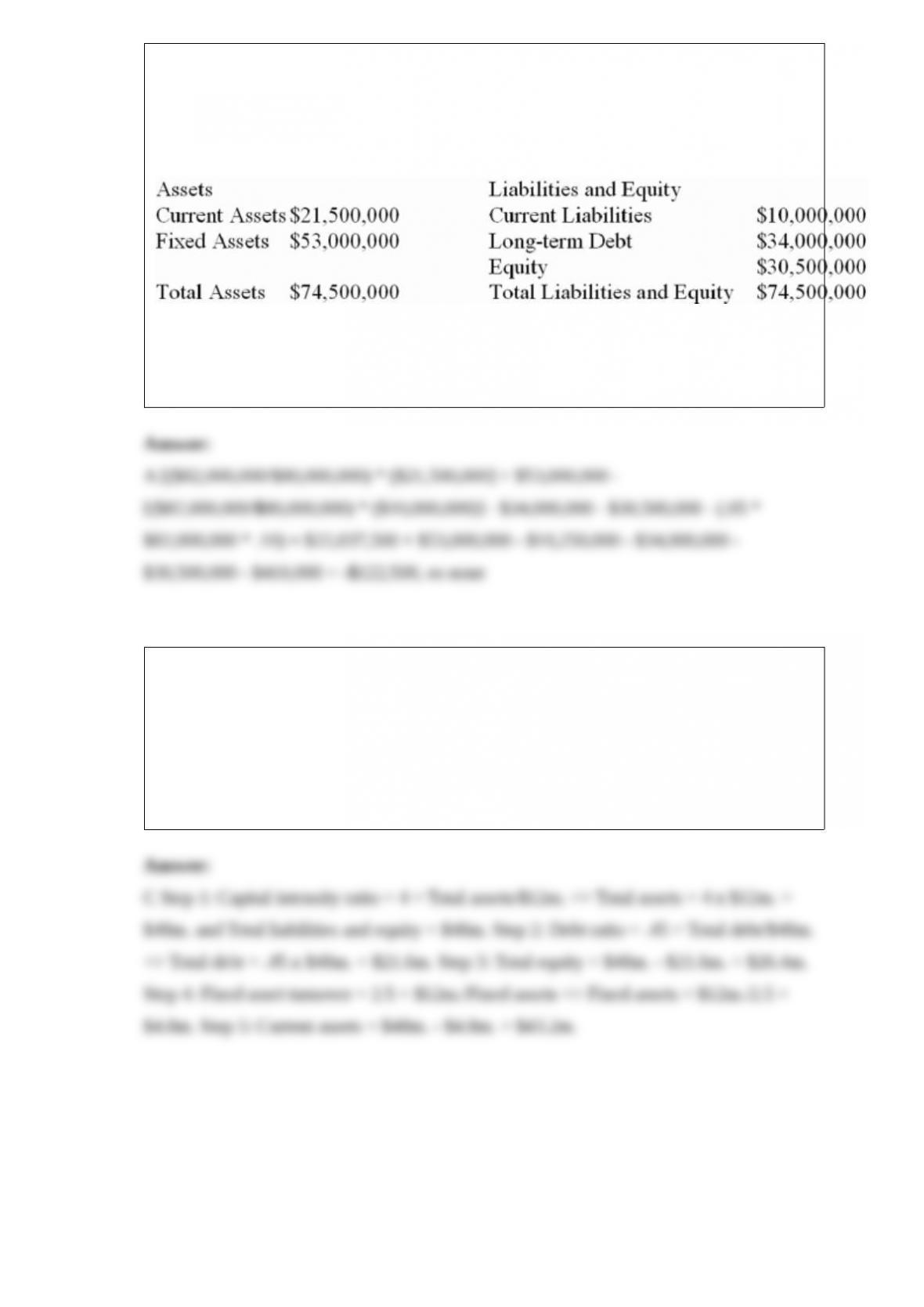
percent, a retention ratio of 10 percent, and expects sales of $82 million next year. If
fixed assets have enough capacity to cover the increase in sales and all other assets and
current liabilities are expected to increase with sales, what amount of additional funds
will the company need from external sources to fund the expected growth?
A.$0
B.$122,500
C.$112,500
D.$287,500
14) Asset Management and Debt Management Ratios Use the following information to
calculate current assets: Sales = $12 million, capital intensity ratio = 4 times, debt ratio
= 45%, and fixed asset turnover ratio = 2.5 times.
A.$4.8 m
B.$21.6 m
C.$43.2 m
D.$48 m
15) Currency Exchange Compute the number of dollars that can be bought with 2
million of foreign currency units:
$1 = 48.210 Philippine Peso
A.$41,485.16905
B.$1,959,439.60
C.$414,851.6905
D.$4,148,516.905
16) Which of the following is the theory relating the expected adjustment needed in the
future spot exchange rate between countries to the inflation rate in each country?
A.purchasing power parity
B.interest rate parity
C.law of one price
D.currency swap parity
17) Rule of 72 Approximately how many years does it take to double a $500 investment
when interest rates are 4% per year?
A..06 years
B.6 years
C.6.94 years
D.18 years
18) A 2-year Treasury security currently earns 5.13%. Over the next 2 years, the real
interest rate is expected to be 2.15% per year and the inflation premium is expected to
be 1.75% per year. Calculate the maturity risk premium on the 2-year Treasury security.

A.5.13%
B.3.38%
C.2.98%
D.1.23%
19) As residual claimants, these investors claim any cash flows to the firm that remain
after the firm pays all other claims.
A.creditors
B.bondholders
C.preferred stockholders
D.common stockholders
20) Law of One Price If the price of silver in England is £7.10 per ounce, what is the
expected price of silver in the United States if the spot exchange rate is $1 = £0.5275?
A.$7.6275 per ounce
B.$7.429 per ounce
C.$3.74525 per ounce
D.$13.4597 per ounce
21) Your current $155,000 mortgage calls for monthly payments over 25 years at an
annual rate interest rate of 6%. If you pay an additional $50 each month beginning with
the first payment, how much interest expense do you save by pre-paying?
A.$15,981.28
B.$16,009.62
C.$17,152.22
D.$19,001.69

22) Calculating the Probability of Bankruptcy A linear probability model you have
developed finds there are two factors influencing the past bankruptcy behavior of firms:
the debt-to-equity ratio and the sales-to-total assets ratio. Based on past bankruptcy
experience, the linear probability model is estimated as:
PDi = .60 (debt/equity) + .02 (sales/total assets)
A firm you are thinking of lending to has a sales-to-assets ratio of 1.75 and its expected
probability of default, or bankruptcy, is estimated to be 8.1 percent. Calculate the firm’s
debt ratio.
A.7.667%
B.7.12%
C.92.88%
D.8.1%
23) Suppose that LilyMac Photography has annual sales of $218,000, cost of goods sold
of $123,000, average inventories of $1,250, and average accounts receivable of
$22,000. Assuming that all of LilyMac’s sales are on credit, what will be the firm’s
operating cycle?
A.40.54 days
B.45.13 days
C.41.16 days
D.37.82 days
24) This is an estimated WACC computed using some sort of proxy for the average
equity risk of the projects in a particular division.
A.Average WACC
B.Divisional WACC
C.Proxy WACC
D.Pure-play WACC
25) Future Value Given a 6 percent interest rate, compute the year 6 future value of
deposits made in years 1, 2, 3, and 4 of $1,200, $1,400, $1,400, and $1,500.
A.$4,741.68
B.$5,986.26
C.$6,179.80
D.$6,726.16
26) When residual cash flows are high, stock values will be
A.unchanged
B.low
C.high
D.unpredictable
27) Investment Return TechNo stock was $25 per share at the end of last year. Since
then, it paid a $1.50 per share dividend last year. The stock price is currently $23. If you
owned 300 shares of TechNo, what was your percent return?
A.-2%
B.-8%
C.6%
D.6.5%
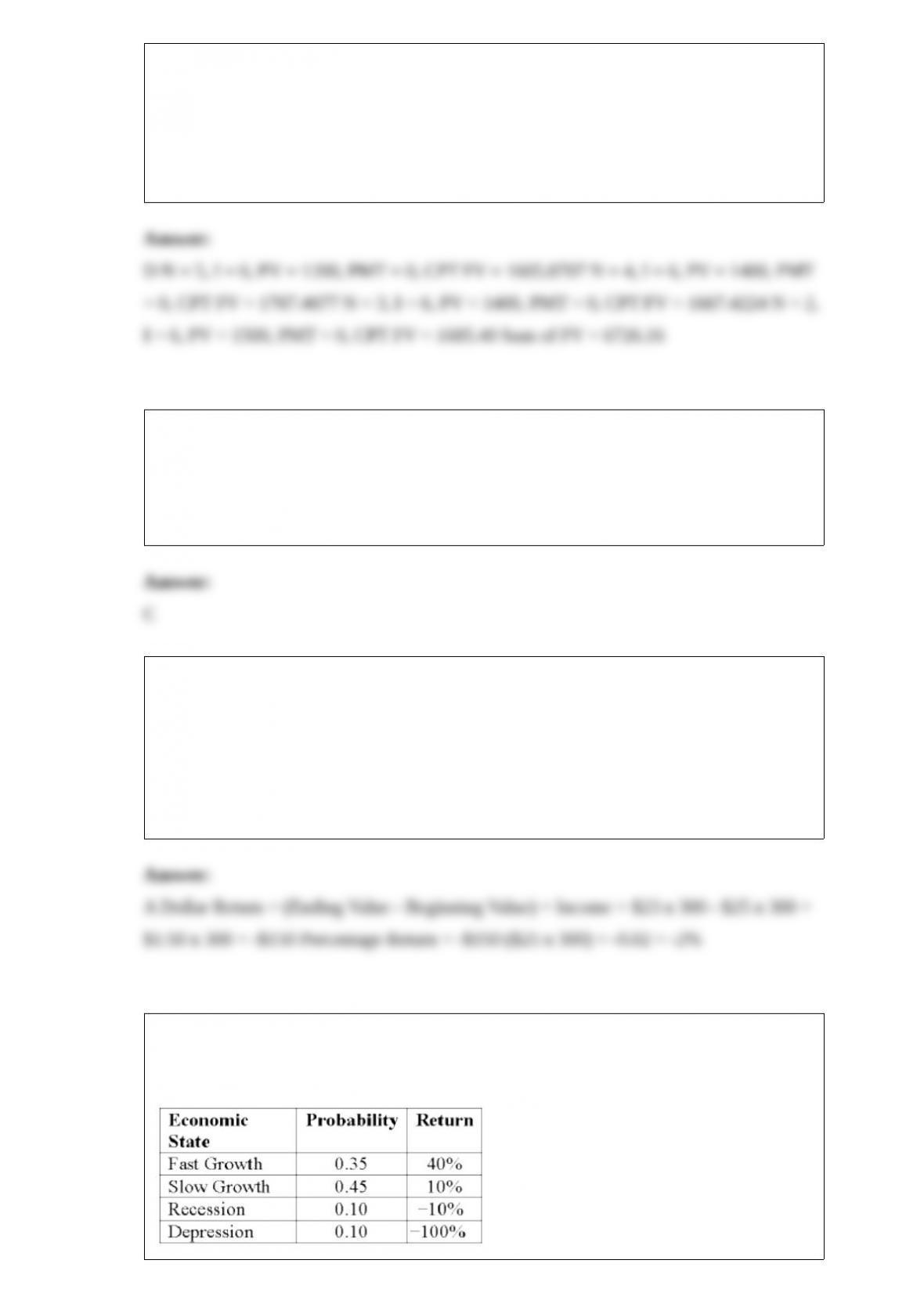
28) Expected Return and Risk Compute the standard deviation given these four
economic states, their likelihoods, and the potential returns:

A.7.5%
B.12.65%
C.39.48%
D.113.69%
29) Jasmine has decided that she wants to build enough retirement wealth that, if
invested at 6% per year, will provide her with $3,000 of monthly income for 30 years.
To date, she has saved nothing but she still has 25 years until she retires. Jasmine
believes that she can earn 9% on her investments until she retires. How much money
does she need to contribute per month to reach her goal?
A.$446.32
B.$521.84
C.$667.13
D.$722.05
30) Candy Town, Inc. normally pays a quarterly dividend. The last such dividend paid
was $2.00, all future quarterly dividends are expected to grow at 10 percent, and the
firm faces a required rate of return on equity of 15 percent. If the firm just announced
that the next dividend will be an extraordinary dividend of $5.00 per share that is not
expected to affect any other future dividends, what should the stock price be?
A.$40.00
B.$42.44
C.$00
D.$46.44

31) Calculating Costs of Issuing Stock TV Technology Corp. recently went public with
an initial public offering of 1.5 million shares of stock. The underwriter used a firm
commitment offering in which the net proceeds was $24.50 per share and the
underwriter’s spread was 5 percent of the gross proceeds. TV also paid legal and other
administrative costs of $300,000 for the IPO. Calculate the gross proceeds per share
received by TV from the sale of the 3 million shares of stock.
A.$24.50
B.$24.70
C.$25.79
D.$26.00
32) Suppose that the current one-year rate (one-year spot rate) and expected one-year
T-bill rates over the following 3 years (i.e., years 2, 3 and 4 respectively) are as follows:
1R1 = 5%, E(2r1) = 6%, E(3r1) = 7.5% E(4r1) = 7.85%
Using the unbiased expectations theory, calculate the current (long-term) rates for
three-year- and four-year-maturity Treasury securities.
A.One-year: 6.16%; Two-year: 6.58%
B.One-year: 6.16%; Two-year: 6.78%
C.One-year: 6.25%; Two-year: 6.45%
D.One-year: 5.95%; Two-year: 6.45%