
1) You have agreed to pay a five percent commission to your best friend if he can locate
a buyer for your car. This arrangement is most similar to the compensation arrangement
for which one of these individuals who is involved with the stock market?
A.Specialist
B.Floor trader
C.Market maker
D.Commission broker
E.Dealer
2) A firm has an equity multiplier of 1.5. This means that the firm has a:
A.debt-equity ratio of 0.67
B.debt-equity ratio of 0.33
C.total debt ratio of 0.50
D.total debt ratio of 0.67
E.total debt ratio of 0.33
3) The written agreement that contains the specific details related to a bond issue is
called the bond:
A.indenture
B.debenture
C.document
D.registration statement
E.issue paper
4) Which one of the following best exemplifies unsystematic risk?
A.Unexpected economic collapse
B.Unexpected increase in interest rates
C.Unexpected increase in the variable costs for a firm
D.Sudden decrease in inflation
E.Expected increase in tax rates
5) A project has sales of $462,000, costs of $274,000, depreciation of $28,000, interest
expense of $3,400, and a tax rate of 35 percent. What is the value of the depreciation

tax shield?
A.$9,800
B.$10,300
C.$10,650
D.$10,800
E.$11,350
6) Which of the following are money market securities?
I. jumbo CDs
II. short-term municipal debt
III. U.S. Treasury bills
IV. commercial paper
A.I and IV only
B.II and III only
C.I, II, and IV only
D.II, III, and IV only
E.I, II, III, and IV
7) You own a portfolio of two stocks, A and B. Stock A is valued at $6,540 and has an
expected return of 11.2 percent. Stock B has an expected return of 8.1 percent. What is
the expected return on the portfolio if the portfolio value is $9,500?
A.9.58 percent
B.9.62 percent
C.9.74 percent
D.9.97 percent
E.10.23 percent
8) Which two of the following determine when revenue is recorded on the financial
statements based on the recognition principle?
I. Payment is collected for the sale of a good or service
II. The earnings process is virtually complete
III. The value of a sale can be reliably determined
IV. The product is physically delivered to the buyer

A.I and II only
B.I and IV only
C.II and III only
D.II and IV only
E.I and III only
9) A firm earns $0.17 in profit for every $1 of equity in the firm. The company borrows
$0.60 for every $1 of equity. What is the firm’s return on assets?
A.10.63 percent
B.13.53 percent
C.25.15 percent
D.26.07 percent
E.28.33 percent
10) Town Centre Market has sales of $311,800, a profit margin of 2.9 percent, and
dividends of $4,500. What is the plowback ratio?
A.46.32 percent
B.49.78 percent
C.50.23 percent
D.51.15 percent
E.53.68 percent
11) You own a stock that has an expected return of 16.48 percent and a beta of 1.33.
The U.S. Treasury bill is yielding 3.65 percent and the inflation rate is 2.95 percent.
What is the expected rate of return on the market?
A.13.07 percent
B.13.30 percent
C.13.64 percent
D.14.09 percent
E.14.42 percent

12) Precision Engineering invested $110,000 at 6.5 percent interest, compounded
annually for 4 years. How much interest on interest did the company earn over this
period of time?
A.$2,481.25
B.$2,911.30
C.$3,014.14
D.$3,250.00
E.$3,333.33
13) A stock produced returns of 16 percent, 9 percent, and 21 percent over three of the
past four years. The arithmetic average for the past four years is 10 percent. What is the
standard deviation of the stock’s returns for the 4-year period?
A.6.82 percent
B.8.54 percent
C.9.09 percent
D.10.83 percent
E.11.75 percent
14) Which one of the following best defines the term credit scoring’?
A.Categorizing customers into groups depending upon the length of time it takes each
customer to pay for purchases
B.Compiling a list of accounts receivables segregated by the length of time each
receivable has been outstanding
C.Evaluating the opportunity costs of a credit policy
D.Process of quantifying the probability of default when granting credit to customers
E.Tracking of both the number and the size of customer orders over a period of time
15) The Road House Diner is offering 10,000 shares of stock to the general public on a
cash basis. Which one of the following terms best applies to this offer?
A.Rights offer
B.General cash offer
C.Green Shoe

D.Red herring
E.Prospectus
16) A.B. Securities assists issuers by pricing and selling new securities to the general
public. Which one of the following terms best fits the role that A. B. Securities is
playing?
A.Underwriter
B.Investment advisor
C.Specialist
D.Securities dealer
E.Venture capitalist
17) Miller & Miller sells earnings forecasts for Chinese securities. Its credit terms are
1/5, net 15. Based on experience, 75 percent of all customers take the discount. What is
the average collection period?
A.6.0 days
B.6.5 days
C.7.0 day
D.7.5 days
E.8.0 days
18) An all-equity firm has net income of $27,300, depreciation of $7,400, and taxes of
$2,050. What is the firm’s operating cash flow?
A.$17,850
B.$21,950
C.$29,350
D.$34,700
E.$36,750
19) Dressler Engine Tuning just decided to save money each year for the next 4 years to

help fund a new building. If it earns 5.5 percent on its savings, how much will the firm
have saved at the end of year 4?
A.$107,525.40
B.$108,392.69
C.$110,414.14
D.$111,737.43
E.$117,882.99
20) Which of the following should be included in the analysis of a new product?
I. Money already spent for research and development of the new product
II. Reduction in sales for a current product once the new product is introduced
III. Increase in working capital needed to finance sales of the new product
IV. Interest expense on the loan used to finance the new product launch
A.II and III only
B.II and IV only
C.I, II, and III only
D.II, III, and IV only
E.I, II, III, and IV
21) Casper’s is analyzing a proposed expansion project that is much riskier than the
firm’s current operations. Thus, the project will be assigned a discount rate equal to the
firm’s cost of capital plus 3 percent. The proposed project has an initial cost of $17.2
million dollars that will be depreciated on a straight-line basis over 20 years. The
project also requires additional inventory of $687,000 over the project’s life.
Management estimates the facility will generate cash inflows of $2.78 million a year
over its 20-year life. After 20 years, the company plans to sell the facility for an
estimated $1.3 million. The company has 60,000 shares of common stock outstanding
at a market price of $49 a share. This stock just paid an annual dividend of $1.84 a
share. The dividend is expected to increase by 3.5 percent annually. The firm also has
10,000 shares of 12 percent preferred stock with a market value of $98 a share. The
preferred stock has a par value of $100. The company has a 9 percent, semiannual
coupon bond issue outstanding with a total face value of $1.1 million. The bonds are
currently priced at 102 percent of face value and mature in 16 years. The tax rate is 33
percent. Should the firm pursue the expansion project at this point in time? Why or why
not?

A.Accept; The NPV is $2.648 million
B.Accept; The NPV is $4.507 million
C.Reject; The NPV is -$3.241 million
D.Reject; The NPV is -$3.027 million
E.Reject; The NPV is -$1.040 million
22) Operating cash flow is defined as:
A.a firm’s net profit over a specified period of time
B.the cash that a firm generates from its normal business activities
C.a firm’s operating margin
D.the change in the net working capital over a stated period of time
E.the cash that is generated and added to retained earnings
23) Suppose that a small, rural city in the countryside of North Dakota plans to issue
$150,000 worth of 10-year bonds. Which one of the following components of the
bond’s yield will be affected by the fact that no active secondary market is expected for
these bonds?
A.real rate
B.liquidity premium
C.interest rate risk premium
D.inflation premium
E.taxability premium

24) Phil is reviewing ABC Company’s dividend policy as it relates to the firm’s
shareholders. As part of this review, he wants to divide shareholders into two basic
categories in respect to dividend payments. The first group will be shareholders who are
taxed on dividend income and the second group will be shareholders who receive some
form of tax break on dividend income. Which of the following types of shareholders
should be placed in the tax-favored second group?
I. corporate
II. pension fund
III. individuals
IV. trust funds
A.I only
B.III only
C.I and III only
D.II and IV only
E.I, II, and IV only
25) Which one of the following generally pays a fixed dividend, receives first priority
in dividend payment, and maintains the right to a dividend payment, even if that
payment is deferred?
A.Cumulative common
B.Noncumulative common
C.Noncumulative preferred
D.Cumulative preferred
E.Senior common
26) You live in the U.S. and want to invest in a Chinese company, which will be
referred to as “CC”, because you believe its stock is uniquely positioned to be unusually
profitable over the next five years. However, you do not have direct access to the
Chinese financial markets. You may be able to indirectly invest in CC by purchasing
which one of the following?
A.Swap
B.ADR
C.Gilt
D.Bulldog bond
E.Samurai bond
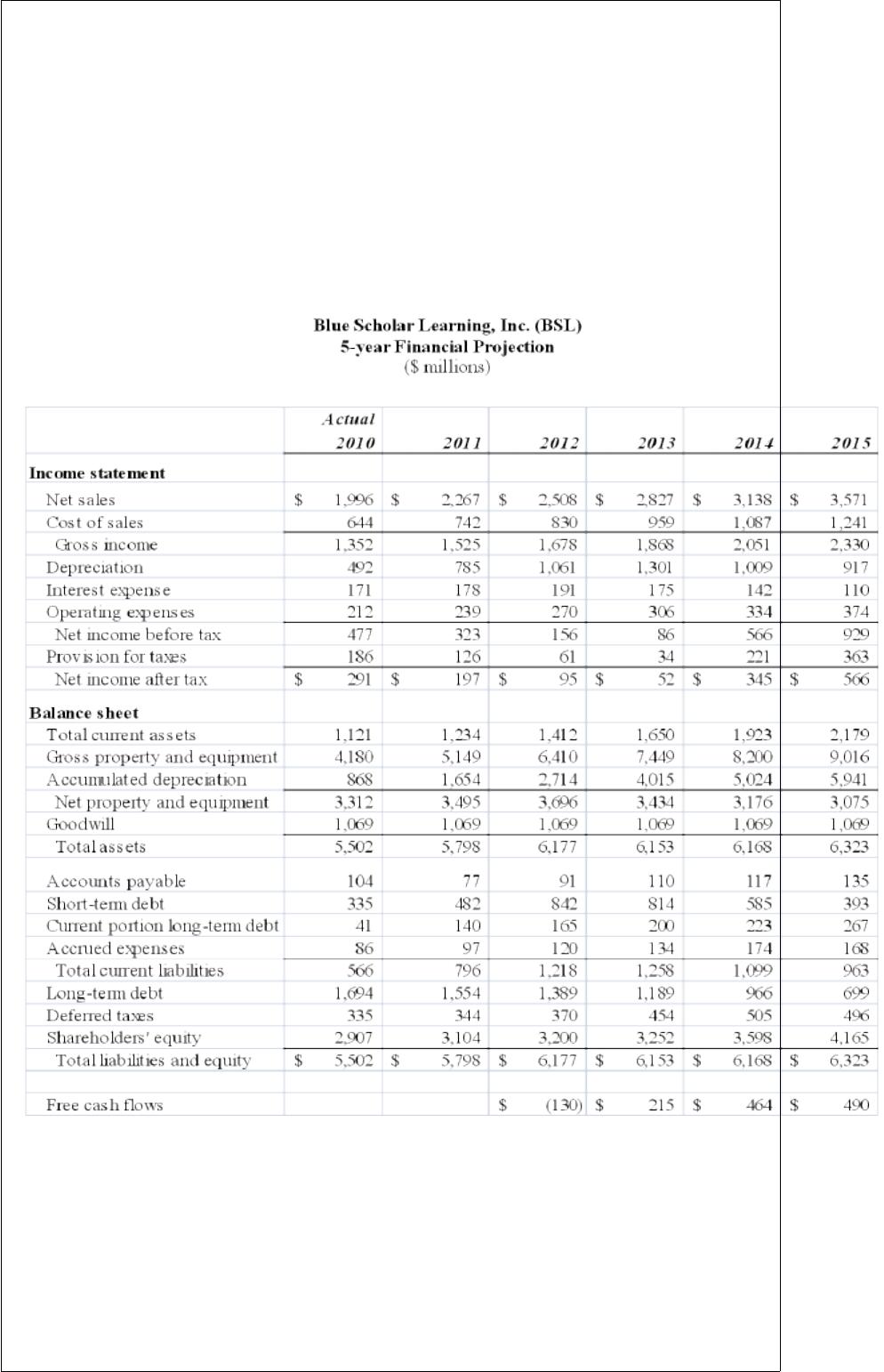
27) Figure 9.1
In March of 2011, Macklemore Corp. considered an acquisition of Blue Scholar
Learning, Inc. (BSL), a privately-held educational software firm. As a first step in
deciding what price to bid for BSL, Macklemore’s CFO, Ryan Lewis, has prepared a
five-year financial projection for the company assuming the acquisition takes place.
Use this projection and BSL’s 2010 actual financial figures to answer the questions
below.
Estimate BSL’s value (in $ millions) at the end of 2010 assuming that at year-end 2015
the company’s equity is worth 15 times earnings after tax and its debt is worth book
value. Macklemore’s WACC is 8.0 percent. BSL’s WACC is 11.5 percent, and the
average of the two companies’ WACCs, weighted by sales, is 8.2 percent.
A.$628.24
B.$3,669.01
C.$7,429.74
D.$6,343.26
E.$6,755.83

28) A firm has a retention ratio of 40 percent and a sustainable growth rate of 6.2
percent. The asset turnover ratio is 0.85 and the assets-to-equity ratio (using
beginning-of-period equity) is 1.80. What is the profit margin?
A.3.79 percent
B.5.69 percent
C.6.75 percent
D.10.13 percent
E.18.24 percent
29) Which one of the following best describes the primary intent of the Sarbanes-Oxley
Act of 2002?
A.Increase the costs of going public
B.Increase protection against corporate fraud
C.Limit secondary issues of corporate securities
D.Decrease the number of publicly traded firms
E.Increase the number of firms that “go dark”

30) The common stock of Modern Interiors has a beta of 1.61 and a standard deviation
of 27.4 percent. The market rate of return is 13.2 percent and the risk-free rate is 4.8
percent. What is the cost of equity for this firm?
A.18.32 percent
B.19.97 percent
C.21.08 percent
D.24.40 percent
E.26.05 percent
31) Which of the following have been offered as justification for IPO underpricing?
I. Young firms tend to be very risky.
II. The best IPOs are oversubscribed.
III. Underwriters like to avoid lawsuits.
IV. It benefits the existing shareholders.
A.I and III only
B.II and IV only
C.I, II, and III only
D.II, III, and IV only
E.I, II, III, and IV
32) The Budget Place is considering opening a new store at a start up cost of $700,000.
The initial investment will be depreciated straight line to zero over the 15-year life of
the project. What is the average accounting rate of return?
A.13.05 percent
B.13.68 percent
C.14.01 percent
D.14.59 percent
E.14.76 percent
33) Identify four parties that have a demand for U.S. dollars and explain why they wish
to obtain those dollars.
34) Law Dog, Inc. is a provider of temporary and permanent personnel in legal services.
The following are selected financial data for the company for the period 2000 – 2004.
Law Dog paid its first dividends in 2004. As an analyst, assess the company’s decision
to pay dividends.
35) Identify the relationship (direct or inverse) between each of the following pairs of
variables as they relate to the time value of money: (Assume all else constant)
Present value and future value _________
Present value and interest rate _________
Present value and time _________
Time and interest rate _________
Time and future value _________

Interest rate and future value _________
36) Kate is the sole founder of the exclusive retail store, Kate’s Interiors. Kate identified
additional locations that she believed offered profitable opportunities for expansion so
decided to take her firm public in order to finance her expansion plans. Bob is an
investor who purchased shares of Kate’s Interiors stock at the offer price. After one
month as a public firm, Kate realized that Bob had earned $1.1 million in profit on his
investment and had already cashed out and moved on. Kate on the other hand, had
made no profit and still owns her shares. Explain how this could happen.
37) Explain what a mortgage backed security (MBS) is and how it functions. Also,
explain why these securities were such a problem during 2008.
38) The standard deviation of returns on Wildcat Oil Drilling is very high. Does this
necessarily imply that Wildcat Oil Drilling is a high-risk investment when investors
hold diversified portfolios? Explain why or why not.
39) In words, explain how the crossover rate is computed and why the net present value
profile is useful.