
1) Companies with ROEs that consistently exceed the industry average generally will
have shares that sell for book value.
2) A product warranty provided with the sale of an item of merchandise gives rise to a
non-monetary liability.
3) Under the lower of cost or market method, the floor provides a lower bound for
write-downs in situations where input replacement cost and selling price do not move
together.
4) Research suggests that financial statement analysts should be alert to the potential
use of impairment write-offs to manage earnings.
5) Revenue recognition irregularities constitute the most frequently cited reason for
restating financial statements during the past few years.
6) Fundamental valuation uses basic accounting measures to assess the amount, timing,
and uncertainty of a firm’s future operating cash flows or earnings.
7) Fair value accounting is widely touted as a means to avoid future financial crises as it
will prevent banks from collapsing.

8) Besides assessing the general reasonableness of reported numbers in relation to the
company’s activities, industry conditions, and business climate, when designing audit
procedures the company’s auditor must also assess fraud risk factors that may be
present.
9) Generally accepted accounting principles require capitalization of an expenditure
when it results in an increase in the economic benefit of an asset.
10) In a troubled debt restructuring, there is a lack of symmetry in the financial
reporting of the borrower and lender.
11) IFRS requires the use of absorption costing.
12) The sales returns and allowances account is a contra-asset account.
13) Authoritative accounting literature provides little guidance regarding revenue
recognition when a sales agreement contains conditions that may allow the buyer to
return the product.
14) To be reported as an extraordinary item on the income statement, an event must be
either unusual in nature or an infrequent occurrence.
15) Information symmetry means that management has access to more and better
information about the business than do people outside the company.
16) International accounting standards permit the use of either the FIFO or weighted
average cost flow assumption, but prohibit the use of LIFO.
17) Firms that use early debt retirement on a recurring basis as part of their ongoing risk
management practices will report the associated gains and losses as part of income from
continuing operations with separate line-item disclosure.
18) The only long-lived asset measurement method that survives the dual filters of
reliability and verifiability is the economic benefit approach.
19) Manero Company included the following information in its annual report:
In a common size income statement for 2010, the cost of goods sold is expressed as
A.40.0%
B.64.3%
C.100.0%
D.230.0%
20) Condensed financial data are presented below for the Phoenix Corporation:
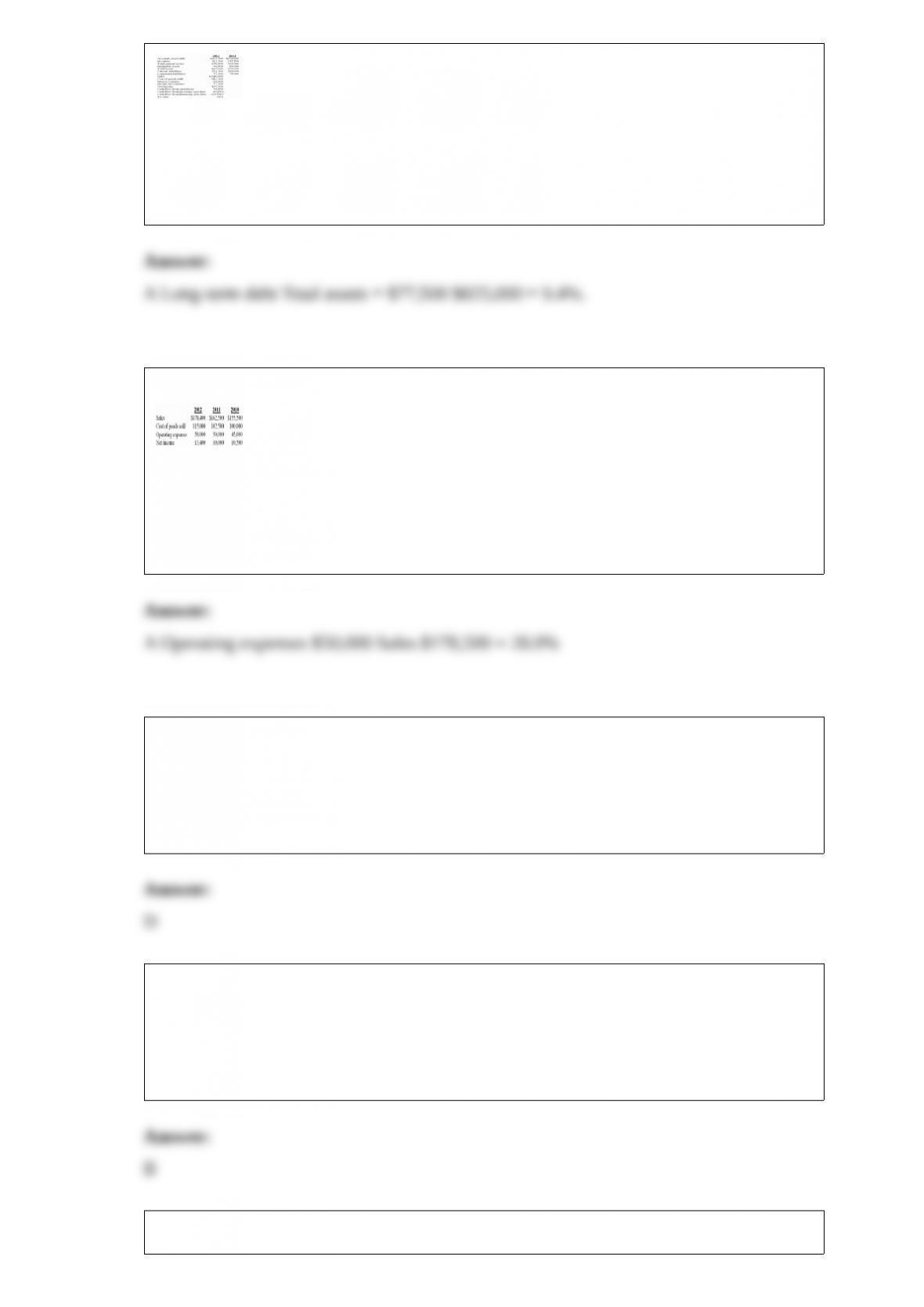
The long-term debt to assets for 2012 is (rounded):
A.9.4%
B.10.2%
C.40.0%
D.43.4%
21) Manero Company included the following information in its annual report:
In a common size income statement for 2012, the operating expenses are expressed as
A.28.0%
B.30.3%
C.43.8%
D.100.0%
22) The interest rate on a revolving loan will usually
A.be below prime interest
B.be equal to prime interest
C.remain fixed
D.float
23) Which one of the following events would be considered an extraordinary event?
A.A tornado in Kansas
B.An earthquake in New York
C.A flood in St. Louis near the Mississippi River
D.An earthquake in southern California
24) The FASB decided that the allocation of income taxes paid to operating, financing,

and investing activities would be complex and arbitrary, and relied on which one of the
following justifications for its decision?
A.Materiality constraint
B.Historical cost
C.Cost-benefit constraint
D.Revenue recognition principle
25) Eagle Corporation acquired a new machine on January 2, 2011 at a cost of
$126,000. The machine has an expected 4 year life and a salvage value of $6,000.
If Eagle uses the sum-of-years’ digits depreciation method, the depreciation expense in
2013 is
A.$16,000
B.$24,000
C.$32,000
D.$40,000
26) Initial franchise fees should be recorded as revenue by the franchisor
A.in accordance with the franchise agreement
B.when cash is received from the franchisee
C.when all material services relating to the sale have been substantially performed
D.during the year the franchise agreement is signed
27) Several studies show that incoming CEOs have an incentive to
A.increase earnings in the year of the executive change as well as in years subsequent
to the change
B.decrease earnings in the year of executive change and increase earnings in the next
year
C.decrease earnings for a few years after taking over to establish a low “bonus baseline”
D.take actions that will make his/her predecessor look incompetent thus validating the
board’s decision to change CEOs
28) Financial analysts must be wary of business acquisitions accounted for as pooling
of interests because this method tends to inflate the
A.current ratio
B.inventory turnover ratio
C.rate of return ratios
D.cash flow ratio
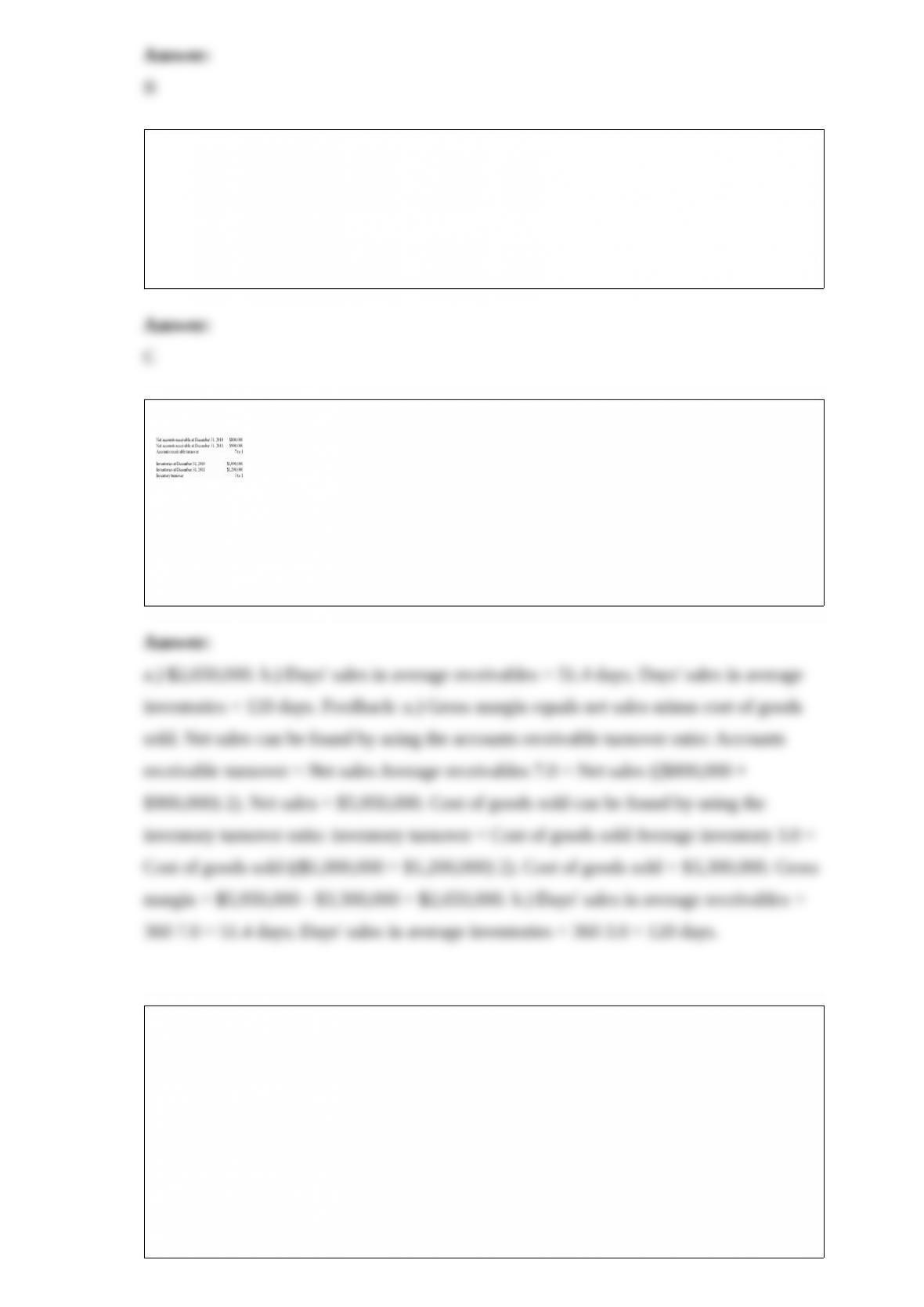
29) Selected information taken from the accounting records of Rigor Company follows:
Required:
a. What was Rigor’s gross margin for 2011?
b. Suppose there are 360 business days in the year. What was the number of days’ sales
outstanding in average receivables and the number of days’ sales outstanding in average
inventories for 2011, respectively?
30) On January 1, 2012, Como Company purchased 45% of the outstanding common
shares of the Lite Company for $200,000. The net assets of Lite Company totaled
$400,000. The inventory had a book value of $100,000 and a fair value of $120,000.
Excess cost attributable to inventory is written off in 2012 . During 2012, Lite Company
earned $200,000 and declared a dividend of $40,000 for the year.
The amount of goodwill implicit in Como’s transaction is
A.$9,000
B.$11,000
C.$20,000
D.$22,000

31) Which one of the following is a permanent difference between book and taxable
income?
A.Interest received on municipal bonds
B.Installment sales
C.Bad debts expense
D.Warranty expense
32) Income statements are classified into sections to
A.separate earned income from unearned income
B.distinguish between sustainable and transitory income
C.separate real income from book income
D.distinguish between book income and taxable income
33) The Palmer Corporation sells goods to its customers on a note basis with 10% credit
terms and interest payable at the end of each quarter. All notes are due in one year.
Palmer makes the following sales on July 1, 2011:
To encourage sales, Berg was given a special deal on interest. Additional information:
Future value of $100,000 in one year (quarterly interest) is $110,381.
Present value of $100,000 for one year (quarterly interest) is $90,595.
At the end of the first quarter, which one of the following entries will be made to record
the interest earned by Palmer on the Berg note?
A.Option a
B.Option b
C.Option c
D.Option d
34) On January 1, 2011, Lessee Corporation entered into a ten-year lease. The lease
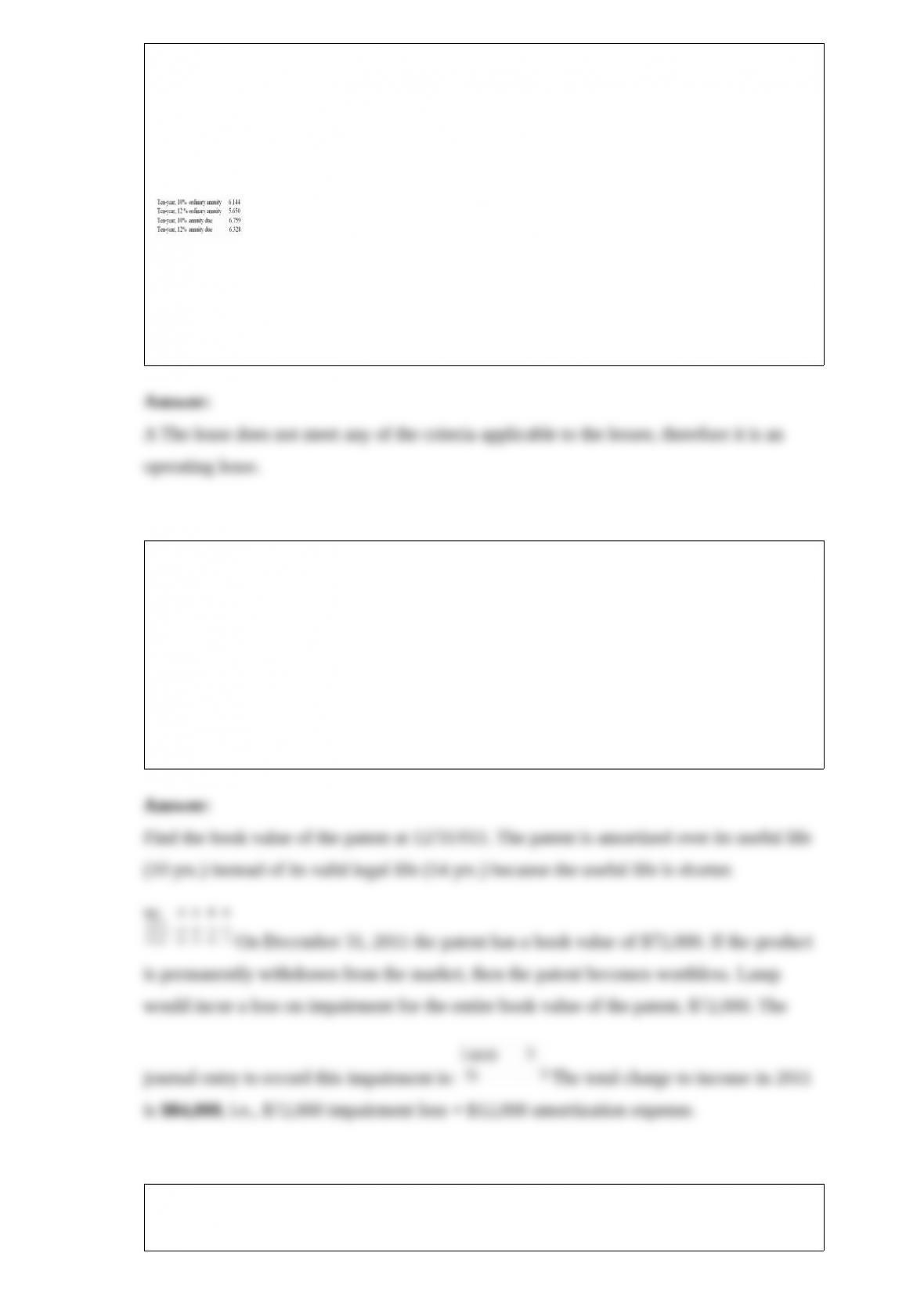
terms required annual year-end payments of $160,000. The lease agreement does not
contain either a bargain purchase option or a transfer of title. The fair value of the
equipment at the inception of the lease was $1,100,000; estimated life of the leased
assets was fourteen years. Lessee Corporation’s incremental borrowing rate was 10%;
the implicit rate of interest, known to the lessee, was 12%. Applicable time value of
money values are as follows:
Lessee Corporation should initially capitalize the lease at what amount?
A.$0, the lease should not be capitalized
B.$983,040
C.$1,081,440
D.$904,000
35) On January 2, 2008 Lamp, Inc. purchased a patent for a new consumer product for
$120,000. At the time of purchase, the patent was valid for 14 years; however, the
patent’s useful life was estimated to be only 10 years due to the competitive nature of
the product. On December 31, 2011 the product was permanently withdrawn from sale
under governmental order because of a potential health hazard in the product.
Required:
a. Record any loss on impairment that Lamp should record in 2011 related to this
patent.
b. What should the total charge against income be in 2011 on this patent?
36) Ralmond Industries owns an investment that experienced a decline during 2012 that
has been judged to be “other than temporary”. The investment is held in Ralmond’s
available-for-sale debt portfolio, and Ralmond does not expect to sell the security and it
is unlikely that Almond will be required to sell the security before recovery of its
amortized cost basis less any current-period credit loss. It was purchased in March 2011
at a cost of $460,000. At the end of 2011, the fair value of the investment was $520,000
and its amortized cost basis was $454,000. At the end of 2012, the fair value of the
investment is $410,000 and its amortized cost is $448,000. At the end of 2012, the
present value of expected cash flows associated with the security discounted at the
effective interest rate implicit when it was originally acquired is $432,000. What
amount of loss will Ralmond Industries report on its income statement for the year
ending December 31, 2012 related to this investment?
A.An unrealized loss $16,000
B.An unrealized loss of $38,000
C.An unrealized loss of $44,000
D.An unrealized loss of $22,000
37) Hansel Corporation’s condensed balance sheets appear below:
In a common size balance sheet for 2010, total liabilities and equity are expressed as
A.89.9%
B.96.5%
C.100.0%
D.111.3%
38) When independent measurers get similar results when using the same accounting
measurement methods, the financial information is
A.relevant
B.verifiable
C.timely
D.faithfully represented

39) Goods available for sale is determined by
A.adding the cost of any beginning inventory and the cost of purchases during the
period
B.subtracting the cost of any ending inventory from the cost of any beginning inventory
C.subtracting the cost of any beginning inventory from the cost of any ending inventory
D.subtracting the cost of any beginning inventory from the cost of purchases during the
period
40) A hedge of the exposure to changes in the fair market value of an existing asset or
liability or a firm commitment is a/an
A.fair value hedge
B.cash flow hedge
C.foreign currency exposure hedge
D.marked-to-market hedge
41) The fundamental valuation approach to business valuation uses basic accounting
measures to assess the amount, timing, and
A.certainty of a company’s past operating cash flows or earnings
B.certainty of a company’s future non-operating cash flows or earnings
C.uncertainty of a company’s future operating cash flows or earnings
D.uncertainty of a company’s future non-operating cash flows or earnings
42) Theta Company has prepared to sell bonds with a stated rate of 6% when the market
rate is 8%. These bonds will sell in the market at
A.par
B.a discount
C.a premium
D.stated value
43) When firms dispose of a long-lived asset before the end of its useful life, in a
transaction that has commercial substance, the difference between the net book value of
the asset and the sale proceeds is a/an
A.extraordinary gain or loss

B.gain or loss from continuing operations
C.gain or loss from a discontinued item
D.gain or loss from a prior period
44) TKE Corporation established a defined benefit pension plan in 2009 . TKE has
provided the following information for the year ended December 31, 2011:
The pension expense for 2011 is
A.$90,000
B.$120,000
C.$160,000
D.$170,000
45) Analysts typically eliminate after-tax interest expense from EBI when calculating
ROA.
46) Cheery Company follows IFRS for its financial reporting. On January 1, 2012
Cheery issued 250 million of 10-year convertible notes that pay interest at 5% annually.
Investors pay 250 million for the notes even though the company’s credit risk at the
time implies a 10% interest rate for traditional debt of similar duration. When the cash
flows associated with the debt are discounted at 10%, the resulting value is 175 million.
How much cash will Cheery pay for interest during 2012?
A.25 million
B.12.5 million
C.17.5 million
D.8.75 million
47) During its first year of operations a company recorded revenues totaling $6,000,000
for book purposes. For tax purposes, $2,400,000 of the revenue is taxable during the
first year of operations and $3,600,000 is taxable during the second year of operations.
The income tax rate for both years is 40%. The balance sheet at the end of the first year
of operations will report a deferred tax liability of
A.$2,400,000
B.$1,440,000
C.$960,000
D.$480,000
48) A minority active ownership is represented by
A.less than 20% ownership
B.20% or more but less than 50% ownership
C.more than 50% ownership
D.more than 60% and less than 70% ownership
49) For the month of December 2011 the records of Seal Corporation show the
following information:
Required:
Determine the net sales for the month of December 2011 .
Find the amount of gross sales by determining credit sales with the accounts receivable
T-account below.
Accounts Receivable
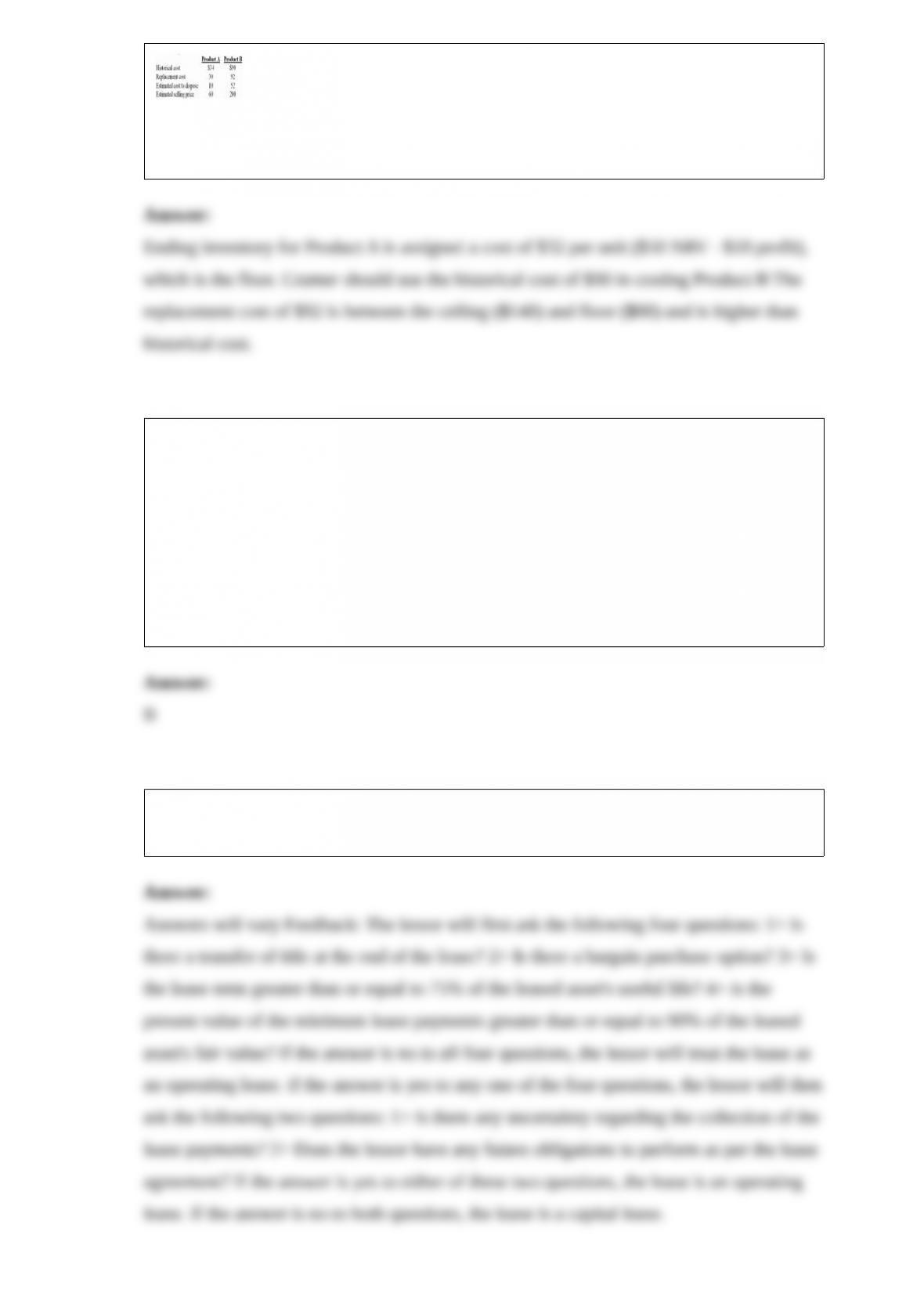
50) Cramer Corporation has two products in its ending inventory and uses lower of cost
or market to account for each. Cramer normally prices its products to maintain a 30%
gross profit margin. Specific data for each product follows:
Required:
Using the lower of cost or market rule, what unit values should Cramer use to cost
Products A and B in its ending inventory?
51) Long lived assets are
A. non-operating assets expected to yield their economic benefits (or service potential)
over a period longer than one year
B. operating assets expected to yield their economic benefits (or service potential) over
a period longer than one year
C. non-operating assets expected to yield their economic benefits (or service potential)
over a period longer than five years
D. operating assets expected to yield their economic benefits (or service potential) over
a period longer than two years
52) Describe the criteria that the lessor must utilize when determining whether a lease is
to be treated as a capital lease or as an operating lease according to current GAAP.
53) The Gopher Company’s transactions during 2012 included the following:
Paid cash dividends totaling $1,200,000.
Paid $900,000 cash toward a long-term note payable.
Issued common stock in exchange for a building valued at $750,000.
Issued bonds with a maturity value of $2,000,000 in exchange for $1,950,000 cash.
Paid $50,000 cash for bond interest.
$2,250 of bond discount amortization was recorded.
Issued preferred stock for $250,000 cash.
A long-term stock investment with a book value of $79,000 was sold for $123,000 cash.
Sold equipment for cash; the equipment’s book value at the time of sale was $90,000
and the sale resulted in a $15,000 loss.
Required:
1> Determine the net cash flow from investing activities for 2012 .
2> Determine the net cash flow from financing activities for 2012 .
54) Why do loan agreements often contain covenants tied to accounting numbers? Are
there any disadvantages to this common practice?

55) At the close of its third year of operations, on December 31, 2012, the Runner
Company had receivables of $350,000, which were net of the related allowance for
doubtful accounts. During 2012, the company had charges to bad debt expense of
$50,000 and wrote off, as uncollectible, accounts receivable of $22,000. Runner had a
balance in its allowance for uncollectible accounts at December 31, 2011 of $8,100.
Required:
What should the company report on its balance sheet at December 31, 2012, as
accounts receivable before the allowance for uncollectible accounts?
A
56) For each of the items below, determine whether the items are temporary differences
or permanent differences. Also, for each temporary difference, you are required to
determine whether a deferred tax asset or deferred tax liability is created by the
temporary difference described. Assume that each of the temporary differences
described is an originating difference.
1> Municipal bond interest
2> Accrued warranty expense
3> Sales revenues received in advance
4> Prepaid insurance where the tax deduction in future years will be less than the book
expense
5> Tax depreciation expense exceeds GAAP (book) depreciation expense
6> Accrued bad debt expense
7> The dividends received deduction
8> Installment sales revenue per the tax return
9> Life insurance payments for executives for which the company is the beneficiary
10> Fines paid for law violations