
1) The audit opinion of a public company is similar to an opinion for a private company
except for the public company comments will be added as to the effectiveness of
internal control over financial reporting.
2) Stock appreciation rights can have a material impact on reported earnings.
3) Noncontrolling interest reflects the ownership of noncontrolling shareholders in the
equity of consolidated subsidiaries that are less than wholly owned.
4) Most companies consolidate the parent’s and subsidiary’s accounts summed.
5) Eventually, the Financial Accounting Standards Board intends to evaluate current
principles in terms of the concepts established in the Financial Accounting Concepts.
6) A sole proprietorship form of business has only one owner.
7) A distinguishing factor about utilities is that generally their services are not
duplicated by another firm.

8) Total earnings from securities include both dividends and price appreciation.
9) Working capital is considered to be one of the prime indicators of liquidity.
10) The basic statement prepared for personal financial statements is the statement of
changes in net worth.
11) The LIFO inventory costing method usually results in working capital being
overstated.
12) The accountant’s report expresses an opinion on reviewed financial statements.
13) At any point in time, assets must equal the contribution of the creditors only.
14) Jazzy Juniors, a retail clothing manufacturer, reported the following profit figures in
its 2012 annual report.
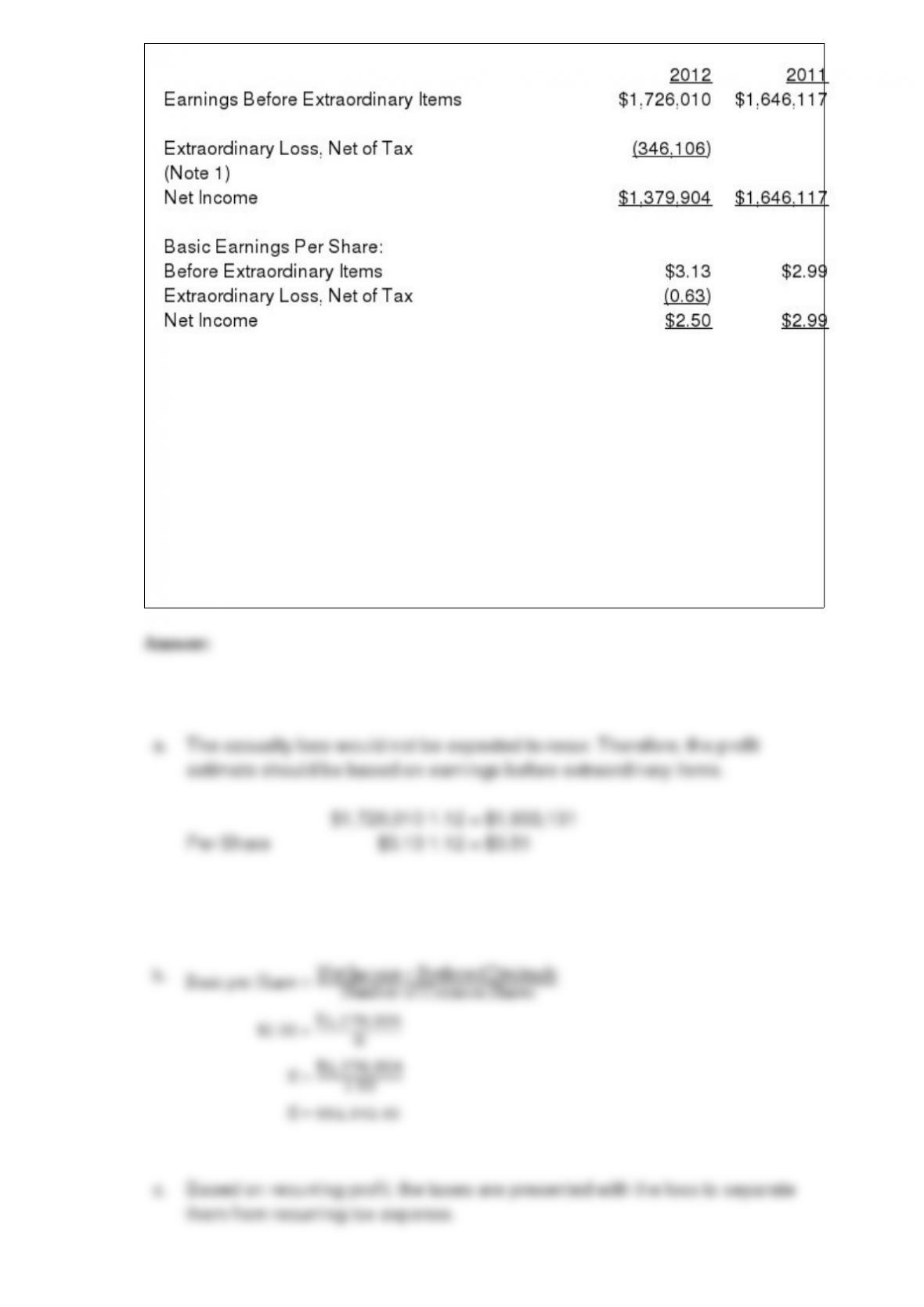
Note 1: On September 3, the firm experienced a substantial fire loss. The uninsured
portion of the loss was $547,910. This loss reduced income taxes by $201,804.
Required:
a. You have been asked to project 2013 earnings for Jazzy Juniors. Your research
indicates that a 12% rise in earnings is reasonable. Compute the estimated earnings and
basic earnings per share. Explain your answer.
b. Compute the number of shares of common stock outstanding in 2012, using net
income and basic earnings per share of $2.50.
Note: There is no preferred stock outstanding.
c. Why are the taxes on the casualty loss presented with the loss rather than with
income taxes?

15) Government-wide financial statements help users do all but which of the following?
a. Relate cash receipts and disbursements to the acquisition of long-lived assets
b. Assess the finances of the government in its entirety, including the year’s operating
results
c. Determine whether the government’s overall financial position improved or
deteriorated
d. Evaluate whether the government’s current-year revenues were sufficient to pay for
current-year services
e. Make better comparisons between governments
16) Which of the following is not true about an ESOP?
a. An ESOP will reduce the amount of voting stock in the hands of employees
b. An ESOP must be a permanent trusted plan for the exclusive benefit of the
employees
c. The plan participants become eligible for favorable taxation of distributions from the
plan
d. Commercial lending institutions, insurance companies, and mutual funds are
permitted an exclusion from income for 50% of the interest received on loans used to
finance an ESOP’s acquisition of company stock
e. An ESOP may reduce the potential of an unfriendly takeover
17) Which of the following would not appear on a conventional balance sheet?
a. Income taxes payable
b. Funds from operations
c. Cash surrender value of life insurance
d. Appropriation for contingencies (restriction of retained earnings)
e. Patents
18) The following are selected accounts and account balances of Gorr Company on
December 31:
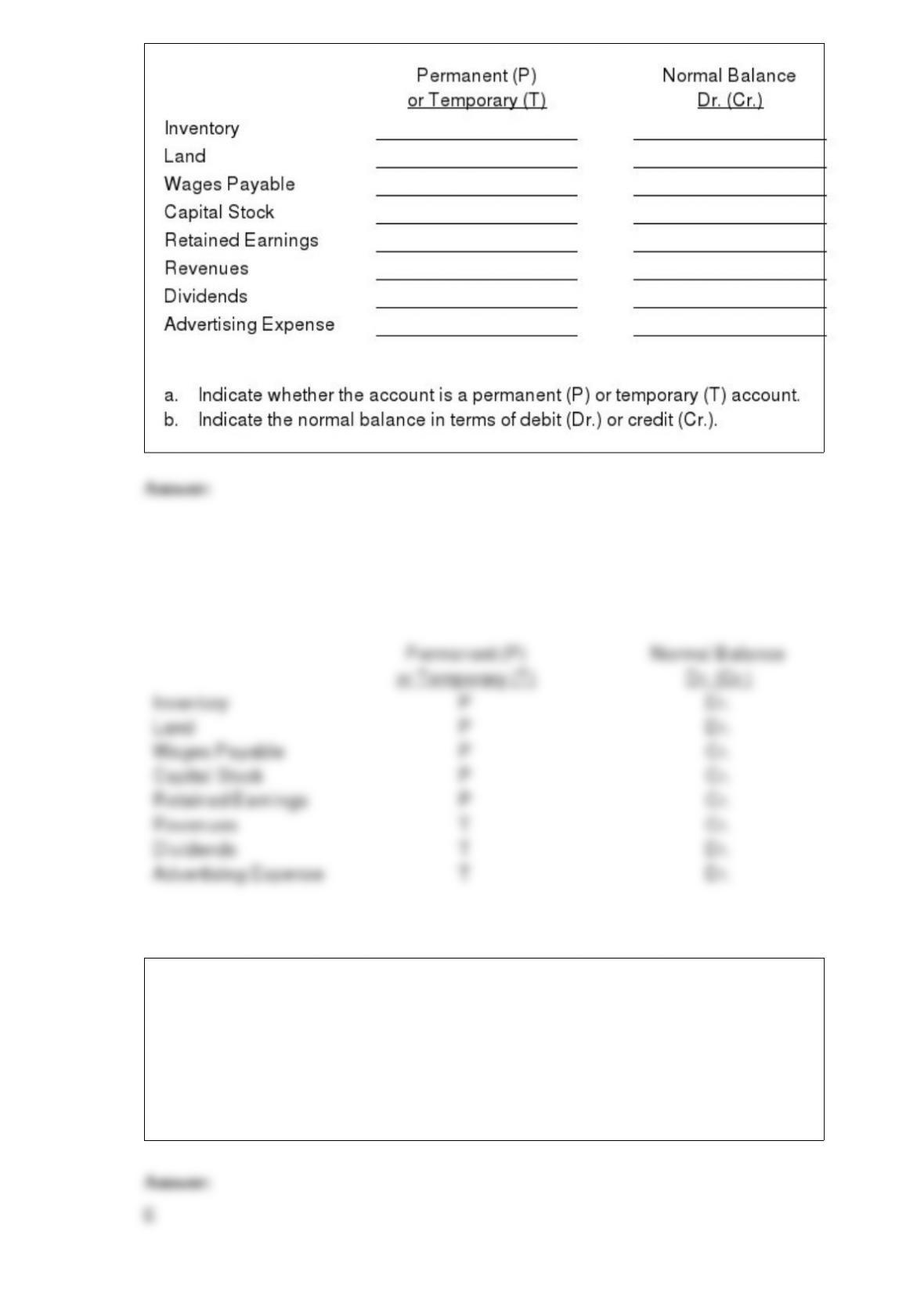
Required:
19) The balance sheet reports:
a. the assets, liabilities, gains, and losses for a period of time
b. the changes in assets, liabilities, and equity for a period of time
c. the assets, expenses, and liabilities as of a certain date
d. the probable future benefits, probable future sacrifices, and residual interest for a
period of time
e. the financial condition of an accounting entity as of a particular date

20) Total asset turnover measures the ability of a firm to:
a. generate profits on sales
b. generate sales through the use of assets
c. buy new assets
d. move inventory
e. cover long-term debt
21) Accountants face a problem of when to recognize revenue. Which of the following
methods of recognizing revenue is not used in practice?
a. Point of sale
b. Point of order acceptance
c. End of production
d. Receipt of cash
e. Revenue recognized during production
22) Tim Company had sales of $30,000, increase in accounts payable of $5,000,
decrease in accounts receivable of $1,000, increase in inventories of $4,000, and
depreciation expense of $4,000. What was the cash collected from customers?
a. $31,000
b. $35,000
c. $34,000
d. $25,000
e. $26,000
23) Which of the following should not be considered as part of “cash and cash
equivalents”?
a. Cash on hand
b. Cash on deposit
c. Highly liquid investments
d. Investments in short-term securities (<90 day maturity)
e. Cash restricted for retirement of bonds
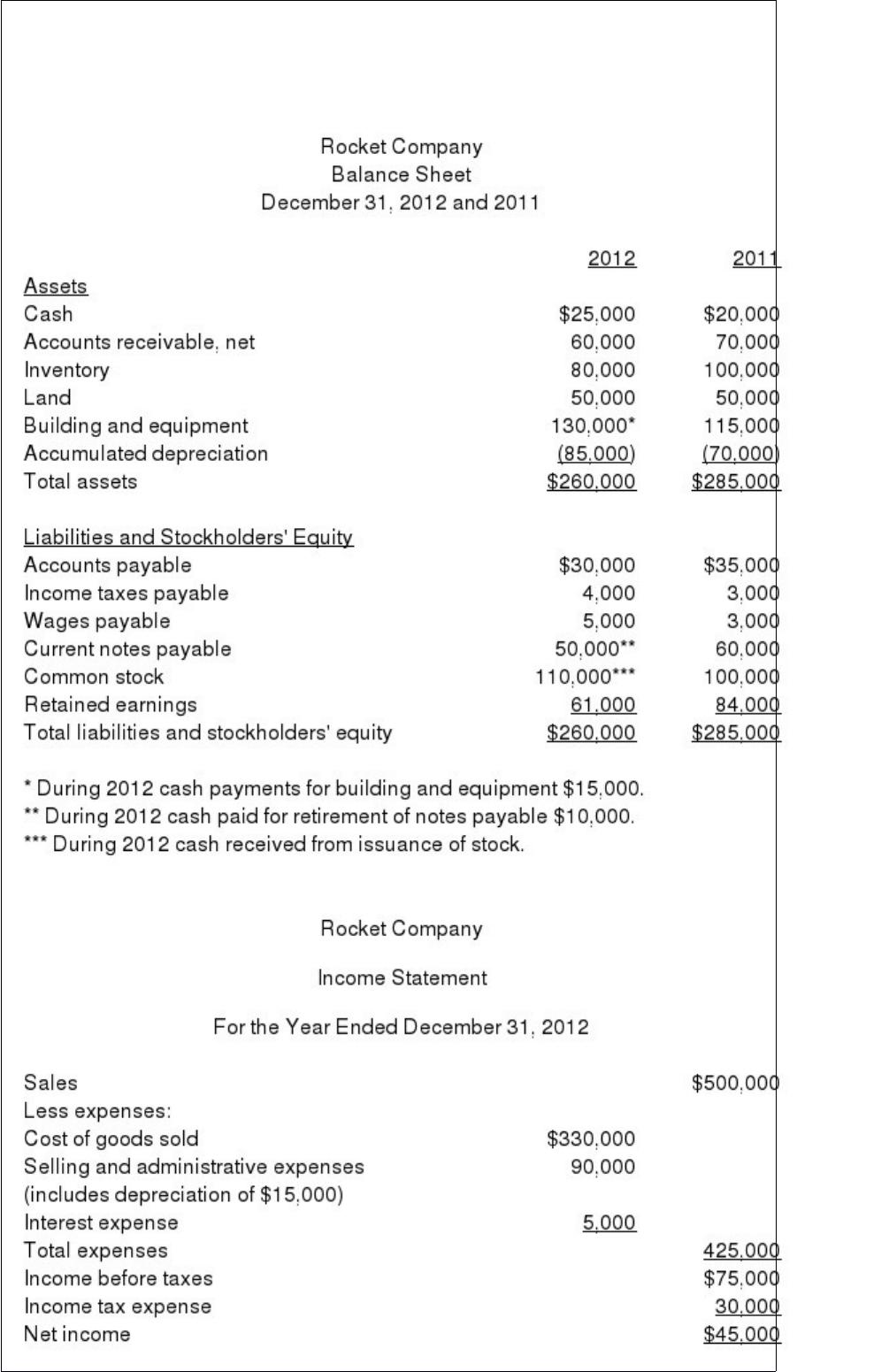
24) The balance sheet for December 31, 2012, December 31, 2011, and the income
statement for the year ended December 31, 2012, for Rocket Company follows.

Note: Cash dividends of $68,000 were paid during 2012.
Required:
a. Prepare the statement of cash flows for 2012. (Present cash flows from operations
using the indirect approach.)
b. Compute the ratio operating cash flow/current maturities of long-term debt and
current notes payable.
c. Comment on the statement of cash flows and the ratio computed in (b).

25) In the formula for return on investment, interest expense is multiplied by (1 – tax
rate). Why is this adjustment made?
a. Interest is not tax deductible
b. Debt is excluded from the denominator
c. Net income in the formula is after tax
d. Dividends are not deductible for tax purposes
e. None of the answers are correct
26) An accounting period that ends when operations are at a low ebb is:
a. a calendar year
b. a fiscal year
c. the natural business year
d. an operating year
e. None of the answers are correct
27) Which of the following is not a discounted cash flow model for valuation?
a. Free cash flow
b. Dividend discount model
c. Discounted cash flow
d. Discounted abnormal earnings
e. All of the answers are discounted cash flow models
28) If the disposal of a segment meets the criteria of a disposal of a segment, then:
a. the loss on disposal is an extraordinary item
b. the loss on disposal is categorized as “other expense”
c. the results of operations of the segment will be reported in conjunction with the gain
or loss on disposal
d. the disposal qualifies as a change in entity, and prior years’ statements presented on
comparative purposes must be restated
e. the effects of the disposal are shown as part of operations
29) Each of the following would generally be thought of as a favorable indicator of the
firm’s financial position:
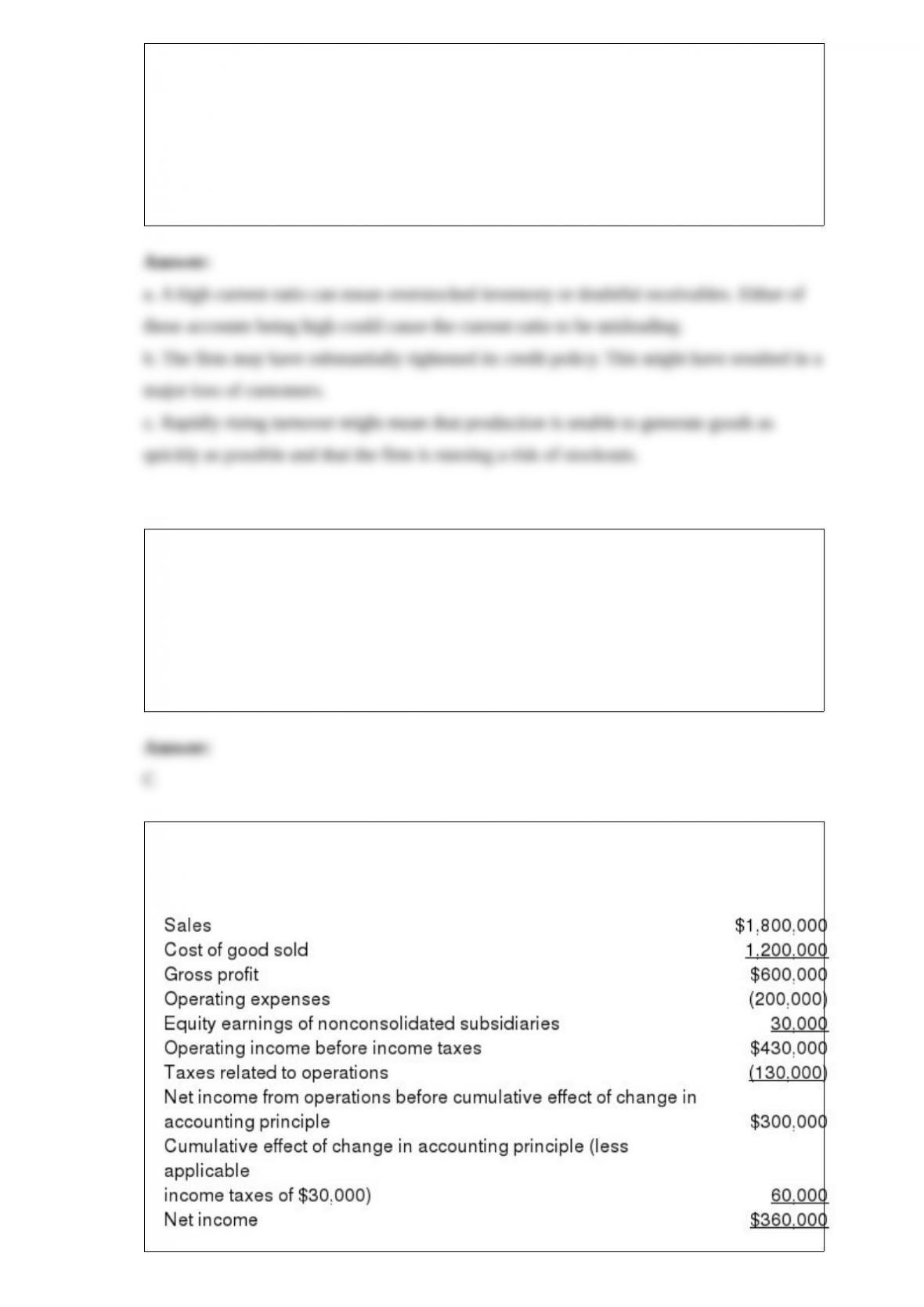
a. A current ratio well above 2.0, which is substantially higher than that for other firms
in the industry.
b. Collection period significantly lower than for several recent periods.
c. Rapidly rising merchandise inventory turnover.
Required:
In each case, give an example of circumstances underlying the ratio that might
represent an unfavorable development.
30) Which financial ratio appears most frequently in loan agreements according to
commercial loan officers?
a. Quick Ratio
b. Cash Flow/Total Debt
c. Debt/Equity
d. Times Interest Earned
e. Cash ratio
31) The income statement of Jones Company for the year ended December 31, 2012,
shows:

Required:
a. Compute the net earnings after removing nonrecurring items.
b. Determine the earnings from the nonconsolidated subsidiary.
c. Determine the total tax amount.
32) Which of the following current assets will not generate cash in the future?
a. Prepayments
b. Accounts receivable
c. Inventory
d. Marketable securities
e. Notes receivable
33) Which of the following would not be a user of financial statements?
a. Management
b. Bankers
c. Employee unions
d. Investment analysts
e. All of the answers are users
34) Amortization of patents can be added to income in the operations section of the
statement of cash flows because:
a. it is not a tax deductible expense
b. it results in an increase in income
c. it does not require the outlay of cash
d. patent amortization is not an expense
e. it represents an inflow of cash
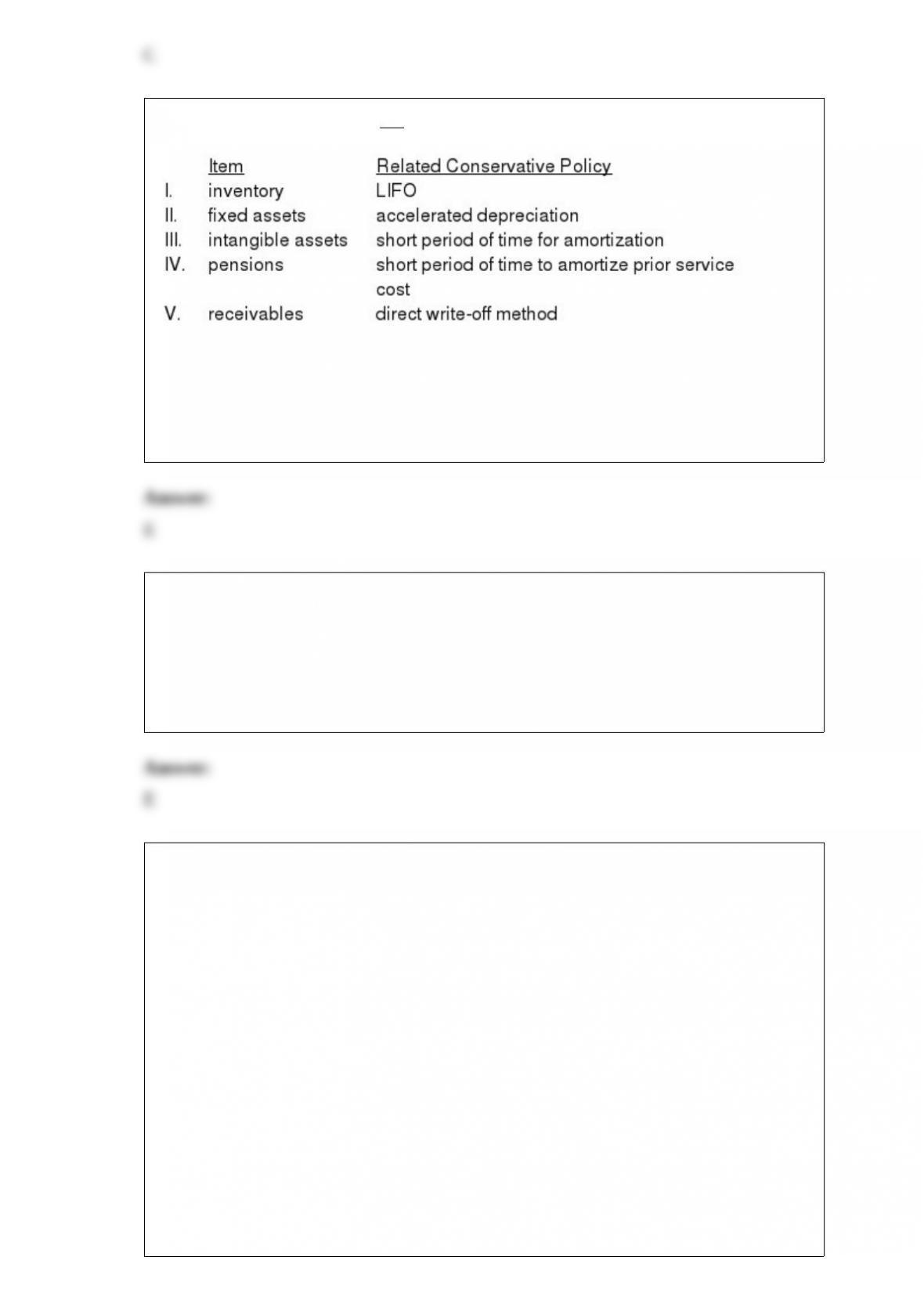
35) Which of the following is not a reasonable matching?
a. I
b. II
c. III
d. IV
e. V
36) Understating expenses is justified based on:
a. time period assumption
b. conservatism assumption
c. materiality assumption
d. matching assumption
e. None of the answers are correct
37) Listed below are interrelated elements that are directly related to measuring
performance and status of an enterprise according to SFAC No. 6, “Elements of
Financial Statements.”
Required:
Match the letter of each element with the appropriate definition.
a. Assets
b. Liabilities
c. Equity
d. Investments by owners
e. Distribution to owners
f. Comprehensive income
g. Revenues
h. Expenses
i. Gains
j. Losses
1>Probable future sacrifices of economic benefits arising from present obligations of a
particular entity to transfer assets or provide services to other entities in the future as a

result of past transactions or events.
2>Increases in the equity of a particular business enterprise resulting from transfers to
the enterprise from other entities of something of value to obtain or increase ownership
interests (or equity) in it.
3>A decrease in the equity of a particular business enterprise resulting from transferring
assets, rendering services, or incurring liabilities by the enterprise to owners. Decreases
ownership interest (or equity) in an enterprise.
4>Decreases in the equity (net assets) from peripheral or incidental transactions of an
entity and from all other transactions and other events and circumstances affecting the
entity during a period, except those that result from expenses or distributions to owners.
5>Outflows or other consumption or using up of assets or incurrences of liabilities (or a
combination of both) from delivering or producing goods, rendering services, or
carrying out other activities that constitute the entity’s ongoing major or central
operations.
6>The change in equity (net assets) of a business enterprise during a period from
transactions and other events and circumstances from nonowner sources. It includes all
changes in equity during a period, except those resulting from investments by owners
and distributions to owners.
7>Probable future economic benefits obtained or controlled by a particular entity as a
result of past transactions or events.
8>The residual interest in the assets of an entity after deducting its liabilities.
9>Inflows or other enhancements of assets of an entity or settlements of its liabilities
(or a combination of both) from delivering or producing goods, rendering services, or
engaging in other activities that constitute the entity’s ongoing major or central
operations.
10>Increases in the equity (net assets) from peripheral or incidental transactions of an
entity and from all other transactions and other events except circumstances from
revenues or investments by owners.
38) Which of the following ratios would generally be used to evaluate a firm’s overall
liquidity position?
a. Working capital
b. Current ratio
c. Acid-test ratio
d. Cash ratio
e. Inventory turnover in days
39) Which of the following ratios will usually have the lowest percent?
a. Return on investment
b. Return on total equity
c. Return on common equity

d. Return on total assets
e. There is not enough information to tell
40) A firm has a degree of financial leverage of 1.20. If earnings before interest and tax
increase by 20%, then net income:
a. will not necessarily change
b. will increase by 20%
c. will decrease by 24%
d. will decrease by 20%
e. None of the answers are correct