A firm that uses its weighted average cost of capital as the required return for all of its
investments will:
A. maintain a constant value for its shareholders.
B. increase the risk level of the firm over time.
C. make the best possible accept and reject decisions related to those investments.
D. find that its cost of capital declines over time.
Answer:
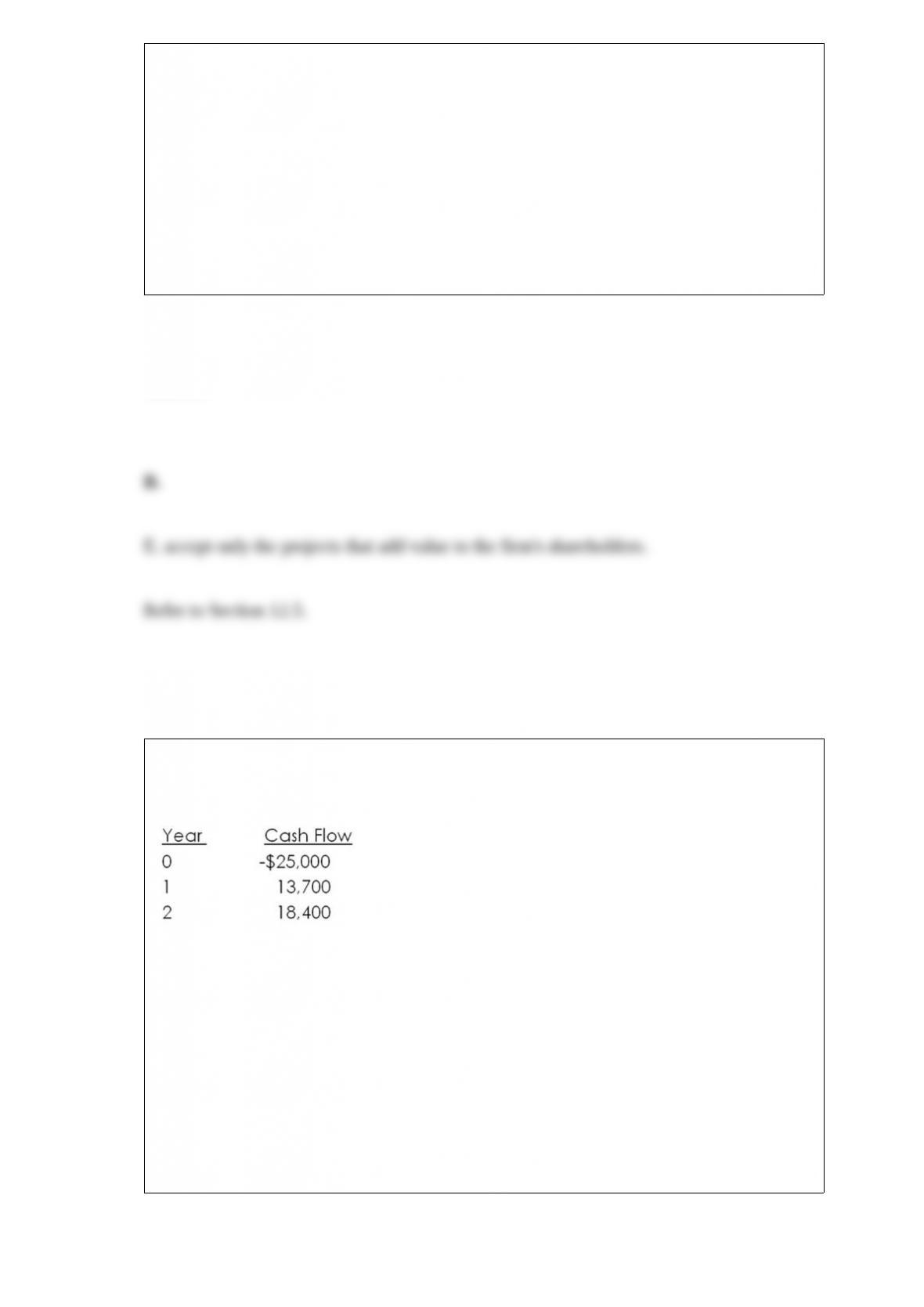
Joe and Rich are both considering investing in a project with the following cash flows.
Joe is content earning a 9 percent return, but Rich desires a return of 16 percent. Who, if
either, should accept this project?
A. Joe, but not Rich
B. Rich, but not Joe
C. Neither Joe nor Rich
D. Both Joe and Rich
E. Joe, and possibly Rich, who will be neutral on this decision as his net present value
will equal zero

Answer:
Jamie is analyzing the estimated net present value of a project under various what if
scenarios. The type of analysis that Jamie is doing is best described as:
A. sensitivity analysis.
B. erosion planning.
C. scenario analysis.
D. benefit planning.
E. opportunity evaluation.
Answer:
Which one of the following terms is defined as an underwriting for which the
underwriters assume full responsibility for any unsold shares?

A. Initial public offering
B. Best efforts underwriting
C. Firm commitment underwriting
D. Rights offer
E. Private placement
Answer:
You own a portfolio that is invested 38 percent in Stock A, 43 percent in Stock B, and
the remainder in Stock C. The expected returns on these stocks are 10.9 percent, 15.4
percent, and 9.1 percent, respectively. What is the expected return on the portfolio?
A. 10.55 percent
B. 11.02 percent
C. 11.67 percent
D. 12.49 percent
E. 13.05 percent
Answer:

Smelly Perfumes sells 3,500 units of its perfume collection each year at a price per unit
of $275. All sales are on credit with terms of 1/7, net 30. The discount is taken by 40
percent of the customers. What is the amount of the company’s accounts receivable?
A. $54,849
B. $58,246
C. $61,003
D. $64,815
E. $67,778
Answer:
A firm has net income of $6,850 and interest expense of $2,130. The tax rate is 34
percent. What is the firm’s times interest earned ratio?
A. 3.22
B. 5.19
C. 5.38
D. 5.87
E. 6.33
Answer:

Three years ago, Stock Tek purchased some five-year MACRS property for $67,400.
Today, it is selling this property for $28,000. How much tax will the firm owe on this
sale if the tax rate is 35 percent? The MACRS allowance percentages are as follows,
commencing with year 1: 20.00, 32.00, 19.20, 11.52, 11.52, and 5.76 percent.
A. -$3,006
B. -$1,480
C. $0
D. $1,480
E. $3,006
Answer:
All else constant, an increase in a firm’s cost of debt:
A. could be caused by an increase in the firm’s tax rate.
B. will result in an increase in the firm’s cost of capital.
C. will lower the firm’s weighted average cost of capital.
D. will lower the firm’s cost of equity.
E. will increase the firm’s capital structure weight of debt.

Answer:
Whitts BBQ would like to issue some semiannual coupon bonds at par. Comparable
bonds have a current yield of 9.16 percent, an effective annual yield of 9.68 percent,
and a yield to maturity of 9.50 percent. What coupon rate should Whitts BBQ set on its
bonds?
A. 9.00 percent
B. 9.16 percent
C. 9.50 percent
D. 9.68 percent
E. 10.00 percent
Answer:
Captain Kurt’s Enterprises has a receivables turnover rate of 12.8, a payables turnover
rate of 11.9, and an inventory turnover rate of 15.6. What is the length of the firm’s
operating cycle?

A. 24.89 days
B. 39.80 days
C. 51.92 days
D. 62.56 days
E. 83.77 days
Answer:
Tim Taylor Tools is a young start-up company. No dividends will be paid on the stock
over the next eight years because the firm needs to plow back its earnings to fuel
growth. The company will then pay a $9 per share dividend in year 8 and will increase
the dividend by 4 percent per year thereafter. If the required return on this stock is 12
percent, what is the current share price?
A. $42.64
B. $45.44
C. $57.23
D. $81.95
E. $100.13
Answer:

Systematic risk is:
A. totally eliminated when a portfolio is fully diversified.
B. defined as the total risk associated with surprise events.
C. risk that affects a limited number of securities.
D. measured by beta.
E. measured by standard deviation.
Answer:
Classic Cars is considering a project that requires $148,000 of fixed assets that are
classified as five-year property for MACRS. What is the book value of these assets at
the end of year 3? The MACRS allowance percentages are as follows, commencing
with year 1: 20.00, 32.00, 19.20, 11.52, 11.52, and 5.76 percent.
A. $34,210
B. $36,667
C. $42,624
D. $43,450
E. $44,504

Answer:
Which one of the following will tend to decrease the length of the credit period?
A. Decrease in default risk
B. Increase in the cost of the product
C. Increase in competition
D. Decrease in the size of the account
E. Decrease in turnover rate
Answer:
Green Tea House has a 35 percent tax rate and an interest tax shield valued at $6,728
for the year. How much did the firm pay in annual interest?
A. $2,153
B. $2,304

C. $2,468
D. $19,107
E. $19,223
Answer:
Which one of the following would be the most common evidence of indebtedness when
a sale is made on open account?
A. Sight draft
B. Commercial draft
C. Banker’s acceptance
D. Promissory note
E. Invoice
Answer:

Your firm has an average collection period of 52 days. Current practice is to factor all
receivables immediately at a 2.2 percent discount. What is the effective cost of
borrowing in this case? Assume that default is extremely unlikely.
A. 16.12 percent
B. 16.18 percent
C. 16.90 percent
D. 17.53 percent
E. 17.59 percent
Answer:
A project has an initial requirement of $698,700 for fixed assets and $61,000 for net
working capital. The fixed assets will be depreciated to a zero book value over the
four-year life of the project and will be worthless at the end of the project. All of the net
working capital will be recouped after four years. The expected annual operating cash
flow is $218,000. What is the project’s internal rate of return if the tax rate is 35
percent?
A. 7.72 percent
B. 8.41 percent
C. 8.69 percent
D. 9.11 percent
E. 9.97 percent

Answer:
Stock Y has a beta of 1.28 and an expected return of 13.7 percent. Stock Z has a beta of
1.02 and an expected return of 11.4 percent. What would the risk-free rate have to be
for the two stocks to be correctly priced relative to each other?
A. 2.38 percent
B. 2.76 percent
C. 3.23 percent
D. 3.69 percent
E. 4.08 percent
Answer:
Chasteen Hall currently has 55 days in its cash cycle and 131 days in its operating
cycle. The firm purchases its inventory from one supplier. This supplier has offered a 5
percent discount to The Switch Back if it will pay for its purchases within 10 days
instead of the normal 32 days. If the Switch Back opts to take advantage of the discount

offered, its new operating cycle will be _____ days and its new cash cycle will be
_____ days.
A. 109; 32
B. 109; 77
C. 131; 32
D. 131; 77
E. 153; 77
Answer:
Bermuda Cruises issues only common stock and coupon bonds. The firm has a
debt-equity ratio of 0.65. The cost of equity is 18.3 percent and the pretax cost of debt is
9.9 percent. What is the capital structure weight of the firm’s equity if the firm’s tax rate
is 34 percent?
A. 46.75 percent
B. 49.97 percent
C. 52.93 percent
D. 59.08 percent
E. 60.61 percent
Answer:

A stock has produced returns of 11 percent, 18 percent, -6 percent, -13 percent, and 21
percent for the past five years, respectively. What is the standard deviation of these
returns?
A. 7.75 percent
B. 8.87 percent
C. 9.23 percent
D. 14.99 percent
E. 16.64 percent
Answer:
Stock J has a beta of 1.47 and an expected return of 15.8 percent. Stock K has a beta of
1.05 and an expected return of 11.9 percent. What is the risk-free rate if these securities
both plot on the security market line?
A. 2.15 percent

B. 3.34 percent
C. 3.88 percent
D. 4.41 percent
E. 4.68 percent
Answer: