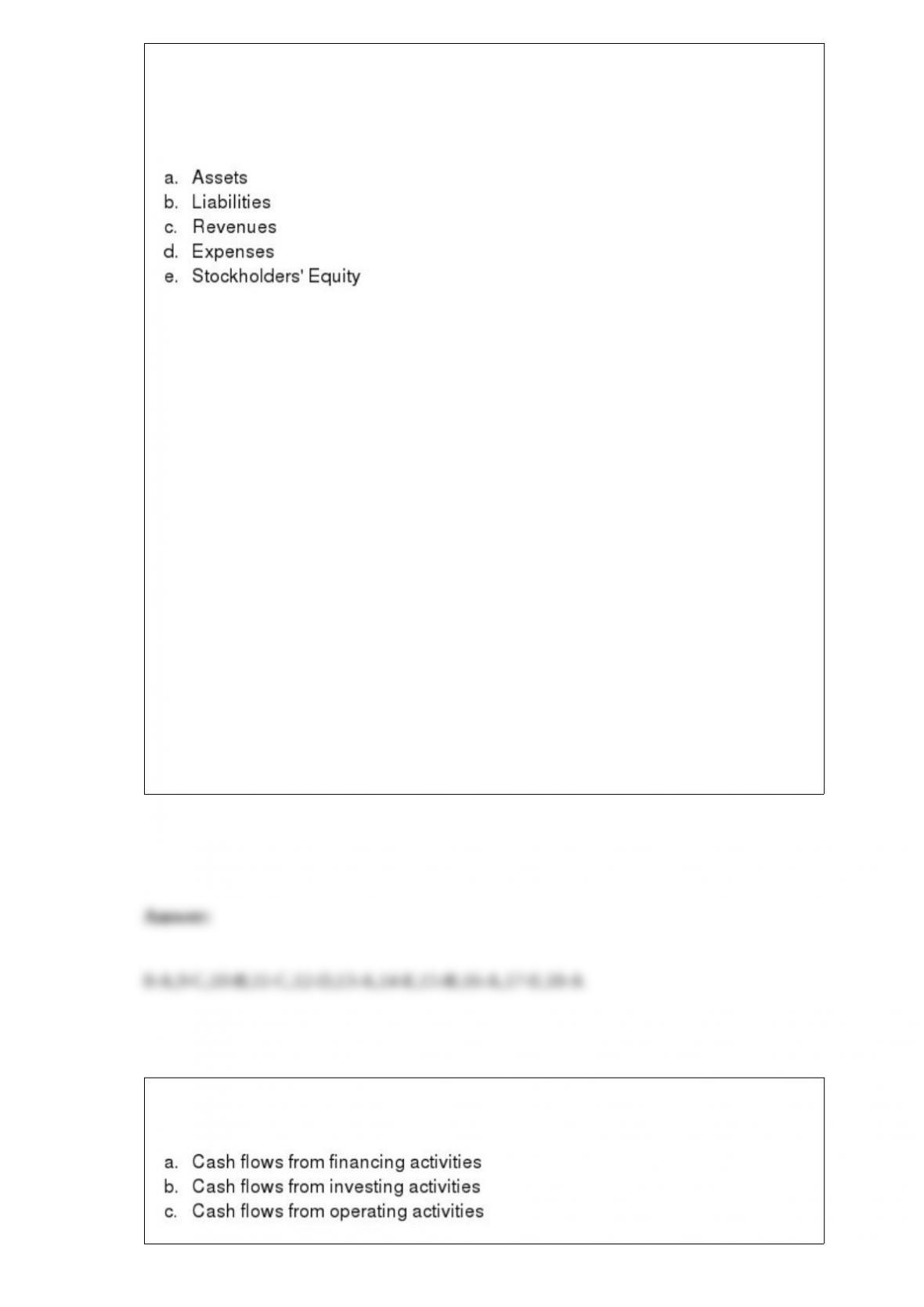
Several items from the financial statements of Fireside Tires are listed. Use the
following choices to identify the type of account for each item listed. (Choices may be
used more than once.)
8/ Inventory
9/ Net sales
10/ Unearned revenue
11/ Interest Income
12/ Research and development expense
13/ Accounts receivable
14/ Common stock
15/ Long-term notes payable
16/ Cash
17/ Retained earnings
18/ Patents
Match each statement to the item listed below.
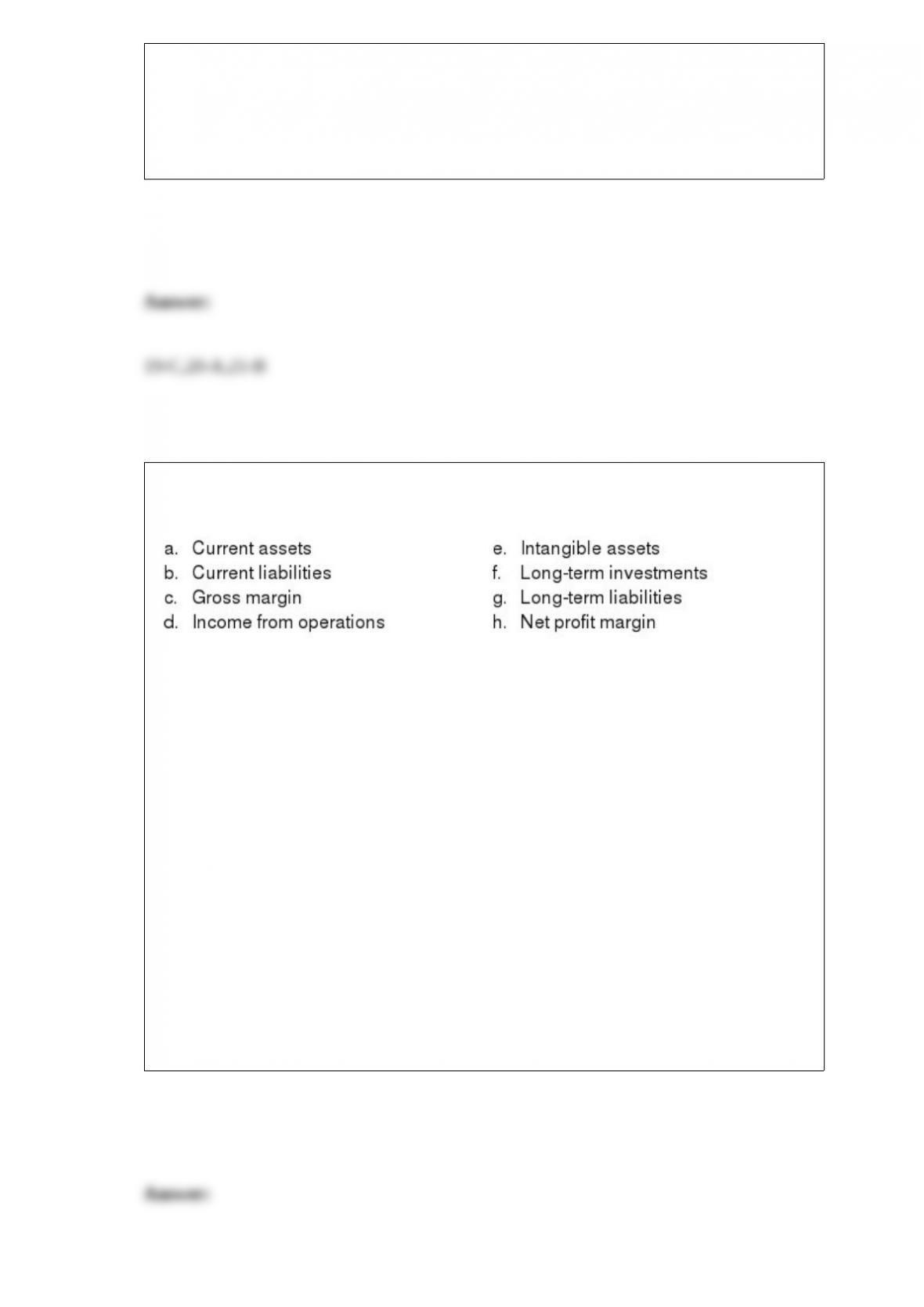
19/ Cash flows directly related to earning income
20/ Cash flows related to obtaining capital for the company
21/ Cash flows related to the acquisition or sale of investment and long-term assets
Match each statement to the item listed below.
22/ Net sales less cost of goods sold expense
23/ Resources that provide a benefit over a number of years but which lack physical
substance
24/ Investment in the debt and stock of other companies that is expected to be held for
more than a year
25/ Obligations that must be satisfied within a year
26/ Net income divided by sales revenue
27/ Gross margin less operating expenses
28/ Obligations that will require payment beyond one year
29/ Cash and other resources that are expected to become cash or used up within a
year’s time or less
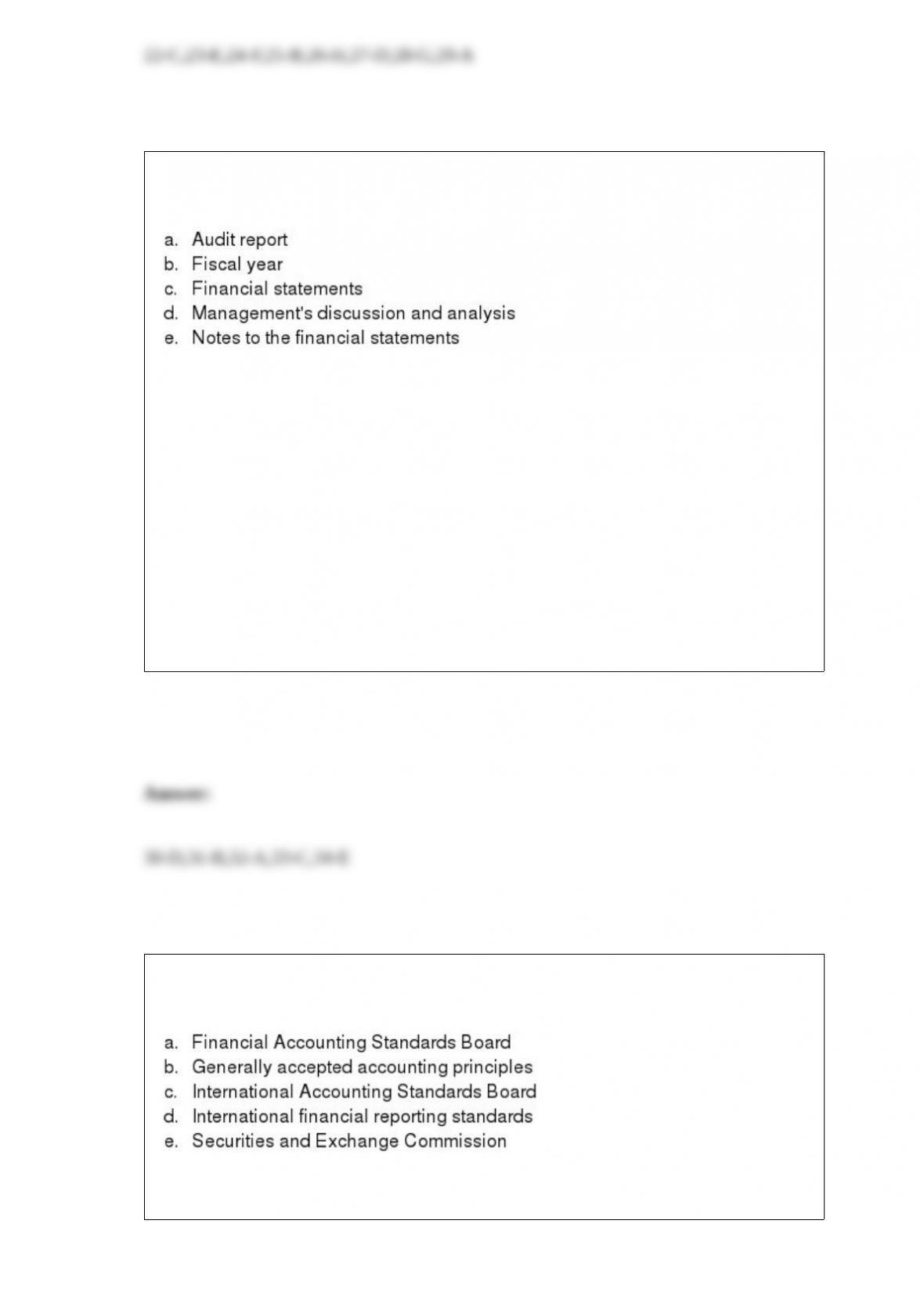
Match each statement to the item listed below.
30/ Section in the annual report that highlights favorable or unfavorable trends and
significant risks facing the company
31/ An accounting period that may or may not cover January 1 – December 31
32/ Contains the auditor’s opinion as to whether the financial statements fairly present
the company’s financial position and results of operations
33/ A set of reports that communicate a company’s financial position and results of
operations
34/ Information that clarifies and expands upon the information presented in the
financial statements
Match each statement to the item listed below.
35. Organization currently working to establish international financial reporting
standards

For each transaction provided, choose the appropriate account from the list that would
receive a debit entry as a result of the transaction. (Choices may be used more than
once.)
a. Cash
b. Accounts receivable
c. Supplies
d. Prepaid insurance
e. Land
f. Equipment
g. Accounts payable
h. Unearned revenues
i. Notes payable
j. Common stock
k. Retained earnings
l. Service revenue
m. Salary expense
n. Insurance expense
o. Utilities expense
p. Dividends
1.Issuing common stock

2.Borrowing cash
3.Purchasing equipment for cash
4.Purchasing a 6-month insurance policy
5.Purchasing supplies on credit
6.Providing services to customers for cash
7.Providing services to customers for credit
8.Receiving cash from a customer in advance of providing any services
9.Paying for items previously purchased on credit
10.Paying salaries to employees
11.Collecting from customers for services sold previously on credit
12.Paying utilities
13.Paying dividends
Several transactions are listed. Use the choices to identify the effect on the accounting
equation for each transaction listed. (Choices may be used more than once.)
a. Assets and liabilities increase
b. Assets and contributed capital increase
c. Assets and retained earnings increase
d. Two asset accounts are impacted, but there is no net effect on total assets
e. Assets and liabilities decrease

f. Assets and retained earnings decrease
g. Liabilities increase and retained earnings decrease
h. Liabilities decrease and retained earnings increase
14. Issuing common stock to investors
15.Borrowing cash from a bank
16.Purchasing a building for cash
17.Purchasing insurance for 1 year
18.Purchasing supplies on credit
19.Providing services for customers for cash
20.Providing services for customers for credit
21.Receiving cash from customers in advance for services to be provided next month
22.Paying for a previous purchase on credit
23.Paying salaries to employees
24.Collecting cash from customers who had previously made credit purchases
25.Paying utilities
26.Paying dividends to investors
Organizations important to accounting are listed. Select the organization that most
closely achieves the role described. (Choices may be used more than once.)

a. Financial Accounting Standards Board (FASB)
b. International Accounting Standards Board (IASB)
c. Securities and Exchange Commission (SEC)
27. Works to reduce differences in accounting standards throughout the world.
28. Issues financial accounting concepts that are used as a guide to accounting
standard-setting in the U.S.
29. Has the ultimate authority to set accounting standards, but has allowed the
profession to do so.
30. Requires that publicly traded companies file financial information on a timely
basis.
Select the choice that describes the type of transaction and whether it should be
recorded in the accounting system. (Choices may be used more than once.)
a. External event to be recorded as a transaction
b. Internal event to be recorded as a transaction
c. Event which should not be recognized in the accounting system
31. An order is placed with a supplier for merchandise.
32.Common stock is issued to investors.

33.Cash sales are made.
34.Materials are entered onto the assembly line.
35.Tax returns are prepared by the company’s accountant.
36. A bill is received for the current month’s utilities.
37.Payments are received from customers to whom merchandise was sold on credit.
38. Amounts collected from cash and credit customers is deposited in the company’s
bank account.
Several accounts from the financial records of Wynn Linders, Inc. are listed. Indicate its
normal balance and the debit/credit rules for increasing the account. (Choices may be
used more than once.)
a. Debit
b. Credit
39. Income Tax Expense
40. Accounts Payable
41. Retained Earnings
42. Prepaid Insurance
43. Service Revenues
44. Notes Payable
45. Intangibles

46. Common Stock
47. Dividends
48. Unearned Revenues
Match the following principles with their correct definition.
a. Comparability g. Historical cost
b. Conservatism h. Matching
c. Double-entry accounting i. Monetary unit
d. Economic entity j. Revenue recognition
e. Going concern k. Time period
f. Full disclosure
49. This principle requires that the activities of a company be initially measured at
their exchange price at the time the activity occurs.
50. This principle states that accountants should take care to avoid overstating assets
or income when they prepare financial statements.
51. This assumption states that in the absence of information to the contrary, it should
be assumed that a company will continue to operate indefinitely.
52. This principle divides the life of a company into artificial time periods such as
quarters and years.
53. The system used by companies to record the effects of transactions on the
accounting equation.
54. This assumption requires that financial information be reported in monetary

terms.56
55. Any information that would make a difference to financial statement users should
be reported.
56. This principle is used to determine when revenue is recorded and reported
57. This principle requires that an expense be recorded and reported in the same period
as the revenue it helped generate.
58. This assumption states that each company will be accounted for separately from its
owners.
Match the following principles with their correct definition.
a. Comparability g. Historical cost
b. Conservatism h. Matching
c. Double-entry accounting i. Monetary unit
d. Economic entity j. Revenue recognition
e. Going concern k. Time period
f. Full disclosure
49. This principle requires that the activities of a company be initially measured at
their exchange price at the time the activity occurs.
50. This principle states that accountants should take care to avoid overstating assets
or income when they prepare financial statements.
51. This assumption states that in the absence of information to the contrary, it should
be assumed that a company will continue to operate indefinitely.

52. This principle states that users should be able to make meaningful comparisons of
different companies.
53. This principle divides the life of a company into artificial time periods such as
quarters and years.
54. The system used by companies to record the effects of transactions on the
accounting equation.
55.This assumption requires that financial information be reported in monetary
terms.56
56. Any information that would make a difference to financial statement users should
be reported.
57. This principle is used to determine when revenue is recorded and reported
58. This principle requires that an expense be recorded and reported in the same period
as the revenue it helped generate.
59. This assumption states that each company will be accounted for separately from its
owners.
Match the following terms with their correct definition.
a. Account f. Debit
b. Accounting cycle g. Event
c. Chart of accounts h. General ledger
d. Cost vs. benefit i. Journal
e. Credit j. Trial balance

60.A list of all the accounts maintained by the business.
61. The sequence of procedures used by companies to transform the effects of business
activities into financial statements.
62.A device used to record increases and decreases in each of the basic elements of the
financial statements.
63.A collection of all the individual financial statement accounts that a company uses.
64.A chronological record showing the debit and credit effects of transactions on a
company.
65.A list of all active accounts and each account’s debit or credit balance.
66.Term used to refer to the left side of an account.
67.It does not make good business sense to spend $100 to save $75.
68.Something that happens to the business that may or may not require a journal entry.
69.Term used to refer to the right side of an account.
Select the correct revenue recognition principle for each of the following. (Choices may
be used more than once.)
a. Recognize revenue over the passage of time.
b. Recognize revenue when the customer takes possession of the product.
c. Recognize revenue when cash is collected.
d. Recognize revenue when service is performed.
1/ Interest
2/ Rent
3/ Prepaid Subscriptions
4/ Inventory
5/ Consulting Services
Match the most probable matching method to the costs listed. (Choices may be used
more than once.)
6/ Storage facility used for storing inventory goods
7/ Commissions earned by sales people
8/ Cost of two-year lease
9/ Rent paid in advance
Match the following types of adjusting entries to the listed situation. (Choices may be
used more than once.)
10/ Two years insurance premium was paid in advance
11/ Cash was collected from customers for services to be performed next year
12/ An office building was acquired for cash
13/ Utility expense was incurred, but not yet paid at the end of the year
14/ Interest is earned but not yet collected
For each transaction select the type of adjustment that would be required. (Choices
may be used more than once.)
a. Deferred (prepaid) expense
b. Deferred (unearned) revenue
c. Accrued expense
d. Accrued revenue
15/ Depreciation on a building is recorded
16/ Revenue is earned for previously received advance cash collections
17/ Interest is earned on notes receivable, but not yet received
18/ The cost of supplies used during the year is recorded

19/ The cost of salaries earned by employees, but not paid at the end of the accounting
period, is recorded
For each transaction select the type of adjustment that would be required. (Choices
may be used more than once.)
a. Deferred (prepaid) expense
b. Deferred (unearned) revenue
c. Accrued expense
d. Accrued revenue
20/ Amounts are earned, but not yet received from customers
21/ Insurance is earned in the current period, although collections from customers had
been received in a previous period
22/ Rent had been incurred, but not yet paid
23/ The depreciation on machinery used during the current year is recorded
24/ The employee salaries has been incurred, but not paid at the end of the accounting
period

From the list of accounts, determine whether the account is a temporary or permanent
account. (Choices may be used more than once.)
a. temporary account
b. permanent account
25/ Cash
26/ Rent Revenue
27/ Land
28/ Depreciation Expense
29/ Prepaid Insurance
30/ Unearned Revenue
31/ Supplies Expense
32/ Salaries Payable
Match each statement to the item listed below
a. Accrual basis accounting f. Depreciation
b. Adjusted trial balance g. Matching principle
c. Adjusting entries h. Revenue recognition principle
d. Cash basis accounting i. Time period assumption
e. Contra accounts j. Worksheet

33/ Without these, some of the account balances will not be up-to-date at the time
financial statements are prepared
34/ Allows companies to artificially divide their operations into periods for ease of
communication
35/ A schedule that facilitates preparation of the financial statements
36/ States that revenues and expenses are recorded in the time period received or
paid
37/ A listing of all the account balances immediately before preparation of the
financial statements
38/ Refers to the process of assigning the cost of an asset such as a building to
expense over the asset’s useful life
39/ Requires that expenses be recorded in the same period as the revenue that they
helped generate
40/ States that revenues should be recorded in the period in which it is earned

Match the following terms with their correct definitions.
a. Accounting system e. Internal control system
b. Business process risks f. Safeguarding
c. Control activities g. Segregation of duties
d. Control environment h. Strategic risks
28/ Policies and procedures established by top management to help ensure that the
company’s accounting system and financial statements are as accurate as possible
29/ Possible external threats to the organization’s success in accomplishing its goals
30/ The collection of environmental factors that influence the effectiveness of control
procedures
31/ Action that reduces the likelihood that records could be used to conceal
intentional misstatements, theft, or fraud
32/ Risks associated with how the company allocates its resources to meet its
objectives
33/ Providing physical protection of the company’s assets
34/ Consists of the methods and records used to identify, measure, record, and
communicate financial information about a business
35/ Collective term for procedures put into place to ensure that employees operate
within the scope of their assigned responsibilities and act for the good of the business
Match the following terms with their correct definition.

a. Cash equivalents c. Operating cycle
b. Cash over and short d. Petty cash
36. The elapsed time between the purchase of goods for resale and the collection of
cash from customers
37. An account used to record any discrepancies between the cash records and the
actual amount of cash received
38. Amounts on deposit with financial institutions and investments primarily held in
money market accounts, with original maturities of less than 90 days
39. A fund used to pay for small amounts to avoid the time and expense of paying by
check
Select the term that matches each of the following descriptions.
a. Interest
b. Maturity Value
c. Principal
d. Lender
e. Factoring
f. Fraction of year
g. Maturity date
h. Implicit

i. Maker
1, The amount borrowed
2, The length of time a note is outstanding–the period of time between the date it is
issued and the date the note is due to be paid
3, The party that receives payment due from a note
4, Date which the total interest and principal must be repaid
5, The difference between the principal amount of the note and its maturity value
6, The amount of cash the maker is to pay the payee on the maturity date of the note
Select the term that matches each of the following descriptions.
a. Sales Discount
b. Trade Discount
c. Sales Allowance
d. Sales Returns
7, Used to induce the customer to keep damaged goods
8, Used to encourage prompt payment
9, Reduction of price granted by the seller for a particular class of customers

Match each statement to the item listed below
a. Bank credit card c. Sears card
b. Debit card d. American Express
10, Results in an immediate electronic withdrawal from the owner’s bank account
when used.
11, Just a special form of factoring.
12, A non-bank credit card.
13, No service charge expense is incurred by the issuer when this card is used.
Match each statement to the item listed below
a. Accounts receivable e. Notes receivable
b. Aging method f. Realized
c. Allowance for Doubtful Accounts g. Securitization
d. Earned
14, The packaging of receivables as financial instruments or securities for sale to
investors.
15, A way to estimate bad debts.
16, Money due the company from another business or individual.
17, Generally entitle the holder to interest.
18, A contra-asset account.

19, Indicates that non-cash resources have been exchanged for cash.
20, Indicates that the earnings process is substantially complete.
Match each statement to the item listed below
a. Bad debt expense d. Percentage of credit sales
b. Net sales revenue e. Profitability ratios
c. Nontrade receivables f. Trade receivables
21, Measure the return the company is earning on sales.
22, Money due from customers purchasing inventory in the ordinary course of
business
23, Receivables that the company is not able to collect.
24, A way to estimate bad debt expense.
25, Arise from transactions not involving inventory (e.g., interest receivable).
26, The amount of sales expected to be collectible after deducting discounts and
returns and allowances.

Match each of the ratios named with the proper formula for computation.
a. Current Ratio
b. Quick Ratio
c. Cash Ratio
d. Operating Cash Flow Ratio
19/ Cash Flows from Operating Activities / Current Liabilities
20/ Current Assets / Current Liabilities
21/ (Cash + Marketable Securities) / Current Liabilities
22/ (Cash + Marketable Securities + Accounts Receivable) / Current Liabilities
Match the following terms with the appropriate definition.
a. Accrued liabilities f. Payroll taxes
b. Contingent liabilities g. Sales taxes
c. Current liabilities h. Warranty
d. Interest rate i. Withholdings
e. Liabilities
23/ Taxes and other amounts deducted from gross pay
24/ Taxes paid to the government by both employees and employers
25/ Obligations that require the firm to pay cash or another current asset within one
yea
26/ Liabilities created by adjusting entries
27/ Guarantees the repair or replacement of defective goods during a specified
period following the sale
28/ Probable future sacrifices of economic benefits
29/ Obligations whose amounts, timing, or recipient depend on future events
30/ Taxes levied by state and local governments
31/ A percentage of the loan amount that compensates the lender for the use of
his/her money
Appendix 3Time Value of Money
Mustard Seed Gifts had the following results for December 31, 2013 and 2014,
respectively:
2014 2013
Cash $ 50,000 $ 40,000
Noncash current assets 190,000 160,000
Cash flows from financing activities 210,000
Cash flows from operating activities 90,000
What was the amount of cash flows from investing activities for 2014?
a. Cash inflow of $290,000
b. Cash outflow of $290,000
c. Cash outflow of $10,000
d. Cash outflow of $30,000
Refer to Rags to Riches. Which of the following would result from a vertical analysis of
the company’s income statement?
a. The accounts receivable turnover ratio is 7.76 in 2015.
b. Gross profit is 57.9% of net sales for 2015.
c. Cost of goods sold decreased $50,000 or 23.8% during 2015.
d. Net sales is 84.4% of total assets for 2015.

Labor Finders, Inc.
Selected data from the company’s financial statements are presented below:
2015 2014
Net income $ 150,000 $ 120,000
Cash dividends paid on preferred stock 15,000 15,000
Cash dividends paid on common stock 42,000 38,000
Common stock price 15 14
Preferred stock price 31 26
Purchases of treasury stock 100,000 -0-
Total stockholders’ equity 2,300,000 2,157,000
Common stockholders’ equity 1,780,000 1,637,000
Average number of preferred shares outstanding 20,000 20,000
Average number of common shares outstanding 104,000 95,000
Refer to Labor Finders, Inc. The company’s 2015 earnings per share is reported as
a. $1.08
b. $1.20
c. $1.30
d. $1.43

A company had sales of $40,000, sales discounts of $800, sales returns of $1,600 and
commissions owed to sales people of $600. Compute net sales.
a. $37,600
b. $37,000
c. $38,400
d. $39,000
Rio Imports
Information from the financial statements are provided below:
2015 2014
Current Liabilities $460,000 $320,000
Long-Term Liabilities 240,000 640,000
Stockholders’ Equity 840,000 1,080,000
Net Cash Flows from Operating Activities 160,000 102,000
Interest and Principal Payments 24,000 16,000
Net Sales 950,000 900,000
Net Income 180,000 144,000
Interest Expense 17,000 23,000
Income Taxes 32,000 29,000
Dividends Paid to Common Stockholders 30,000 60,000

Refer to Rio Imports. The debt-to-equity ratio for 2015 is
a. an indicator that the company’s ability to meet current interest payments to creditors
is increasing.
b. increasing slightly from 2014 to 2015.
c. an indicator that for every $1 of capital that has been provided by stockholders,
creditors provided $0.83.
d. an indicator that the company’s reliance on stockholders for funding increased from
2014 to 2015.
Which of the following would be correct if a company factored $2,500,000 of
receivables with a 2 percent fee?
a. $2,450,000 credit to cash
b. $50,000 debit to factoring fee expense
c. $2,500,000 debit to accounts receivable.
d. $50,000 debit to factoring fee receivable.
For the most recent year, a company’s current ratio was significantly lower than its
industry average. What is the bestpossible explanation for this situation?
a. The company’s competitors were profitable.

b. The company’s liquidity has improved.
c. The company has less equity than the rest of the industry.
d. The company’s liquidity is worse than the rest of the industry.
The stockholders’ equity section of the balance sheet appears as follows at January 1,
2014:
Common Stock, $2 par, 2,000 shares issued and outstanding $ 4,000
Paid-in Capital in Excess of Par–Common Stock 1,600
Total Capital Stock 5,600
Retained Earnings 5,400
Total Stockholders’ Equity $11,000
On March 1, 2014, the company repurchased 800 shares of its common stock at $12 per
share but on April 6, 2014, it reissued 600 shares of the shares at $20 per share.
A) Prepare the journal entries to record for the March 1 and April 6 transactions.
B) How many shares of common stock are outstanding at March 31, 2014, and April
30, 2014, respectively?
Refer to Kalahari Limited. What is the carrying value of the bonds at the end of ten
years before the final maturity payment is made?
a. $850,000
b. $1,200,000
c. $1,000,000
d. $1,150,000

Which one of the following items appears on a balance sheet?
a. service revenue
b. unearned revenue
c. dividends
d. cash flow from operations
Refer to the information provided for Regan Company. Determine the financial
statement effects of the inventory error for 2014.
a. Expenses will be understated and net income will be overstated.
b. Expenses will be overstated and net income will be understated.
c. Both expenses and net income will be overstated.
d. Both expenses and net income will be understated.
Which of the following is considered a profitability ratio?
a. return on equity
b. acid test ratio
c. inventory turnover ratio
d. debt-to-equity ratio

Which pair of accounts has the same set of rules for debit and credit entries?
a. common stock and accounts payable
b. salary expense and retained earnings
c. cash and notes payable
d. sales revenue and accounts receivable
External users of financial information
a. need detailed records of the business to make informed decisions.
b. are primarily responsible for the preparation of financial statements.
c. rely on the financial statements to help make informed decisions.
d. rely on management to tell them whether the company is a good investment.
If a company erroneously records a $50 check received from a customer as $500 in its
records, which of the following must occur when reconciling its bank statement?
a. The company must increase the balance per its records by $500.
b. The company must increase the balance per its records by $450.
c. The company must decrease the balance per its records by $500.
d. The company must decrease the balance per its records by $450.

Common stock usually has all of the following features except
a. voting rights.
b. preemptive right.
c. residual claim to net assets.
d. conversion privilege.
A company forgotto record four adjustments during 2013. Which one of the following
omissions of adjustments will understate net income?
a. Sales made during the last week of the period are not recorded.
b. Interest on monies borrowed has not yet been recorded.
c. Prepaid insurance is not reduced for the portion of the policy that has expired during
the period.
d. Income taxes owed but not yet paid are ignored.

Refer to A2Z Events. What are the effects on the accounting equation when the
company writes off a bad debt under the allowance method?
a. Assets decrease and stockholders’ equity increase
b. Assets and stockholders’ equity decrease
c. Assets increase and stockholders’ equity decreases
d. No effect on overall assets or stockholders’ equity
Which of the following is an example of liquidity analysis?
a. Total liabilities are divided by total assets.
b. Net income is divided by average total assets.
c. Net income is divided by the average number of common shares outstanding.
d. Quick assets are divided by current liabilities.
If a company’s asset turnover ratio decreased from 2012 to 2013, which of the following
conclusions can be made?
a. The company was more efficient during 2013 in using its assets to produce profits.
b. The company produced less sales in 2013 for each dollar invested in assets.
c. The company was less profitable in 2012.
d. The company over invested in assets in 2013.
The bookkeeper made the following errors while recording transactions for the period:
A) A purchase of equipment for $450 cash was recorded as a debit to Equipment for
$540 and a credit to Cash for $540.
B) The sale of services for cash in the amount of $4,134 was recorded as a debit to Cash
for $4,134 and a credit to Service Revenue for $4,314.
C) A purchase of supplies for $200 cash was recorded correctly in the journal but was
omitted from the general ledger.
D) The sale of services for credit in the amount of $3,800 was recorded correctly in the
journal but was posted twice to the general ledger.
E) $5,500 cash paid for salaries was recorded in the journal as a $5,500 debit to Cash
and a $5,500 credit to Salaries Expense.
Indicate whether or not the debit and credit columns of the trial balance will be equal
after recording each of these erroneous entries. Then identify the account(s) that will be
misstated as a result of these errors and the direction of the misstatement (i.e.,
understatement or overstatement).
On January 1, 2013, a machine with an estimated life of 5 years and an estimated

residual value of $5,000 was acquired for $40,000. On July 1, 2015, the machine was
sold for $7,000 cash. The journal entry to record the sale
a. decreases stockholder’s equity.
b. increases total assets.
c. decreases total expenses.
d. increases net income.
Presented below is the operating activities section of a statement of cash flows for
2014:
Operating activities:
Cash collected from customers $ 550,000
Cash payments for merchandise (150,000)
Cash payments for operating expenses (275,000)
Net cash inflow from operating activities $ 125,000
Which method of preparing the operating activities section was used?
a. The direct method.
b. The indirect method.
c. Either method.
d. Cannot be determined without further information.

There are some liabilities, such as income taxes payable and the estimated warranty
liability, for which the amounts must be estimated so they can be recorded in the same
period as the related revenues. Failure to record these amounts in the same period as the
related revenues is a violation of the
a. concept of historical cost.
b. going concern assumption.
c. limitation of materiality.
d. matching principle.
A company’s accounts receivable balance after posting net collections from customers
for 2013 is $150,000. Management feels that uncollected accounts should be based on
the following aging of accounts receivable and uncollected percentages. There are
$100,000 that are 1-30 past due at 2% and $50,000 that are 31 to 60 days past due at
10%. The net realizable value of the accounts receivable is
a. $147,500
b. $148,000
c. $150,000
d. $143,000
Which of the following accounts is increased by a debit entry?
a. common stock
b. equipment
c. notes payable
d. service revenue

Eli Company
Eli Company sells novelty items and offers terms of 1/10, n/30 to credit customers. One
customer, Faulkner, Inc., purchased 100 Sweet-16 party decor packs with a list price of
$20 each on March 5, 2013.
Refer to the information provided for Eli Company. If the customer pays the amount of
the invoice for its purchase on March 14, 2013, how much cash will Eli Company
receive?
a. $1,400
b. $1,800
c. $1,980
d. $2,000
Stallworth Corp.
Stallworth Corp. uses a periodic inventory system. The following information is
available for the month of November:

Nov. 1 On hand, 50 units at $15 each $ 750.00
5 Purchased, 115 units at $15.10 each 1,736.50
16 Purchased, 75 units at $15.20 each 1,140.00
Total cost of goods available for sale $3,626.50
30 On hand, 100 units
Refer to the information provided for Stallworth Corp. How many units did the
company sell during November?
a. 240
b. 140
c. 100
d. 50
The stockholders’ equity section of a balance sheet at December 31, 2015, is as follows:
7% Preferred Stock, $1 par, 10,000 shares authorized, 3,000 shares issued $ 3,000
Common Stock, $1 par, 150,000 share authorized, 10,000 shares issued 10,000
Paid-in Capital in Excess of Par:
Preferred Stock 9,000
Common Stock 20,000
Total Capital Stock 42,000
Retained Earnings 150,000
Less: Treasury Stock (1,000 common shares at cost) 6,000
Total Stockholders’ Equity $186,000
A) What was the average issue price of the preferred stock?
B) What was the average issue price of the common stock?
C) What will be the retained earnings account balance immediately following a
2-for-1 stock split?
D) If the company’s board of directors declares a cash dividend consisting of the
annual stated dividend rate for preferred stockholders plus $1 per share for common
stockholders, what is the total amount of dividends to be paid and what would be the
remaining balance in the retained earnings account immediately following the
declaration of this cash dividend?
Refer to the information provided for Jocque Fabrics. If the company uses the FIFO
method, determine the following amounts:
A) Ending inventory on February 28th?
B) Cost of Goods sold for the month of February?
C) Gross Margin for February?
A company issued additional shares of stock. Which of the following is true with regard
to the effect of the stock issuance transaction on the company’s ratio computations?
a. Earnings per share decreased.
b. The debt-to-equity ratio increased.
c. The asset turnover ratio decreased.
d. Return on equity remained unchanged.
Which internal control activity is followed when the work of one department acts as a
check on the work of another?
a. segregation of duties
b. safeguarding of assets and records
c. checks on recorded amounts
d. clearly defined authority and responsibility
____________________ shares are the maximum number of shares a corporation may
issue in accordance with its corporate charter.
How is a classified balance sheet useful to decision makers?
The terms “realized” and “realizable” mean that the selling price is fixed and
determinable and collectibility is reasonably assured.
____________________ bonds may be retired by the issuing company before their
specified due date.
A ____________________ is a correction of retained earnings resulting from a
previous error that affected net income.
When computing the dividend yield, net income is divided by the common stock price.
The two promises made by a bond issuer to the purchaser of the bond are to pay
periodic interest and to ___________________.
Shares outstanding may be less than shares issued.
Refer to Hatcher Tool Service. Prepare a trial balance in proper format. Assume that
there are no additional accounts or balances other than those created from the June
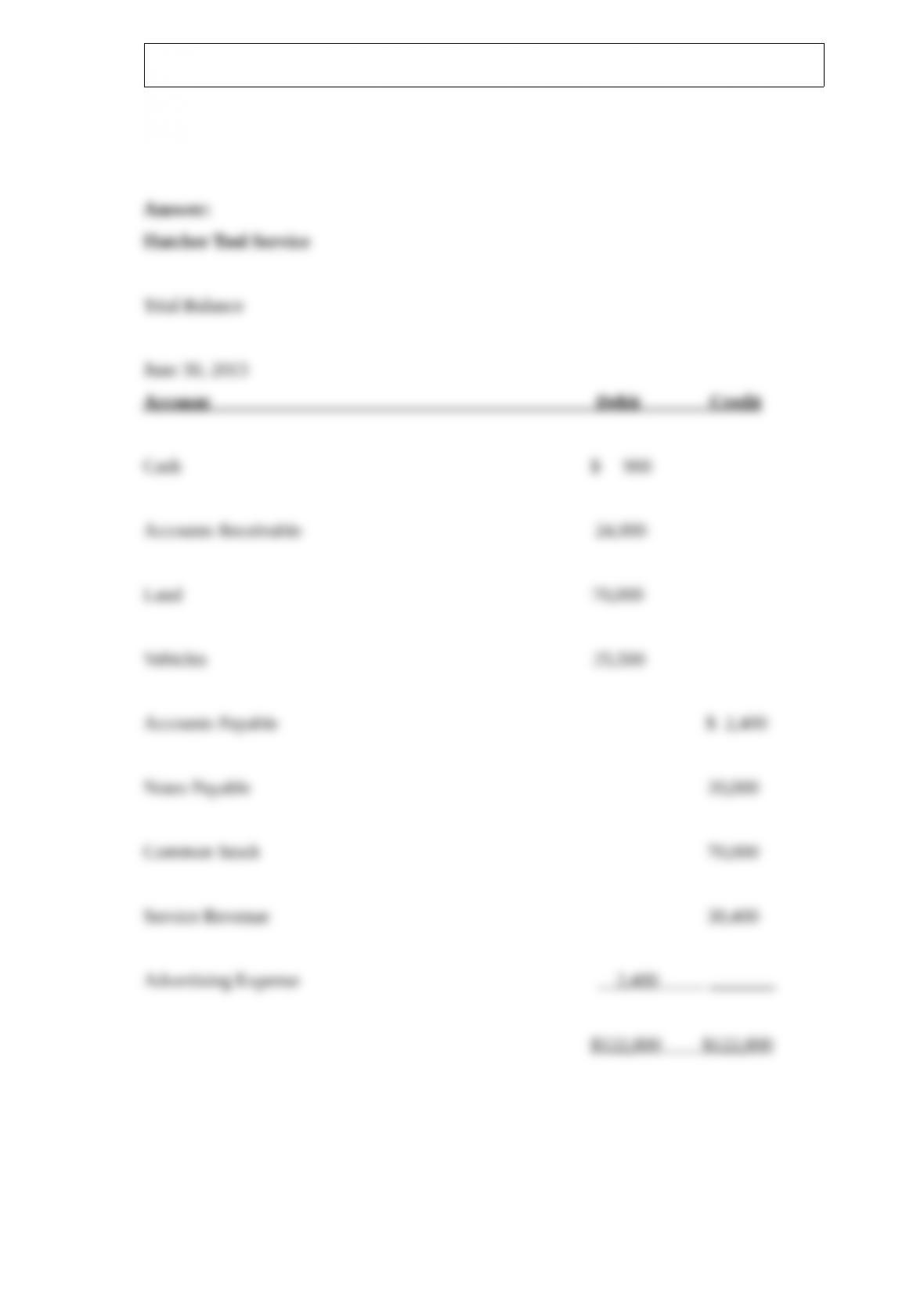
transactions.
A company expects to receive a substantial cash settlement from a lawsuit. Therefore,
the company must record this on its accounting records if a reasonable estimate can be
made of the amount to be received.
Refer to Merry Maids Company. At the end of each year, the company’s cash balance
was approximately $5 to $7 million. What does this indicate about its cash management
techniques?
A check that “bounced” or was returned by the bank due to lack of funds is called a(n)
____________________.
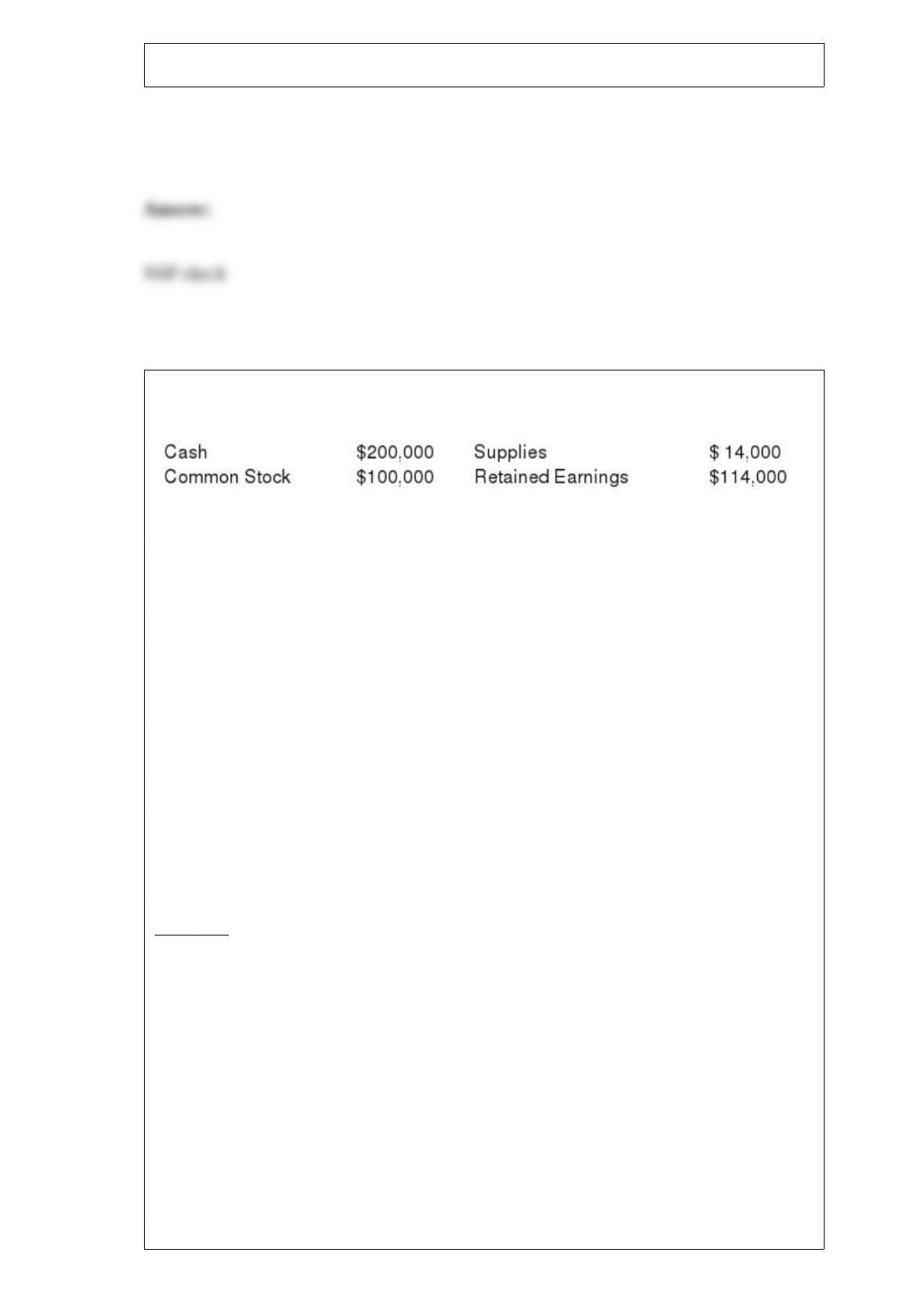
The accounting records of Cary’s Magic Shows reflect the following account balances
at January 1, 2013:
During 2013, the following transactions occurred:
1. On February 1, rented a small office for a one year period of time. Paid $12,000
cash.
2. On November 1, received $3,600 cash for magic lessons to be provided evenly
over November, December, and January.
3. By December 31, used 6,000 of the supplies.
4. At December 31, accrued $5,000 in wages and salaries.
5. During the year, paid cash for $25,000 in wages and salaries.
6. During the year, earned $65,000 cash in magic lesson revenue.
Required:
A) Determine the effect on financial statement accounts of the preceding
transactions.
Hint: It may be helpful to create a table to reflect the increases and decreases in
account.
B) Prepare an income statement for 2013 ignoring income taxes.
C) Prepare a classified balance sheet at December 31, 2013.