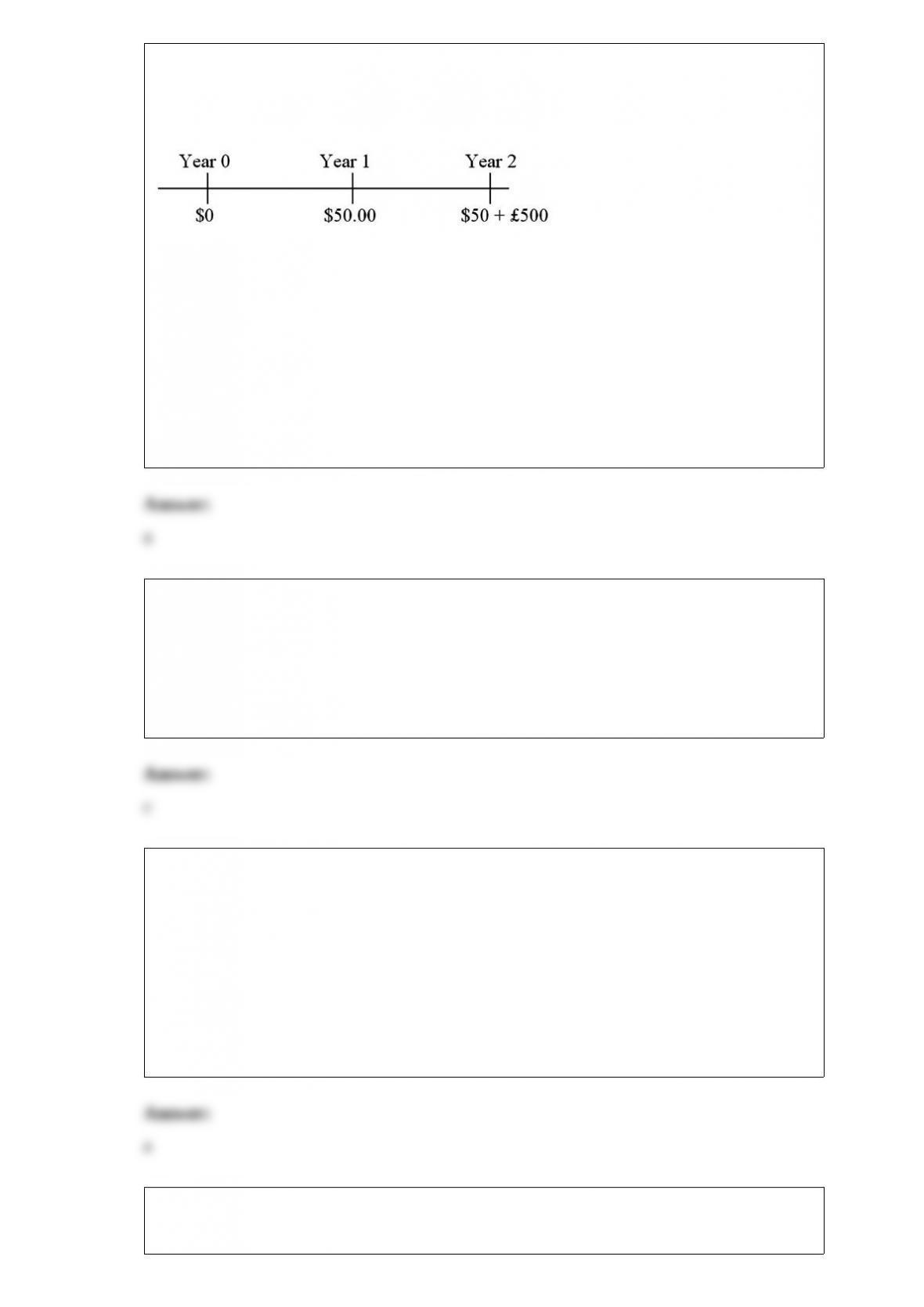
1) find the value today of a 2-year dual currency bond with annual coupons (paid in u.s.
dollars at a 5 percent coupon rate) that pays £500 per $1,000 par value at maturity. the
cash flows of the bond are:
the dollar-based yield to maturity is i$ = 3%; the spot exchange rate is $1.80 = £1.00;
the pound-based yield to maturity is i£ = 4%.
a.$927.77
b.$941.30
c.$965.06
d.$880.65
2) an exporter faced with exposure to a depreciating currency can reduce transaction
exposure with a strategy of
a.paying or collecting early
b.paying or collecting late
c.paying late, collecting early
d.paying early, collecting late
3) transactions in shares of the ishares funds will typically generate tax consequences.
this is because
a.ishares funds are obliged to distribute portfolio gains to shareholders
b.ishares funds are not allowed to be held in tax-qualified accounts such as iras
c.ishares funds feature daily resettlement
d.none of the above
4) generally, the lower the turnover ratio,
a.the less liquid the secondary stock market, indicating difficulty in trading

b.the more liquid the secondary stock market, indicating difficulty in trading
c.the more liquid the primary stock market, indicating difficulty in trading
d.the more efficient the stock market is
5) amortizing currency swaps
a.the debt service exchanges decrease periodically through time as the hypothetical
notational principal is amortized
b.incorporate an amortization feature in which periodically the amortized portions of
the notational principals are re-exchanged
c.both a and b
d.none of the above
6) mncs may undertake overseas investment projects in a foreign country, despite the
fact that local firms may enjoy inherent advantages. this implies that
a.mncs are making a mistake in this case and will have to eventually withdraw
b.mncs should have significant advantages over local firms such as comparative
advantages due to intangible assets
c.the local firms will not have to compete due to their inherent advantages over the
foreigners.
d.none of the above
7) the most direct and popular way of hedging transaction exposure is by
a.exchange-traded futures options
b.currency forward contracts
c.foreign currency warrants
d.borrowing and lending in the domestic and foreign money markets

8) the underlying principle of the monetary/nonmonetary method is
a.assets and liabilities should be translated based on their maturity
b.monetary accounts have a similarity because their value represents a sum of money
whose currency equivalent after translation changes each time the exchange rate
changes
c.monetary accounts are translated at the current exchange rate; other accounts are
translated at the current exchange rate if they are carried on the books at current value;
items carried at historical cost are translated at historic exchange rates
d.all balance sheet accounts are translated at the current exchange rate, except for
stockholders’ equity. a “plug” equity account named cumulative translation adjustment
(cta) is used to make the balance sheet balance, since translation gains or losses do not
go through the income statement according to this method
9) the central issue of corporate governance is
a.how to protect creditors from managers and controlling shareholders
b.how to protect outside investors from the controlling insiders
c.how to alleviate the conflicts of interest between managers and shareholders
d.how to alleviate the conflicts of interest between shareholders and bondholders
10) recent studies suggest that agency costs of managerial discretion are lower in japan
than in the united states. this suggests that
a.the cost of capital can be lower in japan than the united states, but only if international
financial markets are not fully integrated
b.the cost of capital can be lower in japan than the united states, even if international
financial markets are fully integrated
c.the cost of capital will be higher in japan than the united states, even if international
financial markets are fully integrated
d.none of the above

11) the major legislation controlling the operation of foreign banks in the u.s.
a.specifies that foreign branch banks operating in the u.s. must comply with u.s.
banking regulations just like u.s. banks
b.specifies that foreign branch banks operating in the u.s. must comply with their
country-of-origin banking regulations just like u.s. banks operating abroad
c.specifies that the ‘shell” branches are illegal for u.s. and foreign banks
d.both a and c