
1) the expected exchange rate changes will be reflected in the differences between the
term structure of interest rates in two countries.
2) suppose that the current buy rate for the japanese yen is 87.410 (yen/dollar) and the
current sell rate is 87.440 yen per dollar. if a bank buys and sells $1,000,000 in the yen
market, it will make 30,000 yen from a spread.
3) portfolio diversification eliminates the systematic risk that is unique to an individual
asset although nonsystematic risk will remain.
4) the current account shows international transactions that involve currently produced
goods and services.
5) if first american bank quotes bid and offer rates for the russian ruble at $.0350-.0360,
the bank would realize profits of $1,000 on the purchase and sale of 1 million rubles.
6) with imperfect substitutability, investors will hold more foreign assets only if they
are compensated for risks.
7) in the equilibrium approach, changes in exchange rates occur because of changes in
tastes or technology and are part of the adjustment to a shock to the world economy.
8) if the foreign exchange market is efficient, the forward exchange rate would differ
from the expected future spot exchange rate only by a risk premium.
9) the monetary approach states that, under a fixed exchange rate system, an excess
demand for money leads to a trade deficit.
10) when a high degree of currency substitution exists, to prevent currencies from
becoming too variable, countries need international coordination of monetary policy.
11) the assumptions of perfect substitutability of assets and perfect capital mobility
mean that interest rates on domestic assets and comparable foreign assets will be
equalized.
12) the currency in a euro bank account outside the eurozone would be referred to as
euroeuro.
13) the real interest rate is equal to the nominal interest rate plus the expected rate of
inflation.
14) the biggest player in the foreign exchange market are:
a.tourists
b.import/export firms
c.drug dealers
d.financial institutions such as banks
15) a decrease in the u.s.-owned deposit in foreign banks is a(n) ________ to the u.s.
capital.
a.credit to the private capital account
b.debit to the private capital account
c.credit to the official capital account
d.debit to the official capital account
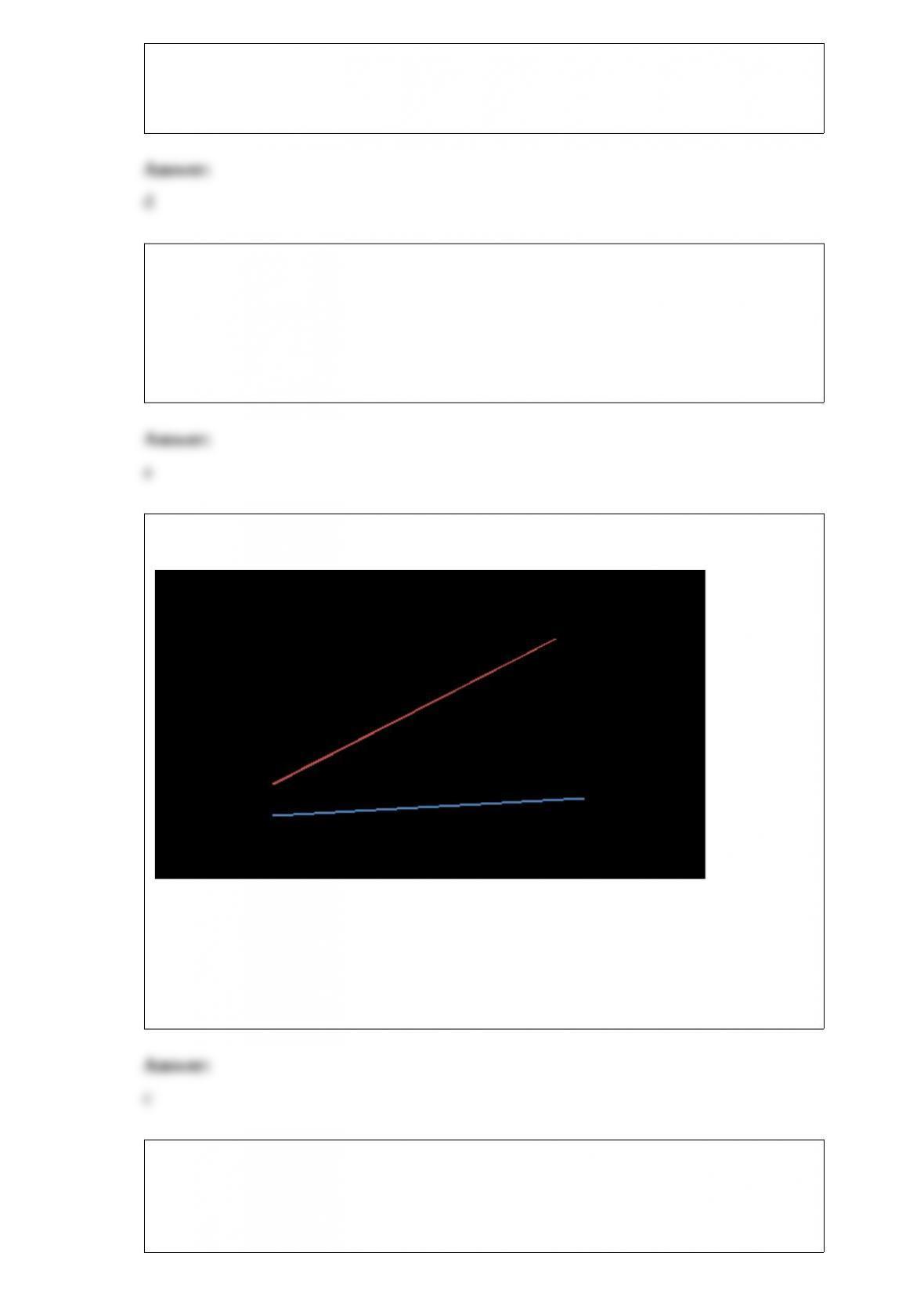
16) figure 6-1: yield curves
refer to figure 6-1. the forward _________ on the u.s. dollar becomes ______ at higher
maturities.
a.discount, larger
b.discount, smaller
c.premium, larger
d.premium, smaller
17) general candy, inc., a u.s. firm, manufactures and sells candies worldwide. because
of a rising price of sugar in the u.s., the company is considering to build a new plant in
the u.k. the plant will cost £15 million to build. assume that the plant will have a life of
3 years before it is confiscated by the british government (zero salvage value) and the
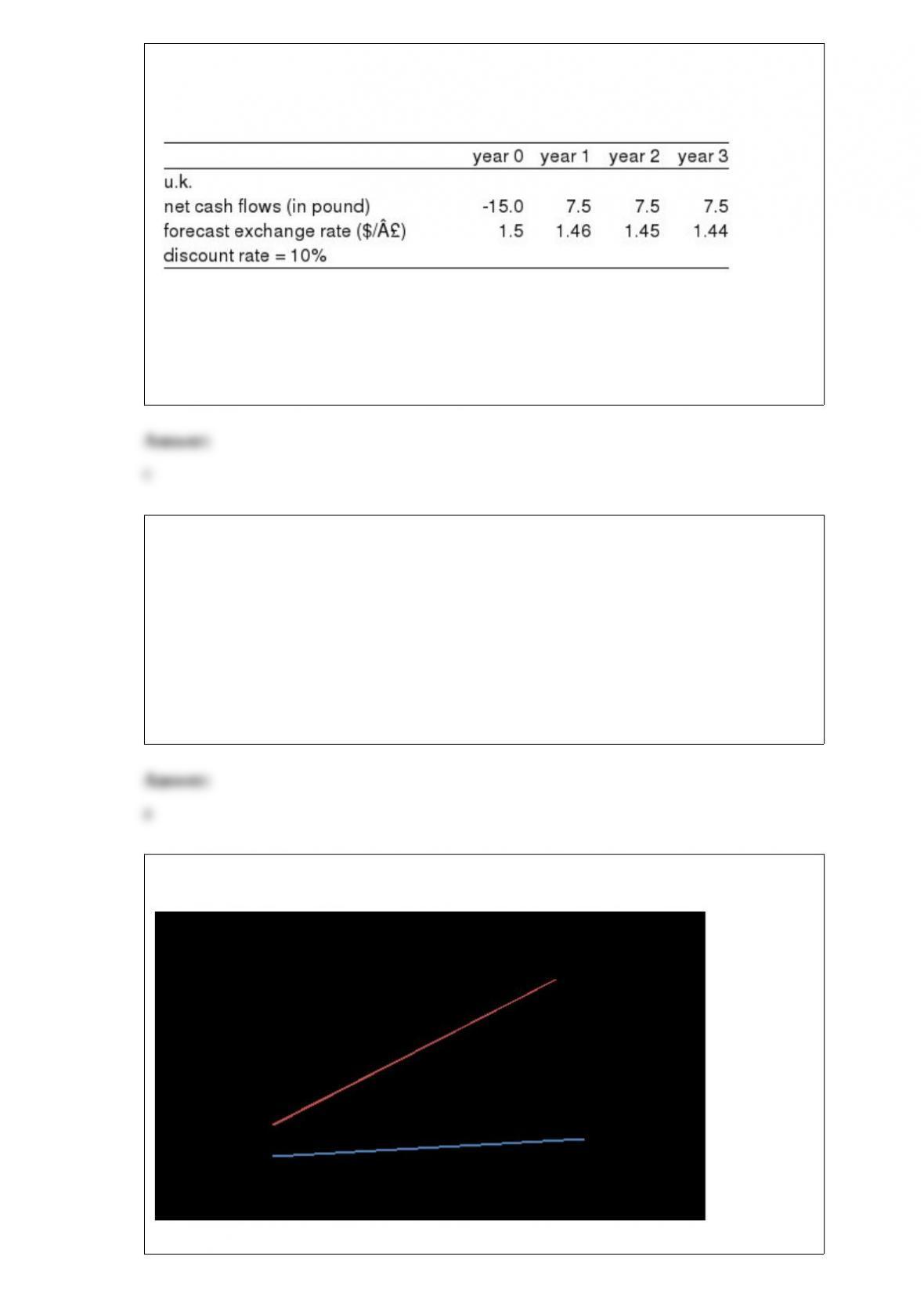
discount rate of the cash flows is 10%. consider the following cash flows for this
project.
table 9-1:
refer to table 9-1. the net present value (npv) of this project in u.s. dollar is estimated at:
a.$2.86 million
b.$3.65 million
c.$4.56 million
d.- $9.21 million
18) general motors, a u.s. firm, withdraws $100 million from bank of america in new
york and deposits $100 million with eurobank x in the bahamas. then, eurobank x
deposits $100 million in eurobank y in switzerland. a swiss chocolate, inc. borrows
$100 million from eurobank y to finance a new plant construction.
at the end, the net deposits of the eurodollar market would be ________.
a.$100 million
b.$200 million
c.$300 million
d.$400 million
19) figure 6-1: yield curves
refer to figure 6-1. at 3-month maturity, the u.s. dollar sells at a forward ______ and the

korean won sells at a forward _______.
a.discount; discount
b.discount; premium
c.premium; premium
d.premium; discount
20) suppose interest parity holds. there is a change in u.s. policy that leads to
expectations of a higher u.s. inflation rate. the increase in expected inflation will cause
dollar interest rates to _______.
a.stay the same
b.fall
c.rise
d.none of the above
21) if interest rates are equalized between two countries, why would we still observe
two-way capital flow between these two countries?
a.investors are irrational
b.investors want to diversify their portfolios
c.immigrants always invest in their home countrys assets
d.assets across countries are homogeneous
22) absolute ppp can be seen as an extension of ________ by generalizing the price of a
good to the countrywide level.
a.relative ppp
b.law of one price
c.exchange rate equilibrium
d.equilibrium currency
23) which of the following factors triggered the 1994-95 mexican peso crises?
a.a rise in oil price
b.a decline in the price of semiconductor, mexicos major exporting goods
c.a sharp devaluation of peso
d.a flexible exchange rate regime

24) which of the following is not a benefit of fdi to the host country?
a.fdi promotes competition in domestic input markets
b.fdi allows the transfer of technology
c.fdi contributes to economic development
d.fdi limits human capital
25) if the price of japanese yen in terms of u.s. dollars is $0.01/yen, then the price of
u.s. dollar in terms of japanese yen is equal to ___________.
a.0.01 yen per dollar
b.10.0 yen per dollar
c.100 yen per dollar
d.110 yen per dollar
26) suppose that an economy is experiencing large trade deficits. according to
pass-through effects, a devaluation could improve trade balance, when:
a.both demand for domestic imports and exports are perfectly inelastic
b.both supply of domestic imports and exports are perfectly inelastic
c.the demand for domestic imports is perfectly inelastic and the supply of domestic
exports is perfectly inelastic
d.the supply of domestic imports is perfectly inelastic and the demand for domestic
exports is perfectly inelastic
27) a u.s. gift of wheat to a nicaragua causes a:
a.debit in the u.s. merchandise account
b.debit in the u.s. unilateral transfers
c.debit in the u.s. private capital account
d.credit in the u.s. private capital account
28) suppose that the government uses an expansionary fiscal policy. then:

a.the is curve shifts right
b.the is curve shifts left
c.the lm curve shifts right
d.the lm curve shifts left
29) the citibank trading desk quotes a buy rate of 1.25 and a sell rate of 2.00 for the
dollar/euro exchange rate (s$/). how much euros would you receive, if you sell $1,000
to citibank?
a.500 euros
b.800 euros
c.1,250 euros
d.2,000 euros
30) suppose that the one-year u.s. interest rate is 8% and the equivalent one-year u.k.
interest rate is 10%. according to the covered interest rate parity, there is a ________ on
the u.s dollar.
a.2% forward discount
b.2% forward premium
c.18% forward discount
d.18% forward premium