
The beta for the market portfolio is closest to:
A) 1
B) 0
C) Unable to answer this question without knowing the markets expected return
D) Unable to answer this question without knowing the markets volatility
The NPV profile
A) shows the payback period – the point at which NPV is positive.
B) shows the internal rate of return – the point at which NPV is zero.
C) shows the NPV over a range of discount rates.
D) B and C are correct.
Based upon the information provided in the table above, you can conclude
A) that the yield curve is flat.
B) nothing about the shape of the yield curve.
C) that the yield curve is downward sloping.
D) that the yield curve is upward sloping.

Suppose you will receive $500 in one year and the risk-free interest rate (rf) is 5%. The
equivalent value today is closest to:
A) $475
B) $476
C) $500
D) $525
Which of the following statements is FALSE?
A) In the real world, specific projects should differ only slightly from the average
investment made by the firm.
B) We can estimate rU for a new project by looking at single-division firms that have
similar business risks.
C) The project’s equity cost of capital depends on its unlevered cost of capital, rU, and
the debt-equity ratio of the incremental financing that will be put in place to support the
project.
D) Projects may vary in the amount of leverage they will support’“for example,
acquisitions of real estate or capital equipment are often highly levered, whereas
investments in intellectual property are not.
Galt Motors currently produces 500,000 electric motors a year and expects output levels
to remain steady in the future. It buys armatures from an outside supplier at a price of
$2.50 each. The plant manager believes that it would be cheaper to make these
armatures rather than buy them. Direct in-house production costs are estimated to be
only $1.80 per armature. The necessary machinery would cost $700,000 and would be
obsolete in 10 years. This investment would be depreciated to zero for tax purposes
using a 10-year straight line depreciation. The plant manager estimates that the
operation would require additional working capital of $40,000 but argues that this sum
can be ignored since it is recoverable at the end of the ten years. The expected proceeds
from scrapping the machinery after 10 years are estimated to be $10,000. Galt Motors
pays tax at a rate of 35% and has an opportunity cost of capital of 14%.
The IRR for Galt Motors of manufacturing the armatures in house is closest to:
A) 48%
B) 49%
C) 50%
D) 53%
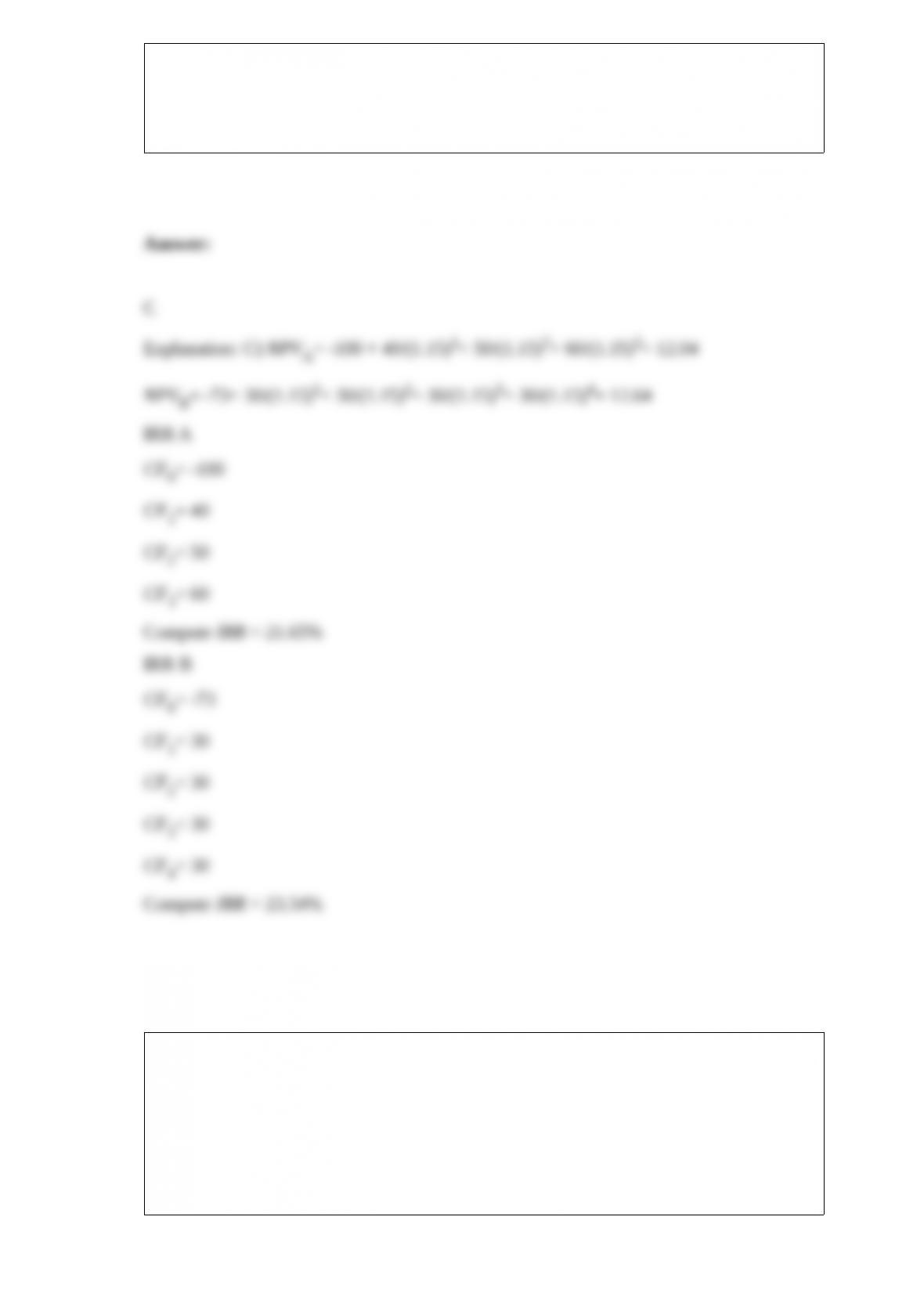
Consider the following two projects:
Assume that projects A and B are mutually exclusive. The correct investment decision
and the best rational for that decision is to
A) invest in project A since NPVB< NPVA.
B) invest in project B since IRRB> IRRA.
C) invest in project B since NPVB> NPVA.
D) invest in project A since NPVA> 0.
Luther Industries has no debt, a total equity capitalization of $20 billion, and a beta of
1.8. Included in Luther’s assets are $4 billion in cash and risk-free securities What is
Luther’s enterprise value?
A) $16 billion
B) $10.5 billion
C) $24 billion
D) $20 billion
Nielson Motors is considering an opportunity that requires an investment of $1,000,000
today and will provide $250,000 one year from now, $450,000 two years from now, and
$650,000 three years from now.
If the appropriate interest rate is 15%, then Nielson Motors should:
A) invest in this opportunity since the NPV is positive.
B) not invest in this opportunity since the NPV is positive.
C) invest in this opportunity since the NPV is negative.
D) not invest in this opportunity since the NPV is negative.
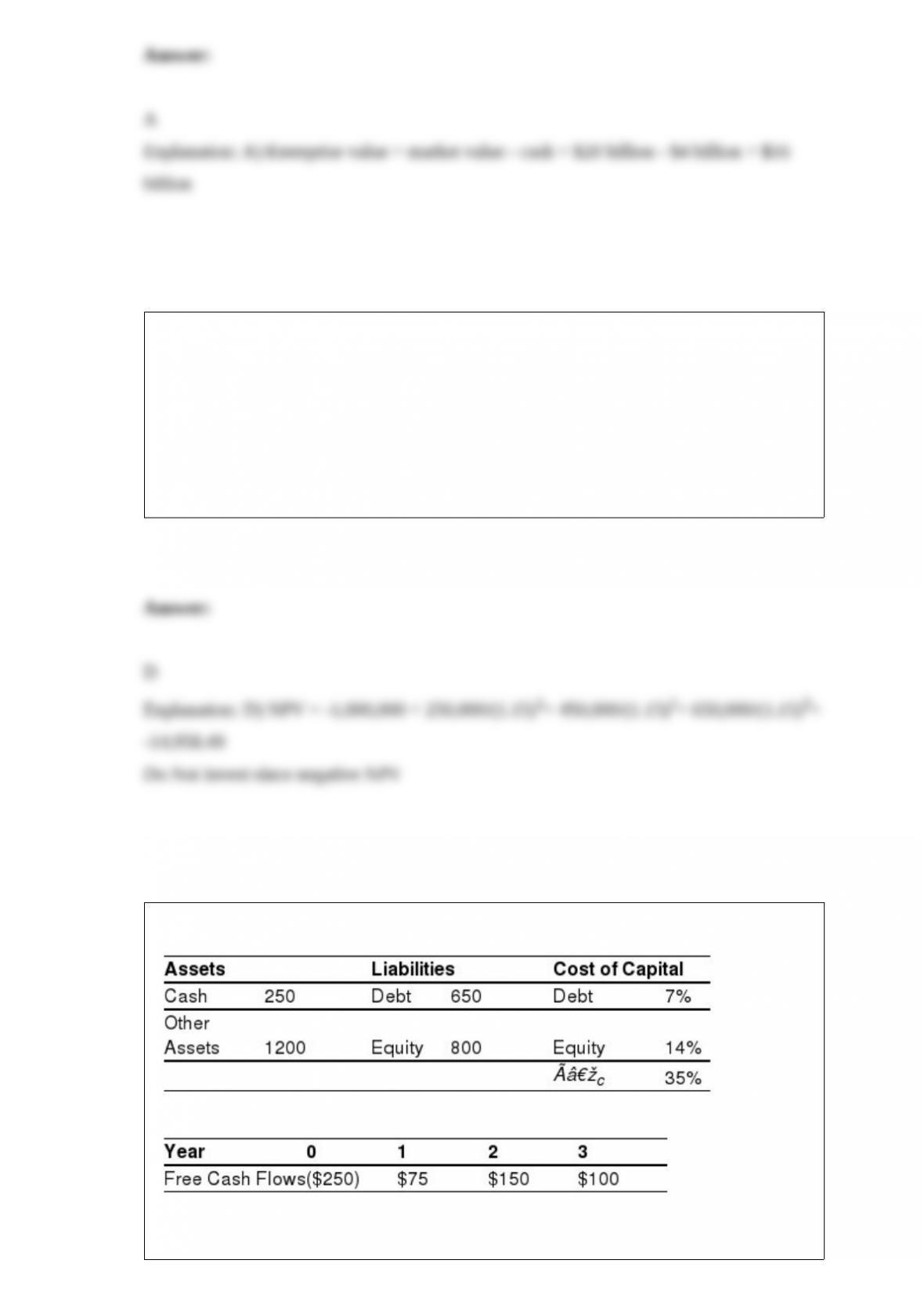
Iota Industries Market Value Balance Sheet ($ Millions) and Cost of Capital
Iota Industries New Project Free Cash Flows
Assume that this new project is of average risk for Iota and that the firm wants to hold

constant its debt to equity ratio.
The Debt Capacity for Iota’s new project in year 0 is closest to:
A) $263.25
B) 87.75
C) $50.25
D) $118.00
You are purchasing a new home and need to borrow $250,000 from a mortgage lender.
The mortgage lender quotes you a rate of 6.25% APR for a 30-year fixed rate mortgage.
The mortgage lender also tells you that if you are willing to pay 2 points, they can offer
you a lower rate of 6.0% APR for a 30-year fixed rate mortgage. One point is equal to
1% of the loan value. So if you take the lower rate and pay the points you will need to
borrow an additional $5000 to cover points you are paying the lender.
Assuming you pay the points and borrow from the mortgage lender at 6.00%, then your
monthly mortgage payment (with payments made at the end of the month) will be
closest to:
A) $708
B) $1530
C) $1540

D) $1600
Which of the following statements is FALSE?
A) We measure the degree of estimation error statistically through the standard error of
the estimate.
B) When focusing on the returns of a single security, its common practice to assume
that all dividends are immediately invested at the risk-free rate.
C) We estimate the standard deviation or volatility as the square root of the variance.
D) We estimate the variance by computing the average squared deviation from the
average realized return.
Consider an equally weighted portfolio that contains five stocks. If the average
volatility of these stocks is 40% and the average correlation between the stocks is .5,
then the volatility of this equally weighted portfolio is closest to:
A) .17
B) ..03
C) .41
D) .19

The Sisyphean Company has a bond outstanding with a face value of $1000 that
reaches maturity in 15 years. The bond certificate indicates that the stated coupon rate
for this bond is 8% and that the coupon payments are to be made semiannually.
How much will each semiannual coupon payment be?
A) $60
B) $40
C) $120
D) $80
LCMS Industries has $70 million in debt outstanding. The firm will pay only interest on
this debt (the debt is perpetual). LCMS’ marginal tax rate is 35% and the firm pays a
rate of 8% interest on its debt.
LCMS’ annual interest tax shield is closest to:

A) $2.8 million
B) $2.0 million
C) $3.6 million
D) $5.6 million
Consider the following equation:
Pretain = Pcum ×
The term Ï„i in this equation represents:
A) the corporation’s tax rate on interest income.
B) the investor’s tax rate on capital gains.
C) the investor’s tax rate on interest income.
D) the investor’s tax rate on cumulative dividends.
Nielson Motors has a debt-equity ratio of 1.8, an equity beta of 1.6, and a debt beta of
0.20. It is currently evaluating the following projects, none of which would change
Nielson’s volatility.

(All amounts are in $millions.)
The total debt overhang associated with accepting project 4, is closest to:
A) $0 million
B) $13.5 million
C) $15.0 million
D) $38.6 million
KT Enterprises is considering undertaking a new project. Based upon analysis of firms
with similar projects, KT has determined that an unlevered cost of equity of 12% is
suitable for their project. KT’s marginal tax rate is 35%, its borrowing rate is 7%, and
KT does not believe that its borrowing rate will change if the new project is accepted.If
KT expects to maintain a debt to equity ratio for this project of .6 then KT’s project
based WACC, rwacc, for this project is closest to:
A) 10.5%
B) 11.1%

C) 9.6%
D) 10.8%
Monsters Incorporated (MI) in ready to launch a new product. Depending upon the
success of this product, MI will have a value of either $100 million, $150 million, or
$191 million, with each outcome being equally likely. The cash flows are unrelated to
the state of the economy (i.e. risk from the project is diversifiable) so that the project
has a beta of 0 and a cost of capital equal to the risk-free rate, which is currently 5%.
Assume that the capital markets are perfect.
Suppose that MI has zero-coupon debt with a $125 million face value due next year.
The total value of MI with leverage is closest to:
A) $133 million
B) $140 million
C) $147 million
D) $125 million
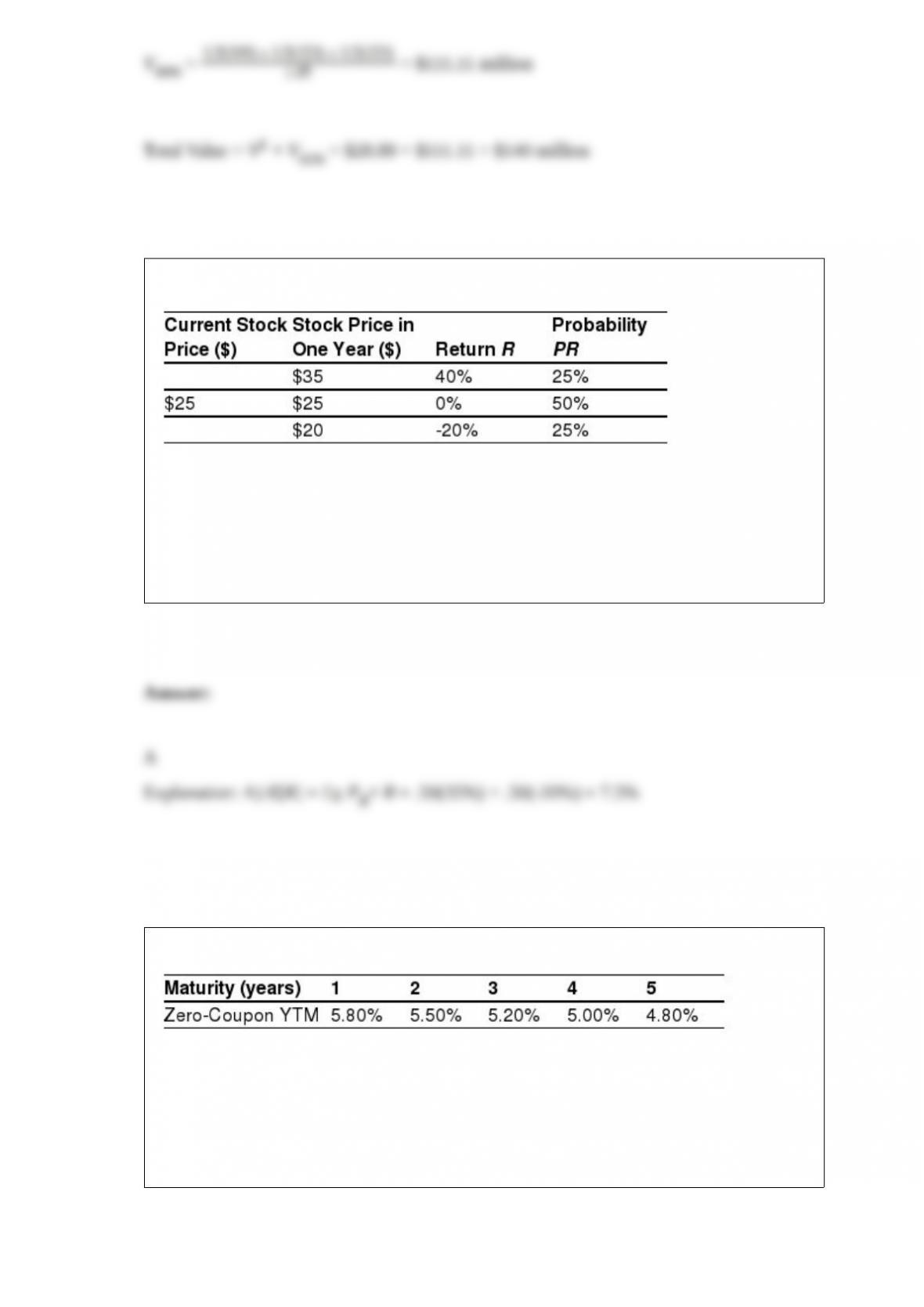
Consider the following probability distribution of returns for Alpha Corporation:
Suppose an investment is equally likely to have a 35% return or a – 20% return. The
expected return for this investment is closest to:
A) 7.5%
B) 15%
C) 5%
D) 10%
Consider the following zero-coupon yields on default free securities:
The forward rate for year 2 (the forward rate quoted today for an investment that begins
in one year and matures in two years) is closest to:
A) 5.80%
B) 5.50%
C) 5.20%
D) 5.65%
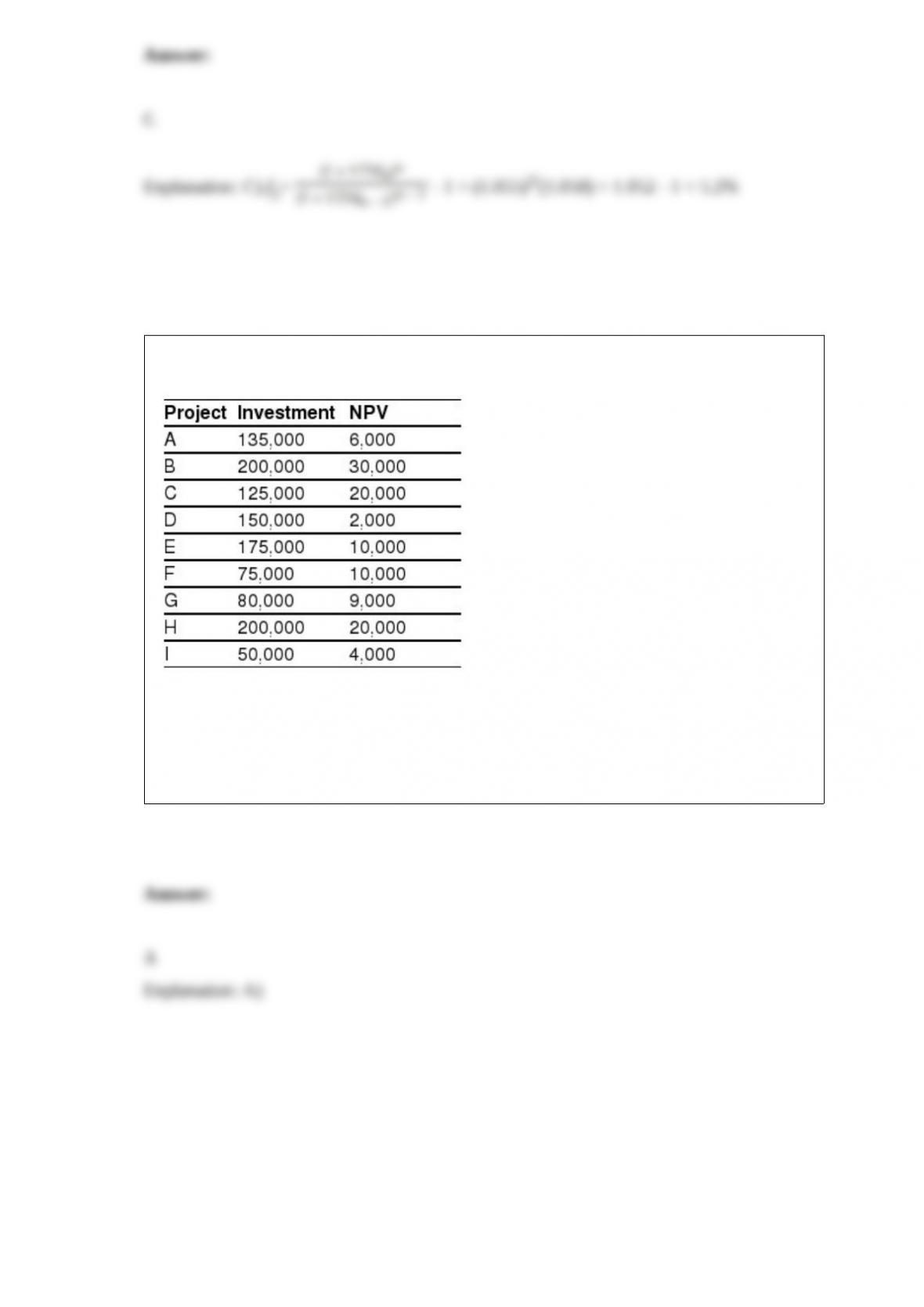
Consider the following list of projects:
Assuming that your capital is constrained, which project should you invest in first?
A) Project C
B) Project G
C) Project B
D) Project F
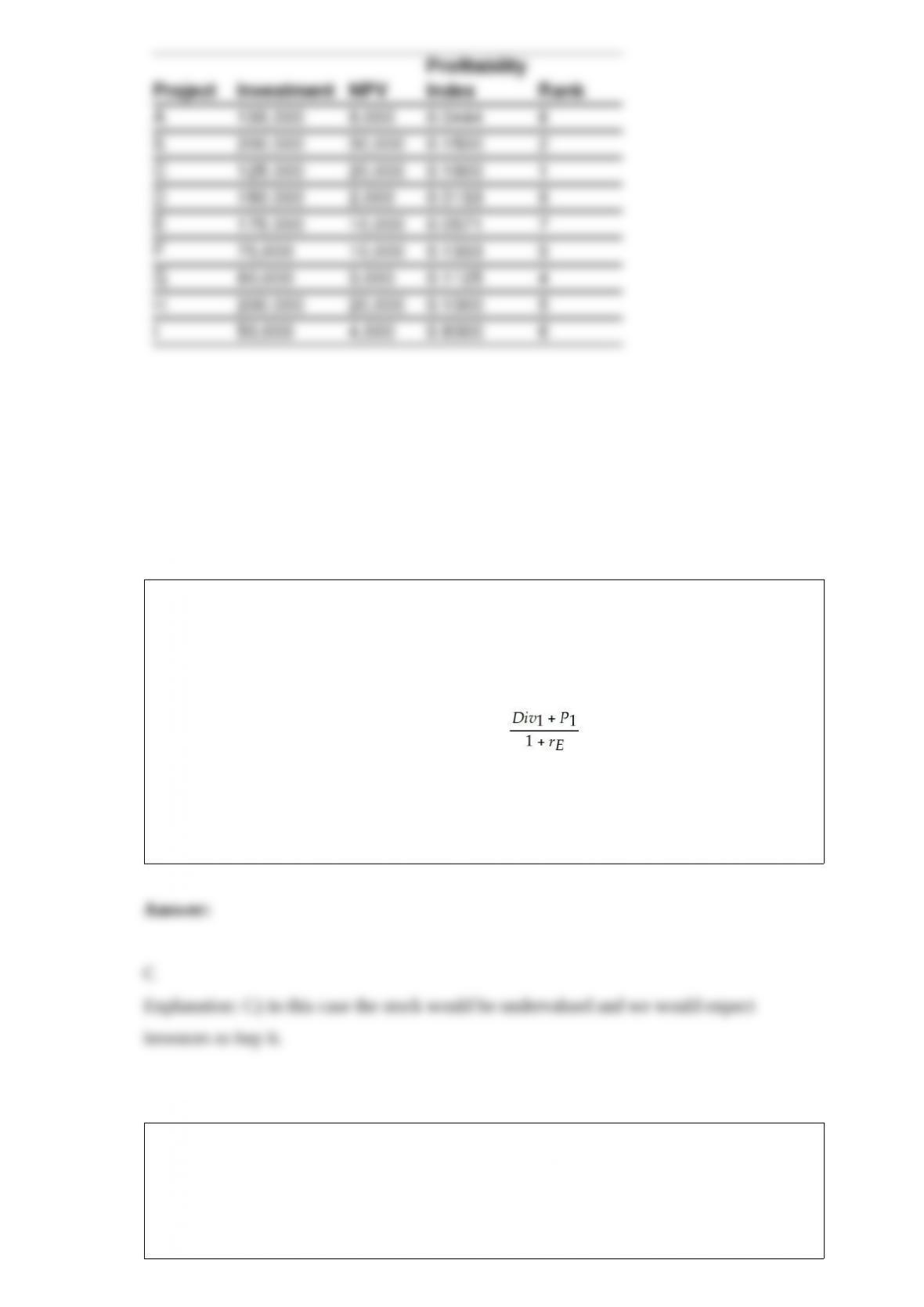
Which of the following statements is FALSE?
A) The equity cost of capital for a stock is the expected return of other investments
available in the market with equivalent risk to the firm’s shares.
B) The price of a share of stock is equal to the present value of the expected future
dividends it will pay.
C) If the current stock price were less than P0= , it would be a negative NPV
investment, and we would expect investors to rush in and sell it, driving down the
stocks price.
D) The law of one price implies that to value any security, we must determine the
expected cash flows an investor will receive from owning it.
Which of the following statements regarding Net Present Value (NPV) is
INCORRECT?
A) The NPV represents the value of the project in terms of cash today.
B) Good projects will have a positive NPV.
C) The NPV of a project is the difference between the present value of its benefits and

the present value of its costs.
D) When faced with a set of alternatives, choose the one with the lowest NPV in order
to minimize the preset value of costs.
Von Bora Corporation is expected pay a dividend of $1.40 per share at the end of this
year and a $1.50 per share at the end of the second year. You expect Von Bora’s stock
price to be $25.00 at the end of two years. Von Bora’s equity cost of capital is 10%.
Suppose you plan to hold Von Bora stock for only one year. Calculate your total return
from holding Von Bora stock for the first year.
The following table summarizes prices of various default-free zero-coupon bonds
(expressed as a percentage of face value):
Compute the yield to maturity for each of the five zero-coupon bonds.
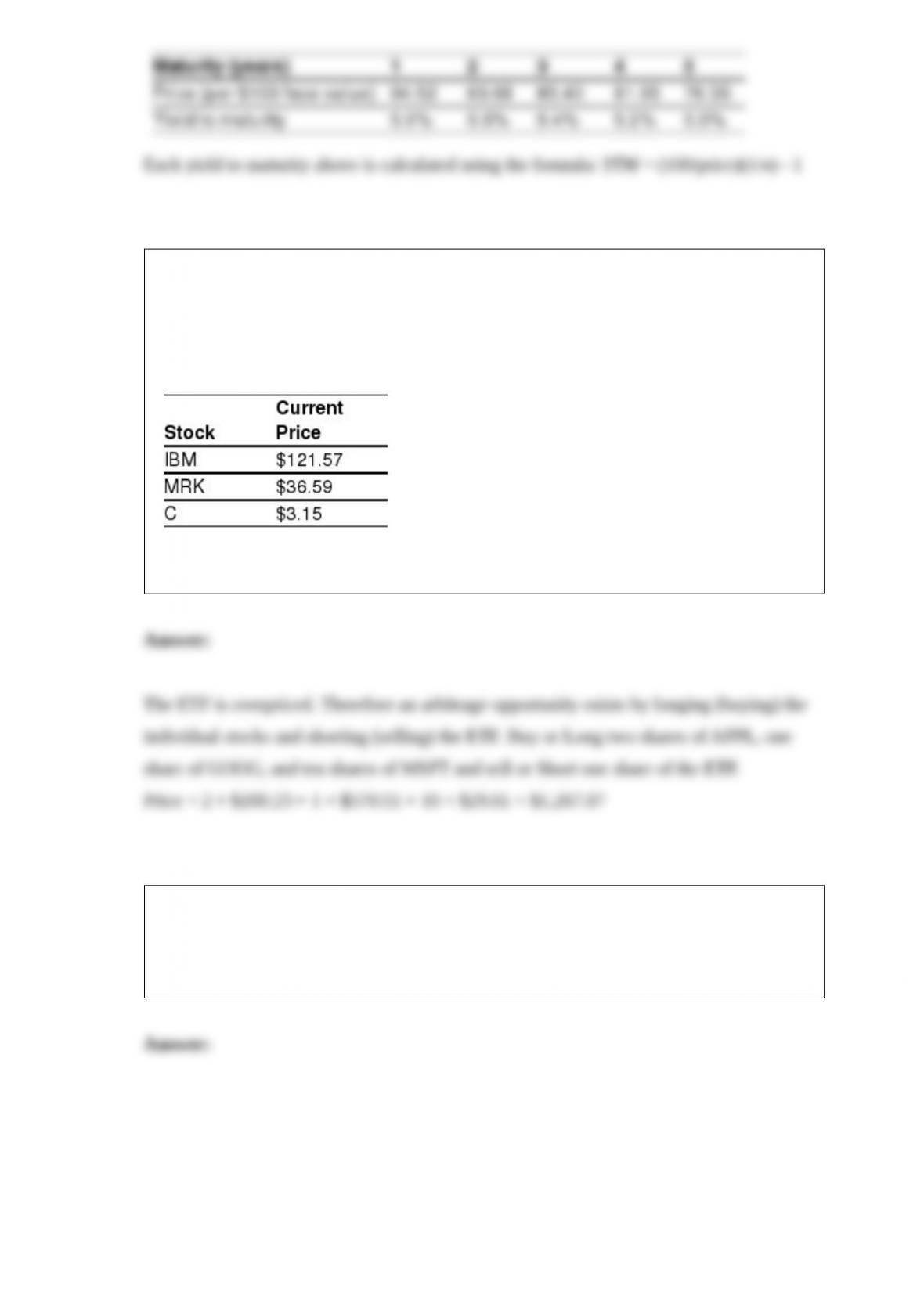
An exchange traded fund (ETF) is a security that represents a portfolio of individual
stocks. Consider an ETF for which each share represents a portfolio of two shares of
International Business Machines (IBM), three shares of Merck (MRK), and three shares
of Citigroup Inc. (C). Suppose the current market price of each individual stock are
shown below:
If the ETF is currently trading for $1,300, what arbitrage opportunity is available? What
trades would you make?
Two separate firms are considering investing in this project. Firm unlevered plans to
fund the entire $80,000 investment using equity, while firm levered plans to borrow
$45,000 at the risk-free rate and use equity to finance the remainder of the initial
investment. Calculate the risk premiums for both the levered and unlevered firm.
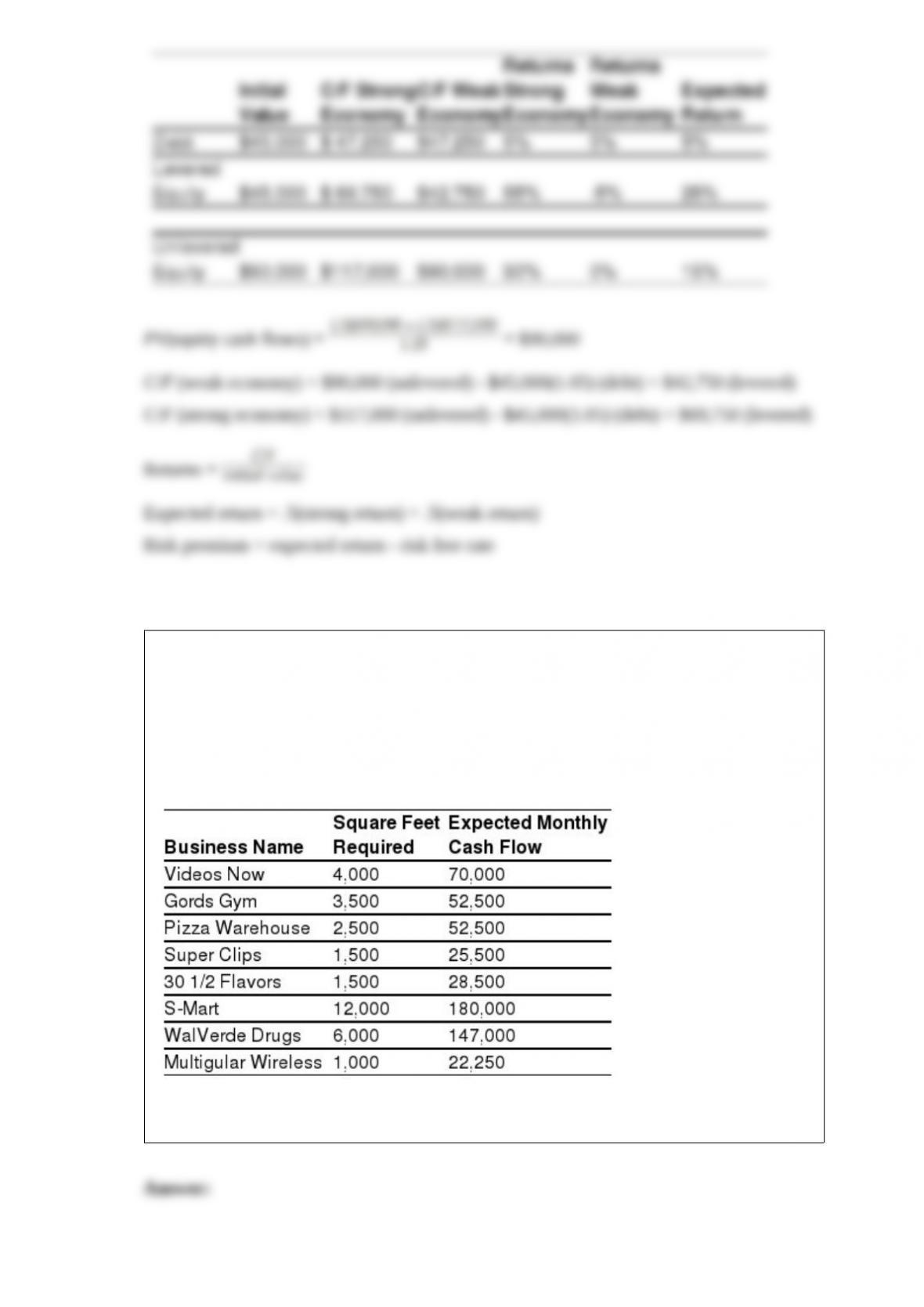
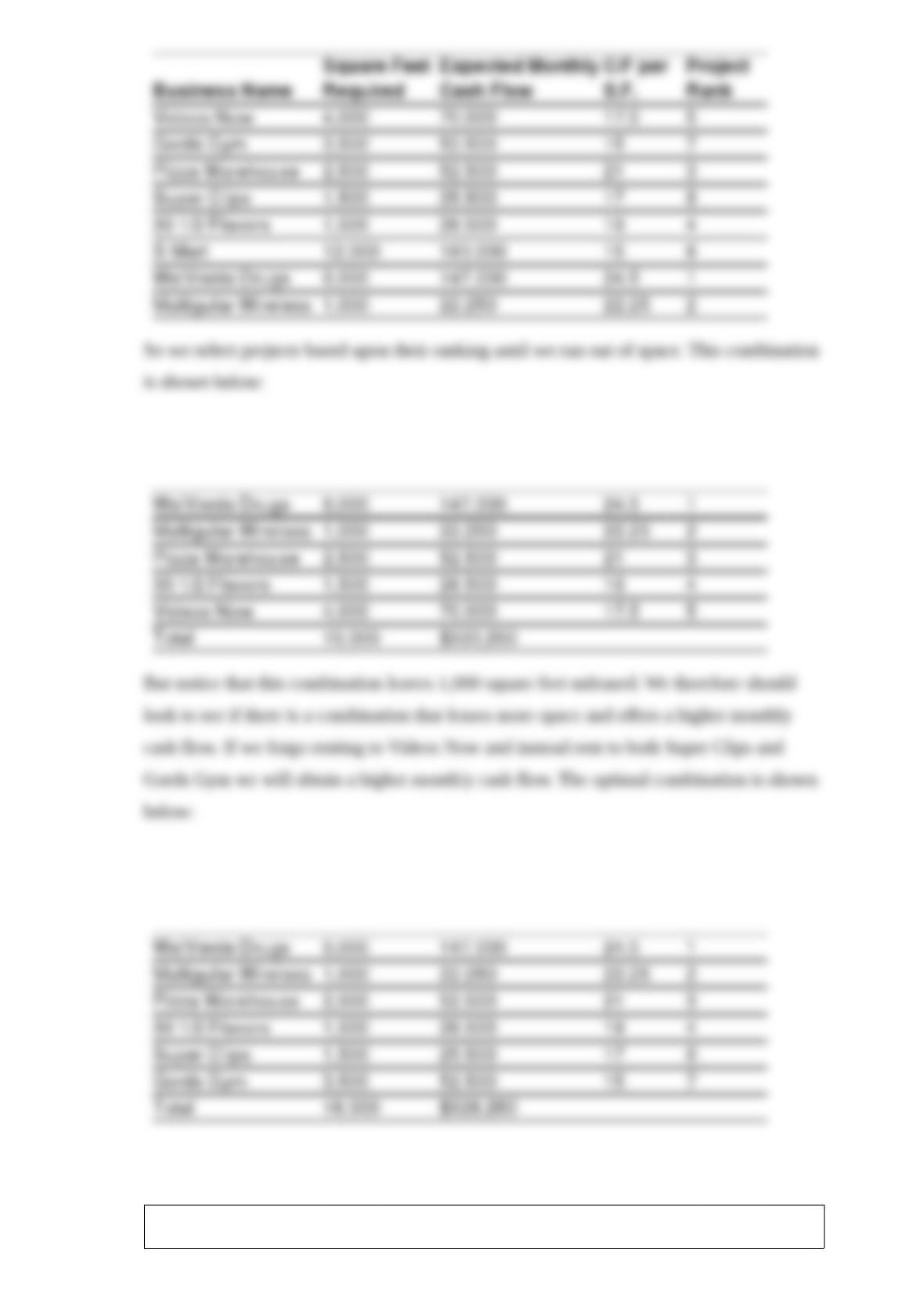
Your firm is preparing to open a new retail strip mall and you have multiple businesses
that would like lease space in it. Each business will pay a fixed amount of rent each
month plus a percentage of the gross sales generated each month. The cash flows from
each of the businesses has approximately the same amount of risk. The business names,
square footage requirements, and monthly expected cash flows for each of the
businesses that would like to lease space in your strip mall are provided below:
If your new strip mall will have 16,000 square feet of retail space available to be leased,
to which businesses should you lease and why?
The Sisyphean Corporation is considering investing in a new cane manufacturing
machine that has an estimated life of three years. The cost of the machine is $30,000
and the machine will be depreciated straight line over its three-year life to a residual
value of $0.
The cane manufacturing machine will result in sales of 2,000 canes in year 1. Sales are
estimated to grow by 10% per year each year through year three. The price per cane that
Sisyphean will charge its customers is $18 each and is to remain constant. The canes
have a cost per unit to manufacture of $9 each.
Installation of the machine and the resulting increase in manufacturing capacity will
require an increase in various net working capital accounts. It is estimated that the
Sisyphean Corporation needs to hold 2% of its annual sales in cash, 4% of its annual
sales in accounts receivable, 9% of its annual sales in inventory, and 6% of its annual
sales in accounts payable. The firm is in the 35% tax bracket, and has a cost of capital
of 10%.
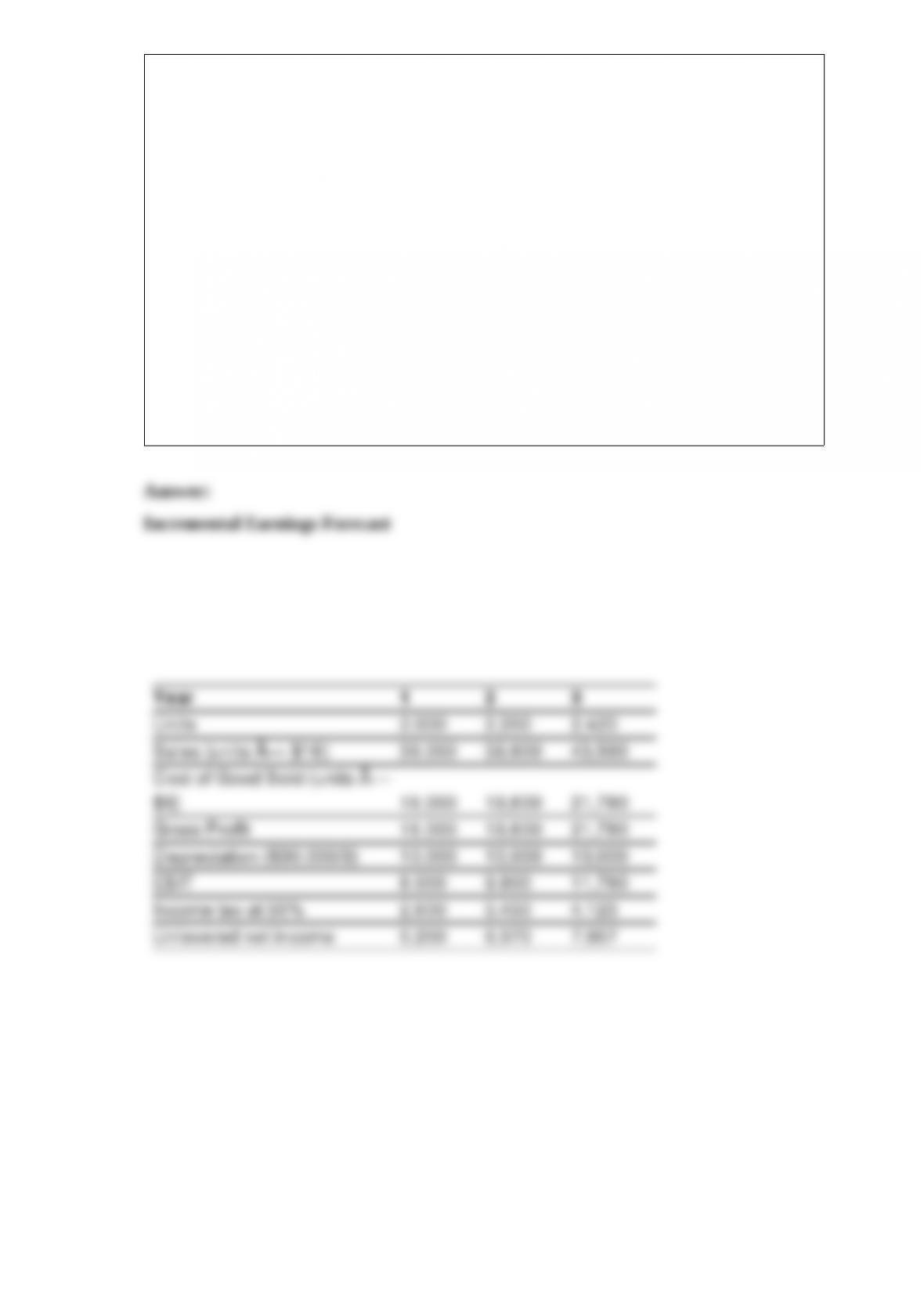
Construct a simple income statement showing the incremental EBIT and the
incremental unlevered net income for all three years of the Sisyphean Companies
project.