1) standardized contracts traded on established exchanges for delivery of currencies at a
specified future date are called foreign currency futures.
2) relative prices only change when demand and supply for individual goods shift
outwards.
3) purchasing power parity is used for short term analysis because it tends to fail in the
long run.
4) economic exposure is the sensitivity of the domestic currency value of future
operating income to unexpected changes in exchange rate.
5) dollarization and currency boards are examples of exchange rate systems that
provide relatively large independent monetary policy as compared to floating exchange
rates.
6) the equivalence of the interest differential between two currencies to the forward
premium or discount is known as interest rate parity.
7) factors considered in the country risk analysis include political risk, diversity of
exports, and quantity of natural resources.
8) other things equal, if american exports to japan are higher than american imports
from japan, then, under a floating exchange rate system, we would expect the dollar to
appreciate against the yen.
9) countries use reserve currencies as an international unit of account, a medium of
exchange, and a store of value.
10) news approach describes how the equilibrium exchange rate can be achieved when
government controls news about market fundamentals, profitability, and riskiness of
investments.
11) a transfer price is the price that one subsidiary charges another subsidiary of internal
good transfers.
12) because cash earns no interest, firms engage in multinational cash management to
use this liquid resource as efficiently as possible.
13) the structure of interest rates existing on investment opportunities over time is
known as the flat structure of interest rates.
14) figure 13-1
refer to figure 13-1. in a fixed exchange rate regime, if an economy is experiencing
external disequilibrium at point b, then to peg the exchange rate the central bank has to:
a.buy domestic currency, sell foreign currency, and shift the lm to the right
b.buy foreign currency, sell domestic currency, and shift the lm to the right
c.buy domestic currency, sell foreign currency, and shift the is to the left
d.buy foreign currency, sell domestic currency, and shift the is to the right
15) according to the monetary approach of the balance of payments (mabp), if the
foreign inflation rate decreases 50%, the u.s. foreign reserves will
a.increase because foreign central bank buys u.s. dollars and sells its currency
b.increase because foreign central bank buys its currency and sells u.s. dollars
c.decrease because foreign central bank buys u.s. dollars and sells its currency
d.decrease because foreign central bank buys its currency and sells u.s. dollars
16) following a shock to the equilibrium, prices will adjust slowly to the new
equilibrium level, whereas exchange rates and interest rates adjust quickly. this causes
the spot exchange rate to move too much before returning to the equilibrium level. this
idea is called _______.
a.hyper-exchange rate effect
b.panic effect
c.overshooting effect
d.imperfect equilibrium effect
17) which of the following is an example of eurocurrency?
a.eurodollar
b.euroyen
c.euroeuro
d.all of the above are examples of eurocurrency
18) a forward discount occurs when:
a.the forward rate is greater than the spot rate
b.the spot rate is greater than the forward rate
c.the forward and spot rates are equal
d.none of the above
19) assume perfect capital mobility and fixed exchange rates. if the central bank
increases money supply, it must also ________, which will ________.
a.buy foreign currency, have no effect on the money supply
b.buy foreign currency, increase the money supply
c.buy domestic currency, increase the money supply
d.buy domestic currency, decrease the money supply
20)
destabilizing speculation is the process where
a.in a free floating exchange system, speculators cause wide fluctuations to the
exchange rate
b.in a fixed peg exchange system, speculators hold foreign reserves too long and
destabilize the peg
c.in a free floating exchange system, the international monetary fund is forced to issue
special drawing rights
d.in a fixed peg exchange system, speculators sell all holdings of special drawing rights
21) in the presence of purchasing-power parity, if one dollar exchanges for 2 british
pounds and if a flat-screen tv costs $400 in the united states, then in great britain the
flat-screen tv should cost:
a.200 pounds
b.400 pounds
c.600 pounds
d.800 pounds
22) a currency is at a ________ when its interest rate is ________ than the interest rate
in the other country.
a.forward flat, lower
b.forward discount, lower
c.forward flat, higher
d.forward premium, lower
23) a u.s. citizen takes a cruise on a norwegian cruise line to canada causes a:
a.credit in u.s. services
b.credit to the u.s. unilateral transfers
c.credit in the u.s. private capital account
d.debit in the u.s. private capital account
24) suppose that the one-year u.s. interest rate is 4% and the equivalent one-year u.k.
interest rate is 6%. according to the covered interest rate parity, there is a ________ on
the british pound.
a.2% forward discount
b.2% forward premium
c.10% forward discount
d.10% forward premium
25) the __________ exchange rate is the price for immediate currency exchange.
a.current
b.forward
c.future
d.spot
26) when chinas central bank authorities acquire u.s. dollars faster than the federal
reserve bank acquires chinese yuan, then the percentage change of u.s. international
reserves ():
a.decreases
b.increases
c.stays the same
d.increases first and then decreases
27) which of the following are considered in country risk analyses?
i.political stability
ii.external debt
iii.labor supply
iv.international reserve holdings
a.i and iii
b.i, ii, and iv
c.ii, iii, and iv
d.i, ii, iii, and iv
28) assume a nominal interest rate on one-year u.s. treasury bills of 5.30% and a real
rate of interest of 1.50%. using the fisher effect equation, what is the approximate
expected rate of inflation in the u.s. over the next year?
a. 3.80%
b.3.53%
c.3.80%
d.6.80%
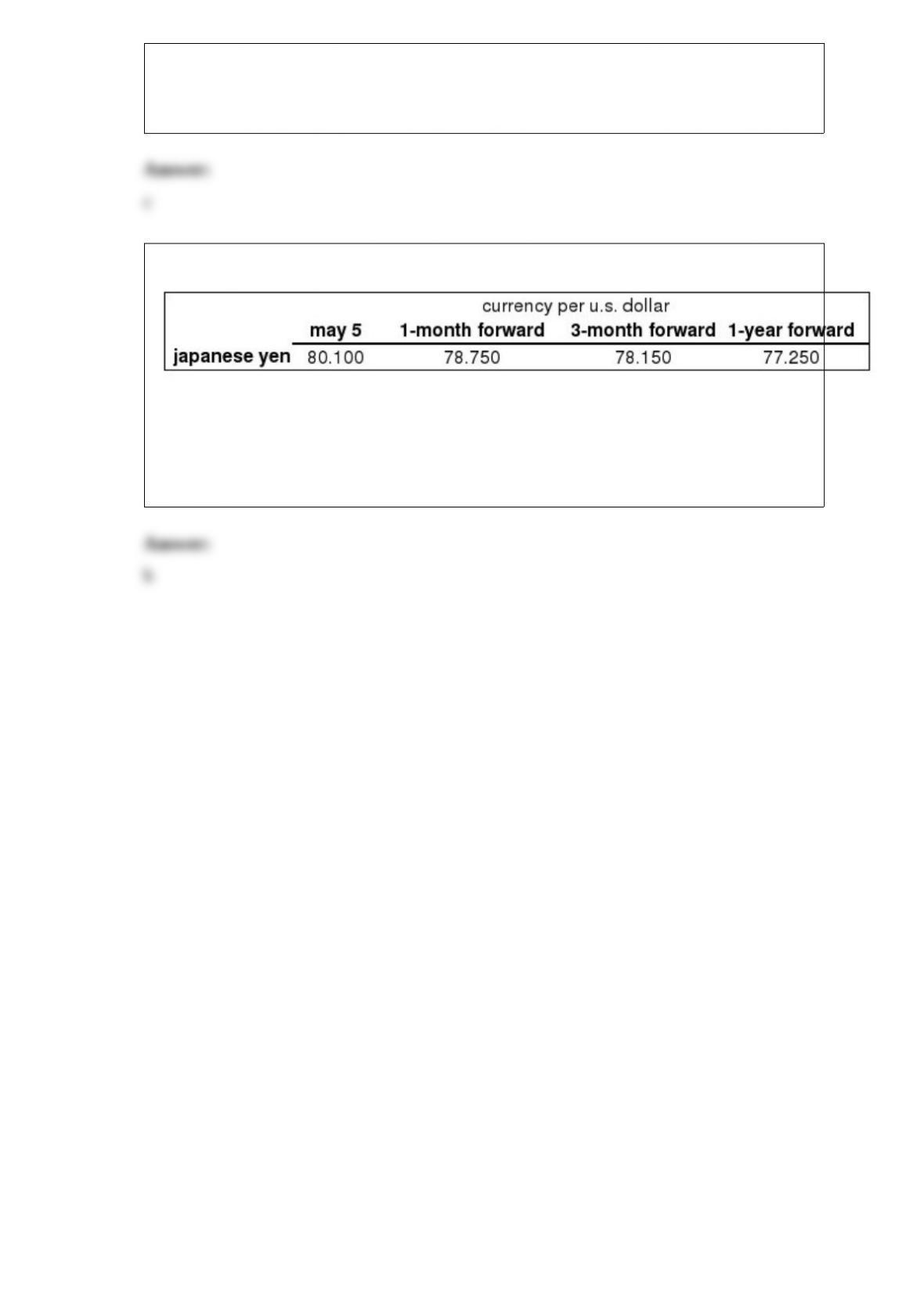
29) table 6-1: spot and forward exchange rates on may 5, 2012
refer to table 6-1. on may 5, 2012, the 3-month forward yen was selling at a:
a.2.43% premium per annum against the dollar
b.9.72% premium per annum against the dollar
c.2.43% discount per annum against the dollar
d.9.72% discount per annum against the dollar