1) Which one of the following items would be subtracted from the balance per bank
statement in a bank reconciliation?
A.Outstanding checks
B.Deposit in transit
C.Service charges
D.Interest on customer note
2) Which one of the following is not a cash equivalent?
A.30-day certificate of deposit
B.60-day commercial paper
C.90-day U. S. treasury bill
D.180-day note issued by a local or state government
3) [APPENDIX] For 2012, Wasabi Company has accounting revenues of $6,000.
However, because of temporary differences between tax and accounting, $1,000 of this
is not subject to tax. If expenses are $3,000 for both tax and accounting, and the tax rate
is 40%, what is the amount of tax payable to the IRS?
A.$400
B.$800
C.$1,200
D.$1,600
4) Use Rizwi Corporations list of accounts at December 31, 2014 to answer the
following question.
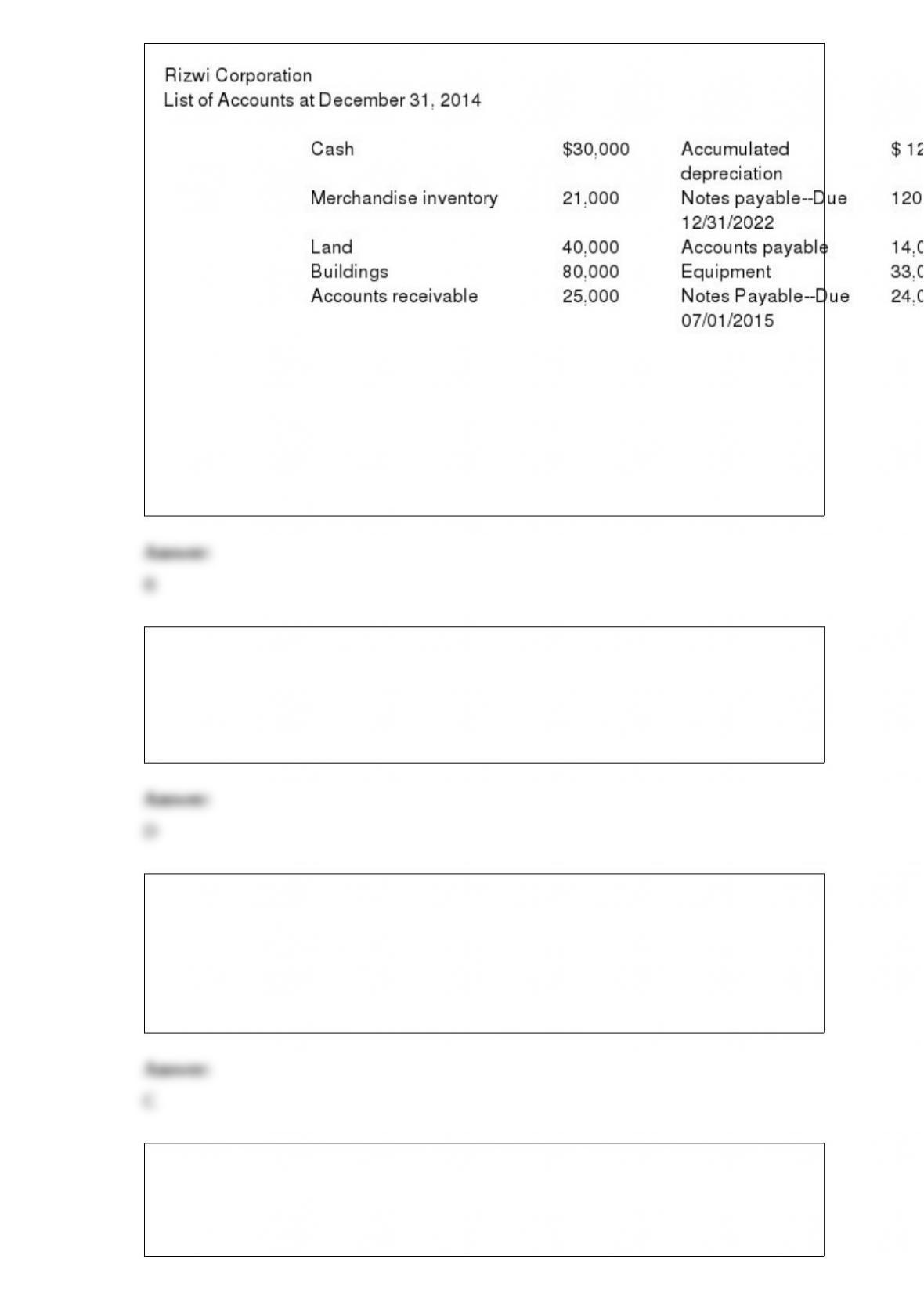
What is Rizwi Corp.s current ratio?
A.0.48 to 1
B.2.00 to 1
C.2.55 to
1
D.2.86 to 1
5) How should intangible assets be disclosed on the balance sheet?
A.As a reduction of stockholders equity
B.At cost in the current assets section
C.at the estimated market value at the balance sheet date
D.Net of the costs already amortized
6) The purchase of office equipment on credit has what effect on the accounting
equation?
A.Assets decrease and stockholders equity decreases
B.Liabilities increase and stockholders equity decreases
C.Assets increase and liabilities increase
D.Assets decrease and liabilities decrease
7) Match the following bond and long-term liability related terms to the appropriate
definition.
1>Bonds that are backed by the general creditworthiness of the issuer and are not
backed by specific collateral. A. Face value
2>The process of transferring a portion of premium or discount to interestexpense. This
method transfers an amount resulting in a constant effectiveinterest rate. B. Debenture
bonds
3>The interest rate that bondholders could obtain by investing in other bonds thatare
similar to the issuing firms bonds. C. Long-term liability
4>The excess of the issue price over the face value of bonds. It occurs when the face
rate on the bonds exceeds the market rate. D. Premium
5>The total of the present value of the cash flows produced by a bond. It is calculated
as the present value of the annuity of interest payments plus the present value of the
principal. E. Serial bonds
6>An obligation that will not be satisfied within one year. F. Discount
7>The principal amount of the bond as stated on the bond certificate. G. Callable bonds
8>Bonds that may be redeemed or retired before their specified due date. H. Effective
interest method of amortization
9>Bonds that do not all have the same due date. A portion of the bonds comes due each
time period. I. Face rate of interest
10>The face value of a bond plus the amount of unamortized premium or minus the
amount of unamortized discount. J. Carrying value
11>The excess of the face value of bonds over the issue price. It occurs when the
market rate on the bonds exceeds the face rate. K. Market rate of interest
12>The difference between the carrying value and the redemption price at the time
bonds are redeemed. This amount is presented as an income statement account. L. Gain
or loss on redemption
13>The interest rate stated on the bond certificate. It is also called the nominal or
coupon rate. M. Bond issue price
8) Cash flows from borrowing and paying off a 90-day bank loan are classified as
A.operating activities
B.investing activities
C.financing activities
D.purchasing activities
9) A company began the year with $150,000 in inventory and ended the year with
$170,000 in inventory. Cost of goods sold for the year amounted to $960,000.
Assuming 360 days in a year, how long, on average, does it take the company to sell its
inventory (to the nearest day)?
A.6 days
B.60 days
C.120 days
D.3 days
10) Utah Co. sold merchandise to Big Sky Corp. on December 1, 2014, for $9,000, and
accepted a promissory note for payment in the same amount. The note has a term of 90
days and a stated interest rate of 8%. Utahs accounting period ends on December 31.
What amount should Utah recognize as interest revenue on the maturity date of the
note?
A.$ -0-
B.$ 60
C.$120
D.$180
11) Plant assets are depreciated because
A.the accrual basis of accounting requires matching of costs to revenues
B.some plant assets last longer than others
C.useful lives cannot be reasonably estimated
D.the replacement cost of plant assets may fluctuate over time
12) The net assets of a company are equal to
A.current assets less current liabilities.
B.total assets less current assets.
C.long-term assets less accumulated depreciation.
D.the stockholders’ equity.
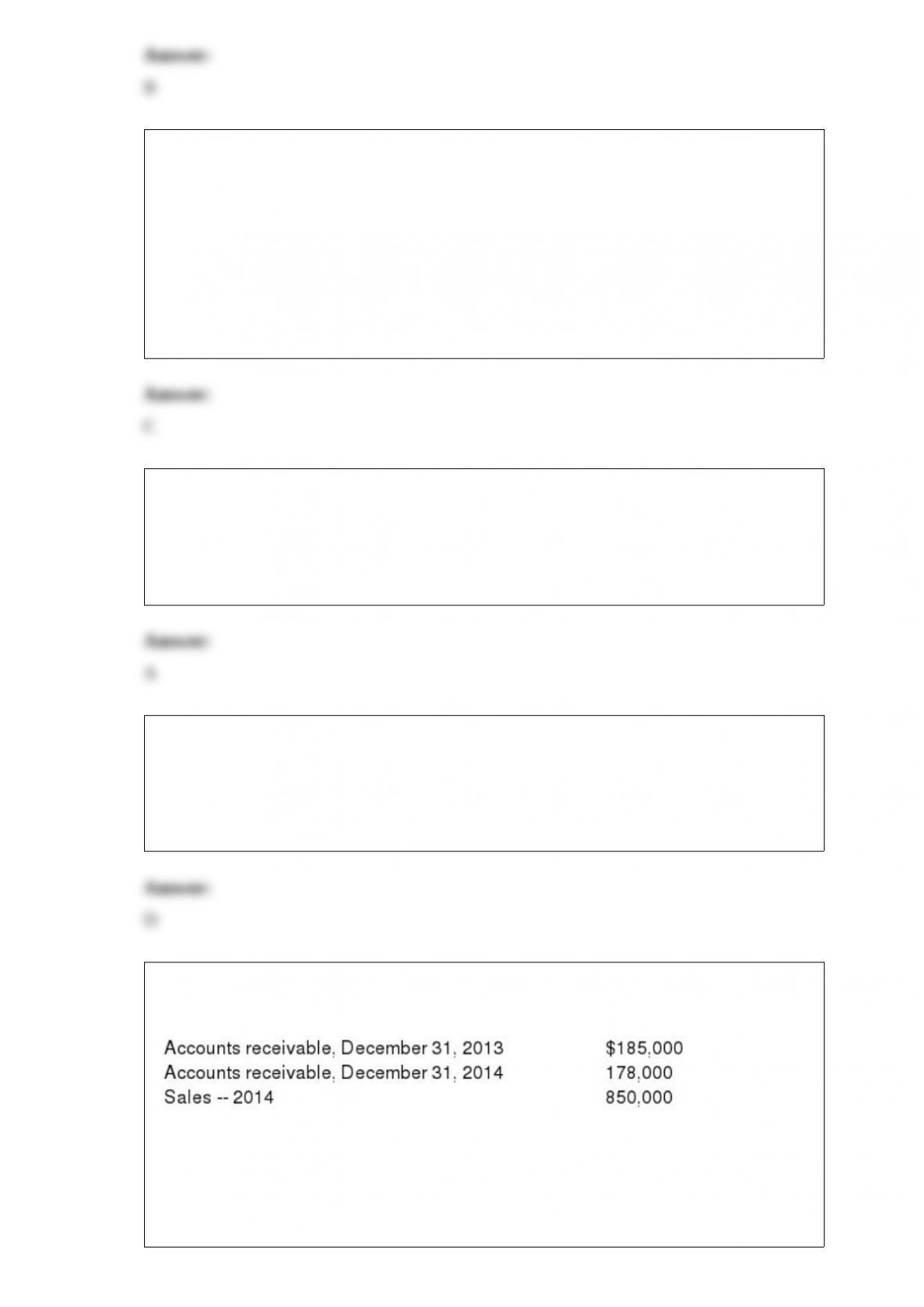
13) The following items were reported on the balance sheets and income statement for
Kensington Co.:
What amount would be reported in the operating activities section of the statement of
cash flows for collections from customers under the direct method assuming that all
sales are on credit?
A.$850,000
B.$857,000
C.$843,000
D.Cannot be determined without further information
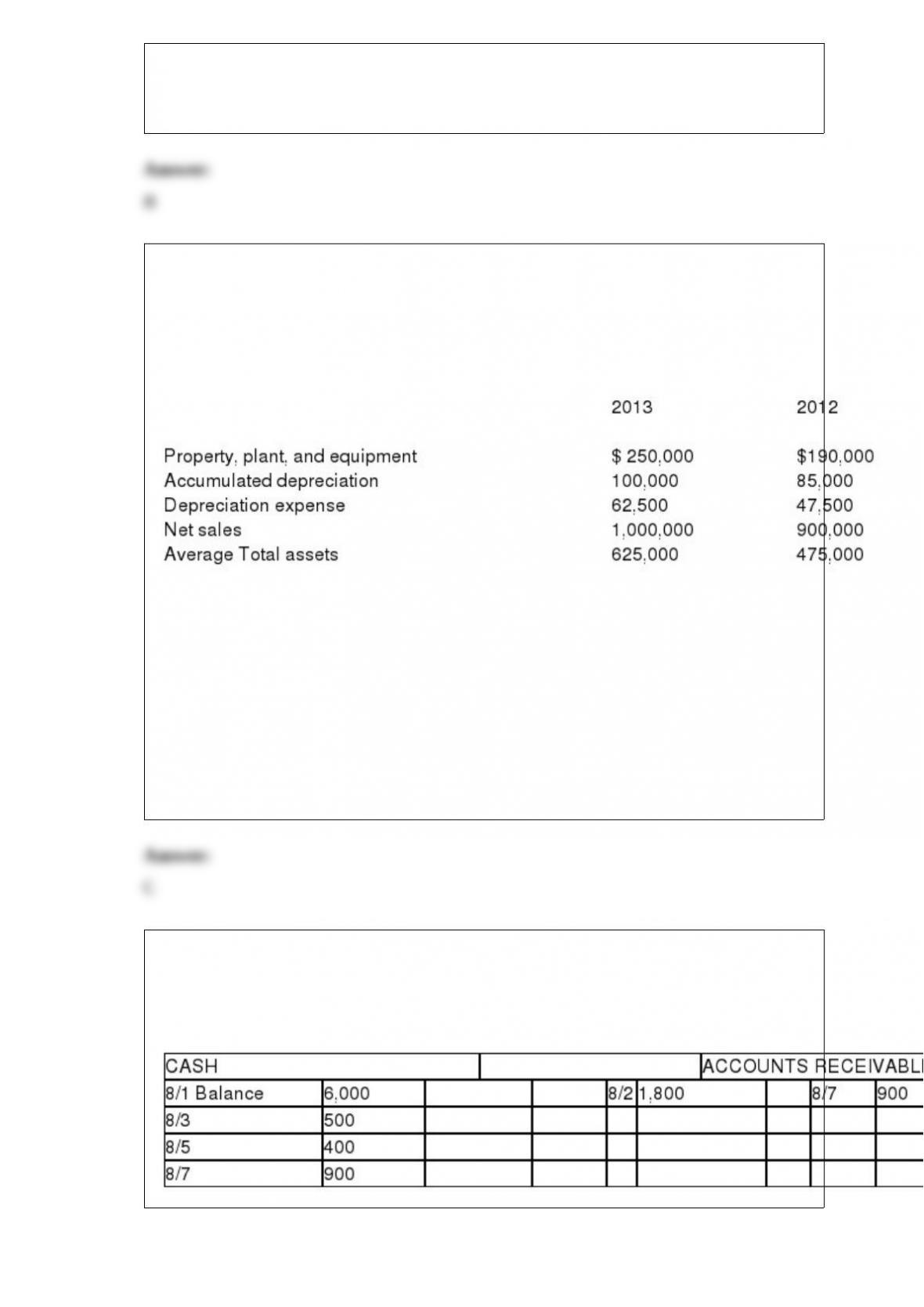
14) Cripple Creek Inc.
Use the information presented below for Cripple Creek, Inc. for 2013 and 2012 to
answer the questions that follow. Cripple Creek uses the straight-line depreciation
method.
Refer to the information for Cripple Creek, Inc.
Using the 2013 data, what is the average life of Cripple Creeks property, plant, and
equipment (rounded to one decimal place)?
A.1.6 years
B.2.5 years
C.4.0 years
D.10.0 years
15) Parachute Country Club
Use the selected accounts for Parachute Country Club presented below to answer the
following question(s).
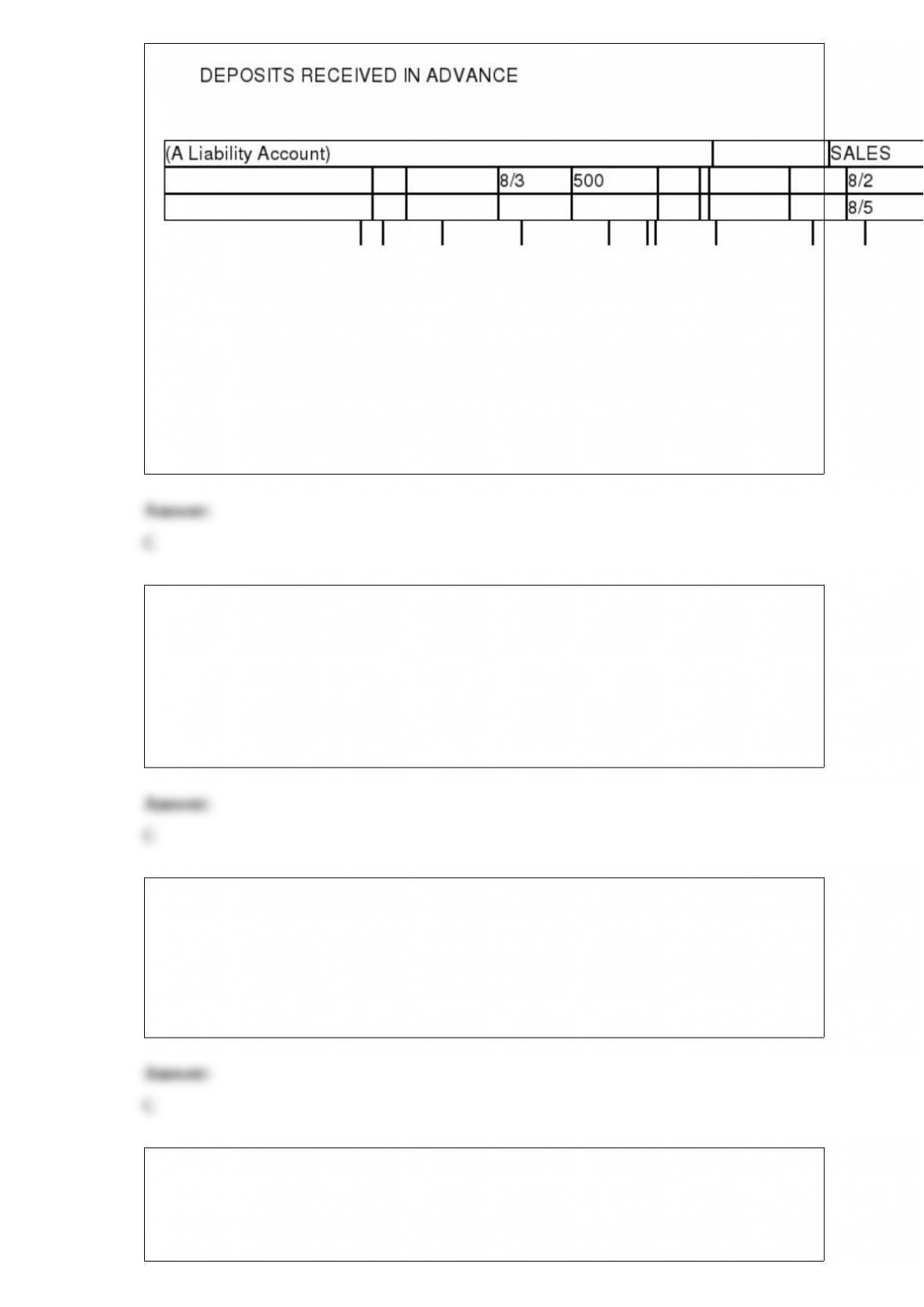
Read the information about Parachute Country Club.
Assuming that there are no other transactions, how much was owed to the club by the
membership on August 7th?
A.$1,800
B.$1,300
C.$ 900
D.$ 500
16) Which of the following statements is true concerning external users of financial
information?
A.External users need detailed records of the business to make informed decisions
B.External users are primarily responsible for the preparation of financial statements
C.External users rely on the financial statements to help make informed decisions
D.External users rely on management to tell them whether the company is a good
investment
17) Long-term assets are $800, current liabilities are $500, and long-term liabilities are
$600. If the current ratio is 2.5 to 1, then current assets are
A.$ 200
B.$ 625
C.$1,250
D.$2,000
18) Yu Corporation
Use the following Assets section of Yu Corporations balance sheets for the years ended
December 31, 2013 and 2012 to answer the questions that follow.
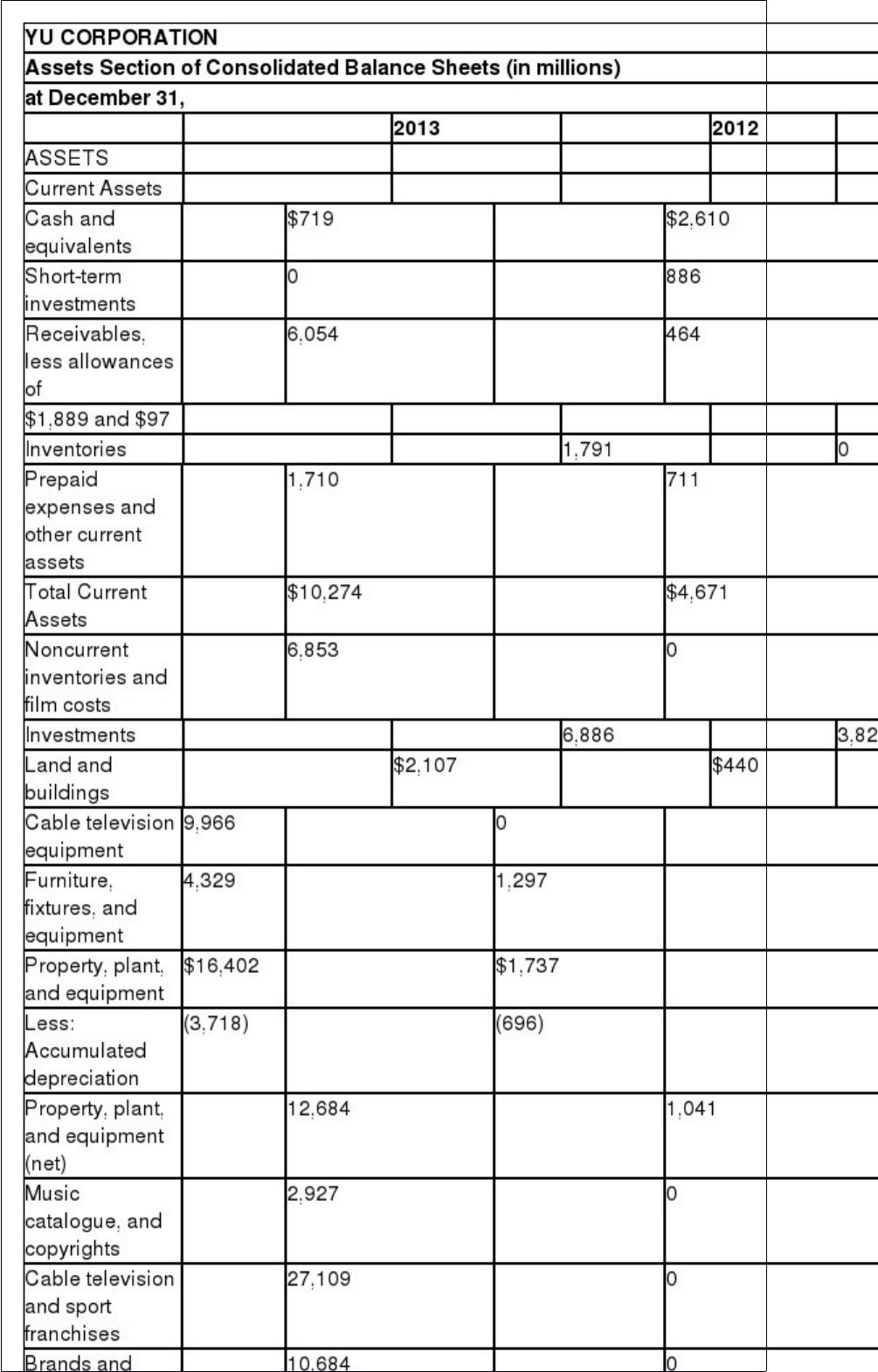
Yu Corporation recorded depreciation expense of $344 million for 2012.
Refer to the information for Yu Corporation.
Required:
(1) Which items on Yus balance sheet could be considered intangible assets? Explain
the nature of each of these.
(2) Explain why it is important that Yu disclose the amounts expended on research and
development each year.
19) Items that are included on a bank statement and increase the bank account balance
are called _________________________.
20) The ______________________ ratio indicates the companys ability to meet the
current years interest payments out of the current years earnings.
21) According to the revenue recognition principle, revenues are recognized when they
are _________________________.
22) One of your friends is majoring in Aeronautics. In this industry, leases are very
important and he is interested in knowing a little bit about how international accounting
standards will affect the industry as compared to current U.S. GAAP treatments for
leasing. How would you explain the differences in their applications?
23) [APPENDIX] Which accounts are used by a sole proprietorship that are not used by
a corporation?
24) On March 31, 2013, Outdoor Closets, Inc. had common stock of $230,000, retained
earnings of $65,000, and additional paid-in capital–common of $540,000. During the
fiscal year ended March 31, 2014, 500 shares of stock were sold for $60,000, of which
$40,000 represented additional paid-in capital. The company reported net income of
$140,000 and declared and paid dividends of $80,000. In good form, prepare the
financial statement that shows all of the changes in the stockholders’ equity accounts.
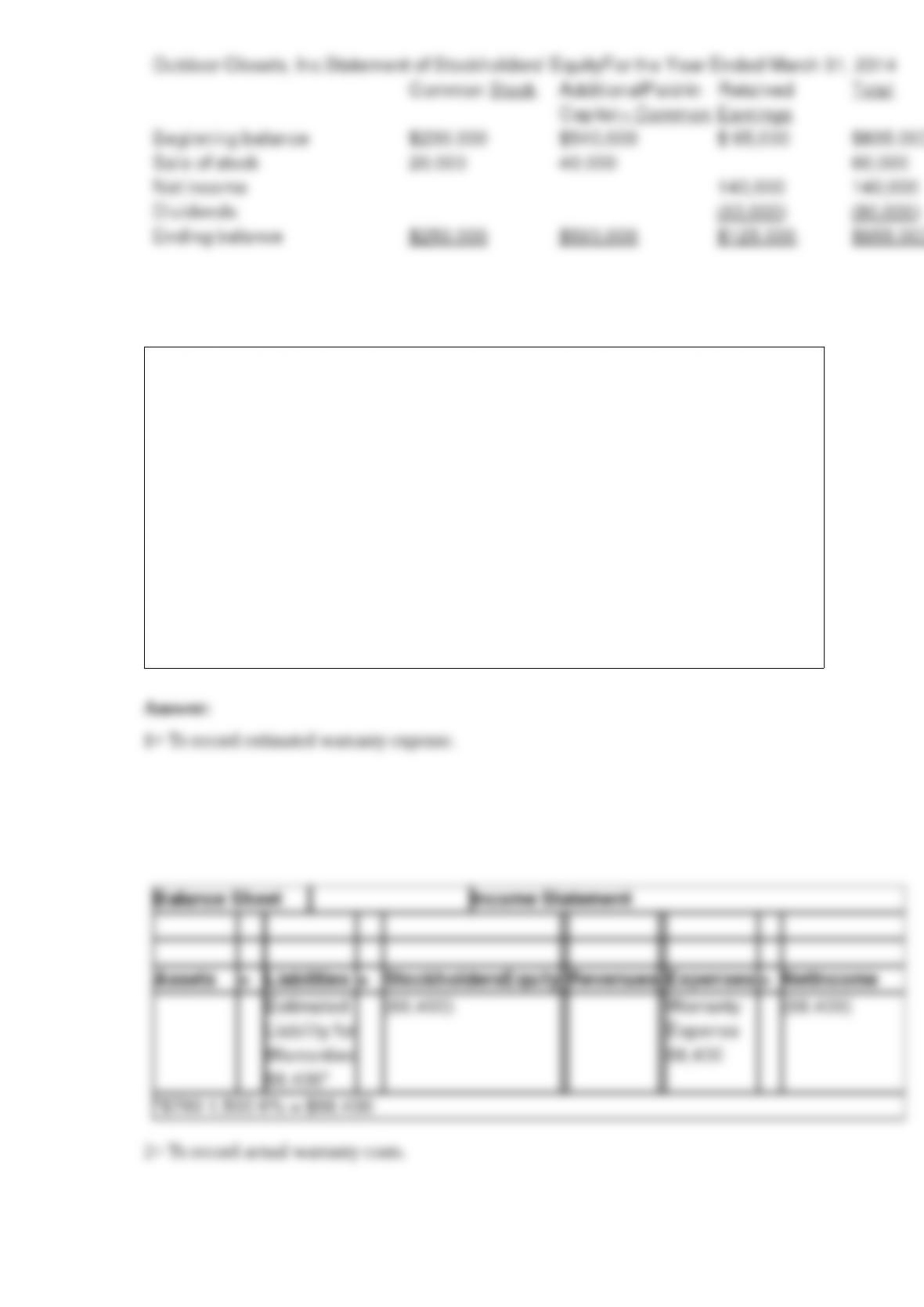
25) Grain Company sells a product for $760. When the customer buys it, Grain
provides a one-year warranty. Grain sold 1,500 products during 2012. Based on analysis
of past warranty records, Grain estimates that repairs will average 6% of total sales.
REQUIRED:
1> Identify and analyze the effect of the transaction to record the estimated liability.
2> Assume that during 2012, products under warranty must be repaired using repair
parts from inventory costing $49,600. Identify and analyze the effect of the transaction
to record the repair of products.
3> Assume that the balance of the Estimated Liabilities for Warranties account as of the
beginning of 2012 was $1,700. Calculate the balance of the account as of the end of
2012.