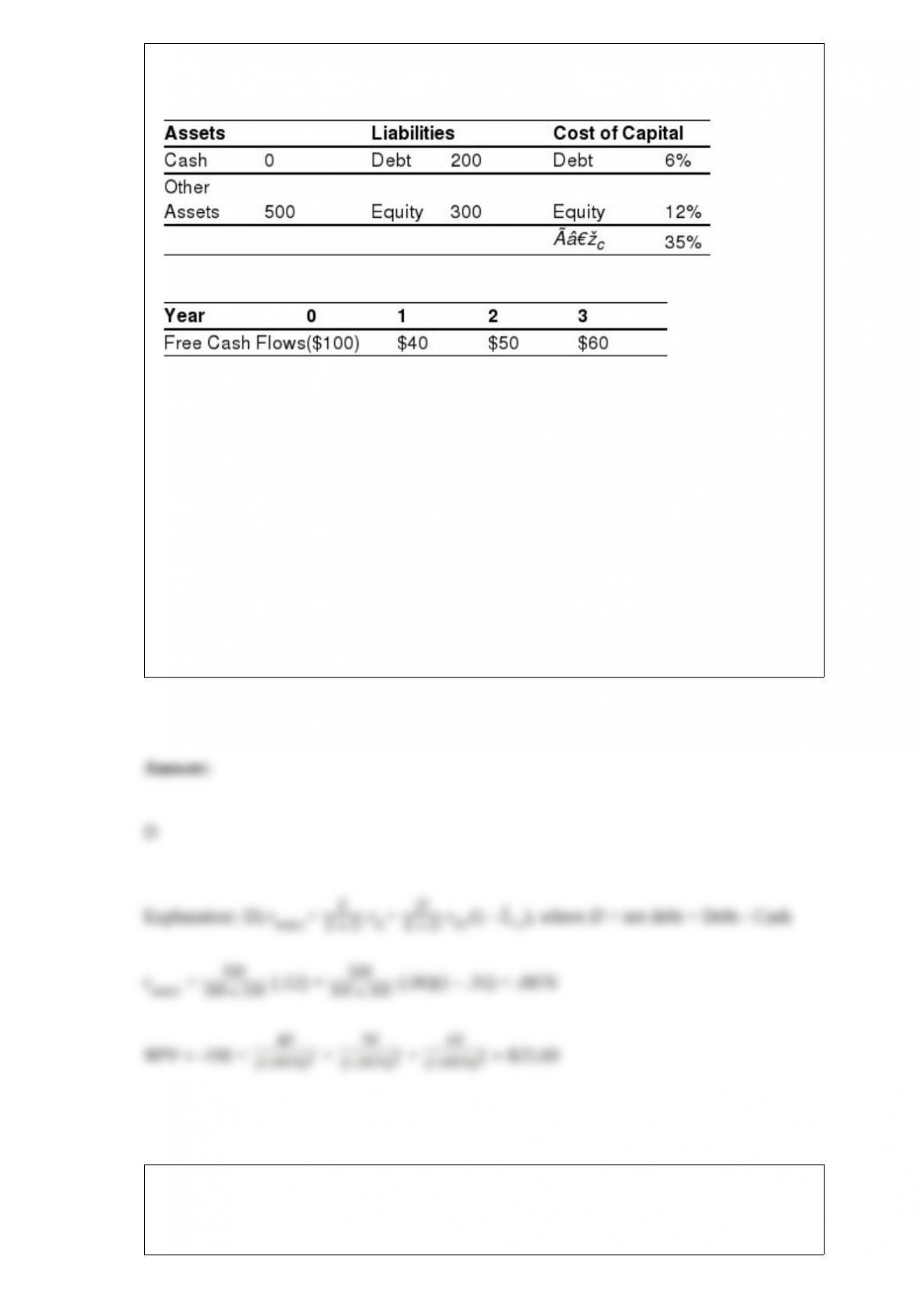
Omicron Industries’ Market Value Balance Sheet ($ Millions)
and Cost of Capital
Omicron Industries New Project Free Cash Flows
Assume that this new project is of average risk for Omicron and that the firm wants to
hold constant its debt to equity ratio.
The NPV for Omicron’s new project is closest to:
A) $23.75
B) $27.50
C) $28.75
D) $25.75
LCMS Industries has $70 million in debt outstanding. The firm will pay only interest on
this debt (the debt is perpetual). LCMS’ marginal tax rate is 35% and the firm pays a
rate of 8% interest on its debt.

The present value of LCMS’ interest tax shield is closest to:
A) $45.5 million
B) $20.0 million
C) $24.5 million
D) $35.0 million
Which of the following statements is FALSE?
A) Tax rates vary by income, by jurisdiction, and by whether the stock is held in a
retirement account. Because of these differences, firms may attract different groups of
investors depending on their dividend policy.
B) While many investors have a tax preference for share repurchases rather than
dividends, the strength of that preference depends on the difference between the
dividend tax rate and the capital gains tax rate that they face.
C) Long-term investors are more heavily taxed on capital gains, so they would prefer
dividend payments to share repurchases.
D) One-year investors, pension funds, and other non-taxed investors have no tax
preference for share repurchases over dividends, they would prefer a payout policy that
most closely matches their cash needs.
Which of the following organization forms accounts for the greatest number of firms?
A) “S” corporation
B) Limited partnership
C) Sole proprietorship
D) “C” corporation
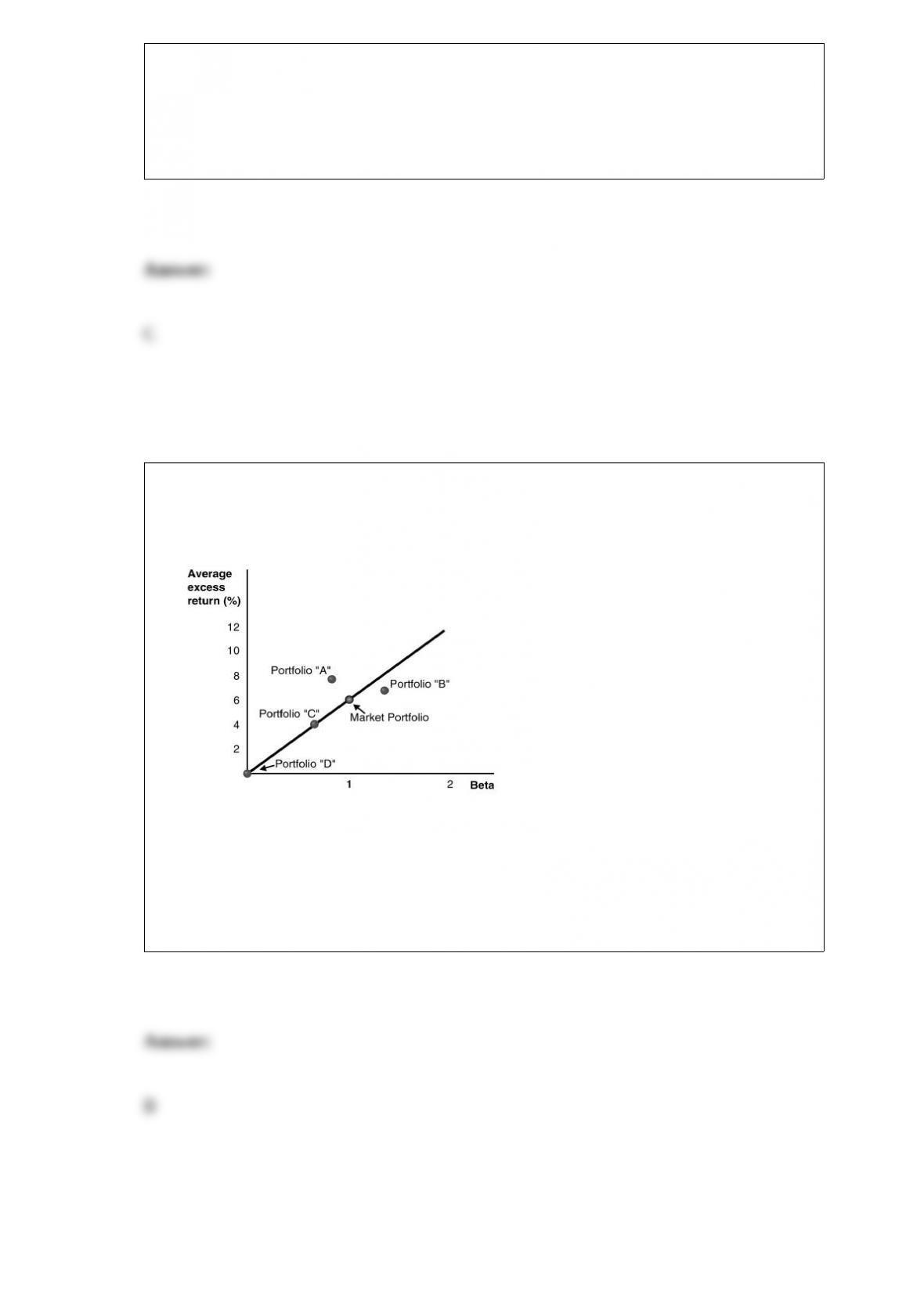
Consider the following graph of the security market line:
Portfolio “B”:
A) is less risky than the market portfolio.
B) is overpriced.
C) has a positive alpha.
D) falls above the SML.
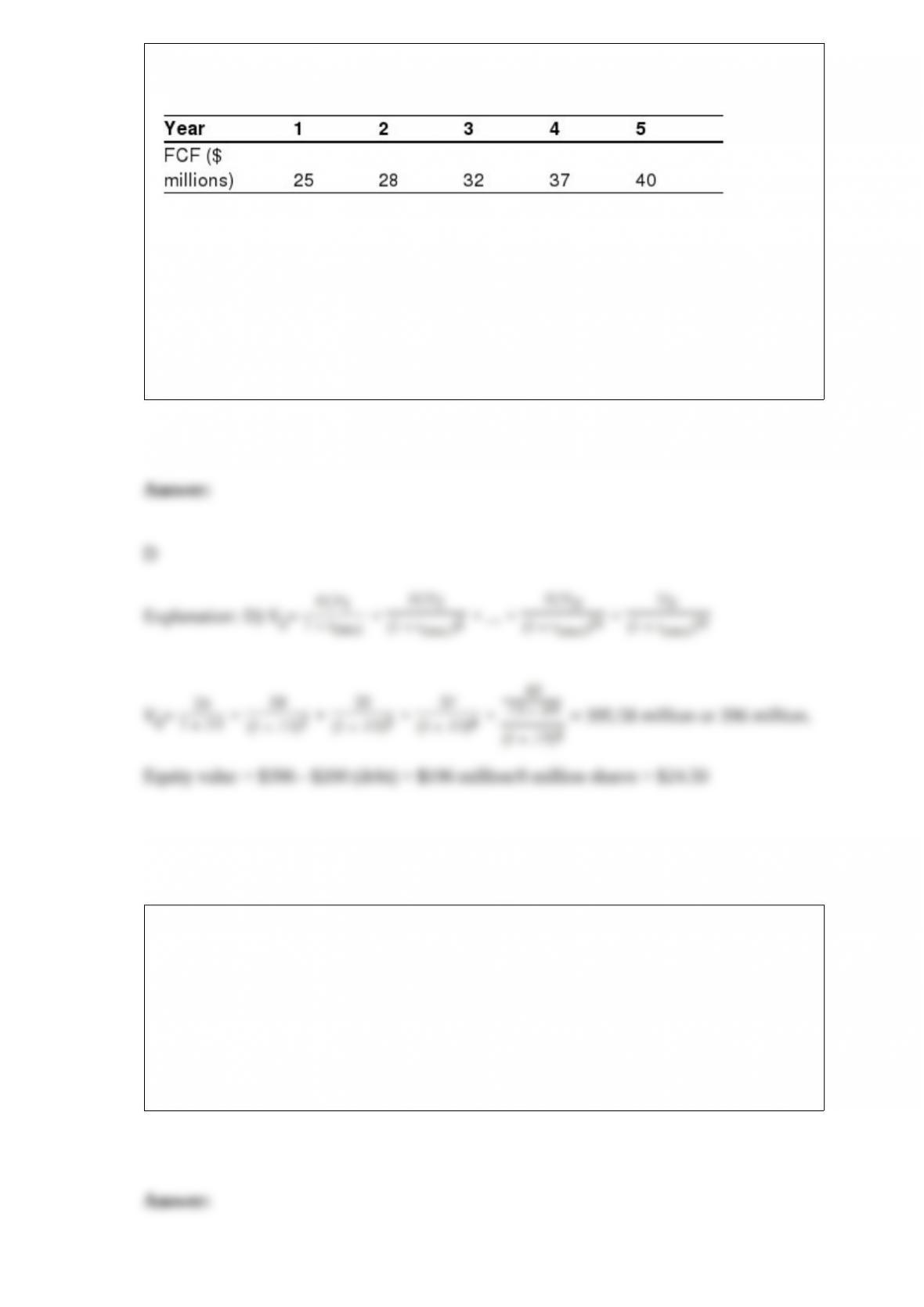
You expect CCM Corporation to generate the following free cash flows over the next
five years:
Following year five, you estimate that CCM’s free cash flows will grow at 5% per year
and that CCM’s weighted average cost of capital is 13%.
If CCM has $200 million of debt and 8 million shares of stock outstanding, then the
share price for CCM is closest to:
A) $49.50
B) $12.50
C) $19.35
D) $24.50
Luther Industries has 25 million shares outstanding trading at $18 per share. In addition,
Luther has $150 million in outstanding debt. Suppose Luther’s equity cost of capital is
13%, its debt cost of capital is 7%, and the corporate tax rate is 40%.
Luther’s unlevered cost of capital is closest to:
A) 7.0%
B) 9.8%
C) 10.8%
D) 11.5%

Which of the following statements is FALSE?
A) The CAPM remains the predominant model use in practice to determine the equity
cost of capital.
B) Low beta stocks have tended to perform somewhat better than the CAPM predicts.
C) The empirically estimated security market line is somewhat steeper than that
predicted by the CAPM.
D) Some evidence suggests that the market risk premium has declined over time.
Which of the following statements is FALSE?
A) Unlike taxes on capital gains or interest income, which are paid annually, taxes on
dividends are paid only at the time the investor sells the stock.
B) Deferring the payment of capital gains taxes lowers the present value of the taxes,
which can be interpreted as a lower effective capital gains tax rate.
C) Investors with longer holding periods or with accrued losses face a lower tax rate on
equity income, decreasing the effective tax advantage of debt.
D) Investors with accrued losses that they can use to offset gains face a zero effective
capital gains tax rate.
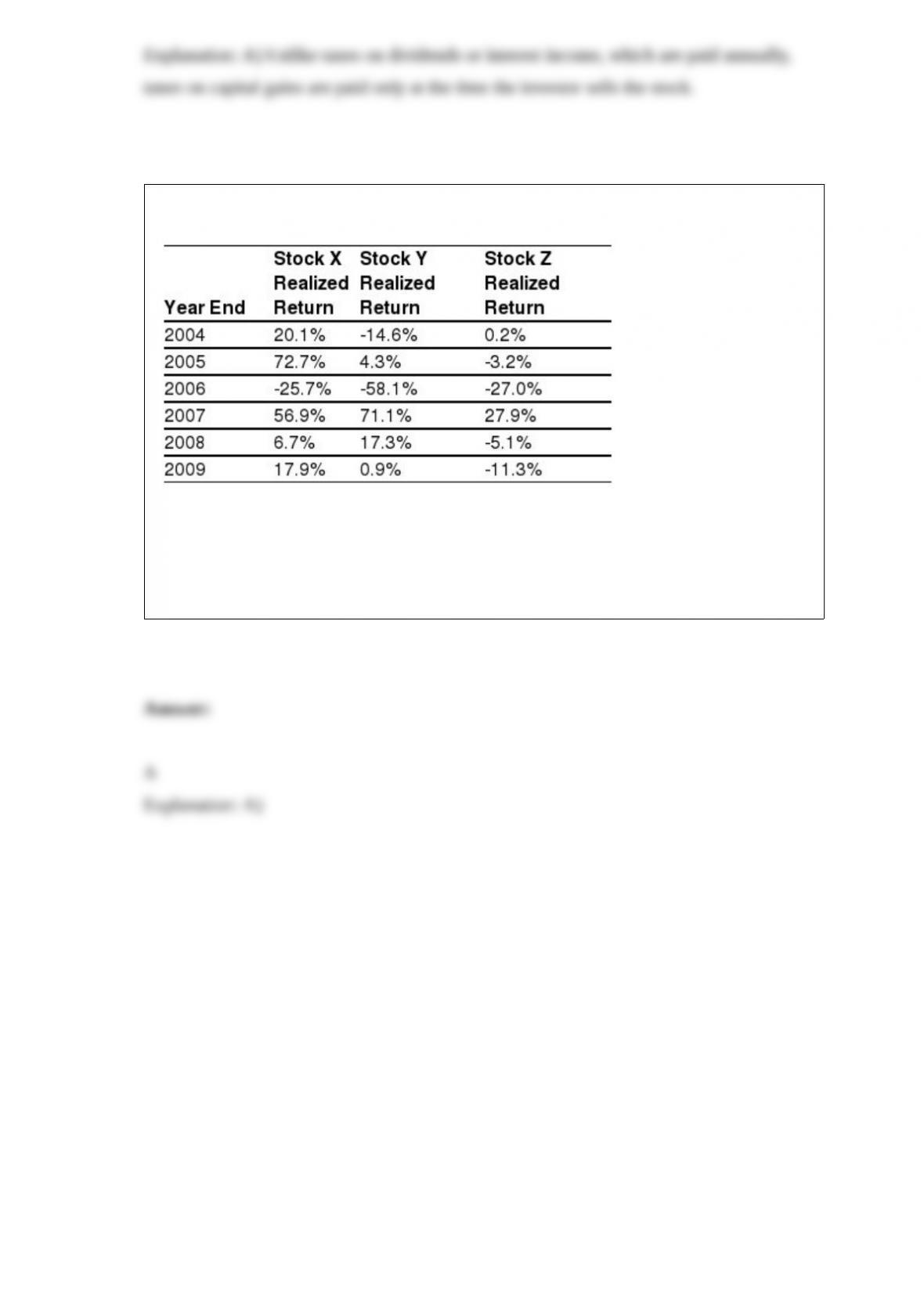
Consider the following returns:
The covariance between Stock X’s and Stock Z’s returns is closest to:
A) 0.05
B) 0.06
C) 0.10
D) 0.71
Consider two banks. Bank A has 1000 loans outstanding each for $100,000, that it
expects to be fully repaid today. Each of Bank A’s loans have a 6% probability of
default, in which case the bank will receive $0 for each of the defaulting loans. Bank B
has 100 loans of $1 million outstanding, which it also expects to be fully repaid today.
Each of Bank B’s loans have a 5% probability of default, in which case the bank will
receive $0 for each of the defaulting loans. The chance of default is independent across
all the loans.
The expected overall payoff to Bank B is:
A) $5,000,000
B) $6,000,000
C) $94,000,000
D) $95,000,000

Suppose that a young couple has just had their first baby and they wish to insure that
enough money will be available to pay for their child’s college education. They decide
to make deposits into an educational savings account on each of their daughter’s
birthdays, starting with her first birthday. Assume that the educational savings account
will return a constant 7%. The parents deposit $2000 on their daughter’s first birthday
and plan to increase the size of their deposits by 5% each year. Assuming that the
parents have already made the deposit for their daughter’s 18th birthday, then the
amount available for the daughter’s college expenses on her 18th birthday is closest to:
A) $42,825
B) $97,331
C) $67,998
D) $103,063
Rockwood Enterprises is currently an all equity firm and has just announced plans to
expand their current business. In order to fund this expansion, Rockwood will need to
raise $100 million in new capital. After the expansion, Rockwood is expected to
produce earnings before interest and taxes of $50 million per year in perpetuity.
Rockwood has already announced the planned expansion, but has not yet determined
how best to fund the expansion. Rockwood currently has 16 million shares outstanding
and following the expansion announcement these shares are trading at $25 per share.
Rockwood has the ability to borrow at a rate of 5% or to issue new equity at $25 per
share.
If Rockwood finances their expansion by issuing new stock, what will Rockwood’s cost
of equity capital be?
A) 12%
B) 15%
C) 8%
D) 10%

Temporary Housing Services Incorporated (THSI) is considering a project that involves
setting up a temporary housing facility in an area recently damaged by a hurricane.
THSI will lease space in this facility to various agencies and groups providing relief
services to the area. THSI estimates that this project will initially cost $5 million to
setup and will generate $20 million in revenues during its first and only year in
operation (paid in one year). Operating expenses are expected to total $12 million
during this year and depreciation expense will be another $3 million. THSI will require
no working capital for this investment. THSI’s marginal tax rate is 35%.
Ignoring the original investment of $5 million, what is THSI’s free cash flow for the
first and only year of operation?
A) $5.0 million
B) $3.75 million
C) $8.0 million
D) $6.25 million
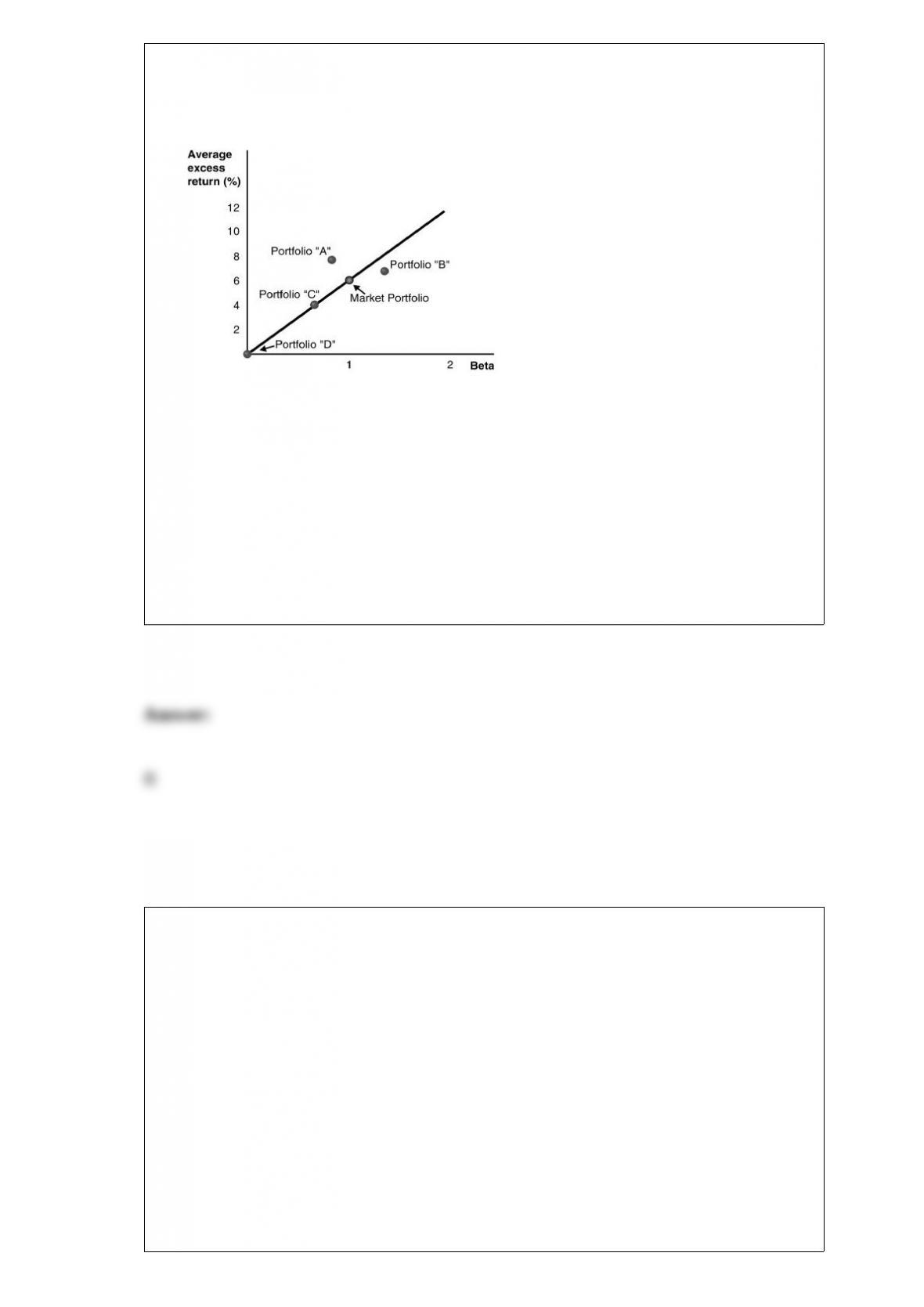
Consider the following graph of the security market line:
Which of the following statements regarding portfolio “A” is/are correct?
1. Portfolio “A” has a positive alpha.
2. Portfolio “A” is overpriced.
3. Portfolio “A” is less risky than the market portfolio.
4. Portfolio “A” should not exist if the market portfolio is efficient.
A) 1 and 2
B) 1, 3, and 4
C) 1 and 3
D) 1, 2, 3, and 4
JR Industries has a $20 million loan due at the end of the year and under its current
business strategy its assets will have a market value of only $15 million when the loan
comes due. JR is considering a new much riskier business strategy. While this new
riskier strategy can be implemented using JR’s existing assets without any additional
investment, the new strategy has only a 40% probability of succeeding. If the new
strategy is a success, the market value of JR’s assets will be $30, but if the strategy fails
the assets will be worth only $5 million.
What is the expected payoff to debt holders under JR’s new riskier business strategy?
A) $20 million
B) $4 million

C) $15 million
D) $11 million
If you want to value a firm but don’t want to explicitly forecast its dividends, share
repurchases, or its use of debt, what is the simplest model for you to use?
A) Discounted free cash flow model
B) Dividend discount model
C) Enterprise value model
D) Total payout model
Rosewood Industries has EBIT of $450 million, interest expense of $175 million, and a
corporate tax rate of 35%.
Rosewood’s net income is closest to:
A) $450 million
B) $180 million
C) $290 million
D) $95 million

Which of the following statements is FALSE?
A) The Sharpe ratio if the portfolio tells us how much our expected return will increase
for a given increase in volatility.
B) We should continue to trade securities until the expected return of each security
equals its required return.
C) The required return is the expected return that is necessary to compensate for the risk
that an investment will contribute to the portfolio.
D) If security i‘s required return exceeds its expected return, then adding more of it will
improve the performance of the portfolio.
KD Industries has 30 million shares outstanding with a market price of $20 per share
and no debt. KD has had consistently stable earnings, and pays a 35% tax rate.
Management plans to borrow $200 million on a permanent basis through a leveraged
recapitalization in which they would use the borrowed funds to repurchase outstanding
shares.
After the recapitalization, the value of KD’s levered equity is closest to:
A) $670 million
B) $400 million
C) $330 million
D) $470 million

Which of the following statements is FALSE?
A) The relationship between the investment term and the interest rate is called the term
structure of interest rates.
B) Real interest rates indicate the rate at which your money will grow if invested for a
certain period.
C) The yield curve is a potential leading indicator of future economic growth.
D) The shape of the yield curve will be strongly influenced by interest rate
expectations.
Wyatt Oil has a net profit margin of 4.0%, a total asset turnover of 2.2, total assets of
$525 million, and a book value of equity of $220 million. Wyatt Oil’s current
return-on-equity (ROE) is closest to:
A) 8.8%
B) 9.5%
C) 21.0%
D) 22.8%