
Which one of the following statements is correct?
A. The financial market generally reacts the same to a new issue of equity as it does to a
new issue of debt as long as the issuer is the same.
B. Issuing new equity shares is always viewed by the market as a positive event.
C. Informed managers tend to issue new securities when the existing securities are
underpriced.
D. A decline in the price of existing stock when a new issue is released is a direct cost
of selling securities.
E. A firm’s existing shareholders would prefer that new securities be issued when those
securities are overpriced rather than underpriced.
Answer:
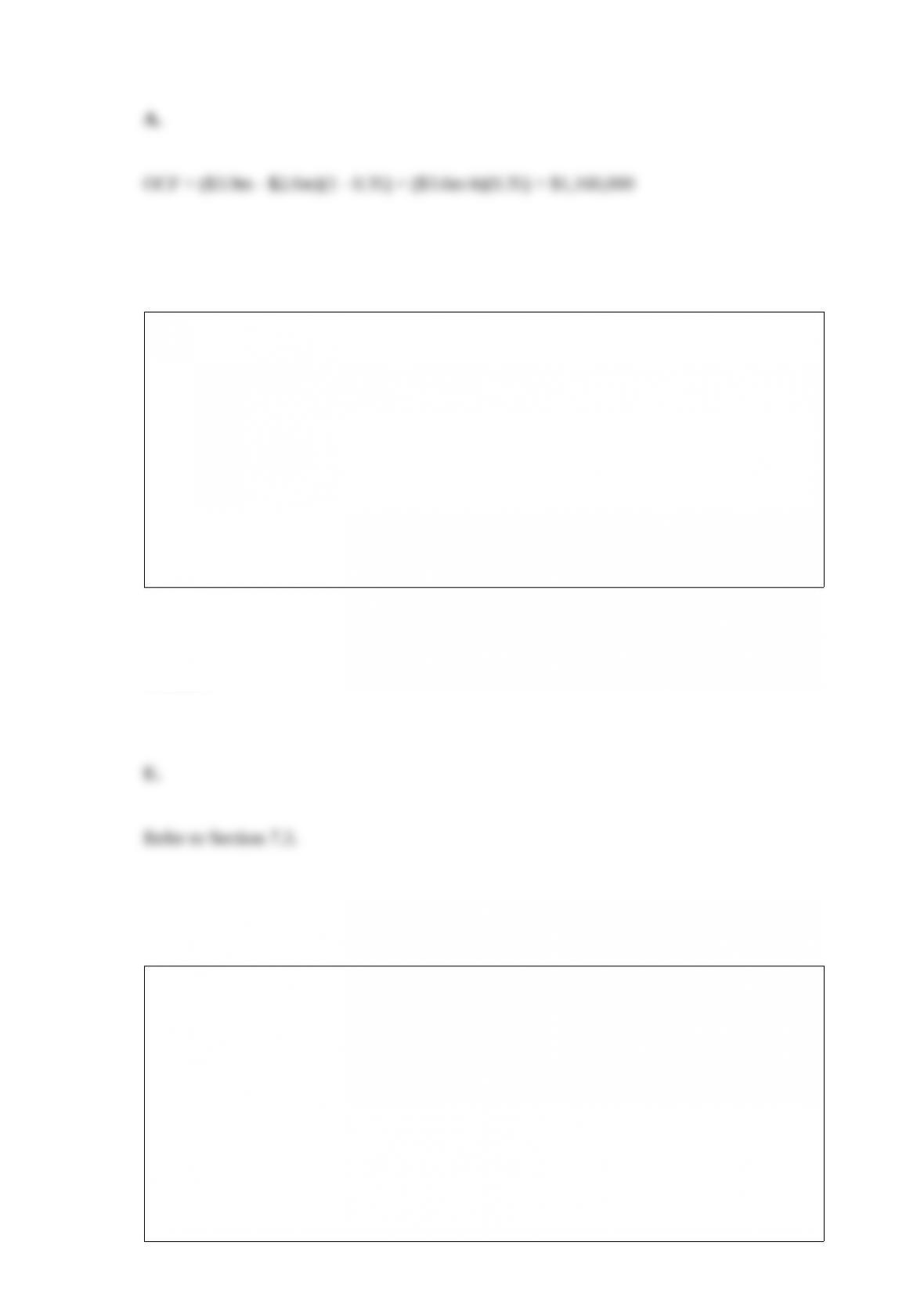
Miller Lite, Inc. is considering a new four-year expansion project that requires an initial
fixed asset investment of $3.6 million. The fixed asset will be depreciated straight-line
to zero over its four-year life, after which time it will be worthless. The project is
estimated to generate $3.9 million in annual sales, with costs of $2.6 million. If the tax
rate is 35 percent, what is the OCF for this project?
A. $1,160,000
B. $997,720
C. $684,280
D. $845,000,000
E. $911,760
Answer:
Newly issued securities are sold to investors in which one of the following markets?
A. Proxy
B. Stated value
C. Inside
D. Secondary
E. Primary
Answer:
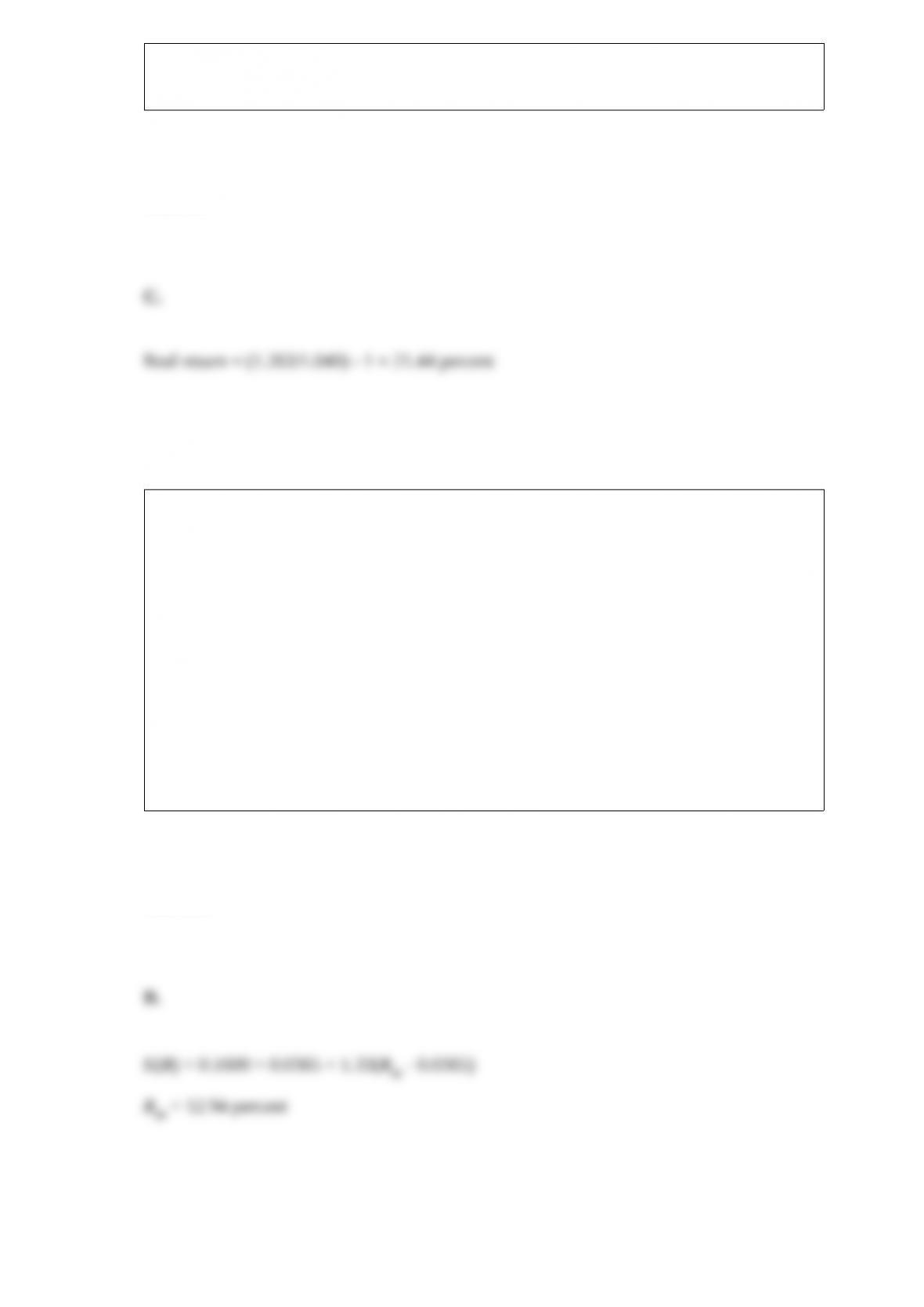
You earned 26.3 percent on your investments for a time period when the risk-free rate
was 3.8 percent and the inflation rate was 4.0 percent. What was your real rate of return
for the period?
A. 19.12 percent
B. 20.06 percent
C. 21.44 percent
D. 21.67 percent
E. 21.08 percent
Answer:
You own a stock that has an expected return of 16.00 percent and a beta of 1.33. The
U.S. Treasury bill is yielding 3.65 percent and the inflation rate is 2.95 percent. What is
the expected rate of return on the market?
A. 12.07 percent
B. 12.94 percent
C. 13.64 percent
D. 14.09 percent
E. 14.42 percent
Answer:

The Road House Diner is offering 10,000 shares of stock to the general public on a cash
basis. Which one of the following terms best applies to this offer?
A. Rights offer
B. General cash offer
C. Green Shoe
D. Red herring
E. Prospectus
Answer:
To minimize collection float, a firm should do which of the following?
I. Deposit its collections at least daily
II. Make sure all checks it receives at the sales counter are properly dated and signed
III. Pay its bills in a more timely manner
IV. Eliminate its regional lockboxes and have only one central lockbox located near the
firm’s home office
A. I and II only
B. III and IV only
C. II, III, and IV only
D. I, II, and III only
E. I, II, III, and IV

Answer:
Which one of the following statements related to the static theory of capital structure is
correct?
A. A firm begins to lose value as soon as the first dollar of debt is incurred.
B. The actual value of a firm continually rises in direct proportion to the increased use
of debt.
C. The linear function of a firm’s value has a constant positive slope.
D. A firm’s value is maximized when a firm operates at its optimal debt level.
E. The value of a firm will automatically decrease whenever the debt-equity ratio is
decreased.
Answer:
Semistrong form market efficiency states that the value of a security is based on:
A. all public and private information.
B. historical information only.
C. all publicly available information.

D. all publicly available information plus any data that can be gathered from insider
trading.
E. random information with no clear distinction as to the source of that information.
Answer:
Sticks and Stuff Furniture is offering a bedroom suite for $3,000. The credit terms are
60 months at $50 per month. What is the interest rate on this offer?
A. 0.00 percent
B. 1.50 percent
C. 1.65 percent
D. 1.15 percent
E. 1.30 percent
Answer:

Mary’s Baked Goods has 20,000 shares of stock outstanding at a market price of $25.00
per share. What will the price per share be after the firm declares a 6 percent stock
dividend? Ignore taxes and market imperfections.
A. $22.90
B. $23.58
C. $25.00
D. $25.31
E. $25.40
Answer:
Suppose the spot exchange rate for the Canadian dollar is Can$1.19 and the six-month
forward rate is Can$1.16. Assuming absolute PPP holds, what is the current cost in the
United States of a beer if the price in Canada is Can$3.75?
A. $2.48
B. $2.54
C. $3.15
D. $3.42
E. $3.51

Answer:
When is a firm insolvent from an accounting perspective?
A. When the firm is unable to meet its financial obligations in a timely manner
B. When the firm’s debt exceeds the value of the firm’s equity
C. When the firm has a negative net worth
D. When the firm’s revenues cease
E. When the market value of the firm’s equity equals zero
Answer:
Which two of the following determine when revenue is recorded on the financial
statements based on the recognition principle?
I. Payment is collected for the sale of a good or service.
II. The earnings process is virtually complete.
III. The value of a sale can be reliably determined.
IV. The product is physically delivered to the buyer.

A. I and II only
B. I and IV only
C. II and III only
D. II and IV only
E. I and III only
Answer:
Which one of the following is an example of a direct bankruptcy cost?
A. Operating at a debt-equity ratio that is less than the optimal ratio
B. Reducing the dividend payout ratio as a means of increasing a firm’s equity
C. Forgoing a positive net present value project to conserve current cash
D. Incurring legal fees for the preparation of bankruptcy filings
E. Losing a key customer due to concerns over a firm’s financial viability
Answer:
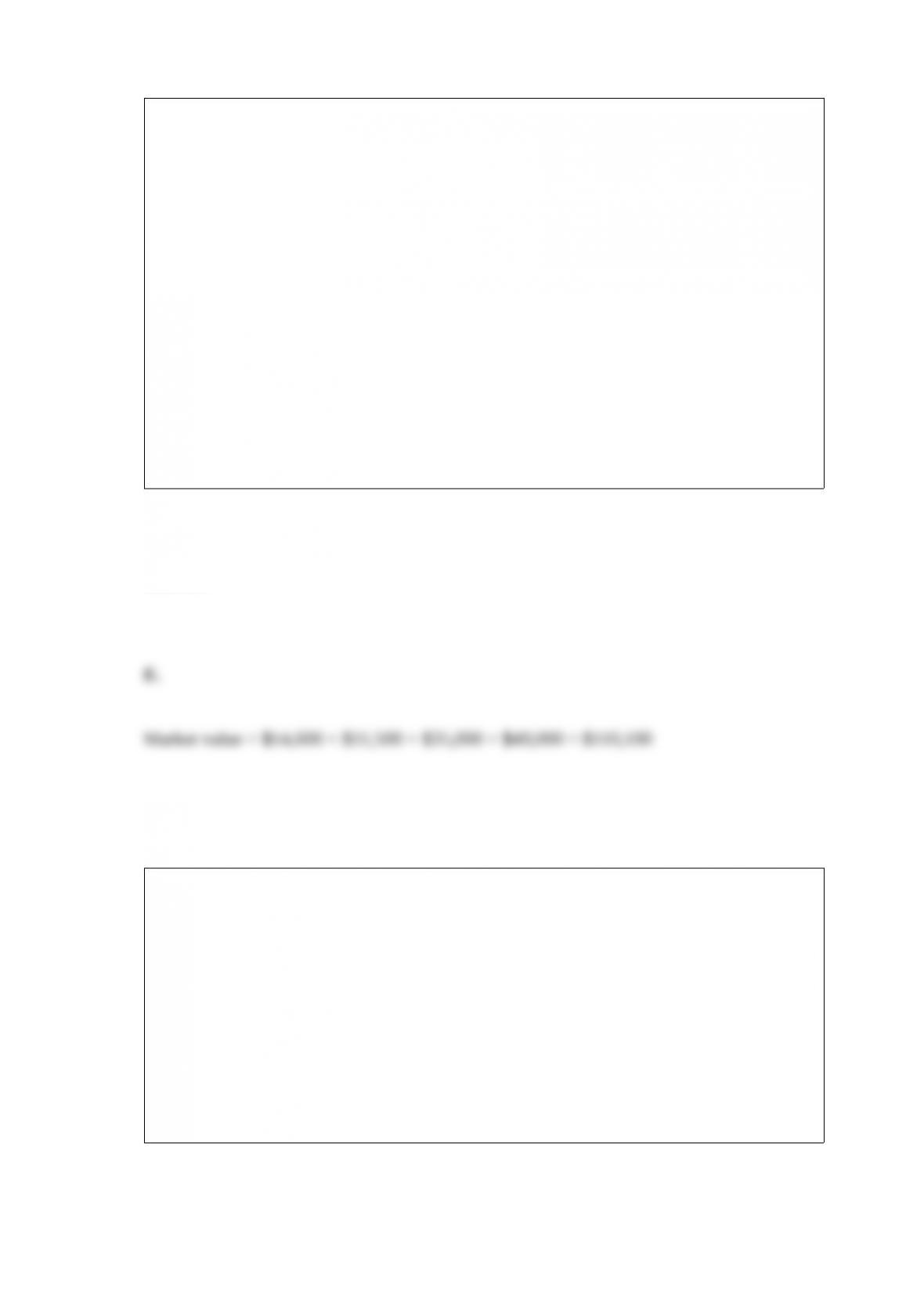
The financial statements of Jame’s Auto Repair reflect cash of $14,600, accounts
receivable of $11,500, accounts payable of $22,900, inventory of $17,800, long-term
debt of $42,000, and net fixed assets of $63,800. The firm estimates that if it wanted to
cease operations today it could sell the inventory for $35,000 and the fixed assets for
$49,000. The firm could also collect 100 percent of its receivables. What is the market
value of the assets?
A. $32,800
B. $39,900
C. $74,000
D. $95,500
E. $110,100
Answer:
Which one of the following is the positive square root of the variance?
A. Standard deviation
B. Mean
C. Risk-free rate
D. Average return
E. Real return
Answer:

A corporation:
A. is ultimately controlled by its board of directors.
B. is a legal entity separate from its owners.
C. is prohibited from entering into contractual agreements.
D. has its identity defined by its bylaws.
E. has its existence regulated by the rules set forth in its charter.
Answer:
Forecasting risk is best defined as:
A. reality risk.
B. value risk.
C. potential risk.
D. management risk.
E. estimation risk.

Answer:
Solar Energy, Inc. will pay an annual dividend of $1.85 next year. The company just
announced that future dividends will be increasing by 2 percent annually. How much
are you willing to pay for one share of this stock if you require a 14 percent return?
A. $15.14
B. $15.42
C. $15.78
D. $16.12
E. $16.62
Answer:
Outdoor Sports is considering adding a miniature golf course to its facility. The course
would cost $138,000, would be depreciated on a straight-line basis over its five-year
life, and would have a zero salvage value. The estimated income from the golfing fees
would be $72,000 a year with $24,000 of that amount being variable cost. The fixed
cost would be $11,600. In addition, the firm anticipates an additional $14,000 in
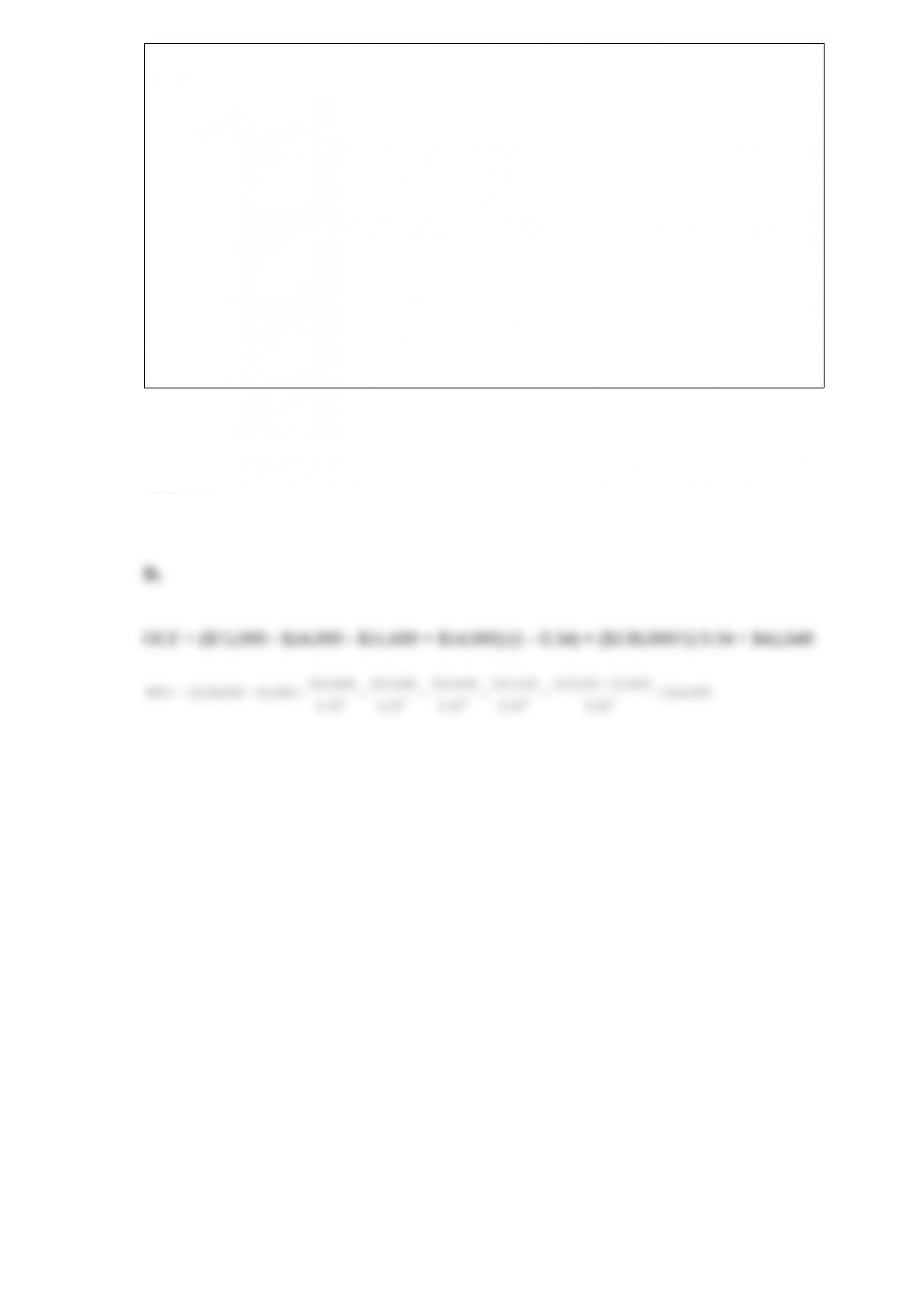
revenue from its existing facilities if the golf course is added. The project will require
$3,000 of net working capital, which is recoverable at the end of the project. What is
the net present value of this project at a discount rate of 12 percent and a tax rate of 34
percent?
A. $11,309
B. $11,628
C. $12,737
D. $14,439
E. $14,901
Answer: