
1) A direct quote of $1.6255 dollars to buy one U.K. pound corresponds to an indirect
quote of .6152 pounds per one dollar.
2) The EOQ model assumes constant demand and constant unit price.
3) The process of shelf-registration is beneficial to the issuing firm because it will
reduce the time needed for the firm to take an issue to market.
4) A firm can increase the growth rate of common stockholders’ investment in the firm
by retaining more earnings or increasing return on equity.
5) A preferred stock that pays an annual dividend of $10, has a par value of $100, and
has a required return of 5% will be valued at $200.
6) A stock with a beta of 1 has systematic or market risk equal to the “typical” stock in
the marketplace.
7) Increases in inventory and accounts receivable expected to occur if a proposed
advertising campaign is undertaken are examples of sunk costs.

8) NPV may be calculated on an Excel spreadsheet simply by entering the project’s free
cash flows into Excel’s NPV function.
9) The cost of capital is the rate that must be earned on an investment project if the
project is to increase the value of the common shareholders’ investment.
10) Short-term daily fluctuations in exchange rates are caused by supply and demand
conditions in the foreign exchange market.
11) According to accrual accounting, revenues are recognized when earned and
expenses are recognized when incurred.
12) The best form of business entity to attract new capital is the sole proprietorship
because investors only need to deal with one owner.
13) If the increase in net working capital is recovered entirely at the end of the project
then it may be ignored.
14) A quote of .7645 euros per dollar in New York is an example of a direct quote.

15) A secured loan should have a higher interest rate because the lender has less risk
and therefore values the loan more highly.
16) An infinite-life replacement chain allows projects of different lengths to be
compared.
17) A weakness in the capital budgeting process is the funds for an investment proposal
obtained by issuing bonds, and the respective interest payments, are not considered in
the capital budgeting process.
18) The yield-to-maturity is the discount rate that equates the present value of the
interest and principal payments with the face value of the bond.
19) If you are an importer of goods and you will make payment for the purchase of
inventory on 90-day terms, which of the below is the correct term for the exchange rate
that you will use?
A) indirect rate
B) spot rate
C) direct rate
D) forward rate
20) A Spot transaction occurs when
A) one currency is deposited in a foreign bank
B) one currency is immediately exchanged for another currency
C) one currency is exchanged for another currency at a specified price
D) one currency is exchanged for another currency in 30, 60, or 90 days

21) If you compare the yield of a municipal bond with that of a negotiable certificate of
deposit, what is the equivalent before-tax yield of the certificate of deposit if the
municipal bond has a yield of 8% per year and the investor has a marginal tax rate of
28%?
A) 8.28%
B) 9.30%
C) 10.24%
D) 11.11%
22) If you put $200 in a savings account at the beginning of each year for 10 years and
then allow the account to compound for an additional 10 years, how much will be in the
account at the end of the 20th year? Assume that the account earns 10% and round to
the nearest $100.
A) $8,300
B) $9,100
C) $8,900
D) $9,700
23) If you were to use the standard deviation as a measure of investment risk, which of
the following has historically been the least risky investment?
A) common stock of large firms
B) U.S. Treasury bills
C) common stock of small firms
D) long-term government bonds
24) All of the following are potential advantages of commercial paper EXCEPT
A) flexible repayment terms
B) lower interest rates than comparable sources of short-term financing
C) no compensating balance requirements
D) ability to borrow very large amounts

25) Suppose the following rates are averages for banks in your area: interest checking
accounts pay 1%, savings accounts pay 2%, and one-year certificates of deposit pay
3%. All accounts are federally insured by the FDIC. The difference in rates can be
explained mainly by
A) liquidity premiums
B) default risk premiums
C) maturity premiums
D) inflation risk premiums
26) The prime lending rate is the base rate on
A) mortgage loans
B) home equity loans
C) auto loans
D) corporate loans
27) You are considering an investment in Citizens Bank Corp. The firm has a beta of
1.6. Currently, U.S. Treasury bills are yielding 2.75% and the expected return for the S
& P 500 is 14%. What rate of return should you expect for your investment in Citizens
Bank?
A) 11.15%
B) 15.39%
C) 16.75%
D) 20.75%
28) If bankruptcy costs and/or shareholder under diversification are an issue, what
measure of risk is relevant when evaluating project risk in capital budgeting?
A) total project risk
B) contribution-to-firm risk
C) systematic risk
D) capital rationing risk
29) In what way does a cash budget provide management with better information about
financing requirements than a pro forma balance sheet?

A) A pro forma cash budget gives greater details about the depreciation of fixed assets
B) A pro forma cash budget not only delineates the financing that is needed but it also
pinpoints in greater detail when the financing is needed
C) A pro forma cash budget utilizes superior methods in determining a firm’s income
tax liability for the planned period
D) A pro forma cash budget does not offer better information to management regarding
financing than a pro forma balance sheet
30) Gross profit is equal to
A) profits plus depreciation
B) revenues – expenses
C) earnings before taxes minus taxes payable
D) sales – cost of goods sold
31) When evaluating an investment project, which of the following best describes the
financial information needed by the decision maker?
A) after-tax accounting profits
B) after-tax incremental cash flows to the company as a whole
C) incremental cash flows before taxes so the decision will not be biased by a tax code
that may change in the future
D) pre-tax accounting profits adjusted for any accounting method changes
32) Given the following financial statements for ARGON Corporation, what is the
company’s after-tax cash flow from operations?
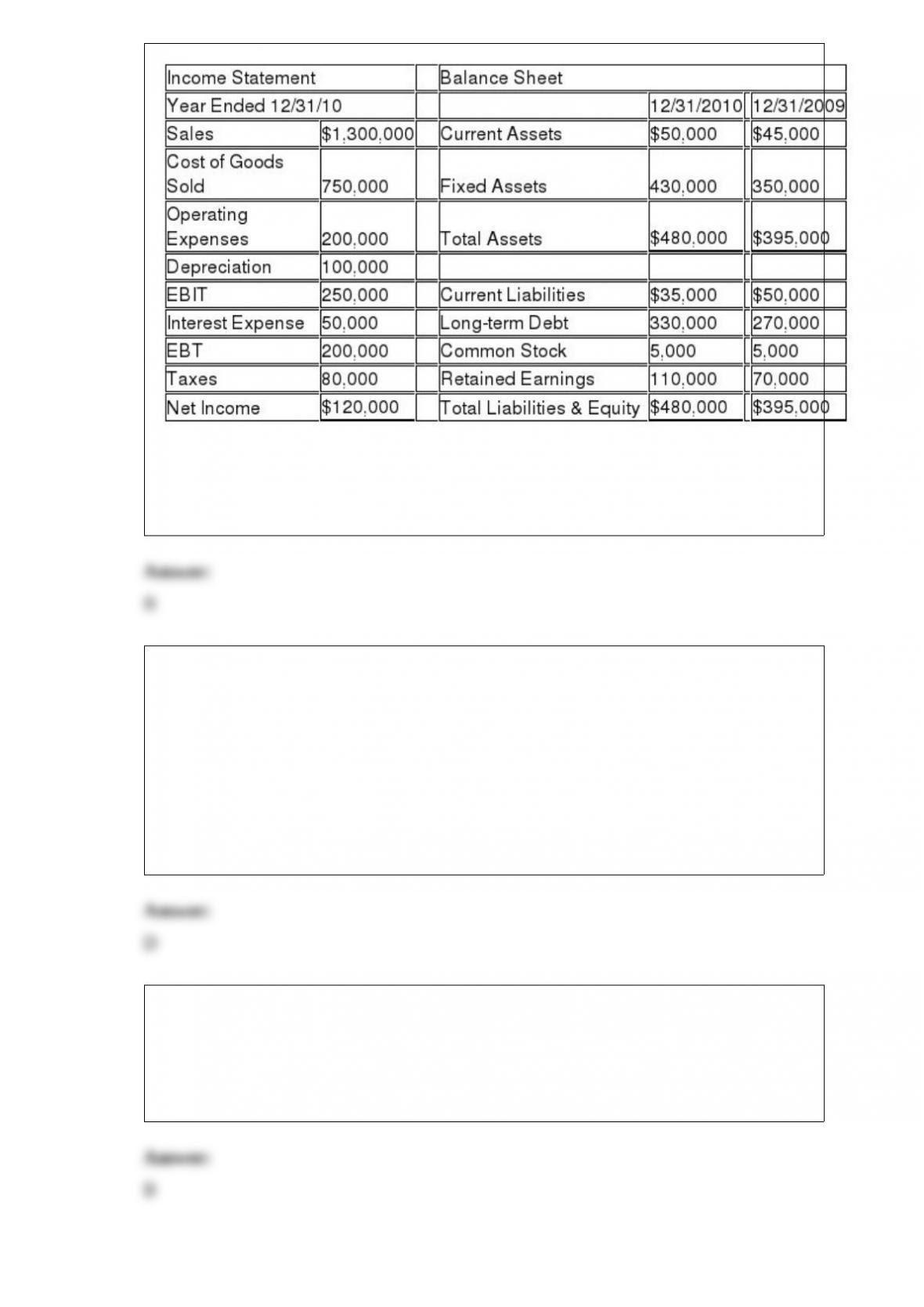
A) $10,000
B) $270,000
C) $120,000
D) $295,000
33) The risk free rate of return is 3% and the expected return on the market portfolio is
14%. Oklahoma Oilco has a beta of 2.0 and a standard deviation of returns of 26%.
Oilco’s marginal tax rate is 35%. Analysts expect Oilco’s net income to grow by 12%
per year for the next 5 years. Using the capital asset pricing model, what is Oklahoma
Oilco’s cost of retained earnings?
A) 18.6%
B) 21.2%
C) 22.8%
D) 25.0%
34) If the Beta for stock A equals zero, then
A) stock A’s required return is equal to the required return on the market portfolio
B) stock A’s required return is equal to the risk-free rate of return
C) stock A has a guaranteed return
D) stock A’s required return is greater than the required return on the market portfolio

35) A firm paid dividends of $10,000, paid interest of $20,000, reduced debt principal
outstanding (paid off debt) in the amount of $100,000, and sold new stock for $150,000.
What was the firm’s cash flow from financing activities?
A) +$20,000 ($20,000 flowed into the firm)
B) -$20,000 ($20,000 flowed out of the firm)
C) +$280,000 ($280,000 flowed into the firm)
D) -$280,000 ($280,000 flowed out of the firm)
36) Which of the following represents an attempt to measure the net results of the firm’s
operations (revenues versus expenses) over a given time period?
A) balance sheet
B) statement of cash flows
C) income statement
D) sources and uses of funds statement
37) You have the choice of two equally risk annuities, each paying $5,000 per year for 8
years. One is an annuity due and the other is an ordinary annuity. If you are going to be
receiving the annuity payments, which annuity would you choose to maximize your
wealth?
A) the annuity due
B) the ordinary annuity
C) Since we don’t know the interest rate, we can’t find the value of the annuities and
hence we cannot tell which one is better
D) either one because they have the same present value
38) Basic tools of capital-structure management include
A) EBIT-EPS analysis
B) comparative leverage ratios
C) capital budgeting techniques
D) both A and B
39) White Company stock has a beta of 2 and a required return of 23%, while Black
Company stock has a beta of 1.0 and a required return of 14%. The standard deviation
of returns for White Company is 10% more than the standard deviation for Black
Company. The risk free rate of return according to the CAPM is
A) 4%
B) 5%
C) 6%
D) impossible to determine with the information given
40) Meacham Corp. wants to issue bonds with a 9% coupon rate, a face value of
$1,000, and 12 years to maturity. Meacham estimates that the bonds will sell for $1,090
and that flotation costs will equal $15 per bond. Meacham Corp. common stock
currently sells for $30 per share. Meacham can sell additional shares by incurring
flotation costs of $3 per share. Meacham paid a dividend yesterday of $4.00 per share
and expects the dividend to grow at a constant rate of 5% per year. Meacham also
expects to have $12 million of retained earnings available for use in capital budgeting
projects during the coming year. Meacham’s capital structure is 40% debt and 60%
common equity. Meacham’s marginal tax rate is 35%.
a.Calculate the after-tax cost of debt assuming Meacham’s bonds are its only debt.
b.Calculate the cost of retained earnings.
c.Calculate the cost of new common stock.
d.Calculate the weighted average cost of capital assuming Meacham’s total capital
budget is $30 million.
41) Project A is expected to generate positive cash flow of $1 million in 10 years while
Project B is expected to generate $500,000 in 5 years. Therefore
A) Project A is preferred because shareholder value is based on cash flow
B) Project B is preferred because its cash flow is expected to be received sooner than
the cash flow from Project A
C) Both projects have equal value because they average $100,000 per year
D) Project B may be preferred to Project A if the opportunity cost of money is high
enough

42) All of the following would result in an increase in stockholders equity EXCEPT
A) the company sold common stock at par value
B) the company sold common stock above par value
C) the company purchased treasury stock
D) the company had positive net income greater than dividends paid
43) Which of the following is an advantage of the sole proprietorship?
A) limited liability for its owners
B) double taxation for its owners
C) no significant legal requirements for starting the business
D) easily transferred ownership
44) A construction firm that accumulates cash in anticipation of a significant drop in
lumber costs is an example of the ________ motive for holding cash.
A) transaction
B) speculative
C) hedging
D) precautionary
45) A local restaurant owner is considering expanding into another rural area. The
expansion project will be financed through a line of credit with City Bank. The
administrative costs of obtaining the line of credit are $500, and the interest payments
are expected to be $1,000 per month. The new restaurant will occupy an existing
building that can be rented for $2,500 per month. The incremental cash flows for the
new restaurant include
A) $500 administrative costs, $1,000 per month interest payments, $2,500 per month
rent
B) $500 administrative costs, $2,500 per month rent
C) $1,000 per month interest payments, $2,500 per month rent
D) $2,500 per month rent
46) The current ratio of a firm would be increased by which of the following?
A) Land held for investment is sold for cash

B) Equipment is purchased, financed by a long-term debt issue
C) Inventories are sold for cash
D) Inventories are sold on a credit basis
47) IMXP Corp. enters into a 30-day forward exchange contract to buy 113,540,000 yen
for $100,000. Which of the following statements is true concerning this transaction?
A) IMXP will pay $100,000 and receive 113,540,000 yen 30 days from now
B) IMXP will pay $100,000 today and receive 113,540,000 yen 30 days from now
C) The spot exchange rate in 30 days will be 113.54 yen per dollar
D) IMXP will receive 113,540,000 yen today and pay $100,000 30 days from now
48) What financial statement explains the changes that took place in the firm’s cash
balance over a period?
A) statement of cash flow
B) balance sheet
C) income statement
D) reconciliation of free cash flow
49) In general, which of the following rankings, from highest to lowest cost, is most
accurate?
A) cost of new common stock, cost of preferred stock, cost of debt, cost of retained
earnings
B) cost of debt, cost of preferred stock, cost of new common stock, cost of retained
earnings
C) cost of new common stock, cost of retained earnings, cost of preferred stock, cost of
debt
D) cost of preferred stock, cost of new common stock, cost of retained earnings, cost of
debt