
1) The initial outlay includes the cost of purchasing the asset and getting it operational,
including the purchase price, shipping and installation, and any training costs for
employees who will be operating the equipment, and any increases in working capital
requirements.
2) The main purpose of using a payable-through draft system is to gain effective control
over field payments.
3) A company’s investment in accounts receivable is determined by the company’s level
of sales, percent of credit sales to total sales, and credit and collection policies.
4) Exceptions to purchase power parity exist if arbitrage opportunities are limited by
characteristics such as perishability or high transportation costs.
5) Depreciation is considered a fixed cost.
6) The balance sheet equation is Total Assets = Total Revenues – Total Liabilities.
7) An investment banker assumes underwriting risk in both negotiated purchases and
privileged subscriptions with standby agreements.

8) Share repurchases are not part of the stock valuation process because by definition
the cash flow from a share repurchase ends the investment as the stock is no longer
owned by the shareholder.
9) Common stock valuation can be based on the present value of future dividends or
alternatively on the present value of the firm’s future quarterly net income.
10) An investment project is acceptable if the total cash received over the life of the
project exceeds the total cash spent over the life of the project.
11) In the EOQ model, the carrying cost on inventory should include the required rate
of an investment in inventory.
12) Return on equity is driven by (1) the spread between the operating return on assets
and the interest rate, and ( changes in the debt ratio.
13) Finance theory suggests that the IRR criterion is the most favorable capital
budgeting decision tool.
14) In an international trade contract involving one buyer and one seller, both parties
may be exposed to exchange rate risk if the contract is denominated in a third currency.
15) The cost of debt measures the cost of a bank loan, while the cost of preferred stock
is used as a proxy for the cost of a new bond issue.
16) Proper diversification generally results in the elimination of risk.
17) The purpose of finished goods inventory is to uncouple the production and sales
functions so that it is not necessary to produce the goods before a sale can occur.
18) Theoretically, market values of assets are better for evaluating the creation of
shareholder wealth than accounting numbers, but accounting numbers are used because
they are more readily available.
19) A real interest rate is the interest rate on a fixed-income security that has no risk in
an economic environment of high inflation.
20) Flotation costs are typically greater in the secondary market than in the primary
market.

21) A company is technically insolvent when
A) cash outflows in a given period are greater than cash inflows
B) earnings before interest payments are less than the interest payments
C) it lacks the necessary liquidity to promptly pay its current debt obligations
D) current ratio is less than 1.0
22) A 65 year-old man is retiring and can take either $500,000 in cash or an ordinary
annuity that promises to pay him $50,000 per year for as long as he lives. Which of the
following statements is MOST correct?
A) Because of the time value of money, the man will always be better off taking the
$500,000 up front
B) The higher the interest rate, the more likely the man will prefer the $500,000 lump
sum
C) If the man expects to live more than 10 years, then he will prefer the annuity
D) If the man is certain the company will not default on its future payments, he should
select the $50,000 per year
23) pr Corporation just issued $1,000 par 20-year bonds. The bonds sold for $936 and
pay interest semiannually. Investors require a rate of 7.00% on the bonds. What is the
amount of the semiannual interest payment on the bonds?
A) $64.50
B) $55.00
C) $32.00
D) $21.75
24) A firm that uses large amounts of debt financing in an industry characterized by a
high degree of business risk would have ________ earnings per share fluctuations
resulting from changes in levels of sales.
A) no
B) constant
C) large
D) small

25) Today is your 21st birthday and your bank account balance is $25,000. Your
account is earning 6.5% interest compounded daily. How much will be in the account
on your 50th birthday?
A) $159,795
B) $162,183
C) $163,823
D) $164,631
26) Crandal Dockworks is undergoing a major expansion. The expansion will be
financed by issuing new 15-year, $1,000 par, 9% annual coupon bonds. The market
price of the bonds is $1,070 each. Crandal’s flotation expense on the new bonds will be
$50 per bond. Crandal’s marginal tax rate is 35%. What is the pre-tax cost of debt for
the newly-issued bonds?
A) 8.76%
B) 8.12%
C) 7.49%
D) 10.25%
27) A project that requires an initial investment of $340,000 is expected to have an
after-tax cash flow of $70,000 per year for the first two years, $90,000 per year for the
next two years, and $150,000 for the fifth year? Assume the required return for this
project is 10%.
a.What is the NPV of the project%?
b.What is the IRR of the project?
c.What is the MIRR of the project?
d.What is the PI of the project?
e.What decision would you make regarding this project if the required rate of return is
10%?
f.What is the equivalent annual annuity using a 10% required rate of return?

28) What is the yield to maturity of a corporate bond with 13 years to maturity, a
coupon rate of 8% per year, a $1,000 par value, and a current market price of $1,250?
Assume semiannual coupon payments.
A) 4.2%
B) 4.7%
C) 6.0%
D) 5.3%
29) Which of the following statements concerning bonds and risk is TRUE?
A) Because the interest payments and maturing value are known, the only risk
associated with investing in bonds is default risk
B) Zero coupon bonds are always more risky than bonds with high coupon rates
because of the time value of money
C) Bonds are generally less risky than common stock because of the preference for debt
over equity in the event of bankruptcy and liquidation
D) B-rated bonds are above average for risk, i.e., less risky than the average bond
30) Flashbinder Guitars, Inc. is considering a lockbox system that will increase its
check processing cost by $.20 per check. The company estimates an average check size
of $900 and expects any funds freed up by the new lockbox system can be invested in
an account that earns 4% per year before taxes. What reduction in collection time is
necessary for the lockbox to be beneficial to Flashbinder Guitars Inc.?
A) 1.96 days
B) 2.03 days
C) 1.73 days
D) 2.15 days
31) If market interest rates rise
A) short-term bonds will decline in value more than long-term bonds
B) short-term bonds will rise in value more than long-term bonds
C) long-term bonds will decline in value more than short-term bonds
D) long-term bonds will rise in value more than short-term bonds

32) All of the following are TRUE EXCEPT
A) Trade credit represents inventories sold to customers
B) Temporary investments are current assets that will be liquidated and not replaced
within the current year
C) Permanent investments are assets a firm expects to hold for longer than one year
D) Compensating balance requirements increase the cost of financing
33) WRJ has a debt ratio of .4, current liabilities of $18,000, and total assets of
$120,000. What is the level of WRJ’s total liabilities?
A) $22,000
B) $48,000
C) $58,000
D) $63,934
34) Williams Inc. has a current ratio equal to 3, a quick ratio equal to 1.8, and total
current assets of $6 million. Williams’ inventory balance is
A) $2,000,000
B) $2,400,000
C) $4,000,000
D) $4,800,000
35) A corporation has annual sales of $18 million, total assets of $4 million, a debt ratio
of 40%, depreciation expense of $200,000, and a tax rate of 40%. The corporation’s
total stockholders’ equity is equal to
A) $5,600,000
B) $2,800,000
C) $2,400,000
D) $1,800,000
36) A firm’s cash position would most likely be hurt by
A) decreasing excess inventory
B) establishing stricter (shorter) credit terms
C) retiring outstanding debt

D) increasing the net profit margin
37) Concentric Corporation has 10 million shares of stock outstanding. Concentric’s
after-tax profits are $140 million and the corporation’s stock is selling at a
price-earnings multiple of 18, for a stock price of $252 per share. Concentric’s
management issues a 40% stock dividend. What is the effect on an investor who owns
100 shares of Concentric before the dividend if Concentric’s price-earnings multiple
remains the same after the dividend is paid?
A) The investor will own 140 shares worth $25,200.
B) The investor will own 140 shares worth $35,280.
C) The investor will own 100 shares worth $25,200.
D) The investor will own 100 shares worth $35,280.
38) D’Anthony borrowed $50,000 today that he must repay in 15 annual end-of-year
installments of $5,000. What annual interest rate is D’Anthony paying on his loan?
A) 2.222%
B) 3.333%
C) 5.556%
D) 33.33%
39) Determining the best way to raise money to fund a firm’s long-term investments is
called
A) the capital budgeting decision
B) the portfolio decision
C) the money flow processing decision
D) the capital structure decision
40) Most stocks have betas between
A) -1.00 and 1.00
B) 0.00 and 1.00
C) 0.60 and 1.60
D) 1.00 and 2.00

41) Bellington, Inc. is considering the purchase of new, sophisticated machinery for a
special three-year project. The machinery requires a special lubricating oil that probably
will never be used, but must be available at all times should the machine break down.
Bellington purchases $2,000 of lubricating oil to keep on hand just in case it is needed.
At the end of the three-year project, it is expected the lubricating oil can be sold back to
the distributor for $2,000. Which of the following statements is MOST correct?
A) The lubricating oil is a sunk cost that should be excluded from the analysis
B) The $2,000 for the lubricating oil should be excluded from the analysis because it is
recovered at the end of three years, so the final cost is zero
C) The $2,000 represents an additional investment in working capital that should be
included in the capital budgeting analysis
D) The $2,000 for lubricating oil is simply an accounting entry and does not represent a
real cash flow
42) The dividend irrelevance hypothesis is based on all of the following assumptions
EXCEPT
A) investment decisions will not be altered by the amount of dividend payments
B) investors do not need cash dividends to supplement their current income
C) perfect capital markets
D) borrowing decisions will not be altered by the amount of dividend payments
43) All of the following are found in the cash budget EXCEPT
A) a net change in cash for the period
B) accounts receivable
C) cash disbursements
D) new financing needed
44) Anchor Incorporated has a beta of 1.0. If the expected return on the market is 15%,
what is the expected return on Anchor Incorporated’s stock?
A) 15%
B) 14%
C) 18%
D) cannot be determined without the risk free rate

45) Managing a firm’s cash outflows through use of a “zero balance account” system
offers all but which of the following benefits?
A) centralized control over disbursements
B) reduction of management time spent on superficial cash management activities
C) higher rate of return on invested funds
D) reduction of excess balances in outlying accounts
46) Kinard’s Kennels Inc. ROE is 20%. Their dividend payout ratio is 70%. The last
dividend, just paid, was $2.00. If dividends are expected to grow by the company’s
internal growth rate indefinitely, what is the current value of Kinard’s common stock if
its required return is 18%?
A) $17.67
B) $16.89
C) $14.92
D) $11.52
47) Inflation affects the EOQ model in all of the following ways EXCEPT
A) changing the investment in accounts receivable
B) encourages anticipatory buying
C) increased carrying costs
D) encourages buying early to avoid price increases
48) You are analyzing the purchase of new equipment. Since you are not an expert on
this type of equipment, you hire a consulting firm to make recommendations. The
consultant charged you $1,500 and recommended the purchase of the latest model from
ACME Corp. of America. The equipment costs $80,000, and it will cost another
$10,000 to modify it for special use by your firm. The equipment will be depreciated on
a straight-line basis over six years with no salvage value. You expect the equipment will
be sold after three years for $28,000. Use of the equipment will require an increase in
your company’s net working capital of $4,000, but this $4,000 will be recovered at the
end of year three. The use of the equipment will have no effect on revenues, but it is
expected to save the firm $50,000 per year in before-tax operating costs. Your
company’s marginal tax rate is 35%. What is the incremental free cash flow for the first
year of the project?
A) $23,800
B) $29,850
C) $32,440
D) $37,750
49) Rogue Industries reported the following items for the current year: Sales =
$3,000,000; Cost of Goods Sold = $1,500,000; Depreciation Expense = $170,000;
Administrative Expenses = $150,000; Interest Expense = $30,000; Marketing Expenses
= $80,000; and Taxes = $300,000. Rogue’s net profit margin is equal to
A) 25.67%
B) 35.67%
C) 36.67%
D) 50.00%
50) A machine that costs $1,500,000 has a 3-year life. It will generate after tax annual
cash flows of $700,000 at the end of each year. It will be salvaged for $200,000 at the
end of year 3 . If your required rate of return for the project is 13%, what is the NPV of
this investment?
A) $291,417
B) $400,000
C) $600,000
D) $338,395
51) Consider the following two projects:
a.Calculate the net present value of each of the above projects, assuming a 14 percent
discount rate.
b.What is the internal rate of return for each of the above projects?
c.Compare and explain the conflicting rankings of the NPVs and IRRs obtained in parts
a and b above.
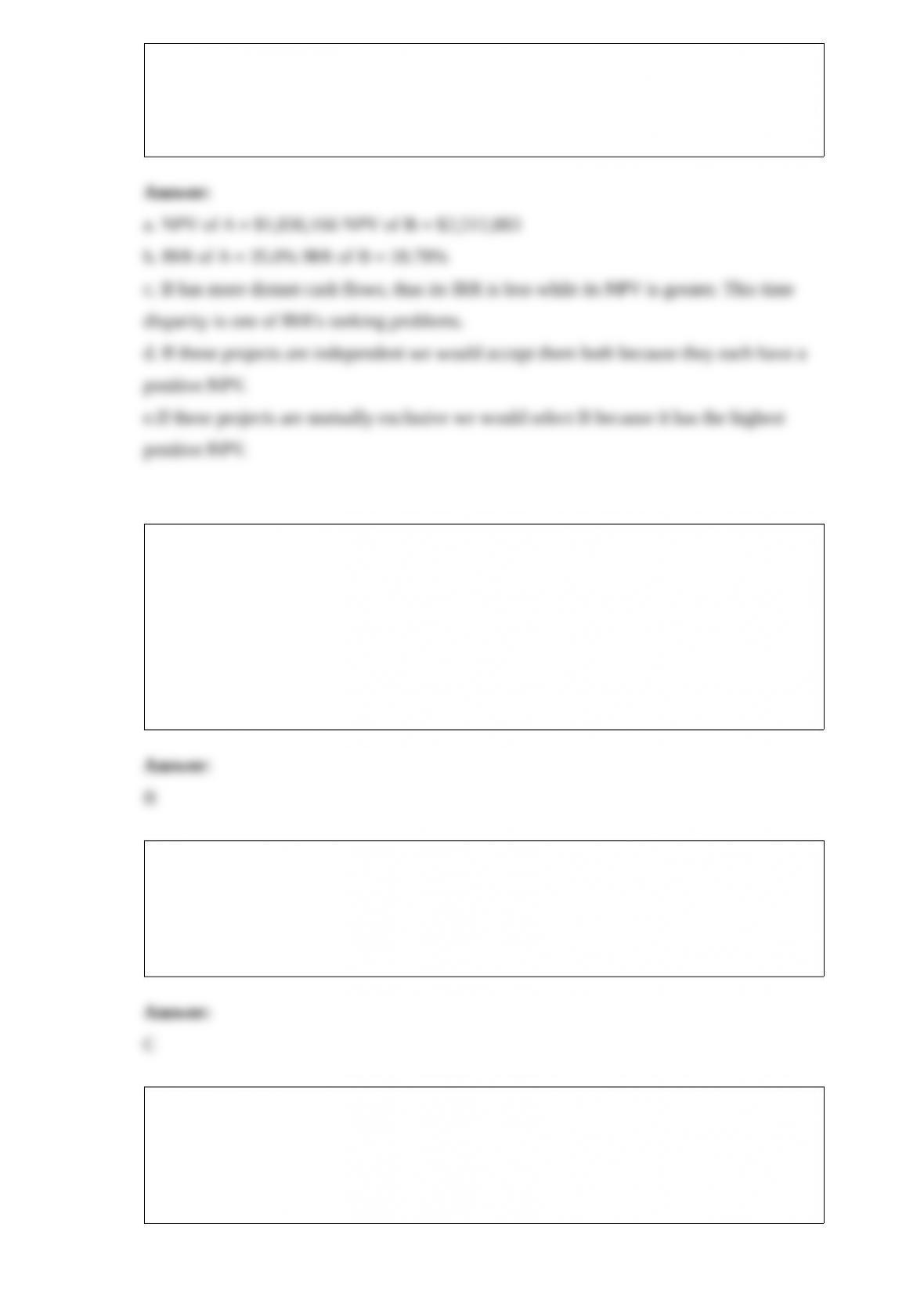
d.If 14 percent is the required rate of return, and these projects are independent, what
decision should be made?
e.If 14 percent is the required rate of return, and the projects are mutually exclusive,
what decision should be made?
52) QRM, Inc.’s marginal tax rate is 35%. It can issue 10-year bonds with an annual
coupon rate of 7% and a par value of $1,000. After $12 per bond flotation costs, new
bonds will net the company $966 in proceeds. Determine the appropriate after-tax cost
of new debt for the firm to use in a capital budgeting analysis.
A) 2.62%
B) 4.87%
C) 7.50%
D) 7.8%
53) The simulation approach provides us with
A) a single value for the risk-adjusted net present value
B) an approximation of the systematic risk level
C) a probability distribution of the project’s net present value or internal rate of return
D) a graphic exposition of the year-by-year sequence of possible outcomes
54) Which of the following securities will likely have the highest default risk premium?
A) U.S. Treasury Bond maturing in 2027
B) BBB-rated corporate bond maturing in 2020 actively traded on a major exchange
C) AAA-rated corporate bond maturing in 2015 not actively traded
D) U.S. Treasury Bill

55) Jiffy Co. expects to pay a dividend of $3.00 per share in one year. The current price
of Jiffy common stock is $60 per share. Flotation costs are $3.00 per share when Jiffy
issues new stock. What is the cost of internal common equity (retained earnings) if the
long-term growth in dividends is projected to be 8 percent indefinitely?
A) 13 percent
B) 14 percent
C) 15 percent
D) 16 percent
56) Table 4-1
Stewart Company
Balance Sheet
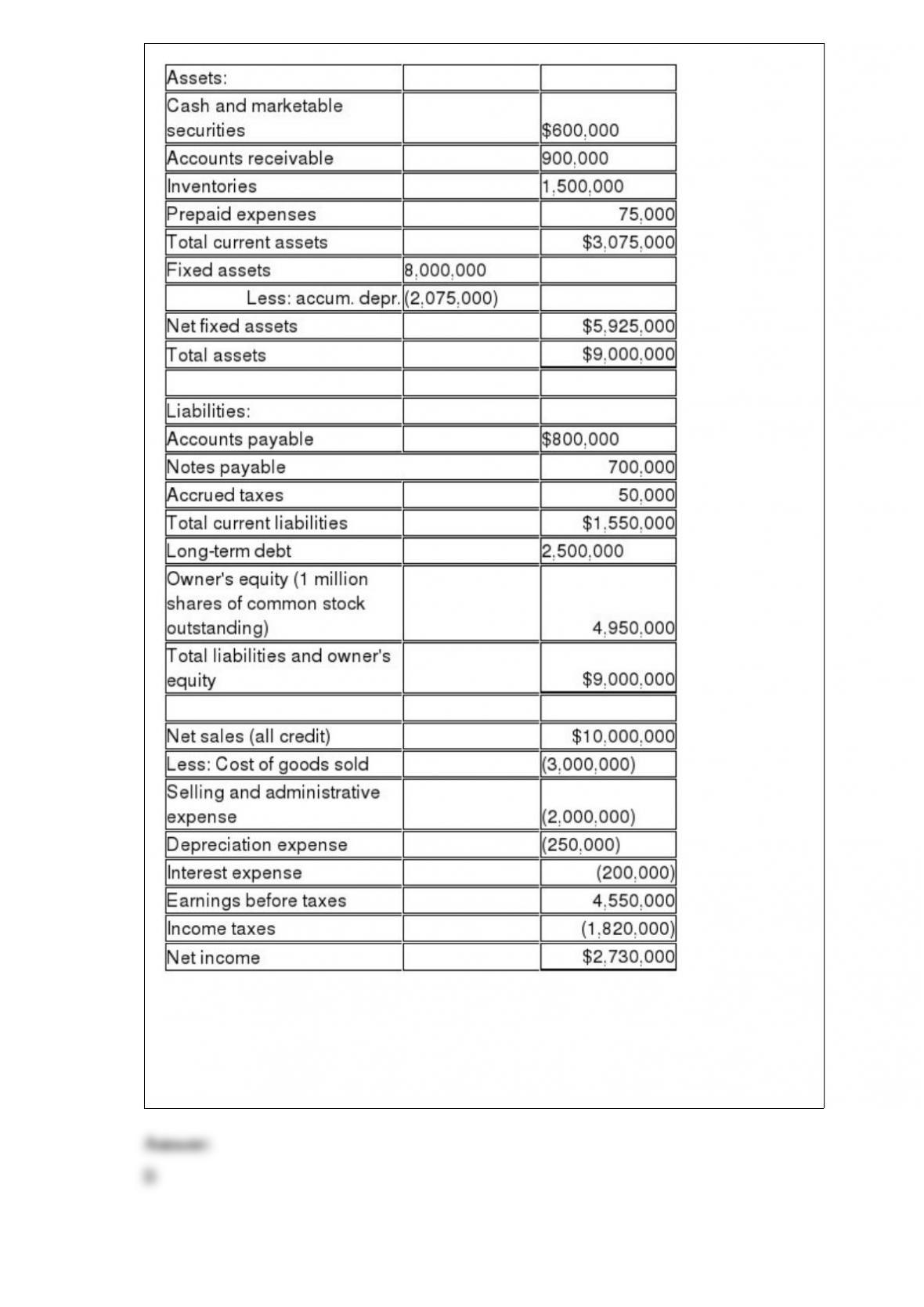
The average collection period is
A) 36.50 days
B) 32.85 days
C) 46.34 days
D) 29.85 days

57) Baker Corp. is required by a debt agreement to maintain a current ratio of at least
2.5, and Baker’s current ratio now is 3 . Baker wants to purchase additional inventory
for its upcoming Christmas season, and will pay for the inventory with short-term debt.
How much inventory can Baker purchase without violating its debt agreement if their
total current assets equal $15 million?
A) $0.50 million
B) $1.67 million
C) $4.50 million
D) $6.00 million
58) If you were a treasurer for a Fortune 1,000 corporation who has responsibility for
investing “excess cash balances,” which of the following alternatives would you be
least likely to select?
A) commercial paper
B) common stock
C) bankers’ acceptances
D) U.S. Treasury bills