The current price of a bond is not affected by
a. current interest rates
b. the risk classification of the bond
c. the maturity date
d. last year’s interest rates
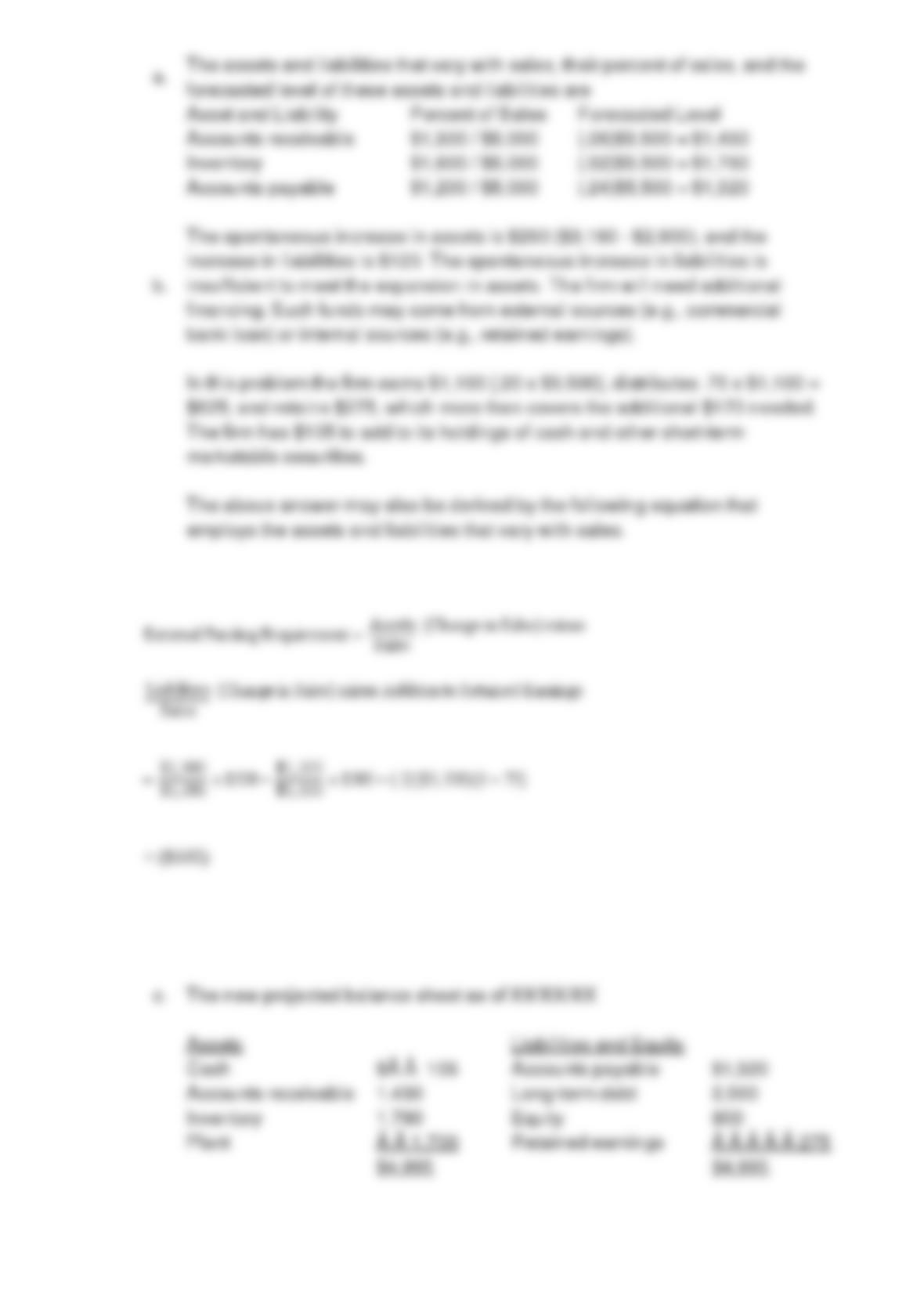
A firm with sales of $5,000 has the following balance sheet:
The firm earns 20 percent on sales and expects those sales to rise to $5,500. The
increased sales may require additional financing. Accounts receivable and inventory
will increase, and trade accounts will also spontaneously increase with the increase in
sales. Management expects to distribute 75% of earnings.
a. Determine the new balance sheet entries for those assets and liabilities that
spontaneously change with the level of sales using the percent of sales technique.
b. Will the firm need external financing to achieve sales of $5,500?
c. Construct the pro forma balance sheet for sales of $5,500. Any new financing should
be obtained by issuing new long-term debt. Any excess funds should be held in cash.
Components of the capital asset pricing model include
a. a stock’s market price
b. the standard deviation of a stock’s return
c. the rate on a risk-free security
d. the investor’s need for income versus capital gains
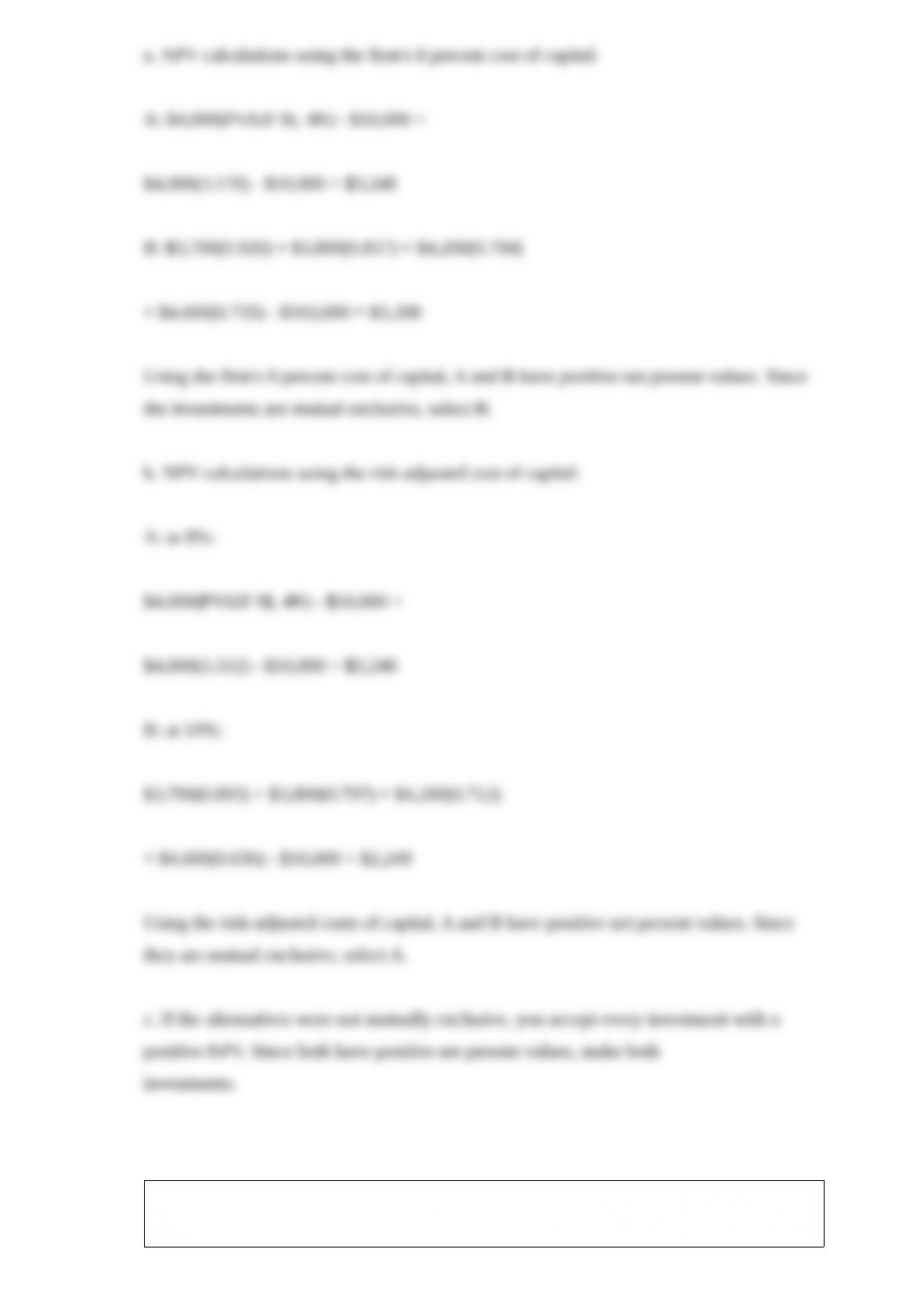
A firm has the following investment alternatives. Each cost $10,000 and has the
following cash inflows.
Investment A is considered to be typical of the firm’s investments, but investment B’s
cash flows are less certain. The firm’s cost of capital is 8 percent, but the financial
manager uses a hurdle rate of 6 percent for less risky projects and 10 percent for riskier
projects.
a. Based on the cost of capital, which investment(s) should be made?
b. If the financial manager uses the risk-adjusted cost of capital, which investment(s)
should be made?
c. Would the answers to (a) and (b) be different if the two investments were not
mutually exclusive?
A beta coefficient is a measure of the volatility of

a. a firm’s position in its industry
b. a stock’s return relative to the market return
c. aggregate market stock prices
d. a firm’s earnings
Which of the following assets do not spontaneously vary with the level of sales?
a. 1 and 2
b. 1 and 3
c. 2 and 3
d. 1, 2, and 3
Which of the following increases net working capital?
a. an increase in plant financed by issuing bonds

b. an increase in bonds and a decrease in equity
c. an increase in cash and a decrease in accounts receivable
d. an increase in preferred stock and a decrease in accounts payable
Organized securities markets
a. are examples of financial intermediaries
b. transfer resources from savers to borrowers
c. are secondary markets
d. are not subject to regulation
The marginal cost of capital rises
a. 1 and 3
b. 1 and 4

c. 2 and 3
d. 2 and 4
Which of the following is a cash outflow?
a. a new issue of bonds
b. a decrease in accounts receivable
c. an increase in plant
d. an increase in accounts payable
Which of the following is usually a variable expense?
a. salaries
b. rent
c. wages
d. insurance premiums
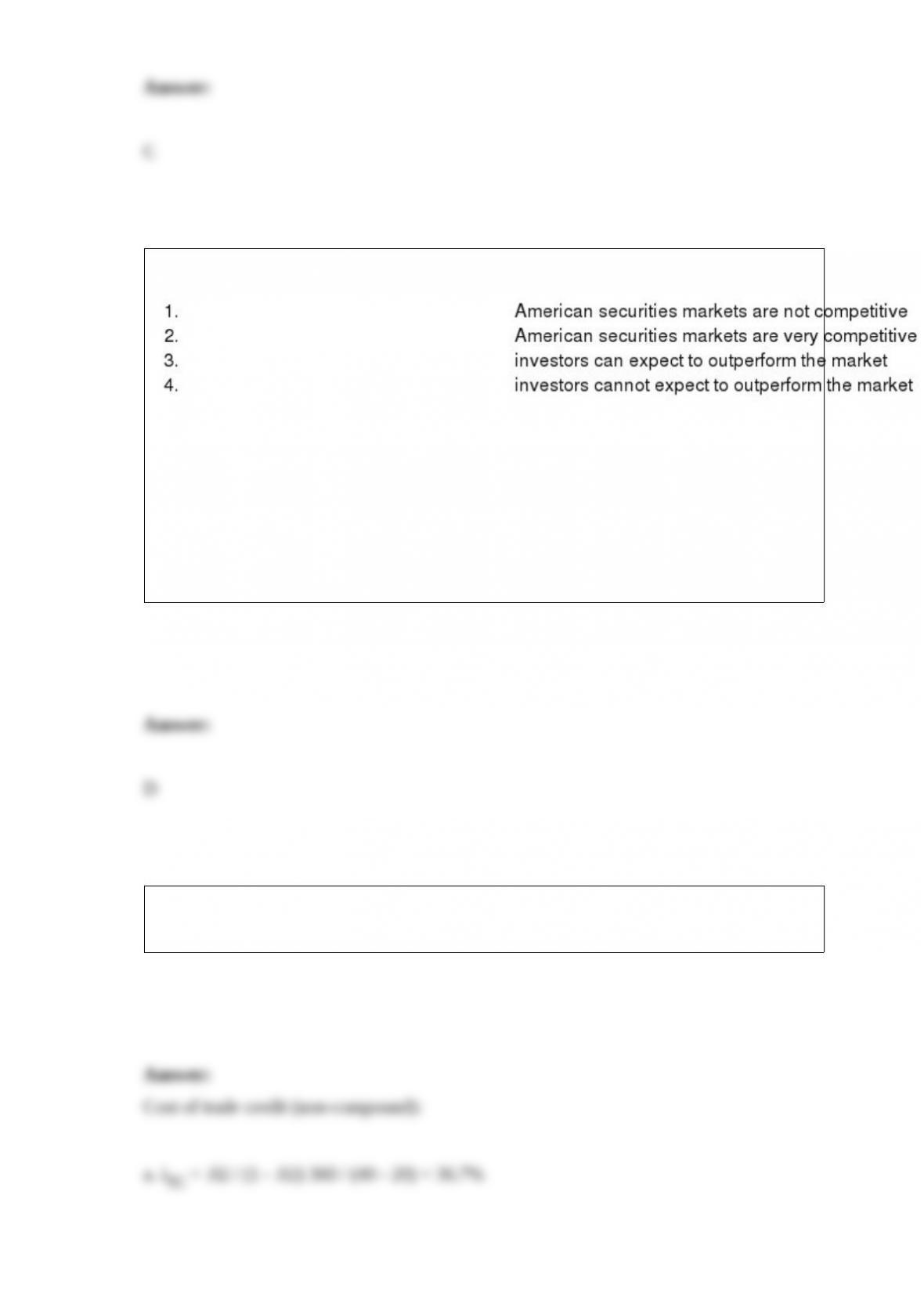
The efficient market hypothesis suggests
a. 1 and 3
b. 1 and 4
c. 2 and 3
d. 2 and 4
What is the cost (in percentages) of the following terms of trade credit (a) 2/20, n40, (b)
1/5, n30, and (c) n30?
The marginal cost of capital
a. is the firm’s cost of debt and equity finance
b. is constant given an optimal capital structure
c. declines as flotation costs alter equity financing
d. refers to the cost of additional financing
The price of a convertible bond is often
a. 1 and 3
b. 1 and 4
c. 2 and 3
d. 2 and 4

Corporate losses
a. only offset income from prior years
b. only offset income earned in subsequent years
c. may not be used to offset income from other years
d. are carried back and then carried forward
The cash budget includes
a. cash receipts and current liabilities
b. disbursements and depreciation expense
c. cash receipts and disbursements
d. assets and equity
Over-the-counter stock quotes are obtained through

a. Nasdaq
b. SEC
c. SIPC
d. FDIC
Which of the following money market securities are sold at a discount?
a. 1 and 2
b. 2 and 3
c. 3 and 4
d. 1 and 4
If a term loan requires equal annual payments that pay the interest and retire the
principal, that is similar to

a. lease payments
b. mortgage payments
c. dividend payments
d. compensating balances
Given the information below, answer the following questions.
A convertible bond has the following features:
Principal $1,000
Maturity date 20 years
Interest $80 (8% coupon)
Call price $1,050
Exercise price $65 a share
a. The bond may be converted into how many shares?
b. If comparable non-convertible debt offered an annual yield of 12 percent, what
would be the value of this bond as debt?
c. If the stock were selling for $52, what is the value of the bond in terms of stock?
d. Would you expect the bond to sell for its value as debt (i.e., the value determined in
b) if the price of the stock were $52?
e. If the price of the bond were $960, what are the premiums paid over the bond’s value
as stock and its value as debt?
f. If the price of the stock were $35, what would be the minimum price of the bond?
g. What is the probability that the bond will be called when the price of the stock is
$52?
h. If the price of the stock rose to $73, what would happen to the price of the bond?
i. If the price of the stock were $73, what would the investor receive if the bond were
called?

A put option is the right to
a. buy stock
b. receive dividends
c. sell stock
d. earn capital gains
A firm may obtain financial leverage by
a. 1 and 2
b. 1 and 3
c. 2 and 3
d. 1, 2, and 3

The term structure of interest rates relates
a. risk and yields
b. yields and credit ratings
c. term and yields
d. stock and bond yields
A beta coefficient of 1.2 implies
a. 1 and 2
b. 1 and 4
c. 2 and 3
d. 3 and 4
If an investor sells short, the individual

a. 1 and 3
b. 1 and 4
c. 2 and 3
d. 2 and 4
A bond has the following terms:
principal amount $1,000
semi-annual interest $50
maturity 10 years
a. What is the bond’s price if comparable debt yields 12%?
b. What would be the price if comparable debt yields 12% and the bond matures after
five years?
c. What are the current yields and yields to maturity in a. and b.?
d. What would be the bond’s price in a. and b. if interest rates declined to 8%?
e. What are the current yields and yield to maturity in d.?
f. What two generalizations may be drawn from the above price changes?

If the stock market declines,
a. 1 and 3
b. 1 and 4
c. 2 and 3
d. 2 and 4
The internal rate of return will be higher if
a. the cost of capital is lower
b. the cost of capital is higher

c. the cost of the investment is lower
d. the cost of the investment is higher
If investors anticipate that interest rates will fall, they
a. should buy bonds
b. should sell bonds
c. should buy shares in money market mutual funds
d. should take no action
Unsuccessful use of financial leverage
a. increases earnings per share
b. increases investors’ rate of return
c. decreases earnings per share
d. decreases interest expense

An index fund limits its portfolio to
a. high quality stock and bonds
b. stocks that respond to changes in inflation
c. stocks of firms in a particular industry
d. stocks included in an aggregate measure of the stock market
You bought a stock with a beta of 1.4 and earned a return of 8.3%. Did you outperform
the market if, during the same period, the market rose by 7.4% and you could have
earned 5.4% by investing in a Treasury bill?

The amount of margin required to buy a futures contract is equal to 50 percent of the
value of the contract.
Dividend reinvestment plans permit stockholders to defer income taxes on dividends.
An increase in interest rates tends to reduce the earnings of money market mutual
funds.
The expected return on an investment includes both the expected of income plus

expected price appreciation.
Blanket inventory loans are illustrations of unsecured short-term credit.
Investments in money market mutual funds are insured up to $100,000 by the federal
government.
Over time the time premium paid for an option tends to rise.

It is not wise to use a line of credit to finance the acquisition of plant.
Commercial paper is primarily sold in small denominations of less than $10,000.
The optimal capital structure minimizes the cost of debt financing.
A firm’s earnings are not determined by the cash budget but are determined by the
income statement.

Financial leverage may result in lower total earnings but higher earnings per share.