
1) A liquidity-risk premium is the additional return required by investors in longer-term
securities to compensate them for the greater risk of price fluctuation on those securities
caused by interest rate changes.
2) Discretionary financing needed is equal to the predicted change in total assets minus
the change in retained earnings.
3) Finished goods held for sale are inventory, but raw materials to be used in the
production process are considered other assets.
4) For a well-diversified investor, an investment with an expected return of 10% with a
standard deviation of 3% dominates an investment with an expected return of 10% with
a standard deviation of 5%.
5) Because common stock represents a residual interest in the corporation, the value of
common stock is equal to the total firm value less the firm’s outstanding debt.
6) In an efficient market, a stock with a standard deviation of returns of 12% could have
a higher expected return than a stock with a standard deviation of 10% because the beta
for the higher standard deviation stock could be lower than the beta for the lower
standard deviation stock.
7) Operating leverage contributes ultimately to the variability of a firm’s earnings per

share.
8) U.S. Treasury Bills, bankers’ acceptances and commercial paper are all sold on a
discount basis.
9) From the shareholders’ perspective, a stock repurchase has a potential tax advantage
over the payment of a cash dividend.
10) If a project’s internal rate of return is greater than the project’s required return, then
the project’s profitability index will be greater than one.
11) If a project is acceptable using the net present value criteria, then it will also be
acceptable under the less stringent criteria of the payback period.
12) A small, family-owned corporation would be more likely to use the
contribution-to-firm risk criteria rather than the systematic risk to evaluate capital
budgeting projects.
13) A car manufacturer offers either $2,000 cash back or zero percent financing for 5
years. A rational consumer will always take the cash back because money received
today is worth more than money received in the future.

14) Which of the following supports the “bird-in-the-hand” dividend theory?
A) Investors prefer dividends to capital gains because of the time value of money
B) Increasing a firm’s dividends transfers risk and ownership from the current
shareholders to new owners
C) Investment decisions are not influenced by dividend policy
D) Capital mix decisions are not influenced by dividend policy
15) The cost of new preferred stock is equal to
A) the preferred stock dividend divided by the market price
B) the preferred stock dividend divided by its par value
C) (1 – tax rate) times the preferred stock dividend divided by net price
D) preferred stock dividend divided by the net selling price of preferred
16) The current ratio of a firm would equal its quick ratio whenever
A) the firm has no inventory
B) the firm’s inventory is equal to its other current assets
C) the firm’s inventory is equal to its current liabilities
D) the firm’s current ratio is equal to one
17) Money market funds
A) are tax exempt
B) typically invest in a diversified portfolio of short-term, high-grade debt instruments
C) are generally very profitable but fail to provide liquidity to the small investor
D) typically sell shares to the public in $25,000 denominations
18) All else equal, an increase in beta results in
A) an increase in the cost of retained earnings
B) an increase in the cost of newly issued common stock
C) an increase in the after-tax cost of debt
D) an increase in the cost of common equity, whether or not the funds come from

retained earnings or newly issued common stock
19) One bank offers you 4% interest compounded semiannually. What is the equivalent
rate if interest is compounded quarterly?
A) 3.98%
B) 3.96%
C) 3.92%
D) 1.00%
20) Which of the following would NOT be a part of a firm’s capital structure?
A) short-term notes payable
B) long-term bonds
C) preferred stock
D) common stock
21) Is it possible for the cash budget and the pro forma income statement to have
different results?
A) yes, because revenues and expenses included in each statement are different
B) yes, because revenues and expenses are accounted for over different time periods
C) no, because they contain the same variables, while just using different formats
D) no, because the cash budget and the pro forma income statement provide forecasts
for the same time period
22) High Tech Corp. cut its research and development budget in 2010 by $4,000,000 in
order to improve its cash flow for the year. Which of the following statements is MOST
correct?
A) The stock price will likely increase because the value of stock is based on reported
cash flow
B) The stock price may decrease because investors may predict that future cash flows
will decrease due to the lack of innovation and new products
C) The change will have no impact on stock price because the company’s profits will
not change in 2010
D) The stock price will increase only if reported profits in 2010 are also higher than

profits reported in 2009
23) A firm’s weighted average cost of capital is determined using all of the following
inputs EXCEPT
A) the firm’s capital structure
B) the amount of capital necessary to make the investment
C) the firm’s after tax cost of debt
D) the probability distribution of expected returns
24) The primary advantage that pledging accounts receivable provides is
A) the flexibility it gives to the borrower
B) that the financial institution bears the risk of collection
C) the low cost as compared with other sources of short-term financing
D) that the financial institution services the accounts
25) Table 4-1
Stewart Company
Balance Sheet
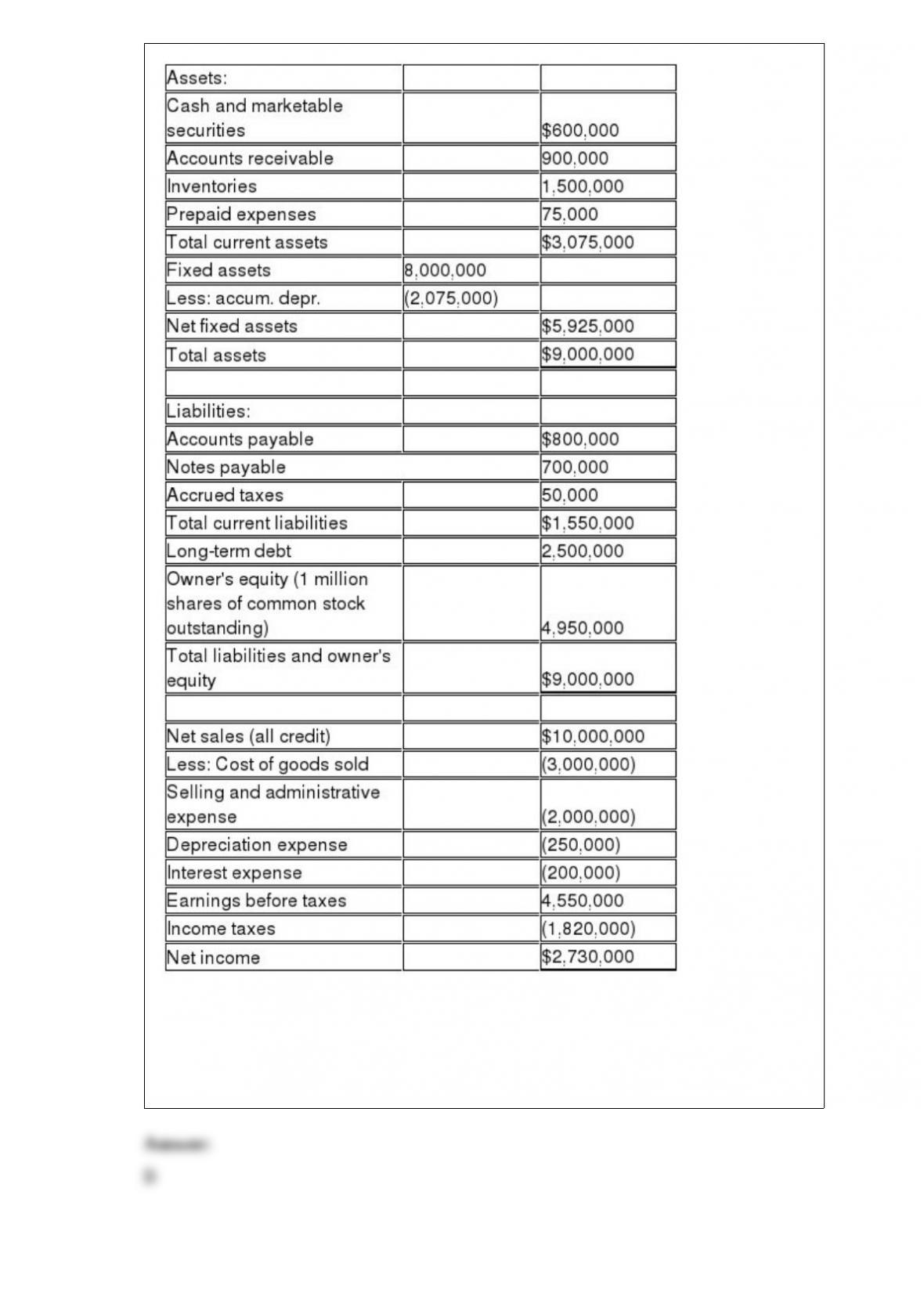
Based on the information in Table 4-1, the inventory turnover ratio is
A) 1.3 times
B) 2.0 times
C) 2.5 times
D) 2.9 times

26) When deciding upon how much debt financing to employ, most practitioners would
cite which of the following as the most important influence on the level of the debt
ratio?
A) providing a borrowing reserve
B) maintaining desired bond rating
C) ability to adequately meet financing charges
D) exploiting advantages of financial leverage
27) In finance, we assume that investors are generally
A) neutral to risk
B) averse to risk
C) fond of risk
D) none of the above
28) All of the following are equity accounts on a balance sheet EXCEPT
A) retained earnings
B) cash
C) common stock
D) paid-in capital
29) WPM, Inc. has current assets of $8,000,000, current liabilities of $4,000,000,
inventory of $1,320,000, and sales of $12,000,000. What is the acid test ratio?
A) 2.0
B) 1.67
C) 0.22
D) 0.1
30) At a minimum, the sales forecast for the coming year would reflect
A) any future trend in sales that is expected to begin in the new year
B) the influence of any anticipated events that might materially affect the sales trend
C) both of the above are correct
D) neither of the above are correct

31) The spot exchange rate is 1.57 dollars per pound. The 30-day forward exchange rate
is .6211 pounds per dollar. The percent-per-year discount on the 30-day pound is
A) 32.77%
B) 30.57%
C) 48.00%
D) 45.93%
32) Assume that the tax on dividends and the tax on capital gains is the same. All else
equal, what would a prudent investor prefer?
A) The prudent investor would be indifferent between receiving dividends or capital
gains
B) The prudent investor would prefer dividendsa dollar today is always worth more
than a dollar to be received in the future
C) The prudent investor would prefer capital gainsthe capital gain tax liability can be
deferred until gains are realized
D) More information is needed
33) FYI bonds have a par value of $1,000. The bonds pay $40 in interest every six
months and will mature in 10 years.
a.Calculate the price if the yield to maturity on the bonds is 7, 8, and 9 percent,
respectively.
b.Explain the impact on price if the required rate of return decreases.
c.Compute the coupon rate on the bonds. How does the relationship between the
coupon rate and the yield to maturity determine how a bond’s price will compare to it
par value?

34) Company A reports sales of $100,000 and net income of $15,000. Company B
reports sales of $100,000 and net income of $10,000. Therefore
A) Company A’s cash flow may be higher or lower than Company B’s cash flow even
though A’s net income is higher
B) Company A’s cash flow is $5,000 more than Company B’s cash flow
C) Company B is creating less value for its shareholders than Company A
D) Company B’s accounts receivable must be higher than Company A’s accounts
receivable
35) A machine that costs $1,500,000 has a 3-year life. It will generate after tax annual
cash flows of $700,000 at the end of each year. It will be salvaged for $200,000 at the
end of year 3. If your required rate of return for the project is 13%, what is the NPV of
this investment?
A) $291,417
B) $400,000
C) $600,000
D) $338,395
36) AFB Corp. needs to replace an old lathe with a new, more efficient model. The old
lathe was purchased for $50,000 nine years ago and has a current book value of $5,000.
(The old machine is being depreciated on a straight-line basis over a ten-year useful
life.) The new lathe costs $100,000. It will cost the company $10,000 to get the new
lathe to the factory and get it installed. The old machine will be sold as scrap metal for
$2,000. The new machine is also being depreciated on a straight-line basis over ten
years. Sales are expected to increase by $8,000 per year while operating expenses are
expected to decrease by $12,000 per year. AFB’s marginal tax rate is 40%. Additional
working capital of $3,000 is required to maintain the new machine and higher sales
level. The new lathe is expected to be sold for $5,000 at the end of the project’s ten-year
life. What is the incremental free cash flow during years 2 through 10 of the project?
A) $13,600
B) $14,400
C) $15,800
D) $16,400

37) Apollo Corp. reported the following balance sheet:
Apollo has sales of $600,000 and net income of $50,000. Apollo’s return on equity is
A) 5.00%
B) 50.00%
C) 38.17%
D) 41.13%
38) Advantages of private placements do NOT include which of the following?
A) more financing flexibility
B) lower flotation costs
C) investor protection through extensive regulation
D) funds which are available more quickly than through a public offering
39) The yield to maturity on long-term bonds
A) is equal to the current yield if the bond is selling for face value
B) is equal to the coupon rate on the bond
C) is equal to the net present value of the bond’s future cash flows
D) is set by the indenture agreement and will not change over the life of the bond
40) A bond will sell at a discount (below par value) if
A) the market value of the bond is less than the present value of the discount rate of the
bond
B) current market interest rates are moving in the same direction as bond values
C) investor’s current required rate of return is above the coupon rate of the bond

D) the economy is booming
41) Which of the following is an advantage of utilizing short-term debt to finance the
acquisition of short-term assets?
A) Interest rates on short-term debt are usually lower than interest-rates on long-term
debt
B) It exposes the firm to less risk than if the firm were to use long-term debt
C) It improves the firm’s debt ratio
D) It increases the firm’s sustainable growth rate
42) Describe the three divergent views of dividend policy’s effect on share price.
43) The current rate of return on a one-year U.S. Government security is 3%. The rate
of return on a two-year U.S. Government security is 5%. According to the expectations
theory, what is the return on a one-year U.S. Government security purchased one year
from today?

44) Brett’s, Inc. is a national distributor of women’s apparel. The company expects to
receive 95,000 checks during the coming year totaling $78 million. A large bank has
offered to install a lock-box system at a charge of $0.45 per processed check. If Brett’s,
Inc. is able to earn 5 percent before tax on additional funds, what is the minimum
amount of total float days that must be saved to make the system worthwhile? Use a
365-day year.
45) Toto and Associates’ preferred stock is selling for $27.50 a share. The firm nets
$25.60 after issuance costs. The stock pays an annual dividend of $3.00 per share. What
is the cost of existing, and new, preferred stock respectively?
46) The price of DDS Corporation stock is expected to be $45 in 5 years. Dividends are
anticipated to increase at an annual rate of 10 percent from the most recent dividend of
$1.00. If your required rate of return is 15 percent, how much are you willing to pay for
DDS stock?

47) Discuss the similarities and differences between a line of credit and a revolving
credit agreement.
48) Premium Seed Sales, Inc. expects to generate sales of $22,000,000 in the coming
year. All sales are done on a credit basis, net 45 days. Premium Seed has estimated that
it takes an average of three days for payments to reach their central office and an
additional two days to process the payments. What is the opportunity cost of the funds
tied up in the mail and processing? Premium Seed uses a 360-day year in all
calculations and can invest free funds at 6.5%.
49) The board of directors of Wireless, Inc. is considering two compensation plans for
the CEO of the company. The first would pay the CEO a salary of $250,000 for the
upcoming year. The second would pay the CEO a salary of $100,000 and provide the
CEO with a stock option to buy 100,000 shares of stock for $11 per share. The current
price per share of Wireless, Inc. stock is $10 per share. The stock option expires at the
end of the year. Why might shareholders prefer the second payment plan? As part of
your answer, calculate the breakeven point for the CEO to obtain the same
compensation under option two as he or she would under option one.

50) The Knight Corporation projects that next year its fixed costs will total $240,000.
Its only product sells for $34 per unit, of which $18 is a variable cost. The management
of Knight is considering the purchase of a new machine that will lower the variable cost
per unit to $14. The new machine, however, will add to fixed costs through an increase
in depreciation expense. How large can the addition to fixed costs be in order to keep
the firm’s break-even point in units produced and sold unchanged?
51) The current direct quote in New York is .01075 dollars per yen. Suppose the current
direct quote in Tokyo is 91 yen per dollar. What is the appropriate indirect quote in New
York? What will arbitrageurs do to eliminate the differential rates in these markets?