
1) Because of political risk, it is generally disadvantageous for U.S. firms to list their
stocks on the world stock exchanges.
2) The movement of the exchange rate between two currencies can increase the total
cost of a loan by making the principal repayment require more money than the original
amount of the loan.
3) The Dodd-Frank Act contains the Volcker Rule, which encourages financial
institutions to allow for more speculative investments for average investors.
4) Although the after-tax cost of debt is below the cost of equity, firms cannot increase
their use of debt without limit.
5) When a firm has a sharp drop off in earnings, its P/E ratio may be artificially high.
6) An after-acquired property clause means that any new property acquired is placed
under the original mortgage claim.
7) Risk-averse investors may discount the future earnings of the merged firm at a higher
rate if they move in different directions during business cycles.

8) The sale of asset-backed securities can sometimes enable the issuing firm to acquire
lower-cost funds than it normally would receive from a bank loan or bond offering.
9) Stock splits are usually utilized to place stock in a lower-price trading range.
10) During tight money periods, short-term financing may be difficult to find.
11) Book value per share is the most important measure of value for a stockholder.
12) The main reason for the small amount of financing with preferred stock is that
dividends on preferred stock are not tax deductible, as is the interest paid on bonds.
13) In determining the cost of bank financing, which is the important factor?
A.The prime rate
B.The nominal rate
C.The effective rate
D.The discount rate
14) Short-term bond yields are generally ______ than long-term bond yields, whereas
long-term bond prices are generally ________ than short-term bond prices.
A.more volatile, less volatile
B.less volatile, more volatile
C.less volatile, less volatile

D.more volatile, more volatile
15) Disinflation may cause
A.anincrease in the value of gold, silver, and gems
B.a reduced required return demanded by investors on financial assets
C.additional profits through falling inventory costs
D.None of the options
16) In determining the appropriate discount rate for an individual project, the financial
manager will be most influenced by the
A.expected value
B.internal rate of return
C.standard deviation
D.coefficient of variation
17) A convertible bond is often utilized
A.as a sweetener when selling debt
B.to sell common stock at prices higher than those prevailing when funds are needed
C.when there is no demand for straight debt
D.All of these options
18) The disadvantages of debt to the corporation include all but which of the following?
A.Debt may have to be paid back with “cheaper” dollars
B.Interest and principal payments must be met regardless of performance results
C.Indenture agreements may place burdensome restrictions on the firm
D.Too much debt may depress the firm’s stock price
19) The Glass-Steagall Act prohibited

A.retail brokerage firms from having investment banking operations
B.commercial banks from combining investment banking and commercial banking
functions
C.investment banks from selling both debt and equity securities
D.insurance companies from selling investment products
20) In a licensing agreement, the multinational corporation will very likely
A.be able to compete with the local domestic manufacturers
B.experience import restrictions imposed by the foreign government
C.allow a foreign firm to use its technology in exchange for a fee
D.None of these options are true
21) Frisch Fish Corp expects net income next year to be $750,000. Inventory and
accounts receivable will have to be increased by $650,000 to accommodate this sales
level. Frisch will pay dividends of $300,000. How much external financing will Frisch
Fish need assuming no organically generated increase in liabilities?
A.No external financing is required
B.$100,000
C.$200,000
D.$300,000
22) Which of the following are advantages of leasing?
A.A lease obligation may be substantially less restrictive than the provisions of a bond
indenture
B.There may be no down payment requirement as in a purchase
C.The negative effects of obsolescence may be eliminated
D.All of these options
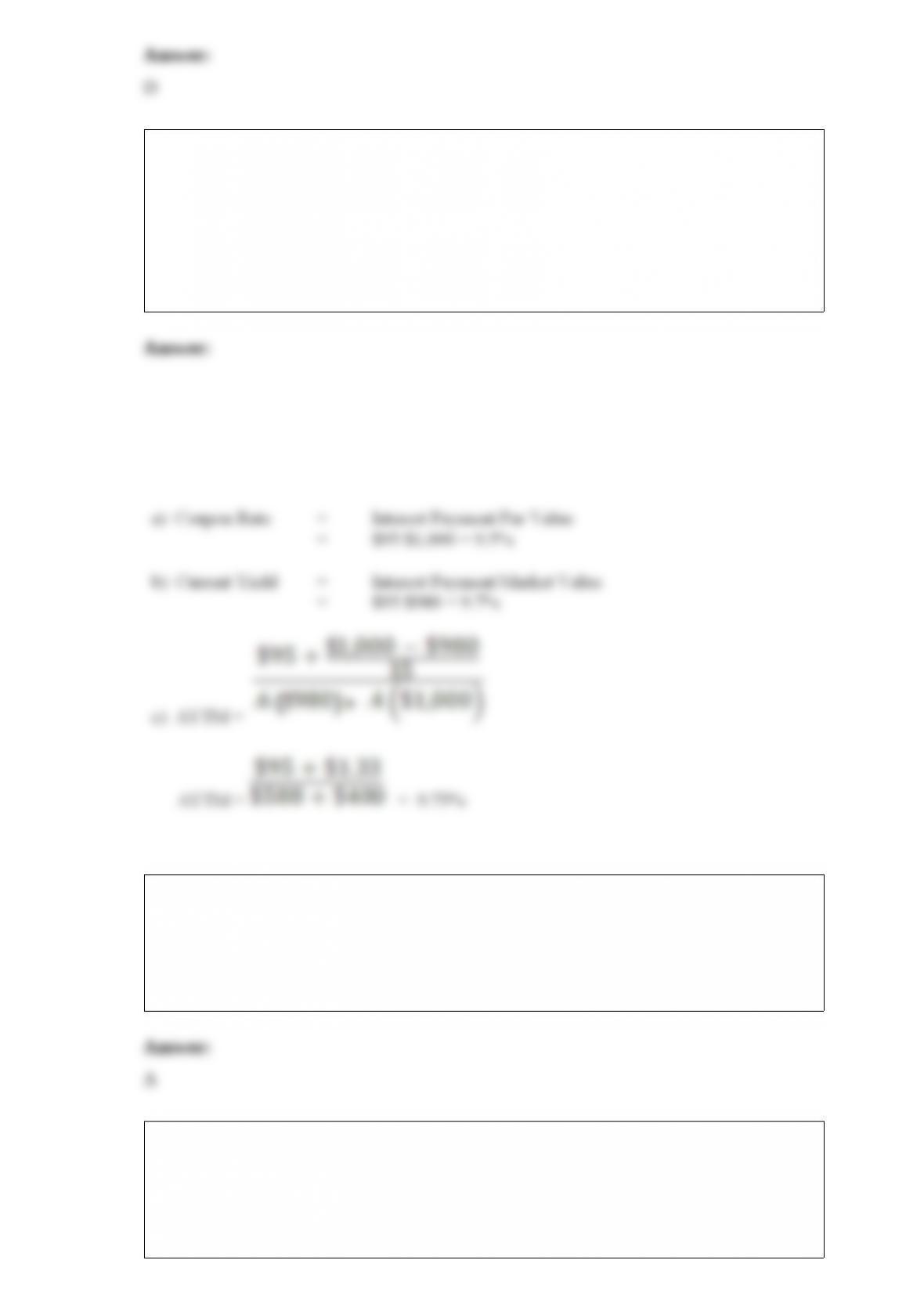
23) Gray House is issuing bonds paying $95 annually that will mature 15 years from
today. The bond is currently selling for $980.
Calculate:
a) Coupon rate
b) Current yield
c) Approximate yield to maturity
24) The American Taxpayer Relief Act of 2013
A.taxes “qualified” dividends and long-term capital gains at the same rate.
B.taxes short-term and long-term capital gains at the same rate.
C.eliminated the tax rate on dividends to avoid double taxation.
D.made high dividend paying stock less attractive to high income investors.
25) Which of the following factors will NOT increase the value of a currency in foreign
markets?
A.High interest rates in that country
B.High inflation in that country
C.A positive balance of payments with that country

D.A strong stock market rally in that country
26) Maxwell Corp. is coming to the market with a new offering of 450,000 shares of
stock at $22 to the public. Maxwell will receive $19 per share. The firm has one million
shares outstanding and earnings of $6 million before recording the new issue. What is
the amount of dilution in earnings per share?
A.$2.79
B.$1.38
C.$1.77
D.No dilution occurs since new money is received by Maxwell
27) Which of the following is a reason for diminishing liquidity in modern
corporations?
A.Just-in-time inventory programs
B.Better utilization of cash via computers
C.Increased use of point-of-sale terminals
D.All of the options are reasons for diminishing liquidity
28) Using higher discount rates,
A.accelerated cost recovery depreciation is more valuable than straight line
B.straight-line depreciation is more valuable than the accelerated cost recovery system
of depreciation
C.depreciation policy makes no difference
D.later year depreciation has a higher net present value
29) A firm has $1,500,000 in its common stock account and $1,000,000 in its paid-in
capital account. The firm issued 100,000 shares of common stock. What was the
original issue price if only one stock issue has ever been sold?

A.$35 per share
B.$25 per share
C.$15 per share
D.Not enough information to determine
30) The benefits of debt to the corporation include all of the following except for which
one?
A.Tax-deductible interest payments
B.Increases the stock value when used heavily
C.Fixed obligation
D.Generally a lower overall cost than equity
31) Which of the following is not an asset utilization ratio?
A.Inventory turnover
B.Return on assets
C.Fixed asset turnover
D.Average collection period
32) The conversion premium is the greatest and the downside risk the smallest when
A.the conversion value equals the pure bond value
B.the conversion value is greater than the pure bond value
C.the conversion value is less than the pure bond value
D.the stock price is expected to go up drastically
33) A project that carries a normal amount of risk and does not affect the risk exposure
of the firm should be discounted back at the
A.coefficient of variation
B.beta
C.risk-free rate
D.firm’s weighted average cost of capital
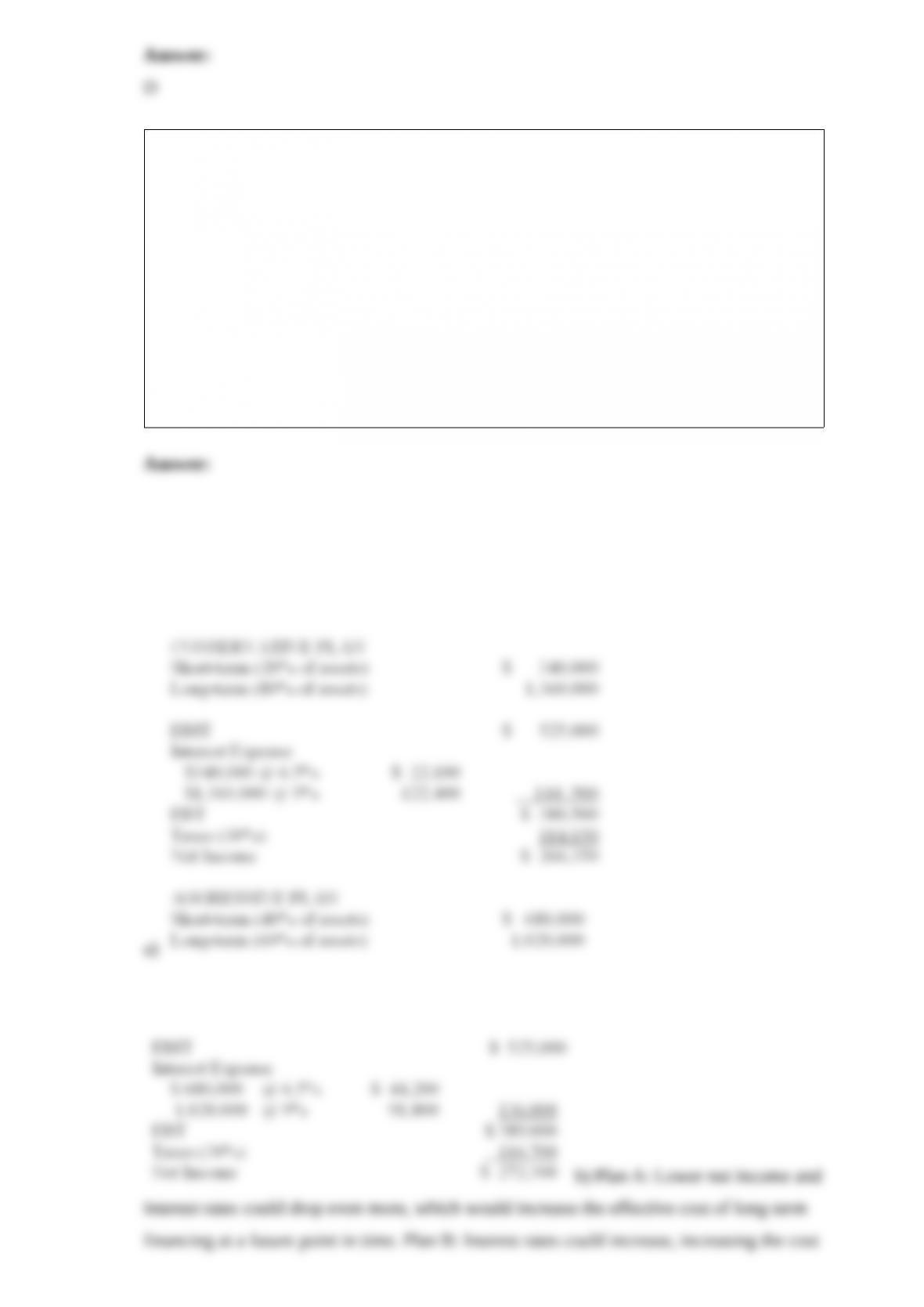
34) Christensen & Assoc. is developing an asset financing plan. Christensen has
$1,000,000 in current assets, of which 15% is permanent, and $700,000 is in fixed
assets. The current long-term rate is 9%, and the current short-term rate is 6.5%.
Christensen’s tax rate is 30%.
a) Construct two financing plans-one conservative, with 80% of assets financed by
long-term sources, and the other aggressive, with only 60% of assets financed by
long-term sources. If Christensen’s earnings before interest and taxes are $525,000,
calculate net income under each alternative.
b) What are some of the risks associated with each plan?
c) If the yield curve is steeply inverted, which financing plan should Christensen
choose?

35) The coupon rate on a debt issue is 6%. If the yield to maturity on the debt is 9%,
what is the after-tax cost of debt in the weighted average cost of capital if the firm’s tax
rate is 34%?
A.3.96%
B.4.08%
C.5.94%
D.7.92%
36) Maximization of shareholder wealth is a concept in which
A.increased earnings is of primary importance
B.profits are maximized on a quarterly basis
C.virtually all earnings are paid as dividends to common stockholders
D.optimally increasing the long-term value of the firm is emphasized
37) Match the following with the items below:
1>liquidity ratios
2>inventory profits
3>fixed charge coverage
4>inflation
5>replacement costs
6>LIFO
7>trend analysis
8>profitability ratios
9>asset utilization ratios
10>times interest earned
11>FIFO
12>debt utilization ratios
13>Du Pont System of ratio analysis
A. A system of including inventory into cost of goods sold in which the items purchased
last are written off first.
B. A phantom source of profit that can mislead even the most alert analysts.
C. result of an inflationary economy in which old stocks of goods are sold at large

profits.
D. A method of study that breaks down return on assets between the profit margin and
asset turnover and compels the analyst to look into the sources of profitability.
E. Ratios that measure the speed at which the firm is turning over its assets.
F. Ratios that measure the firm’s ability to pay off short-term obligations as they come
due.
G. A system that converts inventory into cost of goods sold by writing off the items
purchased earliest sooner.
H. A group of ratios that indicate to what extent a firm has borrowed funds and how
prudently these funds are being managed.
I. Costs incurred if the present asset base were repurchased at current prices.
K. The ratios that measure return on sales, assets, and invested capital of the firm.
L. Analysis of performance over a number of years that is made to ascertain significant
patterns.
M. Measures the firm’s ability to meet all fixed obligations.
N. Indicates the strength of the firm regarding its coverage of interest payments.
38) A bond with a coupon rate of 6.5% (assume it is paid once annually), maturing in 10
years at a value of $1,000 and a current market price of $695, will have a current yield
of
A.11.3%
B.10.2%
C.9.4%
D.8.5%
39) The term “permanent current assets” implies
A.the same thing as fixed assets
B.nonmarketable assets
C.some minimum level of current assets that are not self-liquidating
D.inventory
40) A $1,000 par value bond with a conversion price of $50 has a conversion ratio of
A.$40
B.40 shares
C.$20

D.20 shares
41) Hicks Health Clubs, Inc., expects to generate an annual EBIT of $750,000 and
needs to obtain financing for $1,200,000 of assets. Their tax bracket is 40%. If the firm
goes with a short-term financing plan, their rate will be 7.5%, and with a long-term
financing plan their rate will be 9%. By how much will their earnings after taxes change
if they choose the more conservative financing plan instead of the more aggressive
plan?
A.$10,000
B.($10,800)
C.($6,000)
D.$6,000
42) Raybac is about to go public. Its present stockholders own 500,000 shares. The new
public issue will represent 700,000 shares. The shares will be priced at $25 to the public
with a 5% spread. The out-of-pocket costs in addition to the spread will be $450,000.
What are the net proceeds to the firm?
A.$18,750,000
B.$17,200,000
C.$18,250,000
D.$16,175,000
43) When a firm enters Stage IV of its life cycle,
A.dividend payout ratios are likely to rise to a moderate level of 20-30% of earnings
B.the firm has reached maturity
C.the organization must retain earnings in preparation for cycling back into Stage I of
the life cycle
D.stock splits are common

44) Which of the following are benefits of financial intermediaries?
A.Increase market liquidity
B.Provide a direct market for investors
C.Act as agents of the government
D.Increase market liquidity and provide a direct market for investors
45) The law firm of Bushmaster, Cobra, and Asp is considering investing in a complete
small business computer system. The initial investment will be $50,000. The computer
is in the 5-year MACRS category, and the firm’s tax rate is 34%. The computer system
is expected to provide additional revenue of $32,000 per year for the next six years, and
to reduce expenses by $7,000 per year for the same period.
a) Calculate the net after-tax cash flows from this investment.
b) Calculate the net present value of the system, given that the law firm’s weighted
average cost of capital is 12%.
c) Should they buy the computer system?

46) Capital rationing assumes that
A.a limited amount of capital is available
B.a limited amount of investments is available
C.maximum profitability will be obtained
D.a limited amount of investments is available and maximum profitability will be
obtained
47) Match the following with the questions below:
1>inflation
2>secondary market
3>real capital
4>capital market
5>financial capital
6>restructuring
7>primary market
8>money market
9>disinflation
A. This form of capital is found on the balance sheet under long-term liabilities and
equity.
B. When the purchasing power of the dollar is shrinking over time.
C. A market where the securities being traded are new public offerings.
D. Securities with a maturity of less than one year.
E. Redeploying the asset and liability structure of the firm.
F. A leveling off or slowing down of price increases.
G. Market composed of common stock, preferred stock, commercial and government
bonds, and other long-term securities.
H. This market trades previously issued securities.
I. The high inflation rates of the 1980s caused this form of capital to hold its value
better than other forms of capital during this time period.