
1) assume that the united states faces a 5 percent inflation rate while the u.k has a 7
percent inflation rate. according to the relative ppp, the dollar would be expected to:
a.appreciate by 2 percent against the british pound
b.depreciate by 2 percent against the british pound
c.appreciate by 12 percent against the british pound
d.depreciate by 12 percent against the british pound
2) suppose interest parity holds. there is a change in u.s. policy that leads to
expectations of a lower u.s. inflation rate. the decrease in expected inflation will cause
dollar interest rates to _______.
a.stay the same
b.fall
c.rise
d.none of the above
3) which of the following factors potentially increased the vulnerability to the 1997
asian financial and currency crisis?
a.trade account surplus
b.massive reverse outflows of capital
c.technological transfer from advanced countries
d.symmetric information in financial market
4) which of the following is not a likely example of imf conditionality?
a.reduce current account deficit to 3% of gdp
b.lower taxes 5%
c.forced closure of unviable banks
d.cap inflation at 5%
5) a u.s. gift of wheat to a nicaragua causes a:
a.credit in the u.s. merchandise account
b.credit in the u.s. unilateral transfers
c.credit in the u.s. private capital account
d.debit in the u.s. private capital account
6) the monetary approach is derived from the assumption(s) that:
a.money demand equals money supply
b.money demand is a fixed proportion of the domestic price level times real income
c.the law of one price holds
d.all of the above are correct
7) big can, inc., a u.s. firm, manufactures and sells aluminum cans worldwide. because
of a rising price of aluminum in the u.s., the company is considering to build a new
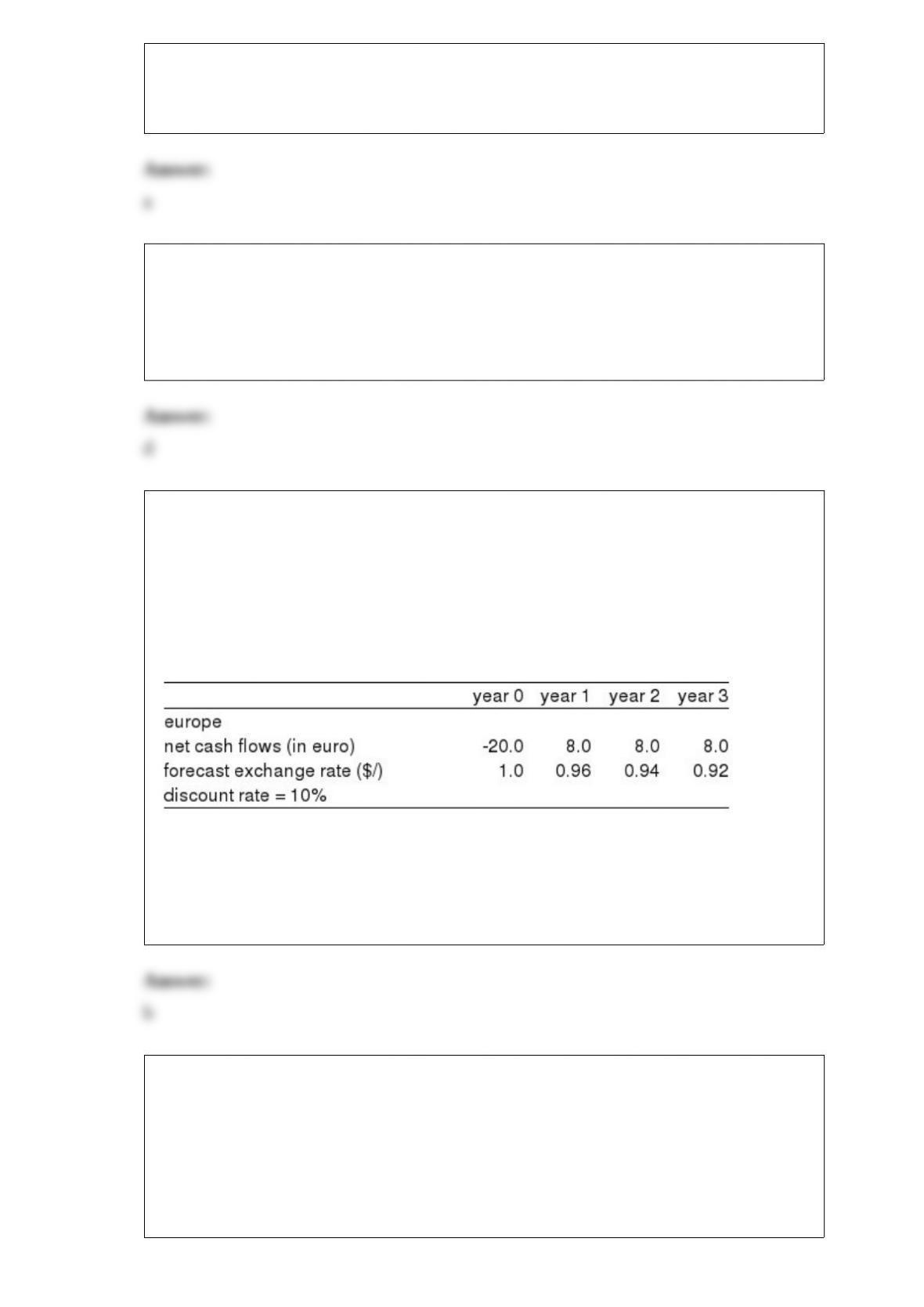
plant in europe. the plant will cost 20 million to build. assume that the plant will have a
life of 3 years before it is confiscated by the european government (zero salvage value)
and the discount rate of the cash flows is 10%. consider the following cash flows for
this project.
table 9-2
refer to table 9-2. based on the net present value,
a.the project can be accepted because the net present value is positive
b.the project should be rejected because the net present value is negative
c.the project can be accepted because the net present value is negative
d.the project should be rejected because the net present value is positive
8) suppose interest parity holds. there is a change in u.s. policy that leads to
expectations of a higher u.s. inflation rate. the increase in expected inflation will cause
dollar interest rates to _______.
a.stay the same
b.fall
c.rise
d.none of the above

9) capital flight is characterized by
a.investment in the aviation industry
b.sudden inflow of funds
c.sudden outflow of funds
d.seizure of capital by foreign governments
10) international banking facilities enable u.s. institutions to
a.be more competitive for business dealing with foreign-source deposits and loan
b.combine eurobank and domestic activity into one operation and eliminate separate
accounting practices
c.cut interest rates for u.s. residents on loans
d.avoid banking requirements when dealing with domestic businesses
11) a foreign firm has stock that can be purchased in new york, london, and tokyo. the
firm must be using a(n):
a.gdr
b.adr
c.variant stock
d.preferred stock