The growth in per share FCFE of CBS, Inc. is expected to be 10% per year for the next
two years, followed by a growth rate of 5% per year for three years. After this five-year
period, the growth in per share FCFE is expected to be 2% per year, indefinitely. The
required rate of return on CBS, Inc. is 12%. Last year’s per share FCFE was $2.00.
What should the stock sell for today?
A. $8.99
B. $22.51
C. $40.00
D. $25.21
E. $27.12
Identify the bond that has the longest duration (no calculations necessary).
A. 20-year maturity with an 8% coupon
B. 20-year maturity with a 12% coupon
C. 20-year maturity with a 0% coupon
D. 10-year maturity with a 15% coupon
E. 12-year maturity with a 12% coupon
In an efficient market,
A. security prices react quickly to new information.
B. security prices are seldom far above or below their justified levels.
C. security analysis will not enable investors to realize superior returns consistently.
D. one cannot make money.
E. security prices react quickly to new information, security prices are seldom far above
or below their justified levels, and security analysis will not enable investors to realize
superior returns consistently.
A put option on a stock is said to be at the money if
A. the exercise price is higher than the stock price.
B. the exercise price is less than the stock price.
C.the exercise price is equal to the stock price.
D. the price of the put is higher than the price of the call.
E. the price of the call is higher than the price of the put.
Alex Goh is 39 years old and has accumulated $128,000 in his selfdirected defined
contribution pension plan. Each year he contributes $2,500 to the plan, and his
employer contributes an equal amount. Alex thinks he will retire at age 62 and figures
he will live to age 86. The plan allows for two types of investments. One offers a 4%
riskfree real rate of return. The other offers an expected return of 11% and has a
standard deviation of 37%. Alex now has 25% of his money in the riskfree investment
and 75% in the risky investment. He plans to continue saving at the same rate and keep
the same proportions invested in each of the investments. His salary will grow at the
same rate as inflation. How much can Alex be sure of having in the safe account at
retirement?
A. $132,473
B. $162,557
C. $178,943
D. $189,211
E. $124,643
If a distribution has “fat tails,” it exhibits
A. positive skewness.
B. negative skewness.
C. a kurtosis of zero.
D. kurtosis.
E. positive skewness and kurtosis.
Financial engineering
A. is the custom designing of securities or portfolios with desired patterns of exposure
to the price of the underlying security.
B. primarily takes place for the institutional investor.
C. primarily takes places for the individual investor.
D.is the custom designing of securities or portfolios with desired patterns of exposure to
the price of the .underlying security and primarily takes place for the institutional
investor.
E .is the custom designing of securities or portfolios with desired patterns of exposure
to the price of the underlying security and primarily takes places for the
individual investor.
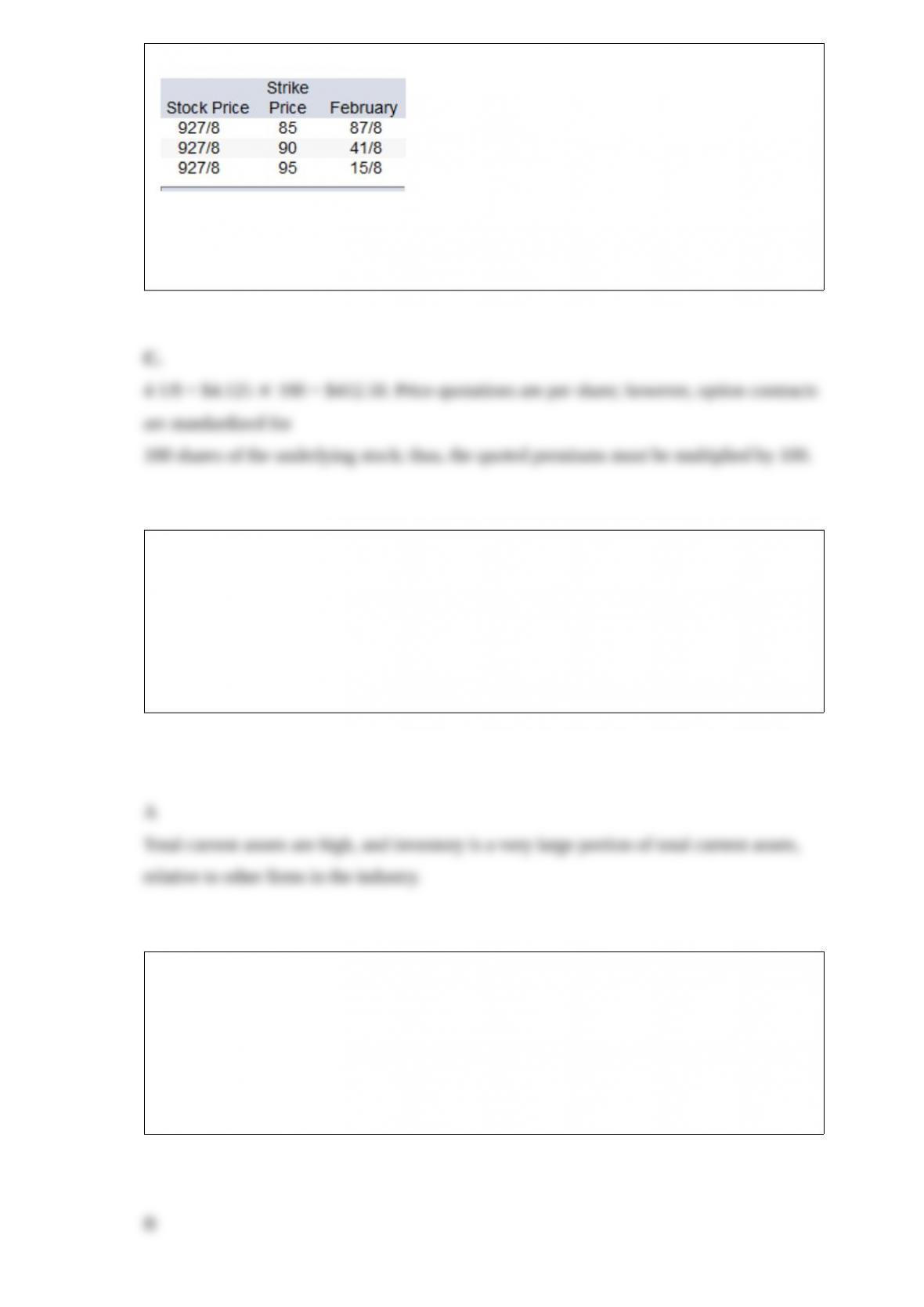
The following price quotations on WFM were taken from the Wall Street Journal.
The premium on one WFM February 90 call
contract is
A. $4.1250.
B. $418.00.
C.$412.50.
D. $158.00.
A firm’s current ratio is above the industry average. However, the firm’s quick ratio is
below the industry average. These ratios suggest that the firm
A. has relatively more total current assets and even more inventory than other firms in
the industry.
B. is very efficient at managing inventories.
C. has liquidity that is superior to the average firm in the industry.
D. is near technical insolvency.
You purchased a share of stock for $68. One year later, you received $3.00 as a
dividend and sold the share
for $74.50. What was your holding-period return?
A. 12.5%
B. 14.0%
C. 13.6%
D. 11.8%
A firm has a higher asset turnover ratio than the industry average, which implies
A. the firm has a higher P/E ratio than other firms in the industry.
B. the firm is more likely to avoid insolvency in the short run than other firms in the
industry.
C. the firm is more profitable than other firms in the industry.
D. the firm is utilizing assets more efficiently than other firms in the industry.
E. the firm has higher spending on new fixed assets than other firms in the industry.
The price that the buyer of a put option receives for the underlying asset if she executes
her option is called the
A. strike price.
B. exercise price.
C. execution price.
D. strike price or execution price.
E. strike price or exercise price.
The price quotations of Treasury bonds in the Wall Street Journal show an ask price of
104.25 and a bid price of 104.125. As a seller of the bond, what is the dollar price you
expect to receive?
A. $1,048.00
B. $1,042.50
C. $1,041.25
D. $1,041.75
E. $1,040.40
Patell and Woflson (1984) report that most of the stock-price response to corporate
dividend or earnings announcements occurs within ____________ of the
announcement.
A. 10 minutes
B. 45 minutes
C. 2 hours
D. 4 hours
E. 2 trading days
You invest $100 in a risky asset with an expected rate of return of 0.11 and a standard
deviation of 0.21 and a
T-bill with a rate of return of 0.045.
What percentages of your money must be invested in the risky asset and the risk-free
asset, respectively, to
form a portfolio with an expected return of 0.13?
A. 130.77% and –30.77%
B. –30.77% and 130.77%
C. 67.67% and 33.33%
D. 57.75% and 42.25%
E. Cannot be determined.
You sold short 150 shares of common stock at $27 per share. The initial margin is 45%.
Your initial investment was
A. $4,800.60.
B. $12,000.25.
C. $2,250.75.
D. $1,822.50.
__________ best explains a ratio of sales/average net fixed assets that exceeds the
industry average.
A. The firm expanded plant and equipment in the past few years
B. The firm makes less efficient use of assets than competing firms
C. The firm has a substantial amount of old plant and equipment
D. The firm uses straight-line depreciation
The market-capitalization rate on the stock of Flexsteel Company is 12%. The expected
ROE is 13%, and the expected EPS are $3.60. If the firm’s plowback ratio is 75%, the
P/E ratio will be
A. 7.69.
B. 8.33.
C. 9.09.
D. 11.11.
E. None of the options are correct.
Suppose two portfolios have the same average return and the same standard deviation
of returns, but portfolio A has a lower beta than portfolio B. According to the Treynor
measure, the performance of portfolio A
A. is better than the performance of portfolio B.
B. is the same as the performance of portfolio B.
C. is poorer than the performance of portfolio B.
D. cannot be measured as there are no data on the alpha of the portfolio.
E. None of the options are correct.
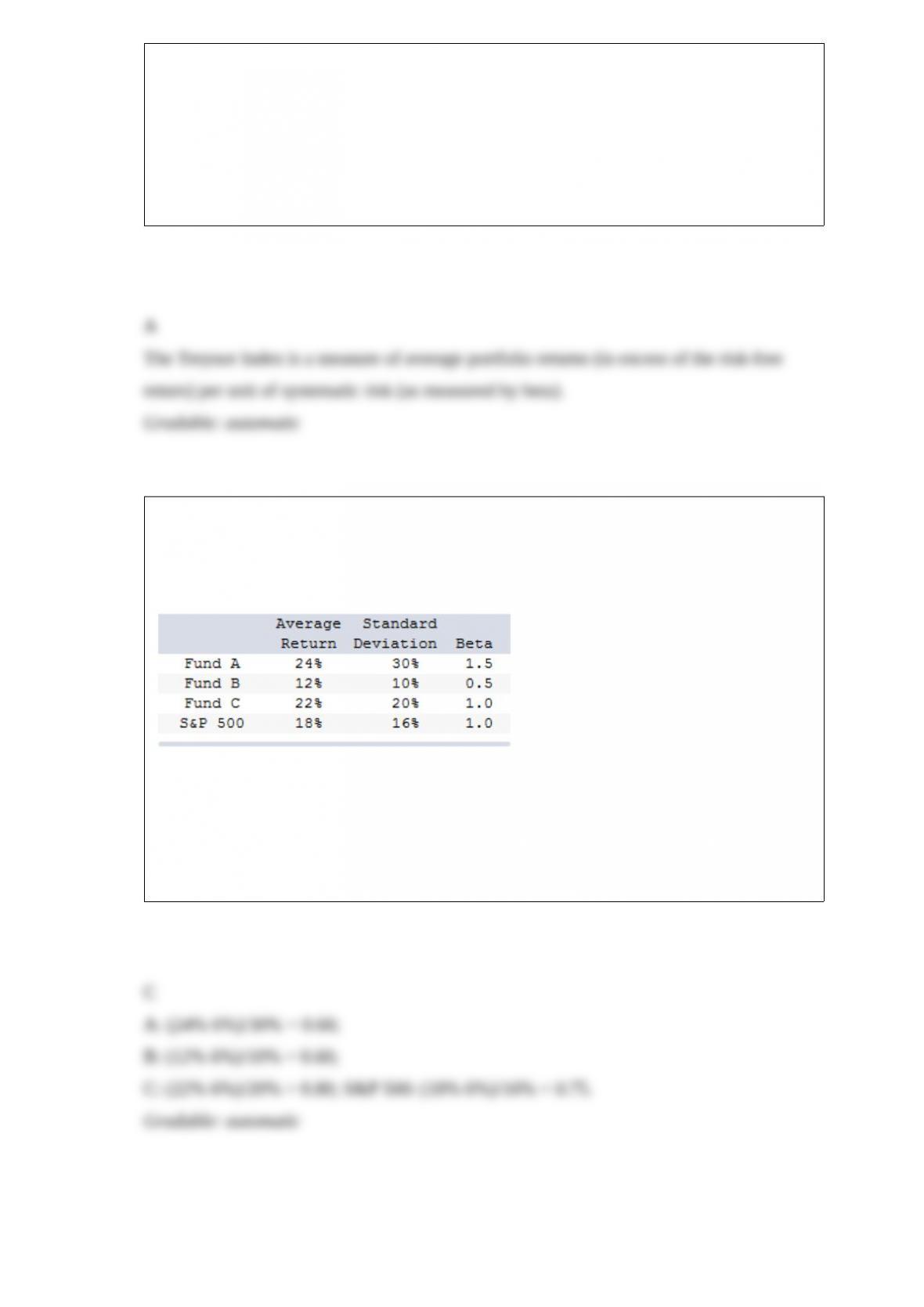
You want to evaluate three mutual funds using the Sharpe measure for performance
evaluation. The risk-free return during the sample period is 6%. The average returns,
standard deviations, and betas for the three funds are given below, as are the data for the
S&P 500 Index.
The fund with the highest Sharpe measure is
A. Fund A.
B. Fund B.
C. Fund C.
D. Funds A and B (tied for highest).
E. Funds A and C (tied for highest).
Hedge funds often employ ______ that require investors to provide ________ notice of
their desire to redeem funds.
A. redemption notices; several weeks to several months
B. redemption notices; several hours to several days
C. redemption notices; several days to several weeks
D. lock-up; several years
E. lock-up; several hours
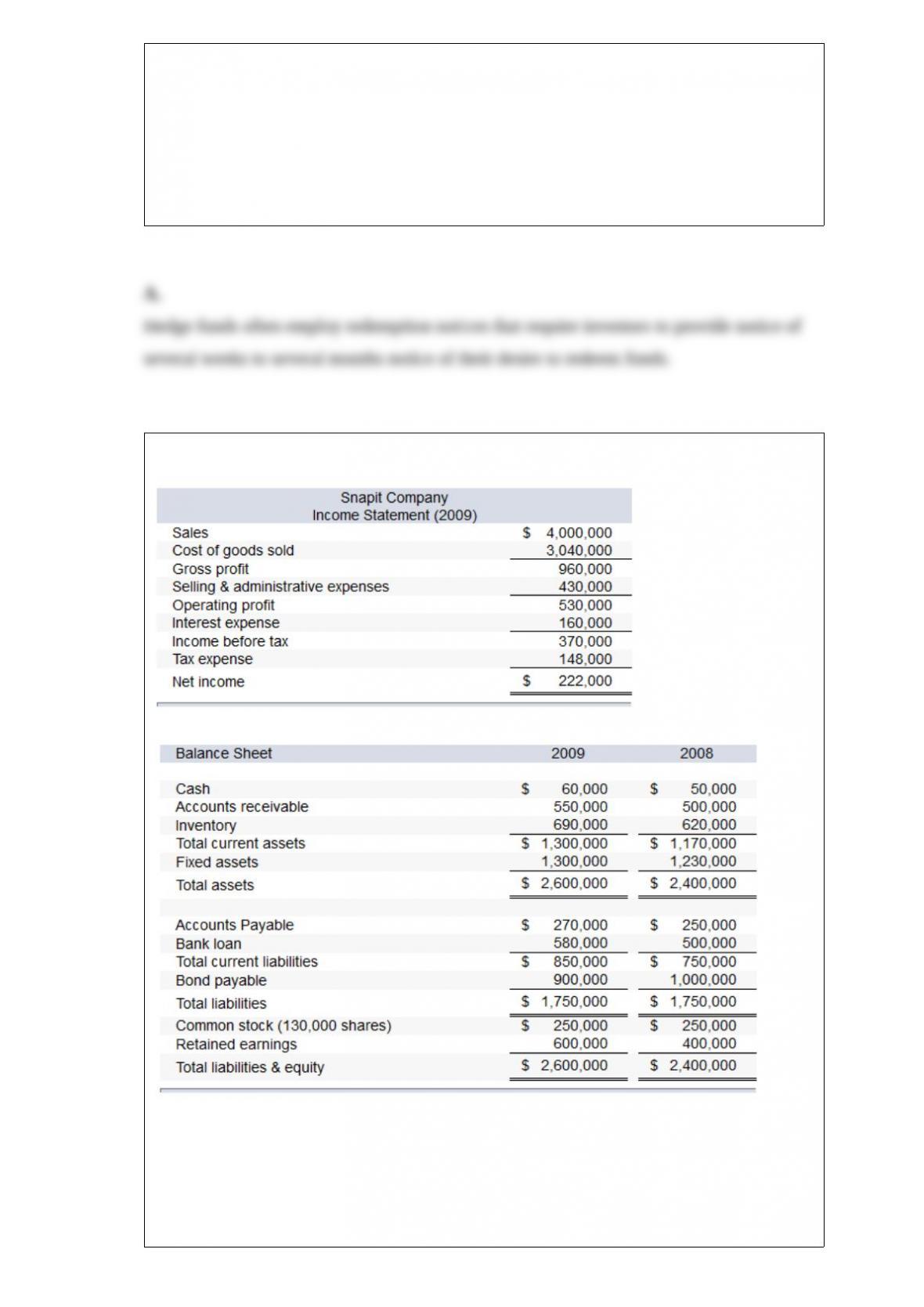
The financial statements of Snapit Company are given below.
Note: The common shares are trading in the stock market for $100 each.
Refer to the financial statements of Snapit Company. The firm’s average collection
period for 2009 is _______ days.
A. 47.91
B. 48.53
C. 46.06
D. 47.65
E. None of the options are correct.
Corporate shareholders are best protected from incompetent management decisions by
A. the ability to engage in proxy fights.
B. management’s control of pecuniary rewards.
C. the ability to call shareholder meetings.
D. the threat of takeover by other firms.
E. one-share/one-vote election rules.
Consider two perfectly negatively correlated risky securities, K and L. K has an
expected rate of return of 13%
and a standard deviation of 19%. L has an expected rate of return of 10% and a standard
deviation of 16%.
The risk-free portfolio that can be formed with the two securities will earn _____ rate of
return.
A. 9.5%
B. 11.4%
C. 10.9%
D. 9.9%
E. None of the options are correct.
The Fama and French three factor model does not use ___ as one of the explanatory
factors.
A. industrial production
B. inflation
C. firm size
D. book to market ratio
E. industrial production or inflation
The yield to maturity on a bond is
A. below the coupon rate when the bond sells at a discount and equal to the coupon rate
when the bond sells at a premium.
B. the discount rate that will set the present value of the payments equal to the bond
price.
C. based on the assumption that any payments received are reinvested at the coupon
rate.
D. None of the options are correct.
Assume that you manage a $2 million portfolio that pays no dividends and has a beta of
1.25 and an alpha of 2% per month. Also, assume that the risk-free rate is 0.05% (per
month) and the S&P 500 is at 1,300. If you expect the market to fall within the next 30
days, you can hedge your portfolio by ______ S&P 500 futures contracts (the futures
contract has a multiplier of $250).
A. selling 1
B. selling 8
C. buying 1
D. buying 8
E. selling 6
The ____________ model allows the private views of the portfolio manager to be
incorporated with market data
in the optimization procedure.
A.Black-Litterman
B. Treynor-Black
C. Treynor-Mazuy
D. Black-Scholes
Suppose a particular investment earns an arithmetic return of 10% in year 1, 20% in
year 2, and 30% in year 3. The geometric average return for the period will be
A. greater than the arithmetic average return.
B. equal to the arithmetic average return.
C. less than the arithmetic average return.
D. equal to the market return.
E. It cannot be determind from the information given.
Using semi-annual compounding, a 15-year zero-coupon bond that has a par value of
$1,000 and a required return of 8% would be priced at approximately
A. $308.
B. $315.
C. $464.
D. $555.
E. None of the options are correct.
Practitioners often use a ________% VaR, meaning that ________% of returns will
exceed the VaR, and
________% will be worse.
A. 25; 75; 25
B. 75; 25; 75
C. 1; 99; 51
D. 95; 5; 95
E. 80; 80; 20
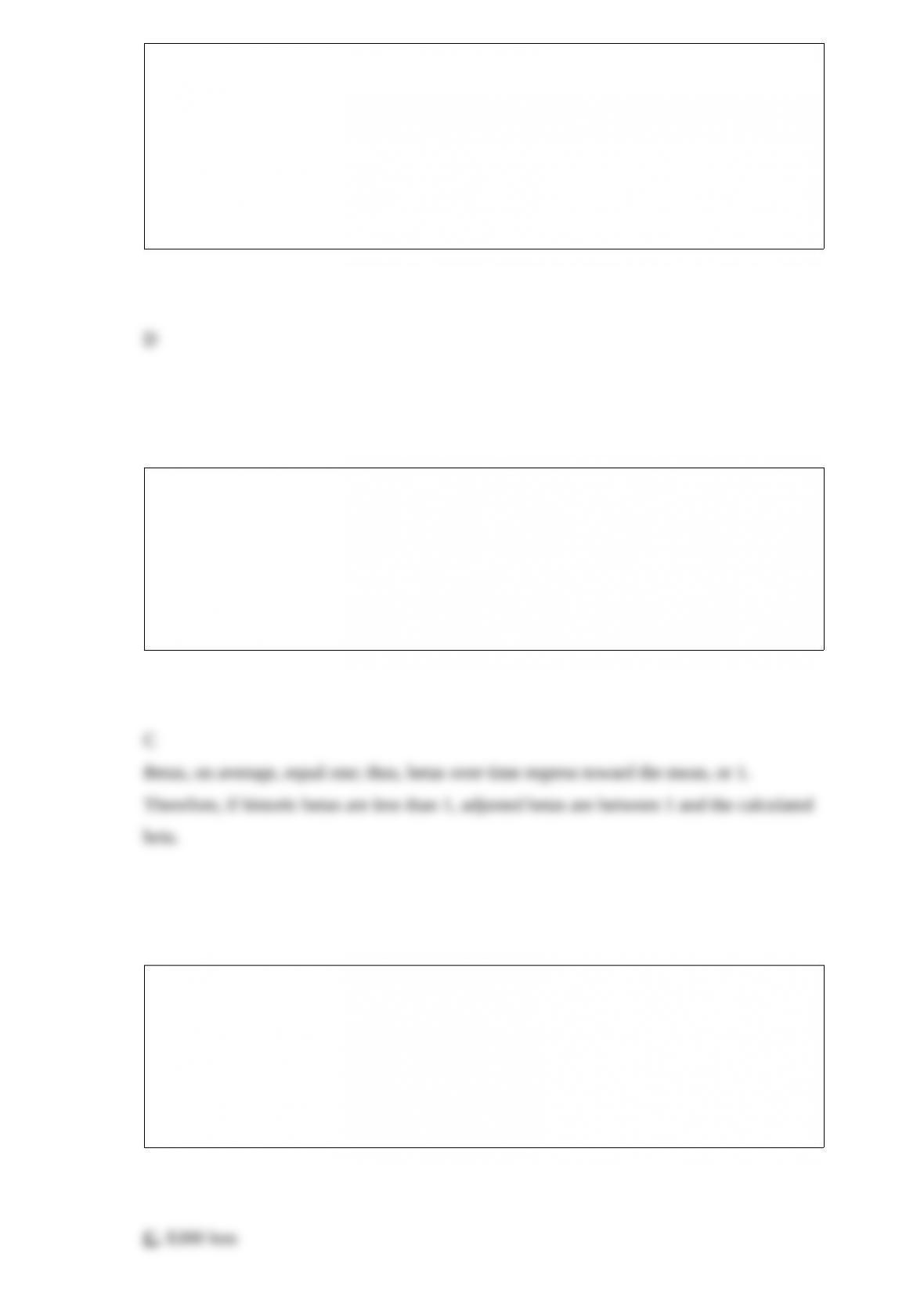
Consider the following probability distribution for stocks A and B:
If you invest 40% of your money in A and 60% in B, what would be your portfolio’s
expected rate of return and
standard deviation?
A. 9.9%; 3%
B. 9.9%; 1.1%
C. 11%; 1.1%
D. 11%; 3%
E. None of the options are correct.
Consider the multifactor APT with two factors. Stock A has an expected return of
16.4%, a beta of 1.4 on factor 1, and a beta of .8 on factor 2. The risk premium on the
factor-1 portfolio is 3%. The risk-free rate of return is 6%. What is the risk-premium on
factor 2 if no arbitrage opportunities exist?
A. 2%
B. 3%
C. 4%
D. 7.75%
If a firm’s beta was calculated as 0.8 in a regression equation, a commonly-used
adjustment technique would provide an adjusted beta of
A. less than 0.8 but greater than zero.
B. between 1.0 and 1.8.
C. between 0.8 and 1.0.
D. greater than 1.8.
E. zero or less.
You purchased one wheat future contract at $3.04 per bushel. What would be your
profit (loss) at maturity if the wheat spot price at that time were $2.98 per bushel?
Assume the contract size is 5,000 bushels and there are no transactions costs.
A. $30 profit
B. $300 profit
C. $300 loss
D. $30 loss
Given a stock index with a value of $1,000, an anticipated dividend of $30, and a
risk-free rate of 6%, what should be the value of one futures contract on the index?
A. $943.40
B. $970.00
C. $1,030.00
D. $915.09
E. $1,000.00
5% × 0.
. You invest $100 in a risky asset with an expected rate of return of 0.12 and a standard
deviation of 0.15 and a
T-bill with a rate of return of 0.05.
A portfolio that has an expected outcome of $115 is formed by
A. investing $100 in the risky asset.
B. investing $80 in the risky asset and $20 in the risk-free asset.
C. borrowing $43 at the risk-free rate and investing the total amount ($143) in the risky
asset.
D. investing $43 in the risky asset and $57 in the riskless asset.
E. Such a portfolio cannot be formed.

Futures contracts are regulated by
A.the Commodities Futures Trading Corporation.
B. the Chicago Board of Trade.
C. the Chicago Mercantile Exchange.
D. the Federal Reserve.
E. the Securities and Exchange Commission.
You purchased one corn future contract at $2.29 per bushel. What would be your profit
(loss) at maturity if the corn spot price at that time were $2.10 per bushel?
Assume the contract size is 5,000 bushels and there are no transactions costs.
A. $950 profit
B. $95 profit
C. $950 loss
D. $95 loss
E. None of the options are correct.
You sold one wheat future contract at $3.04 per bushel. What would be your profit
(loss) at maturity if the wheat spot price at that time were $2.98 per bushel?
Assume the contract size is 5,000 bushels and there are no transactions costs.
A. $30 profit
B. $300 profit
C. $300 loss
D. $30 loss
Which of the following items is not specified in a futures contract?
I) The contract size
II) The maximum acceptable price range during the life of the contract
III) The acceptable grade of the commodity on which the contract is held
IV) The market price at expiration
V) The settlement price
A. II and IV
B. I, III, and V
C. I and V
D. I, IV, and V
E. I, II, III, IV, and V
28. An investor invests 30% of his wealth in a risky asset with an expected rate of
return of 0.15 and a variance of
0.04 and 70% in a T-bill that pays 6%. His portfolio’s expected return and standard
deviation are __________
and __________, respectively.
A. 0.114; 0.12
B. 0.087; 0.06
C. 0.295; 0.06
D. 0.087; 0.12
E. None of the options are correct.
On April 1, you bought one S&P 500 Index futures contract at a futures price of 1,550.
If, on June 15, the futures price was 1,612, what would be your profit (loss) if you
closed your position (without considering transactions costs)?
A. $1,550 loss
B. $15,550 loss
C. $15,550 profit
D. $1,550 profit
. Your opinion is that Boeing has an expected rate of return of 0.112. It has a beta of
0.92. The risk-free rate is
0.04 and the market expected rate of return is 0.10. According to the Capital Asset
Pricing Model, this security
Is
A. underpriced.
B. overpriced.
C. fairly priced.
D. Cannot be determined from data provided.