
If a bank in the United States runs a legal reserve deficit of more than 2 percent of its
required daily average legal reserve position, it will be assessed an interest penalty
equal to the Federal Reserve’s discount rate plus 5 percent.
Answer:
Conditionally free deposits for customers mean that as long as the customers do not
hold above a certain level of deposit, there are no monthly fees or per transaction
charges.
Answer:
According to the textbook, capital and risk are intimately related to each other.
Answer:

An eligible acceptance is one that can be used as collateral for borrowing from the
Federal Reserve Banks.
Answer:
Bank size is not considered a significant factor in determining how banks are
organized.
Answer:
Stripped mortgage-backed securities fully protect investors from having to reinvest
their income at lower interest rates.
Answer:

A time draft is a payment for purchase of goods and services across national borders
which is payable upon presentation to the bank.
Answer:
Asset liquidity management (asset conversion) involves storing liquidity in assets, such
as cash and marketable securities.
Answer:
Off-balance-sheet items for banks have declined in recent years.
Answer:

Half of all transactions made through an ATM machine are deposits.
Answer:
A futures contract is “marked-to-market” weekly to reflect the current market price of
the contract. This means that one or the other party has to make a cash payment to the
exchange at the end of each week.
Answer:
Research indicates that at least half of all households and small businesses hold their
primary checking account at a depository institution situated within 3 miles of their
location.
Answer:

The TRC Bank has a net profit margin of 7.5%, an asset utilization ratio of 18%, and an
equity multiplier of 20. What is the bank’s ROA?
A. 27.00 percent
B. 1.35 percent
C. 7.50 percent
D. 1.50 percent
E. 3.6 percent
Answer:
A financial holding company (FHC), defined as a special type of holding company that
may offer the broadest range of financial services such as securities and insurance
activities, was allowed under which act?
A. Riegle-Neal Interstate Banking and Branching Efficiency Act
B. The Competitive Equality in Banking Act
C. The Basel Agreement
D. The FDIC Improvement Act
E. The Gramm-Leach-Bliley (Financial Services Modernization) Act
Answer:

Which of the following is an option when a liquidity deficit arises and a bank wants to
use stored liquidity in its assets to cover the deficit?
A. Borrowing in the Federal Funds market
B. Issuing a jumbo CD
C. Selling Treasury Bills
D. Increasing their correspondent deposits with another bank
E. All the options are correct
Answer:
A lender that makes a loan that violates its written loan policy would be violating which
of the 6 Cs of lending?
A. Character
B. Capacity
C. Cash
D. Control
E. Collateral
Answer:

The Willis Savings Bank is comparing the prevailing interest rate in the Fed Funds
market with that of the negotiable CD market. It is making sure to include the
noninterest costs, the deposit insurance costs, and the amount of money that will
actually be available for new loans. Which factor that affects a bank’s use of nondeposit
sources of funds is the bank examining?
A. The relative cost of raising the funds
B. The length of time the funds will be required
C. The risk associated with each source of funds
D. The size of the bank
E. Regulations
Answer:
An investor purchases one September T-bond futures contract at 115-110. The
settlement price for the contract on next day is 117-225. What is the marked-to-market
gain/loss for the investor?
A. $2,359.38
B. -$2,539.38
C. $2.36
D. -$2,115

E. $2.115
Answer:
The Johnson National Bank has purchased a bond that has a coupon rate of 5.5% and a
face value of $1000. It has 4 years to maturity and is selling in the market for $917. The
bond makes annual coupon payments. What is the yield-to-maturity on this bond?
A. 5.5%
B. 4.0%
C. 1.5%
D. 8%
E. None of the options is correct
Answer:
A bank is considering adding security underwriting services to the services it offers. It
has estimated that the expected return and standard deviation of its traditional service
are 8% and 10% respectively. It has estimated that the expected return and standard
deviation of its new securities underwriting services are 16% and 20% respectively. The
correlation between these services has been estimated to be -0.3 and the bank estimates

that 80% of its business will be from traditional services and 20% from the new
services. What is the expected return of the new combined firm?
A. 8.0 percent
B. 9.6 percent
C. 12.0 percent
D. 14.4 percent
E. 16 percent
Answer:
A bank has capital to risk-weighted assets of 11.5%, Tier 1 capital to risk-weighted
assets of 7.2% and a leverage ratio of 5.8%. What type of bank is this?
A. Well capitalized
B. Adequately capitalized
C. Undercapitalized
D. Significantly undercapitalized
E. Critically undercapitalized
Answer:
A firm submits their financial records to a bank. Upon examination, the bank discovers
that this firm has $500 in cash, $2,500 in accounts receivables, $1,000 in inventory,
$5,000 in plant and equipment and that their assets totaled $9,000. In addition this bank
discovered that the firm had $2,000 in current liabilities, $2,500 in long-term debt, and
$4,500 in net worth. Finally this bank discovered that this firm had $20,000 in net sales
and $2,000 in net income. What is this firm’s acid test ratio?
A. 1.00 ×
B. 2.00 ×
C. 0.33 ×
D. 3.00 ×
E. 1.50 ×
Answer:
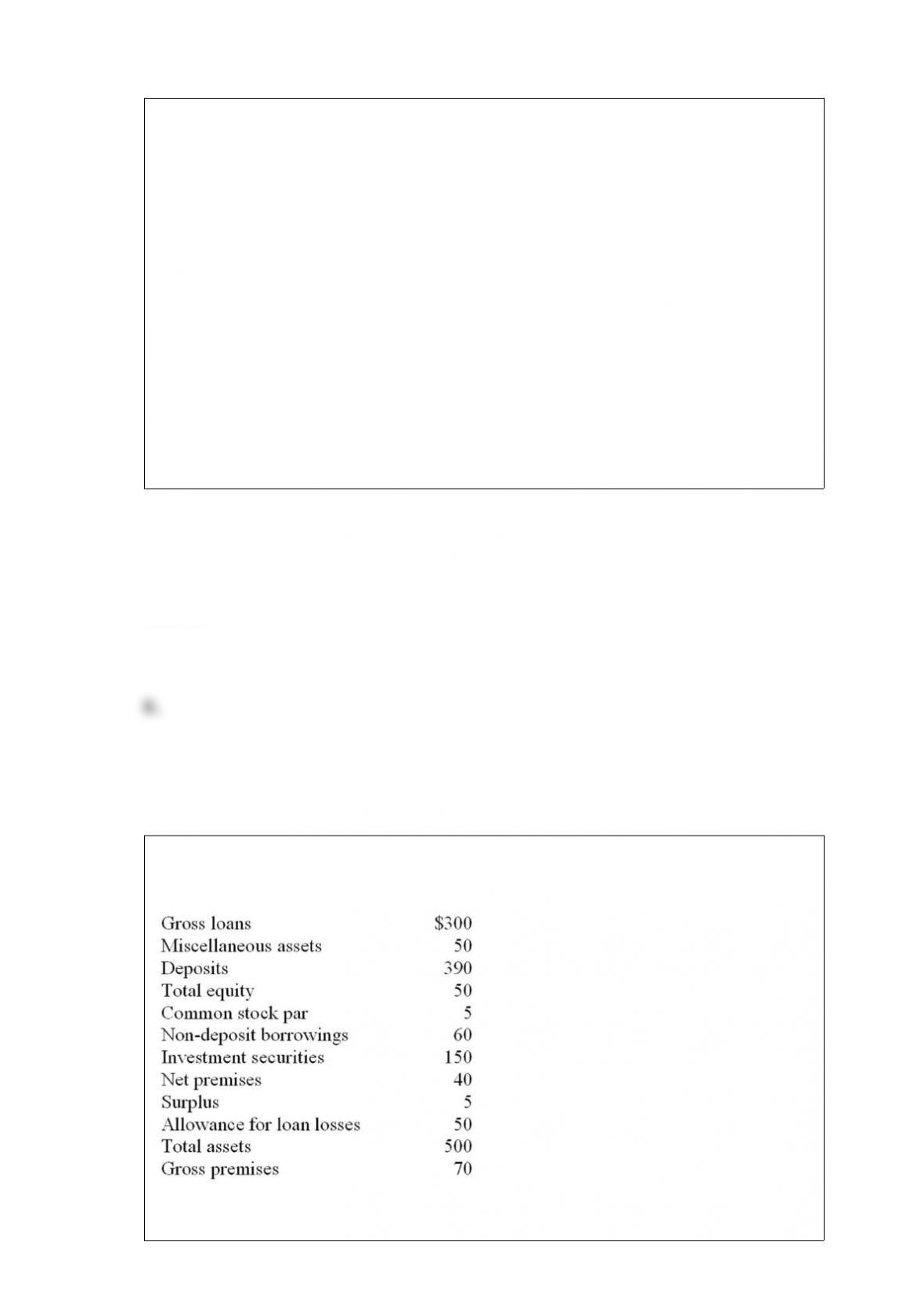
You know the following information about the Miller State Bank:
Given this information, what is the value of this firm’s total liabilities plus equity?

A. $250
B. $450
C. $150
D. $50
E. $500
Answer:
Which of the following is a reason for the growth of the currency swap market in recent
years?
A. It has helped thousands of businesses and governments hedge currency risk.
B. It has provided central banks with a new instrument to trade.
C. It has helped shape money and credit conditions in various countries.
D. It has helped strengthen home nations’ economies.
E. All of the options are reasons for the growth of the currency swap market in recent
years.
Answer:

Zenith Company has borrowed $1 million from Strong Capital Bank at an interest rate
of LIBOR plus 2 percent. However, the CFO of Zenith fears that the short-term interest
rates may rise in the near future and purchases an interest-rate cap of 5 percent from
Strong Capital Bank. What will be the annual interest outflow for Zenith, if the LIBOR
rate rises to 3.5 percent?
A. $50,000
B. $45,000
C. $55,000
D. $5,000
E. Zero
Answer:
Regulations under which of the following law(s) must be complied with by the banks
dealing in mortgage lending?
A. National Affordable Housing Act
B. Community Reinvestment Act
C. Financial Institutions Reform, Recovery, and Enforcement Act
D. Truth-in-Lending Act
E. All of the options are correct
Answer:

Each of the following falls into the category of bank assets except:
A. loans.
B. investment securities.
C. demand deposits.
D. cash and due from banks.
E. other assets.
Answer:
Catastrophe-linked securities (“cat bonds”) have been developed to shift risk from
________ to the financial markets.
A. real-estate developers
B. bankers
C. oil companies engaged in mid-sea explorations
D. insurers
E. rating agencies

Answer:
Which of the following would be the best example of a ratio used to examine the cost of
one of a bank’s liabilities?
A. Demand deposits/Total assets
B. Interest on time deposits/Total time deposits
C. Interest on real estate loans/Total real estate loans
D. Interest sensitive assets/Interest sensitive liabilities
E. Interest on business loans/Total business loans
Answer:
The Sasser State Bank has just sold $25 million in Treasury Bills. Which type of factor
affecting legal reserves is this for the bank?
A. A controllable factor increasing legal reserves
B. A noncontrollable factor increasing legal reserves
C. A controllable factor decreasing legal reserves
D. A noncontrollable factor decreasing legal reserves
E. None of the options is correct

Answer:
Recently, both investment banks and commercial banks have come under a pressure to
raise large amounts of capital, which is designed to:
A. increase their interest income.
B. reduce their high volume of assets.
C. increase their leverage ratio.
D. reduce their non-performing assets.
E. reduce their high debt ratio.
Answer:
Which of the following is a risk of using credit derivatives?
A. Credit derivatives do not protect against credit risk exposure.
B. The partner in a swap or an option contract may fail to perform.
C. Regulators may decide to lower the amount of capital needed for banks using these
derivatives.

D. Regulators may decide that these derivatives make the bank more stable and
efficient.
E. All the options are risks of using credit derivatives
Answer:
According to the textbook, bank mergers are often motivated by:
A. profit potential.
B. expected reduction in the risk of fluctuations in cash flow and earnings.
C. expected tax benefits.
D. market-positioning strategies.
E. All of the options are correct.
Answer:
A bank, concerned about risk exposure in entering a foreign market, lacking the
necessary expertise and customer contacts abroad, or wishing to offer services restricted
to banks alone, may choose to: A. set up a branch office.

B. enter into a joint venture with a foreign financial firm.
C. set up an agency office.
D. set up a representative office.
E. set up a shell branch.
Answer:
Loans extended to finance the purchase of automobiles, mobile homes, home
appliances, and vacations are classified as:
A. real estate loans.
B. financial institution loans.
C. agricultural loans.
D. commercial and industrial loans.
E. None of the options is correct.
Answer:

CDs issued by nonbank savings institutions are called:
A. thrift CDs.
B. domestic CDs.
C. EURO CDs.
D. Yankee CDs.
E. variable rate CDs.
Answer:
A firm submits their financial records to a bank. Upon examination, the bank discovers
that this firm has $500 in cash, $2,500 in accounts receivables, $1,000 in inventory,
$5,000 in plant and equipment, and that their assets totaled $9,000. In addition, this
bank discovered that the firm had $2,000 in current liabilities, $2,500 in long-term debt,
and $4,500 in net worth. Finally, this bank discovered that this firm had $20,000 in net
sales and $2,000 in net income. What is this firm’s net profit margin?
A. 10.00 percent
B. 22.22 percent
C. 44.44 percent
D. 50.00 percent
E. None of the options is correct.
Answer:

Randal Ice needs a loan to purchase pet food and other pet supplies for his local pet
store over the next six months. He has estimated that the maximum amount of inventory
he will need in the next six months is $200,000 and he knows that he will have to use
accounts receivables and the inventory he purchases as collateral for the loan. At the
end of six months, he hopes he can get the loan renewed. What type of loan does
Randal need?
A. Self-liquidating inventory loan
B. Working capital loan
C. Interim construction financing
D. Security dealer financing
E. Retailer and equipment financing
Answer:
Which of the following is an example of a nondeposit investment product of the bank?
A. Time deposit
B. NOW account
C. Passbook savings account
D. Proprietary mutual fund
E. All of the options are correct.

Answer:
The Second National Bank has capital and surplus of $100 million. The bank has
decided that the most that it can loan to the Krumlova Manufacturing Company is $15
million. What factor determining the growth and mix of loans does this most likely
reflect for the bank?
A. Characteristics of the market area
B. Lender size
C. The experience and expertise of management
D. The written loan policy of the bank
E. Bank regulations
Answer:
A bank’s ROE equals its ROA times its:
A. net profit margin.
B. total assets divided by total equity capital.
C. total operating revenues divided by total assets.
D. ratio of net after-tax income to total operating revenues.

E. None of the options is correct.
Answer:
A financial institution has estimated that over the last ten years the deposit withdrawals
during Christmas time is about 25% higher than during any other time of the year. This
is the _________________________ of estimating future deposits.
A. trend component
B. seasonal component
C. cyclical component
D. stationary component
E. None of the options is correct
Answer:
Which of the following is not a current trend in the banking industry?
A. The number of banks is declining
B. The number of bank branches is declining
C. The number of bank services is increasing
D. The number of bank competitors is increasing
E. Bank industry convergence
Answer:
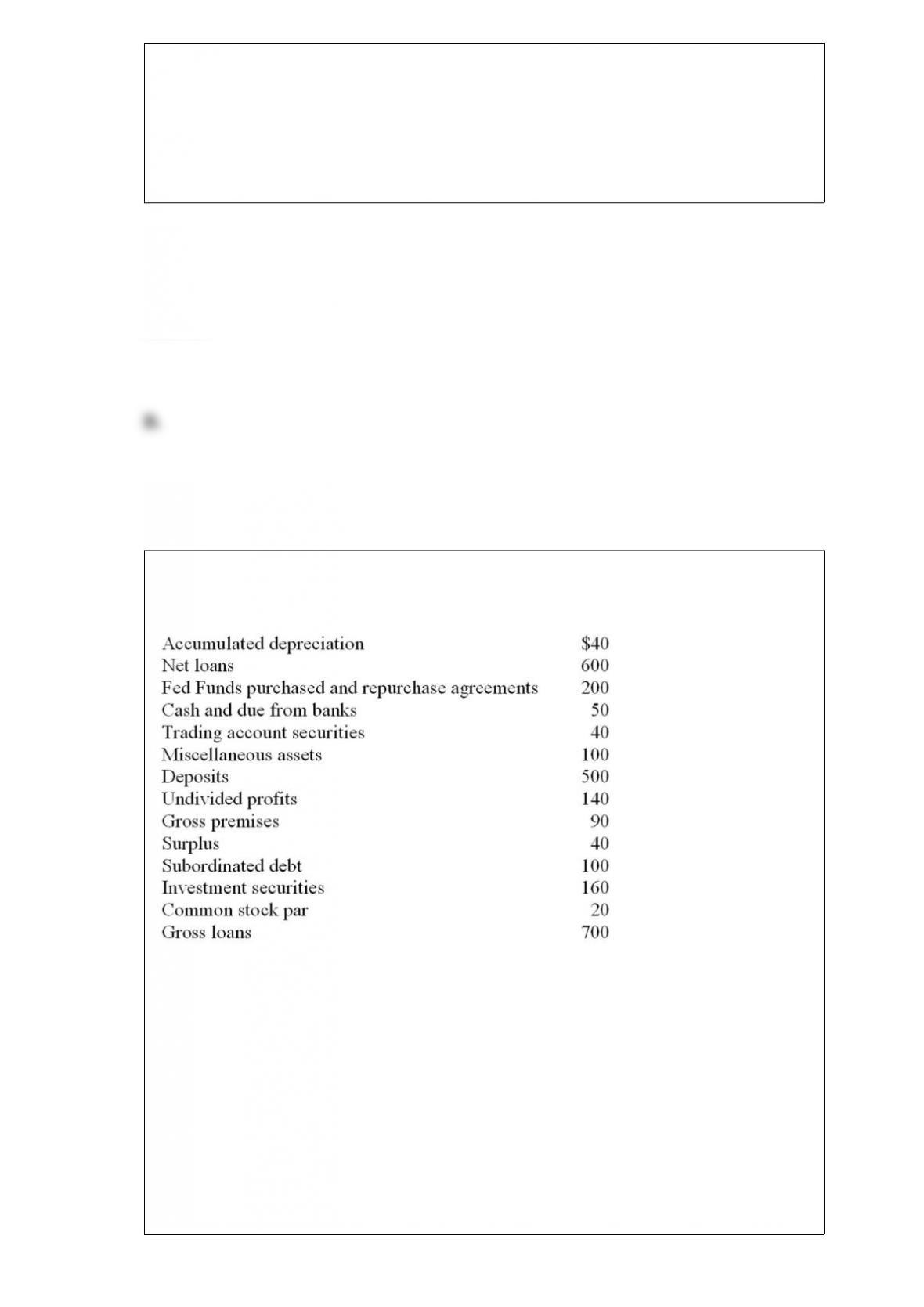
You know the following information about the Webb State Bank:
Given this information, what is the value of this firm’s allowance for loan losses?
A. $1,300
B. $1,000
C. $50
D. $200
E. $100

Answer:
__________________________ are the primary long-term liabilities of the bank.
Answer:
________________________ are types of loans where a lender buys equipment or
vehicles and rents them to its customers.
Answer:
A(n) ______________________ terminal in a retail store allows a customer to pay for
goods and services by instantly debiting his or her checking account.

Answer:
A(n) _________________________ is an agreement between a buyer and a seller today
which calls for the delivery of a particular security in exchange for cash at some future
date for a set price.
Answer:
A bank which operates exclusively over the internet is known as a ___________ bank.
Answer:
Supplemental capital such as the allowance for loan and lease losses, subordinated debt
capital instruments, mandatory convertible debt, intermediate-term preferred stock,
cumulative perpetual preferred stock with unpaid dividends, and equity notes and other
long-term capital instruments that combine both debt and equity features is more

commonly known as ________________________.
Answer:
A(n) ______________________ takeover is a merger which is resisted by the existing
management and stockholders.
Answer:
The fed funds rate is generally most volatile on a bank’s __________ day.
Answer:

A(n) _________________________ gives the bank the right to manage the estate of a
living person without a court order. This can be amended by the customer as desired.
Answer:
The change in a financial institution’s __________________ is equal to difference
between the average duration of assets times the change in the interest rate divided by
(1+ original discount rate) times the dollar amount of total assets and the average
duration of liabilities times the change in the interest rate divided by 1+ original
discount rate times the dollar amount of total liabilities.
Answer:
__________________________ assets of a financial institution are those that will
mature or be repriced within a set period of time.
Answer:

Banks which function under a federal charter through the Comptroller of the Currency
in the United States are known as ____________ banks.
Answer:
A(n) _______________ is a draft for payment due and payable only on a specific future
date.
Answer:
One tool that the Federal Reserve uses to control the money supply is
________________. The Federal Reserve will buy and sell T-bills, bonds, notes, and
selected federal agency securities when they are using this tool of monetary policy.
Answer:

The short-term securities of the bank, including T-Bills and commercial paper, are often
called __________________________ because they are the second line of defense to
meet demands for cash.
Answer:
The method used in the U.S. to determine a bank’s legal reserve requirement, in which
the period for holding legal reserves follows the period used to calculate the required
amount of legal reserves, is called ________________________.
Answer: