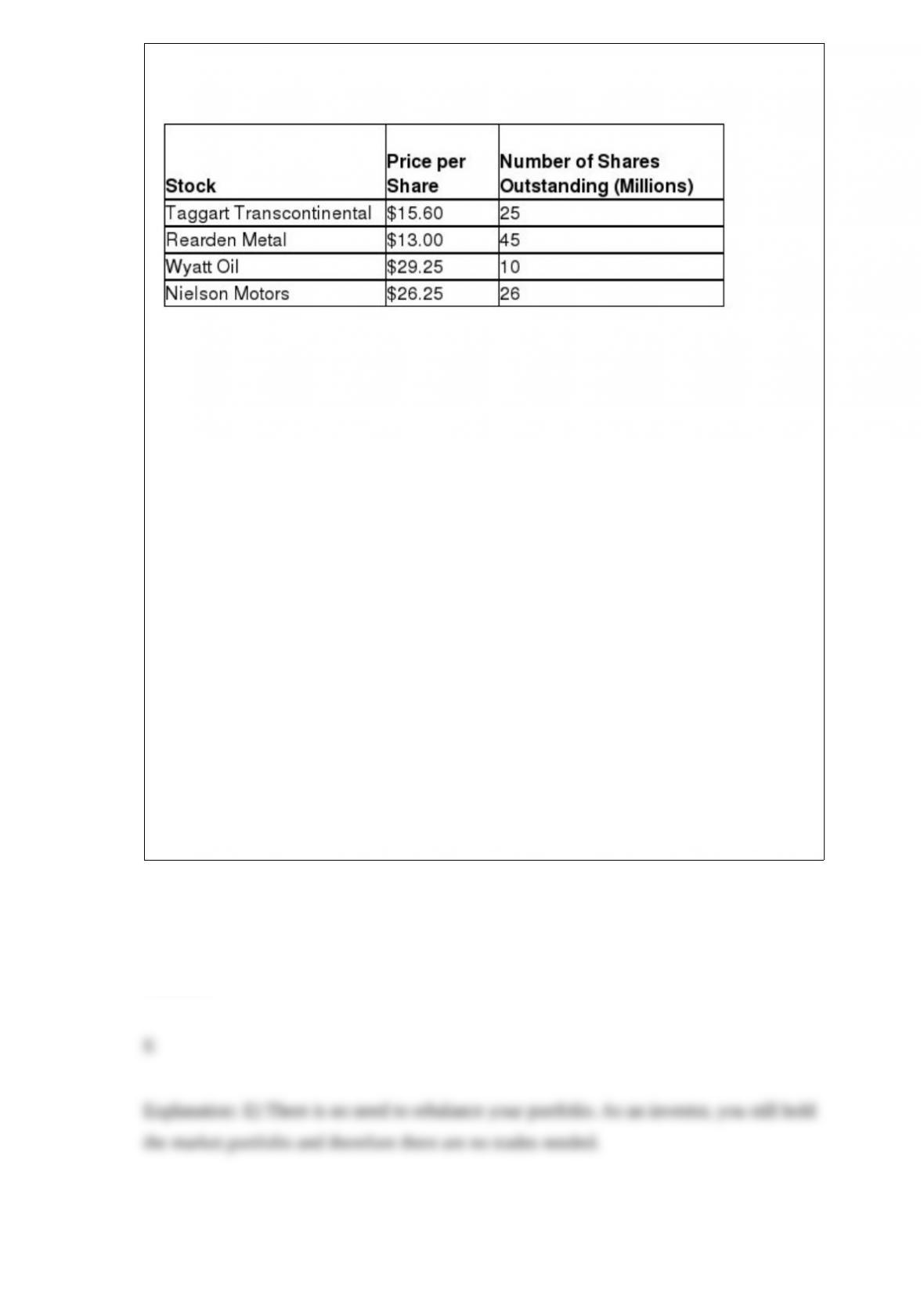
Suppose all possible investment opportunities in the world are limited to the four stocks
list in the table below:
Suppose that you have invested $100,000 invested in the market portfolio and that the
stock price of Taggart Transcontinental suddenly drops to $7.80 per share. Which of the
following trades would you need to make in order to maintain your investment in the
market portfolio:
1. Buy approximately 1,140 shares of Taggart Transcontinental
2. Sell approximately 256 shares of Rearden Metal
3. Sell approximately 57 shares of Wyatt Oil
4. Sell approximately 148 shares of Nielson Motors
A) 1 only
B) 2 only
C) 2, 3, and 4 only
D) 1, 2, 3, and 4
E) None of the above
Answer:

Consider the following equation:
Pretain = Pcum
The term τi in this equation represents
A) the corporation’s tax rate on interest income.
B) the investor’s tax rate on capital gains.
C) the investor’s tax rate on interest income.
D) the investor’s tax rate on cumulative dividends.
Answer:
Which of the following statements is false?
A) Calculating the precise present value of financial distress costs is a relatively
straightforward process.
B) Two key qualitative factors determine the present value of financial distress costs:
(1) the probability of financial distress and (2) the magnitude of the costs after a firm is
in distress.
C) Technology firms are likely to incur high costs when they are in financial distress,
due to the potential for loss of customers and key personnel, as well as a lack of
tangible assets that can be easily liquidated.
D) The magnitude of the financial distress costs will depend on the relative importance
of the sources of these costs and is likely to vary by industry.
Answer:

Which of the following statements regarding best efforts IPOs is false?
A) For smaller IPOs, the underwriter commonly accepts the deal on thisbasis.
B) The underwriter does not guarantee that the stock will be sold, but instead tries to
sell the stock for the best possible price.
C) Often these arrangements have an all-or-none clause: either all of the shares are sold
in the IPO, or the deal is called off.
D) If the entire issue does not sell out, the underwriter is on the hook.
Answer:
Various trading strategies appear to offer non-zero alphas when we examine real world
data. If indeed these alphas are positive, it could be explained by any of the following
except:
A) Investors are systematically ignoring positive-NPV investment opportunities.
B) The market portfolio is inefficient, but the market portfolio proxy used to calculate
the alphas is efficient.
C) A stock’s beta with the market portfolio does not adequately measure a stock’s
systematic risk.
D) The positive alpha trading strategies contain risk that investors are unwilling to bear
but the CAPM does not capture.
Answer:
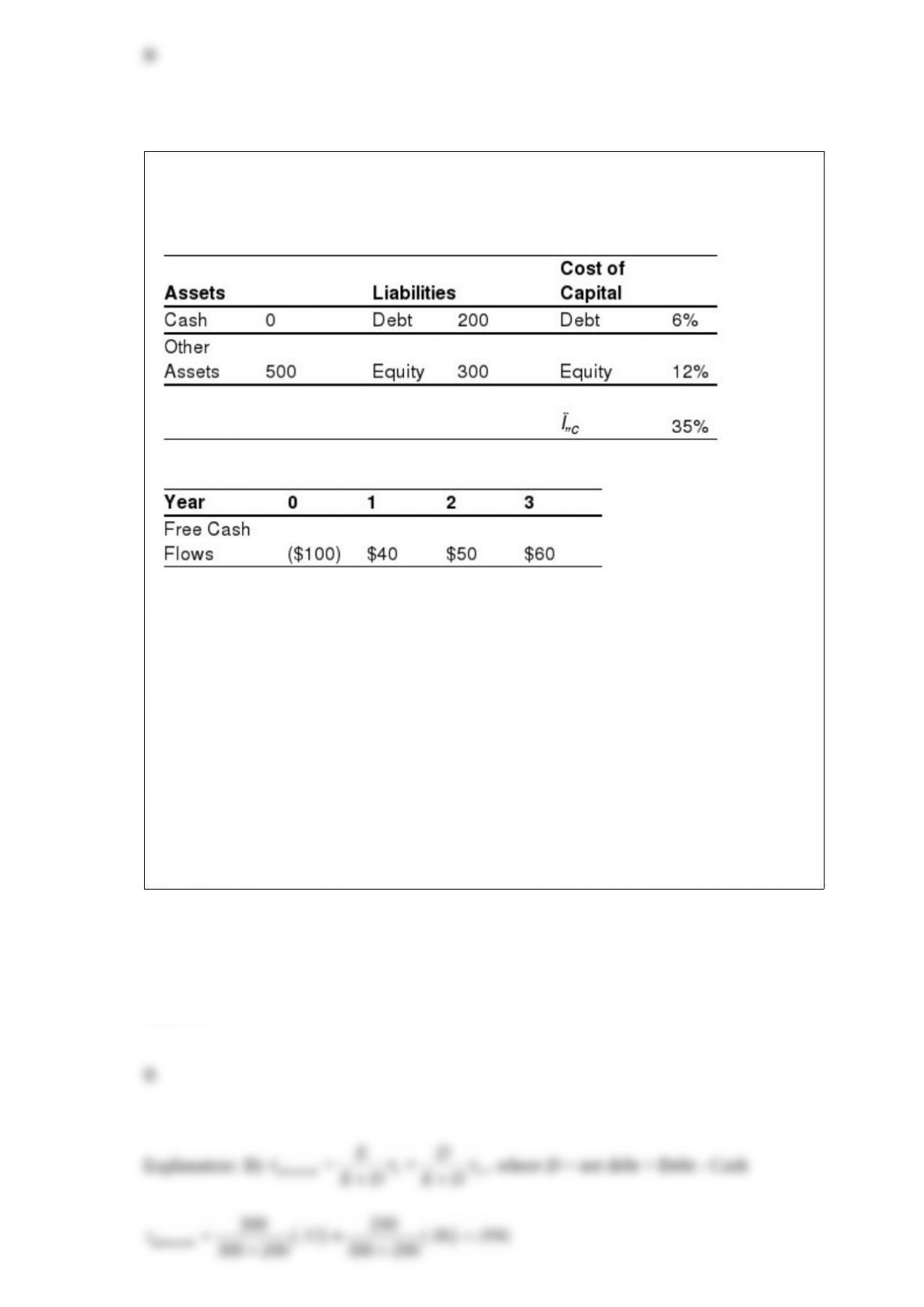
Use the information for the question(s) below.
Omicron Industries’ Market Value Balance Sheet ($ Millions) and Cost of Capital
Omicron Industries New Project Free Cash Flows
Assume that this new project is of average risk for Omicron and that the firm wants to
hold constant its debt to equity ratio.
The unlevered value of Omicron’s new project is closest to:
A) $96
B) $124
C) $126
D) $25
Answer:

Which of the following statements is false?
A) A common approximation is to assume that in the long run, dividends will grow at a
constant rate.
B) The dividend each year is the firm’s earnings per share (EPS) multiplied by its
dividend payout rate.
C) There is a tremendous amount of uncertainty associated with any forecast of a firm’s
future dividends.
D) During periods of high growth, it is not unusual for firms to pay out 100% of their
earnings to shareholders in the form of dividends.
Answer:
Use the information for the question(s) below.
Luther Industries has no debt and expects to generate free cash flows of $48 million
each year. Luther believes that if it permanently increases its level of debt to $100
million, the risk of financial distress may cause it to lose some customers and receive
less favorable terms from its suppliers. As a result, Luther’s expected free cash flows
with debt will be only $44 million per year. Suppose Luther’s tax rate is 40%, the
risk-free rate is 6%, the expected return of the market is 14%, and the beta of Luther’s
free cash flows is 1.25 (with or without leverage).
The value of Luther with leverage is closest to:
A) $315 million
B) $340 million
C) $205 million
D) $300 million
Answer:
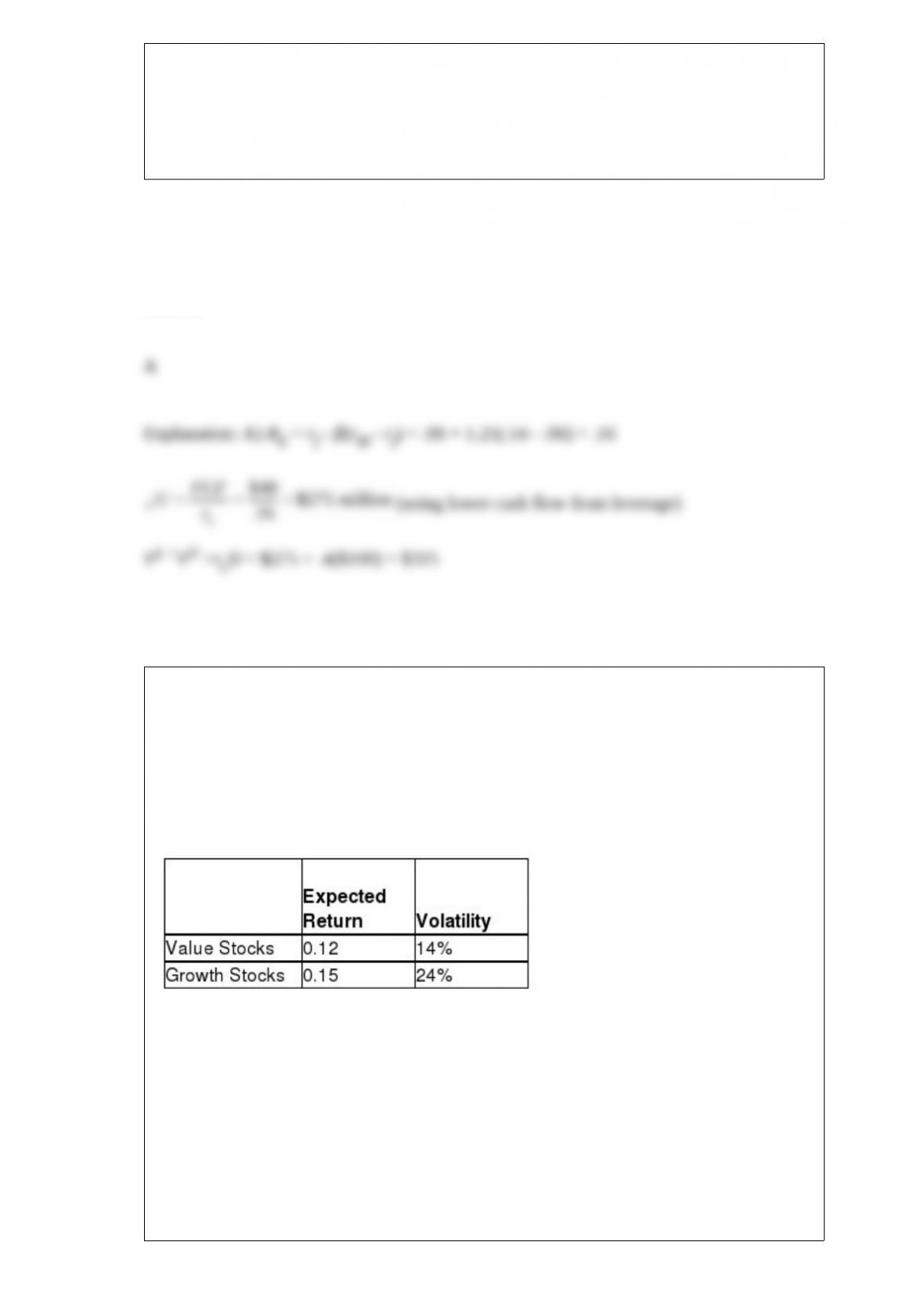
Use the following information to answer the question(s) below.
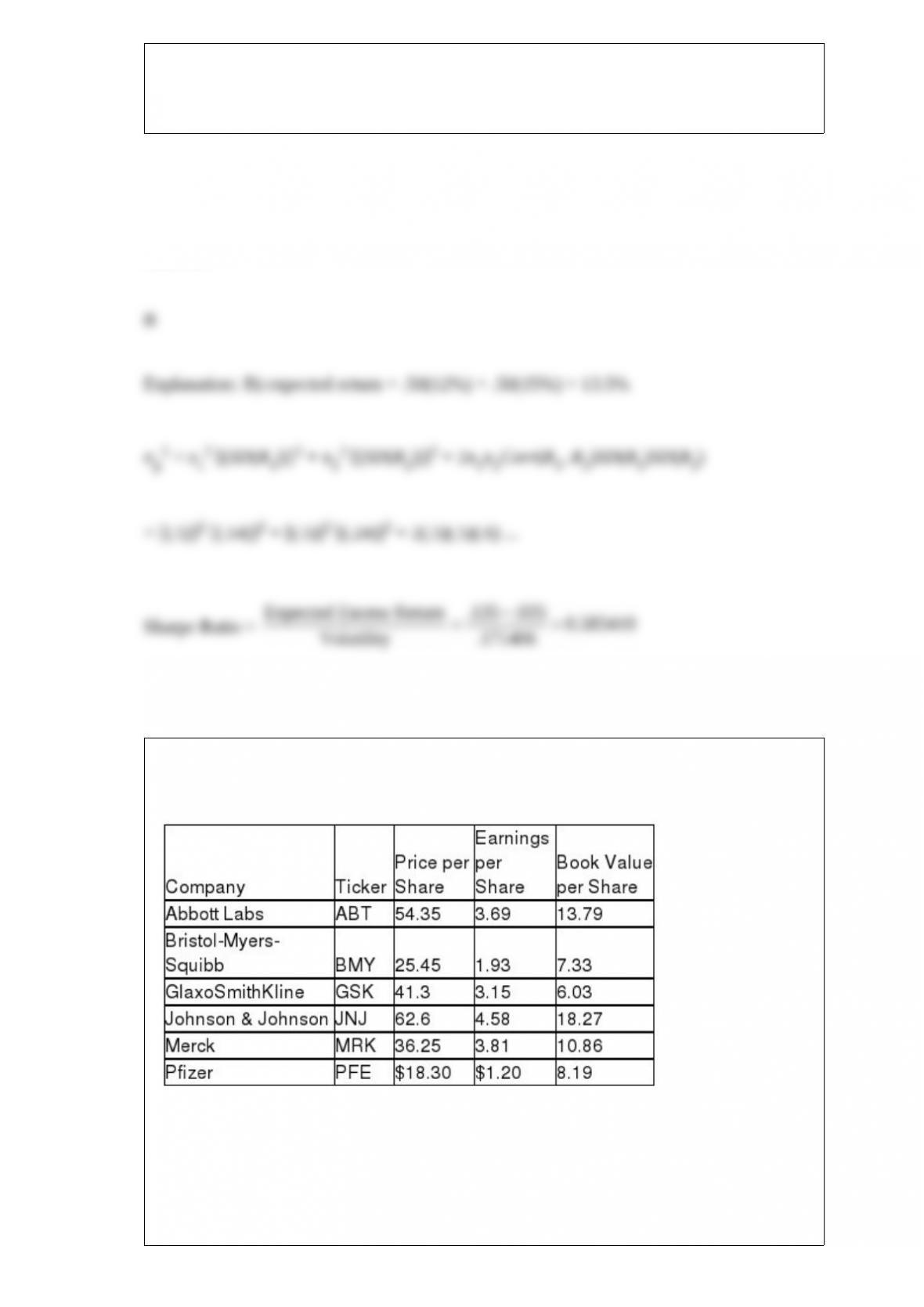
Suppose that all stocks can be grouped into two mutually exclusive portfolios (with
each stock appearing in only one portfolio): growth stocks and value stocks. Assume
that these two portfolios are equal in size (market value), the correlation of their returns
is equal to 0.6, and the portfolios have the following characteristics:
The risk free rate is 3.5%.
The Sharpe ratio for the market (which is a 50-50 combination of the value and growth
portfolios) portfolio is closest to:
A) .53
B) .58
C) .61
D) .79
Answer:
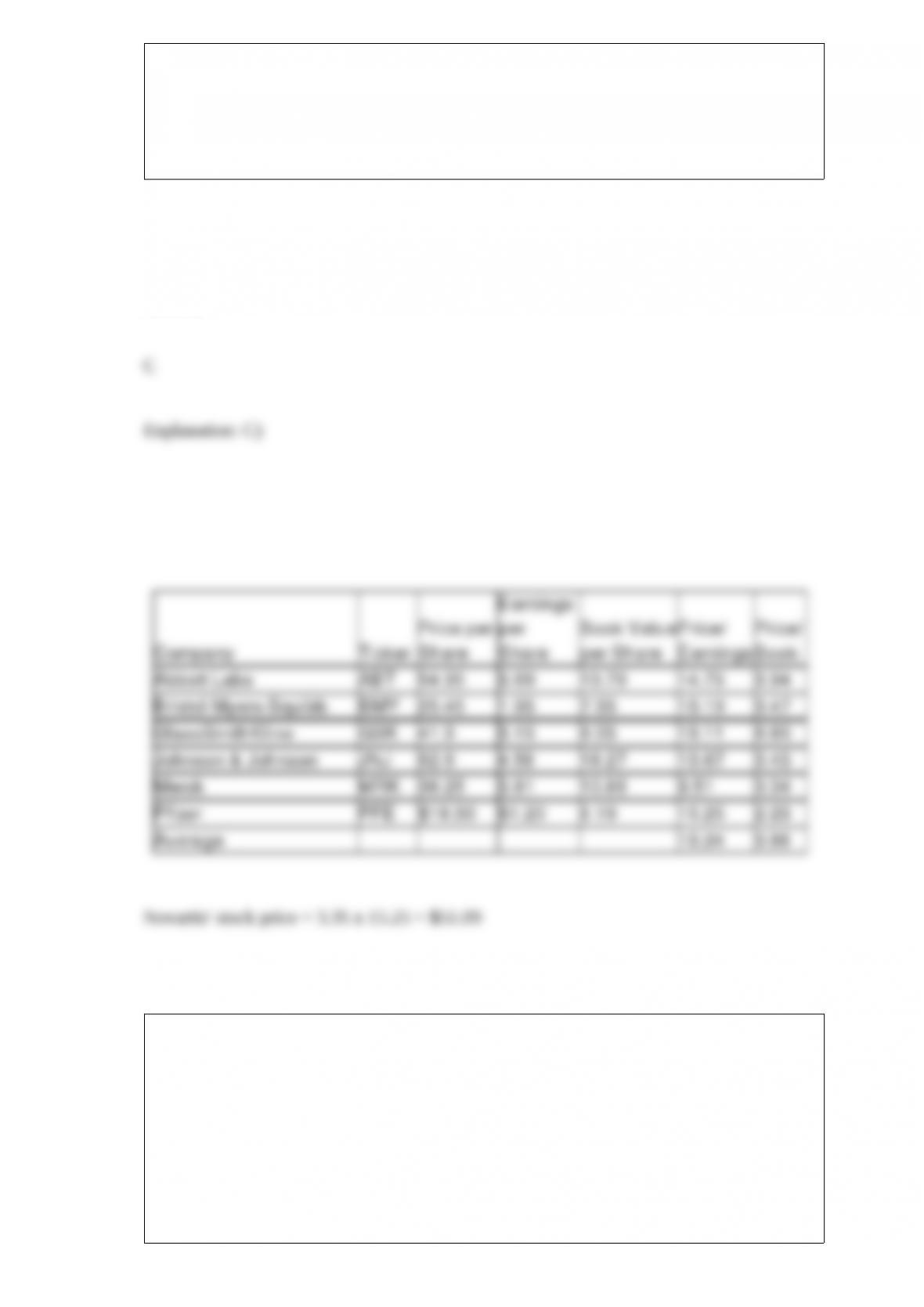
Use the following information to answer the question(s) below.
Assuming that Novartis AG (NVS) has an EPS of $3.35, based upon the P/E ratios for
its competitors, the highest expected stock price for Novartis is closest to:
A) $31.86
B) $44.35
C) $51.09
D) $62.60
Answer:
Which of the following statements is false?
A) Many practitioners prefer to use average industry betas rather than individual stock
betas.
B) When estimating beta by using past returns it is best to use the longest time horizon
of returns available.
C) The CAPM predicts that a security’s expected return depends on its beta with regard

to the market portfolio of all risky investments available to investors.
D) If we use too short a time horizon when estimating beta, our estimate of beta will be
unreliable.
Answer:
Rearden Metal can invest in a risk-free technology that requires an up-front investment
of $1 million. Rearden’s managers are hesitant to invest because of uncertainty over
future interest rates. Suppose that all interest rates will be either 8% or 4% in one year
and remain there forever. The risk-neutral probability that interest rates will drop to 4%
is 40%. The one-year risk-free interest rate is 5% and today’s rate on a risk-free
perpetual bond is 6%. The rate on an equivalent perpetual bond that is repayable at any
time (the callable annuity rate) is 7.65%.
Assuming that this project will provide Rearden with perpetual annual cash flows of
$55,000, the NPV of investing in the project today is closest to:
A) -281,000
B) -150,000
C) -83,000
D) +83,000
E) +281,000
Answer:
Which of the following is consistent with the CAPM and efficient capital markets?
A) A security with a beta of 1 has a return last year of 8% when the market has a return
of 12%.
B) Small stocks with a beta of 1.5 tend to have higher returns on average than large
stocks with a beta of 1.5.
C) A security with only diversifiable risk has an expected return that exceeds the
risk-free interest rate.
D) A security with only systematic risk has an expected return that exceeds the risk-free
interest rate.
Answer:
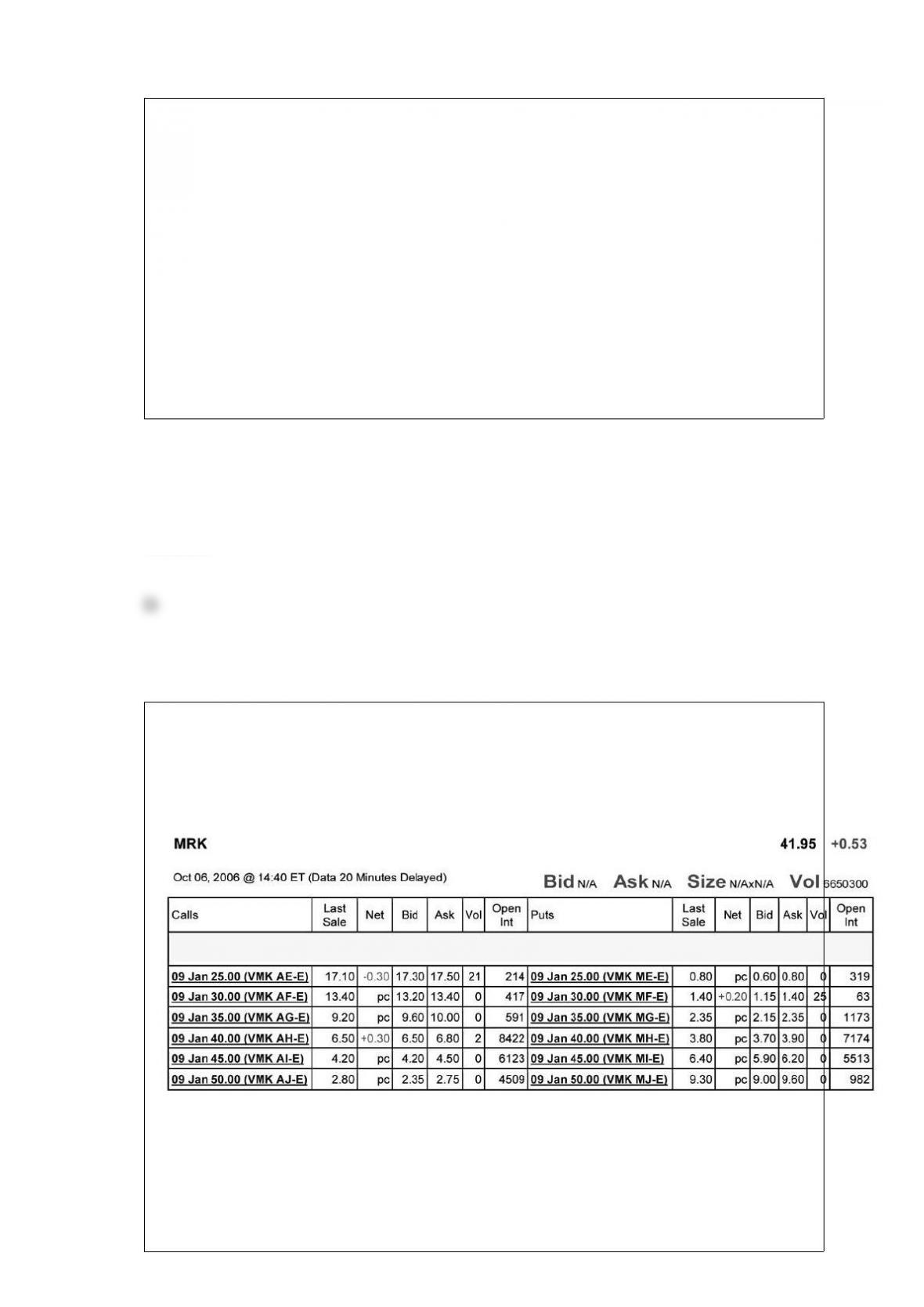
Use the table for the question(s) below.
Consider the following information on options from the CBOE for Merck:
How many of the January 2009 put options are in the money?
A) 1
B) 3

C) 2
D) 4
Answer:
Which of the following statements is false?
A) We say a portfolio is an efficient portfolio whenever it is possible to find another
portfolio that is better in terms of both expected return and volatility.
B) We can rule out inefficient portfolios because they represent inferior investment
choices.
C) The volatility of the portfolio will differ, depending on the correlation between the
securities in the portfolio.
D) Correlation has no effect on the expected return on a portfolio.
Answer:

A three-month treasury bill sold for a price of $99.311998 per $100 face value. The
yield to maturity of this bond expressed as an EAR is closest to:
A) 2.5%
B) 2.8%
C) 3.2%
D) 4.0%
Answer:
Use the information for the question(s) below.
Von Bora Corporation is expected pay a dividend of $1.40 per share at the end of this
year and a $1.50 per share at the end of the second year. You expect Von Bora’s stock
price to be $25.00 at the end of two years. Von Bora’s equity cost of capital is 10%
Suppose you plan on purchasing Von Bora stock in one year, right after the $1.40
dividend is paid. You then plan on selling your stock at the end of year two, right after
the $1.50 dividend is paid. The capital gain rate that you will receive on your
investment is closest to:
A) 4.00%
B) 3.75%
C) 6.25%
D) 3.50%

Answer:
Which of the following is not true regarding individual investor behavior.
A) Individual investors fail to diversify their portfolios adequately.
B) A vast majority of individual investors hold fewer than 10 stocks in their portfolio.
C) Employees tend to overinvest in their company’s own stock.
D) Individual investors’ portfolios consistently outperform the market averages.
Answer:
Use the following information to answer the question(s) below.
Rearden Metals has a current stock price of $30 share, is expected to pay a dividend of
$1.20 in one year, and its expected price right after paying that dividend is $33.
Rearden’s expected dividend yield is closest to:
A) 3.40%
B) 3.65%
C) 4.00%
D) 4.20%
Answer:
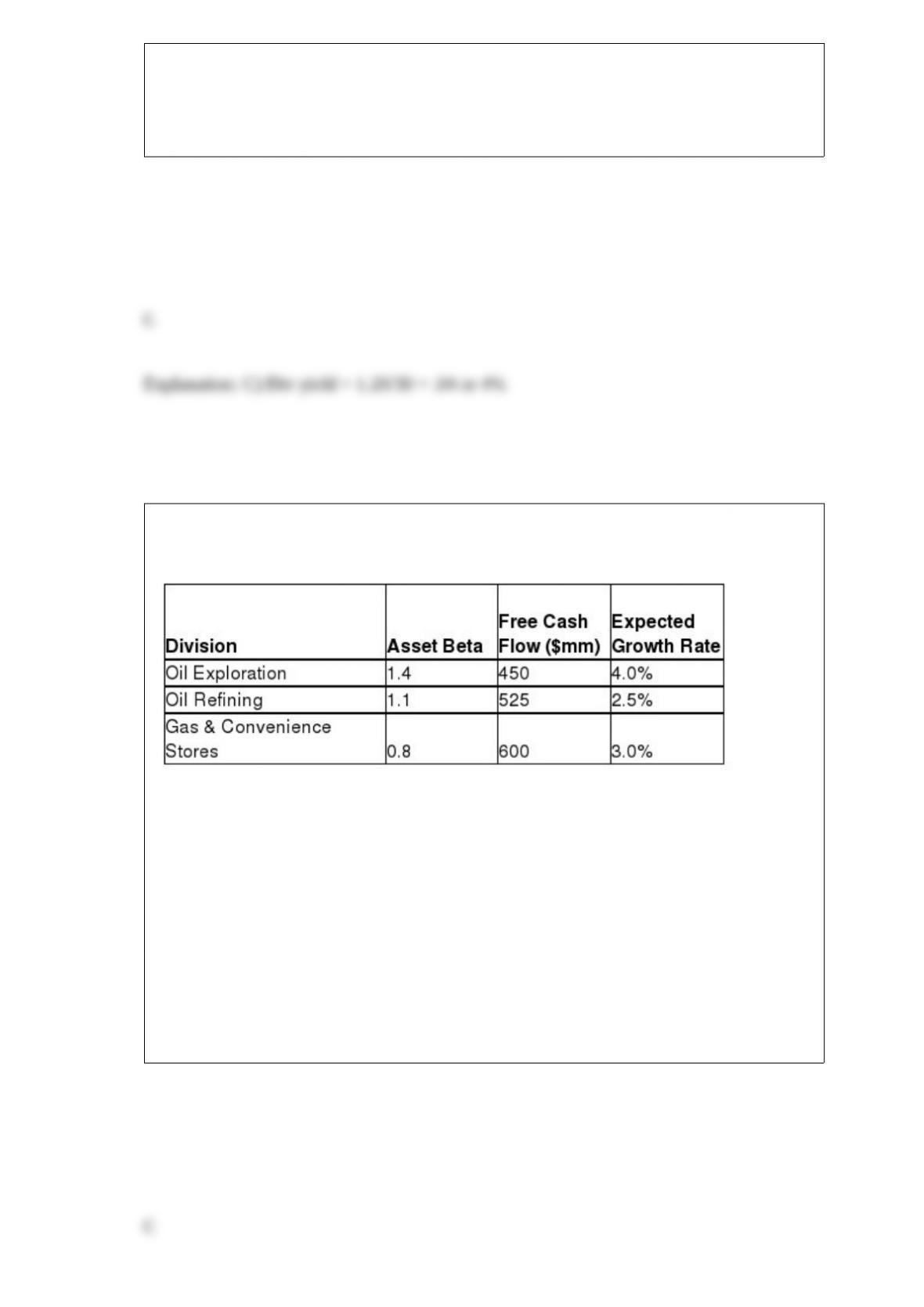
Use the following information to answer the question(s) below.
The risk-free rate of interest is 3% and the market risk premium is 5%.
The overall value of Wyatt Oil (in $ millions) is closest to:
A) 7.0%
B) 8.5%
C) 10.0%
D) 14.0%
Answer:

How do you calculate (mathematically) the present value of a(n):
(a) perpetuity
(b) annuity
(c) growing perpetuity
(d) growing annuity
Answer:

Which of the following types of risk doesn’t belong?
A) Idiosyncratic risk
B) Undiversifiable risk
C) Market risk
D) Systematic risk
Answer:
The inventory days ratio measures
A) the average length of time it takes a company to sell its inventory.
B) the average length of time it takes the company’s suppliers to deliver its inventory.
C) the level of sales required to keep a company’s average inventory on the books.

D) the percentage change in inventory over the past year.
Answer:
The firm’s unlevered (asset) beta is
A) the weighted average of the equity beta and the debt beta.
B) the weighted average of the levered beta and the equity beta.
C) the debt beta minus the equity beta.
D) the unlevered beta minus the cost of capital.
Answer:
Which of the following statements is false?
A) Because only the tax consequences of depreciation are relevant for free cash flow,
we should use the depreciation expense that the firm will use for tax purposed in our
free cash flow forecasts.
B) A firm generally identifies its marginal tax rate by determining the tax bracket that it
falls into based on its overall level of pre-tax income.
C) Free Cash Flow = (Revenues – Costs) x (1 – τc) – Capital Expenditures – ΔNWC + τc
x Depreciation.
D) Net working capital is the difference between current liabilities and current assets.

Answer:
Use the information for the question(s) below.
Rockwood Industries has 100 million shares outstanding, a current share price of $25,
and no debt. Rockwood’s management believes that the shares are under-priced, and
that the true value is $30 per share. Rockwood plans to pay $250 million in cash to its
shareholders by repurchasing shares. Management expects that very soon new
information will come out that will cause investors to revise their opinion of the firm
and agree with Rockwood’s assessment of the firm’s true value.
Assume that Rockwood is not able to repurchase shares prior to the market becoming
aware of the new information regarding Rockwood’s true value. If Rockwood
repurchases the shares following the release of the new information, then the number of
shares outstanding following the repurchase is closest to:
A) 92 million
B) 90 million
C) 75 million
D) 10 million
Answer:

The structure of a merger transaction is summarized in a(n)
A) swap sheet.
B) term sheet.
C) exchange sheet.
D) merger sheet.
Answer:
Which of the following statements is false?
A) The market portfolio is the efficient portfolio.
B) Many practitioners believe it is sensible to use the CAPM and the security market
line as a practical means to estimate a stock’s required return and therefore a firm’s
equity cost of capital.
C) If we plot individual securities according to their expected return and beta, the
CAPM implies that they should all fall along the CML.
D) As savvy investors attempt to trade to improve their portfolios, they raise the price
and lower the expected return of the positive alpha stocks, and they depress the price
and raise the expected return of negative alpha stocks, until the stocks are once again on
the security market line and the market portfolio is efficient.
Answer:
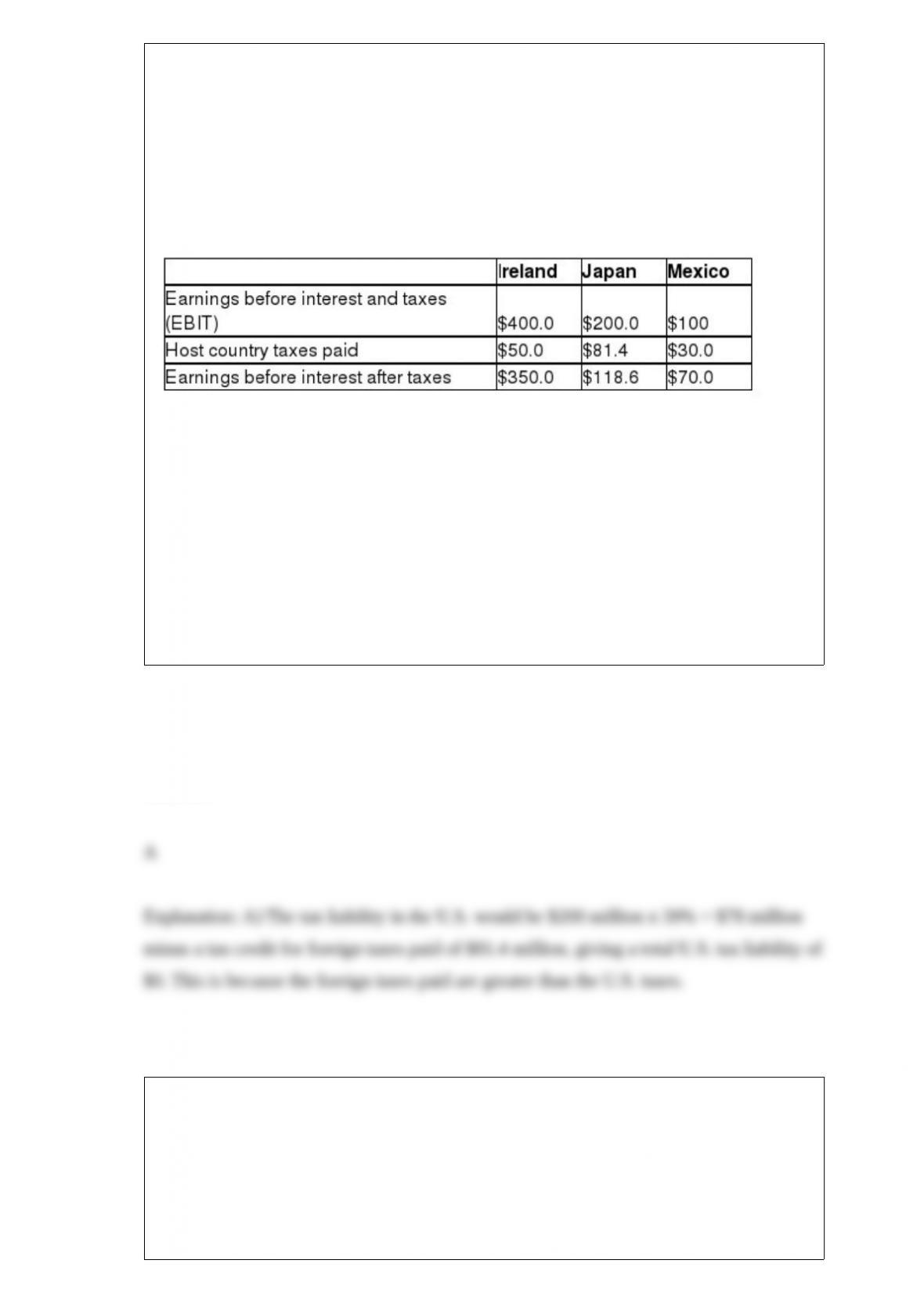
Use the following information to answer the question(s) below.
Incorporated Tool, a U.S. firm, is considering its international tax situation. The
corporate tax rate in the U.S. is currently 39%. Incorporated Tool has major operations
in Ireland, where the tax rate is 12.5%, Japan where the tax rate is 40.7%, and Mexico,
where the tax rate is 30.0%. Incorporated Tool’s profits, which are fully and
immediately repatriated, and foreign taxes paid for the current year are as follows:
Assuming that the Irish and Mexican subsidiaries did not exist, the U.S. tax liability on
the Japanese subsidiary would be closest to:
A) $0
B) $81 million
C) $103 million
D) $106 million
Answer:
A sole proprietorship is owned by
A) one person.
B) two of more persons.
C) shareholders.

D) bankers.
Answer:
Which of the following statements is false?
A) We should be suspicious of beta estimates that are extreme relative to industry
norms.
B) When using historical data, there is always the possibility of estimation error.
C) Evidence suggests that betas tend to revert toward zero over time.
D) For stocks, common practice is to use at least two years of weekly return data or five
years of monthly return data when estimating beta.
Answer:
Use the information for the question(s) below.
Omicron Technologies has $50 million in excess cash and no debt. The firm expects to
generate additional free cash flows of $40 million per year in subsequent years and will
pay out these future free cash flows as regular dividends. Omicrons unlevered cost of
capital is 10% and there are 10 million shares outstanding. Omicron’s board is meeting
to decide whether to pay out its $50 million in excess cash as a special dividend or to
use it to repurchase shares of the firm’s stock.
Assume that Omicron uses the entire $50 million in excess cash to pay a special
dividend. The amount of the regular yearly dividends in the future is closest to:
A) $4.50
B) $5.00
C) $4.00
D) $9.00
Answer:
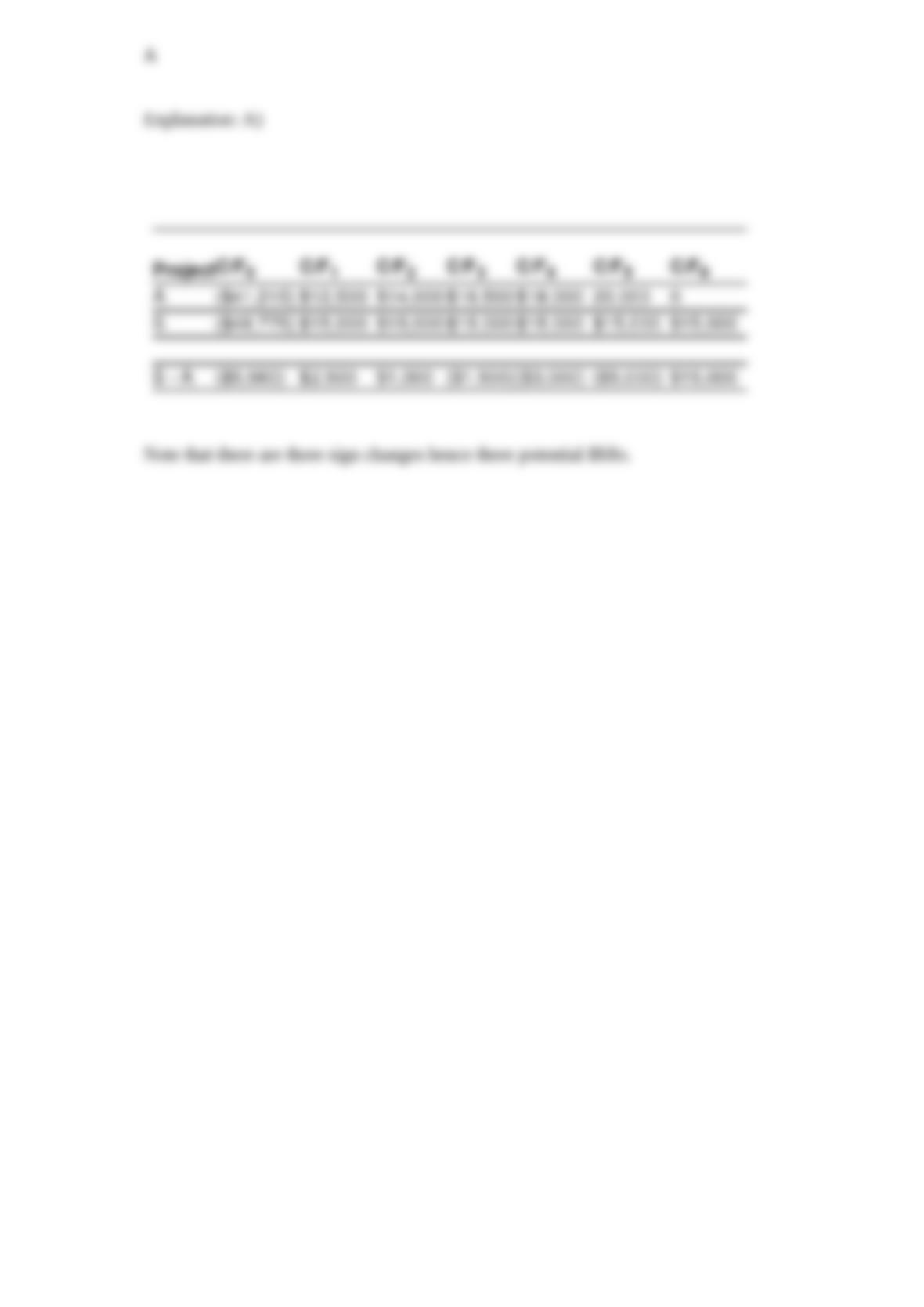
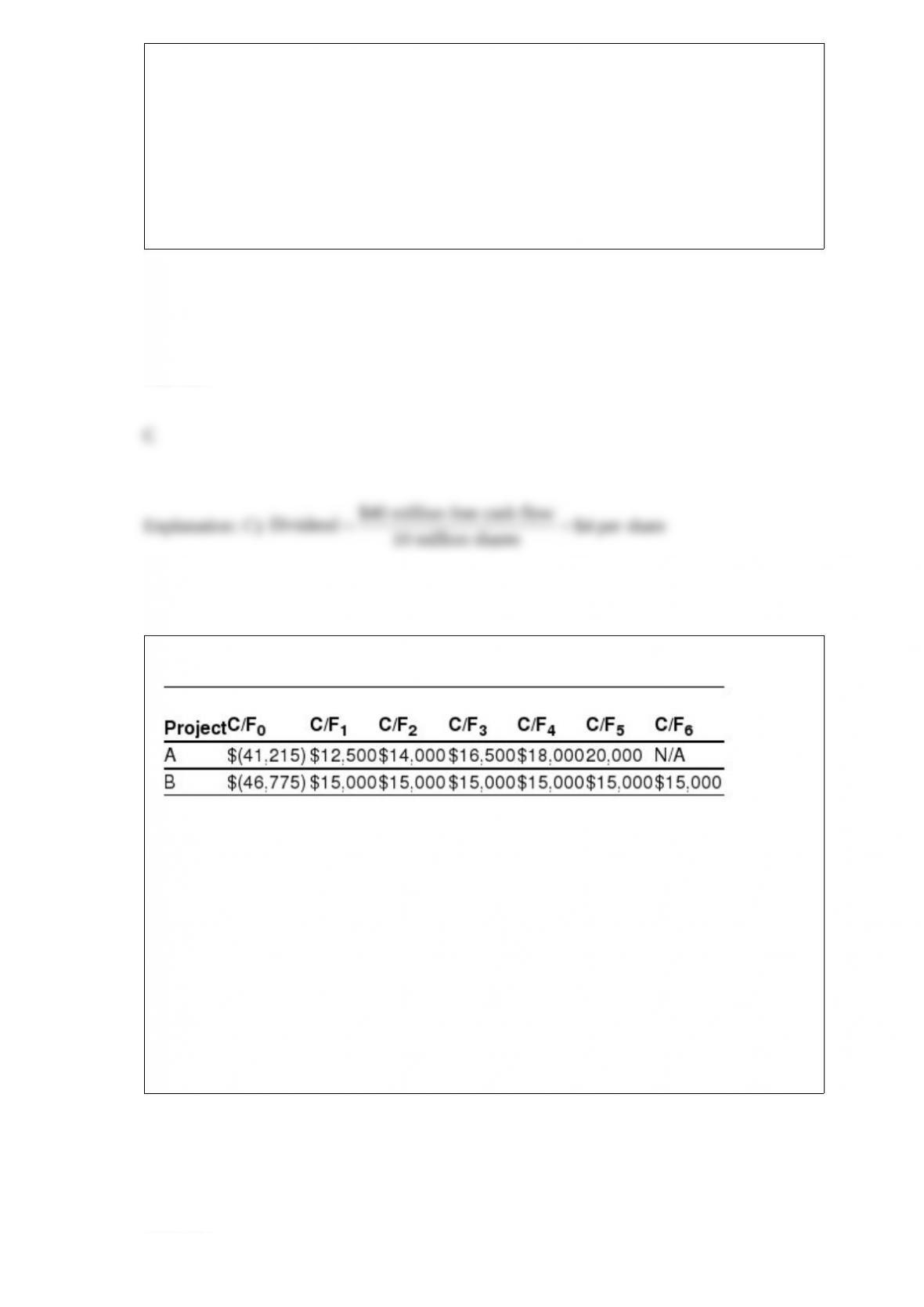
Consider two mutually exclusive projects with the following cash flows:
You are considering using the incremental IRR approach to decide between the two
mutually exclusive projects A & B. How many potential incremental IRRs could there
be?
A) 3
B) 0
C) 2
D) 1
Answer: