
Consider an asset that costs $465,000 and is depreciated straight-line to zero over its
six-year tax life. The asset is to be used in a four-year project; at the end of the project,
the asset can be sold for $120,000. If the relevant tax rate is 35 percent, what is the
aftertax cash flow from the sale of this asset?
A. $132,250
B. $155,000
C. $116,500
D. $97,600
E. $79,200
Answer:
The Outpost currently sells short leather jackets for $349 each. The firm is considering
selling long coats also. The coats would sell for $689 each and the company expects to
sell 900 a year. If the firm decides to carry the long coat, management feels that the
sales of the short jacket will decline from 1,420 to 1,265 units. Variable costs on the
jacket are $210 and $445 on the long coat. The fixed costs for this project are $42,000,
depreciation is $11,000 a year, and the tax rate is 33 percent. What is the projected
operating cash flow for this project?
A. $108,187
B. $111,264
C. $112,212
D. $119,672
E. $120,418
Answer:
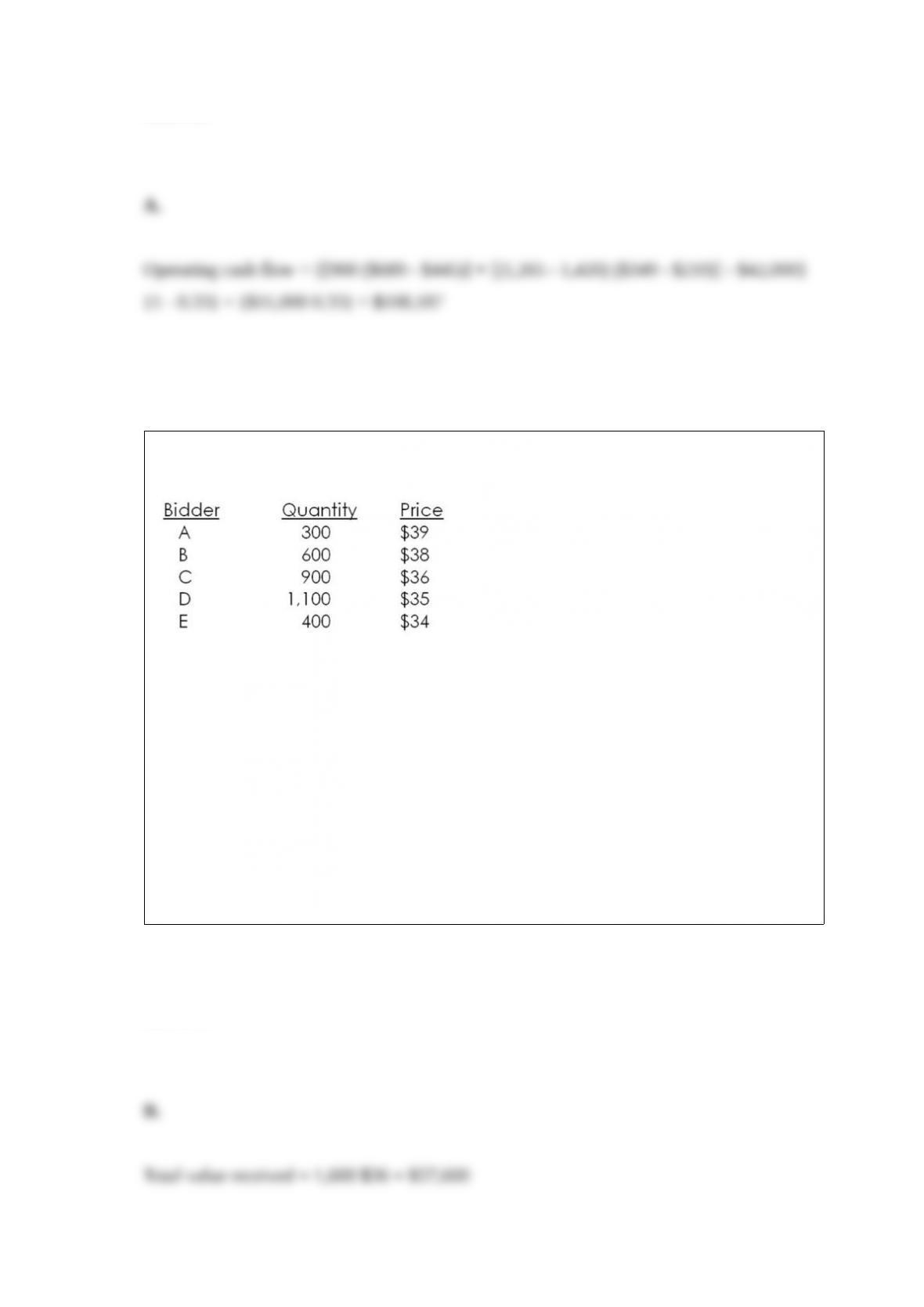
Fresh Foods would like to sell 1,600 shares of stock using a Dutch auction. The bids
received are as follows:
What is the total amount the issuer will receive from this auction? Ignore costs.
A. $59,700
B. $57,600
C. $56,500
D. $54,000
E. $51,000
Answer:

Which one of the following will increase the cash flow from assets for a tax-paying
firm, all else constant?
A. An increase in net capital spending
B. A decrease in the cash flow to creditors
C. An increase in depreciation
D. An increase in the change in net working capital
E. A decrease in dividends paid
Answer:
Which one of the following is the vertical intercept of the security market line?
A. Market rate of return
B. Individual security rate of return
C. Market risk premium
D. Individual security beta multiplied by the market risk premium
E. Risk-free rate
Answer:

Which one of the following terms applies to a bond that initially sells at a deep discount
and pays no interest payments?
A. Callable
B. Income
C. Zero coupon
D. Convertible
E. Tax-free
Answer:
Which one of the following best describes an arithmetic average return?
A. Total return divided by N – 1, where N equals the number of individual returns
B. Average compound return earned per year over a multiyear period
C. Total compound return divided by the number of individual returns
D. Return earned in an average year over a multiyear period
E. Positive square root of the average compound return
Answer:
Home Supply, Inc. has compiled the following information:
For 2014, the cash flow from assets is _____ and the cash flow to shareholders is
______.
A. $49,100; $62,500
B. $49,100; $76,800
C. $49,100; $81,100
D. $56,400; $76,800
E. $56,400; $79,300
Answer:

Which one of the following is the rate of return an investor earns on a bond before
adjusting for inflation?
A. Nominal rate
B. Real rate
C. Dirty rate
D. Coupon rate
E. Clean rate
Answer:
Highly liquid assets:
A. increase the probability a firm will face financial distress.
B. appear on the right side of a balance sheet.
C. generally produce a high rate of return.
D. can be sold quickly at close to full value.
E. include all intangible assets.
Answer:

Smiley Industrial Goods has bonds on the market making annual payments, with 13
years to maturity, and selling for $1,095. At this price, the bonds yield 6.4 percent.
What must the coupon rate be on these bonds?
A. 6.67 percent
B. 6.84 percent
C. 7.23 percent
D. 7.50 percent
E. 7.83 percent
Answer:
A note is a(n):
A. unsecured debt that is generally payable within the next 10 years.
B. formal type of loan that is secured by real estate.
C. long-term debt secured by part, or all, of the assets of the borrower.
D. debt that is secured by a borrower’s accounts receivable.
E. written agreement that details the information relative to a bond issue.

Answer:
Which one of the following will decrease the present value of an annuity?
A. Increase in the annuity’s future value
B. Increase in the payment amount
C. Increase in the time period
D. Decrease in the discount rate
E. Decrease in the annuity payment
Answer:
The specific location on the floor of an exchange where a particular security is traded is
called a:
A. box office.
B. figure 6.
C. DMM’s post.

D. trading booth.
E. seat.
Answer:
Which one of the following statements is correct, all else held constant?
A. Beta is used to compute the return on equity and the standard deviation is used to
compute the return on preferred.
B. A decrease in a firm’s WACC will increase the attractiveness of the firm’s investment
options.
C. The aftertax cost of debt increases when the market price of a bond increases.
D. If you have both the dividend growth and the security market line’s costs of equity,
you should use the higher of the two estimates when computing WACC.
E. WACC is applicable only to firms that issue both common and preferred stock.
Answer:

A stock has an expected return of 15.0 percent, the risk-free rate is 3.2 percent, and the
market risk premium is 8.1 percent. What must the beta of this stock be?
A. 0.88
B. 0.94
C. 1.08
D. 1.31
E. 1.46
Answer:
Which one of the following is an indicator that an investment is acceptable?
A. Modified internal rate of return equal to zero
B. Profitability index of zero
C. Internal rate of return that exceeds the required return
D. Payback period that exceeds the required period
E. Negative average accounting return
Answer:

Which one of the following methods of analysis ignores the time value of money?
A. Net present value
B. Internal rate of return
C. Discounted cash flow analysis
D. Payback
E. Profitability index
Answer:
Which one of the following statements is correct concerning dividends in the U.S.?
A. The total amount of dividends paid by the S&P 500 companies has increased steadily
every year since 1985.
B. Only financial sector firms decreased dividends in 2008.
C. Dividend amounts tend to react quickly to changes in the economy.
D. Firms tend to quickly adjust their dividends to changes in the firm’s earnings per
share.
Answer:

The Underground Cafe has an operating cash flow of $187,000 and a cash flow to
creditors of $71,400 for the past year. During that time, the firm invested $28,000 in net
working capital and incurred net capital spending of $47,900. What is the amount of the
cash flow to stockholders for the last year?
A. -$171,500
B. -$86,700
C. $21,200
D. $39,700
E. $111,100
Answer: