1) Lease obligations currently appear only in the footnotes of U.S. corporate financial
statements.
2) Companies generally prefer to maintain some minimum cash balance.
3) The Internet impacts e-commerce by creating a mechanism for improved
communications between a business, its customers, and its suppliers.
4) Taking on additional debt will reduce the cost of equity.
5) It is possible for companies to operate with negative cash balances on their books.
6) Small-denomination certificates of deposit are usually more liquid than
large-denomination CDs.
7) One reason that investors may prefer dividends to reinvestment by the firm is that
dividend payments provide information to the investor.
8) If an acquiring firm’s merger proposal was initially rejected by a target firm’s
management and its board of directors, the acquiring firm could utilize a tender offer to
gain control of the target firm.
9) With non-mutually exclusive events and no capital rationing, we will usually arrive
at the same conclusions using either the net present value or internal rate of return
methods.
10) Vertical integration usually represents acquisition of a competitor.
11) Generally, the pro forma income statement and balance sheet must be created before
the cash budget is completed.
12) An amount of money to be received in the future is worth less today than the stated
amount.
13) Cyclical businesses are likely to have higher costs of capital than firms with less
variability in earnings. Therefore, more cyclical firms should typically use a higher
discount rate in project evaluation.
14) Novelty Gifts Inc. is experiencing some inventory control problems. The manager,
Wanda LaRue, currently orders 10,000 units four times each year to handle the annual
demand of 40,000 units. Each order costs $15 and each unit costs $1.50 to carry. Ms.
LaRue maintains a safety stock of 200 units.
a) What is Novelty Gifts’ current total annual inventory cost?
b) Calculate the economic ordering quantity (EOQ).
c) What is average inventory under EOQ if Ms. LaRue maintains a safety stock of 200
units.
d) Calculate total annual inventory cost under EOQ. How does this compare to her
current inventory costs?
15) Assume a project has earnings before depreciation and taxes of $15,000,
depreciation of $25,000, and that the firm has a 30% tax bracket. What are the after-tax
cash flows for the project?
A.A positive $18,000
B.A positive $19,000
C.A loss of $21,000
D.None of these options
16) Which of the following is true of forward and spot rates?
A.The premium or discount is usually 7-10%
B.Spot and forward transactions generally occur on the organized exchange
C.The length of a forward contract is generally between one and six months
D.None of these options
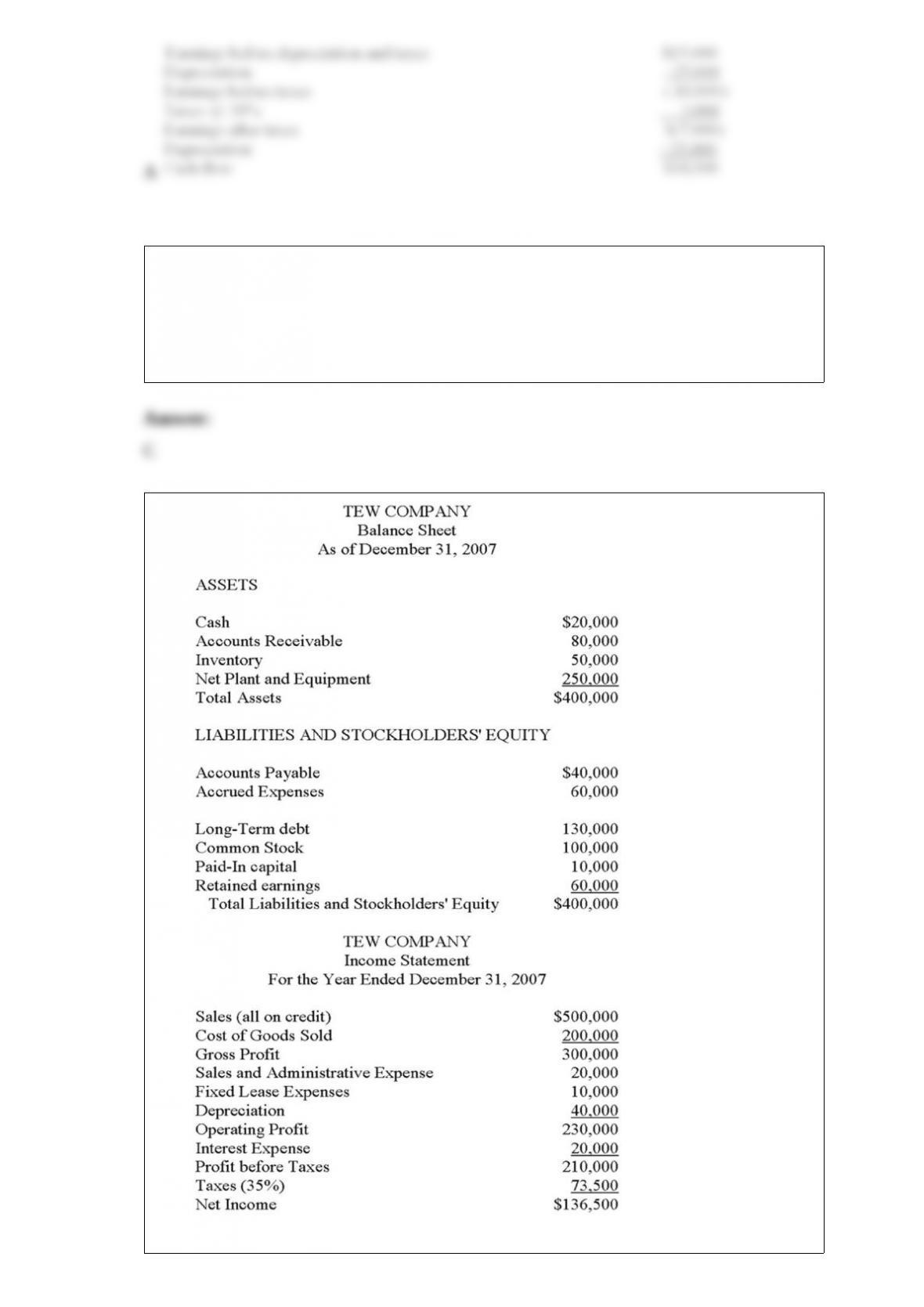
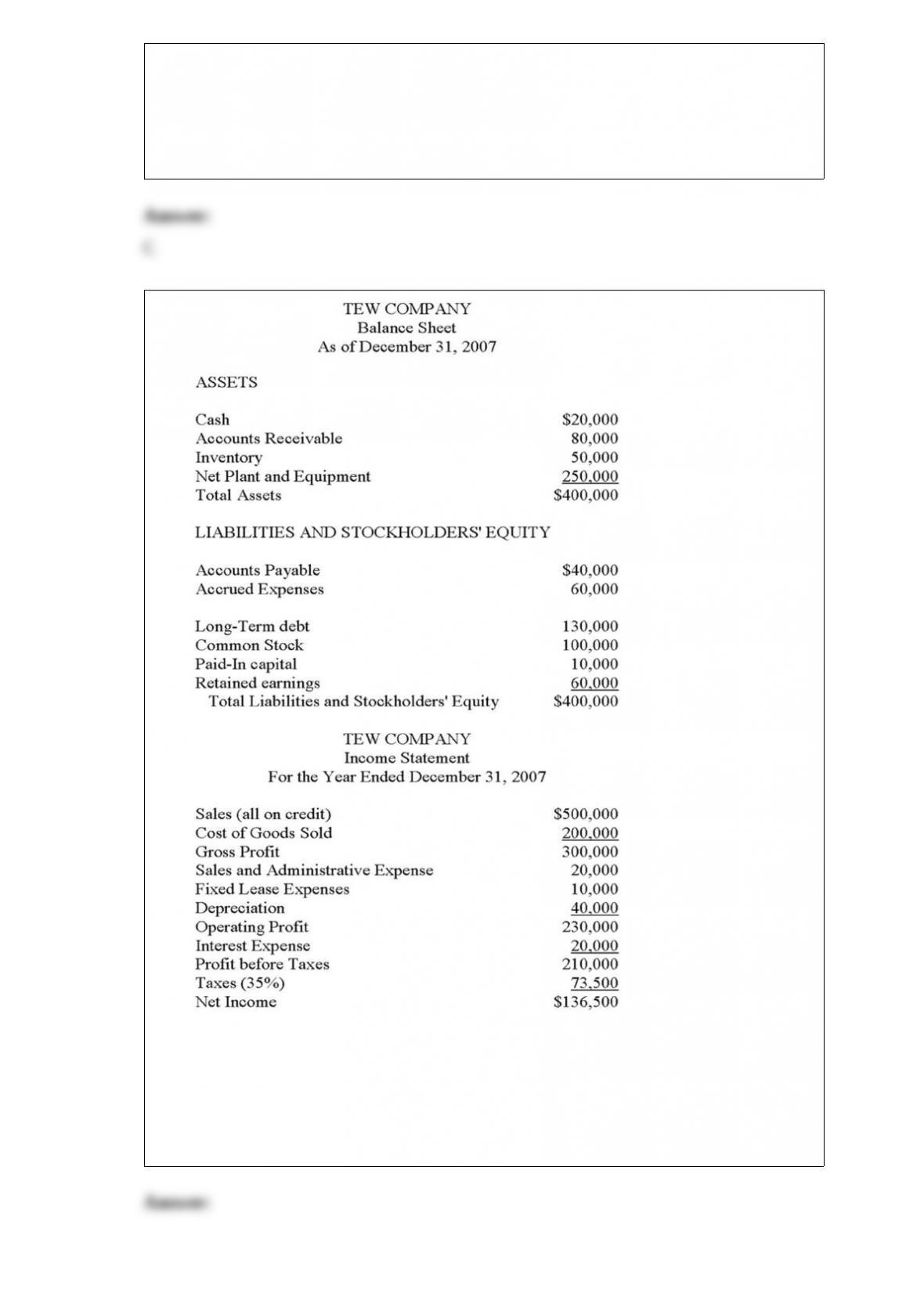
17)
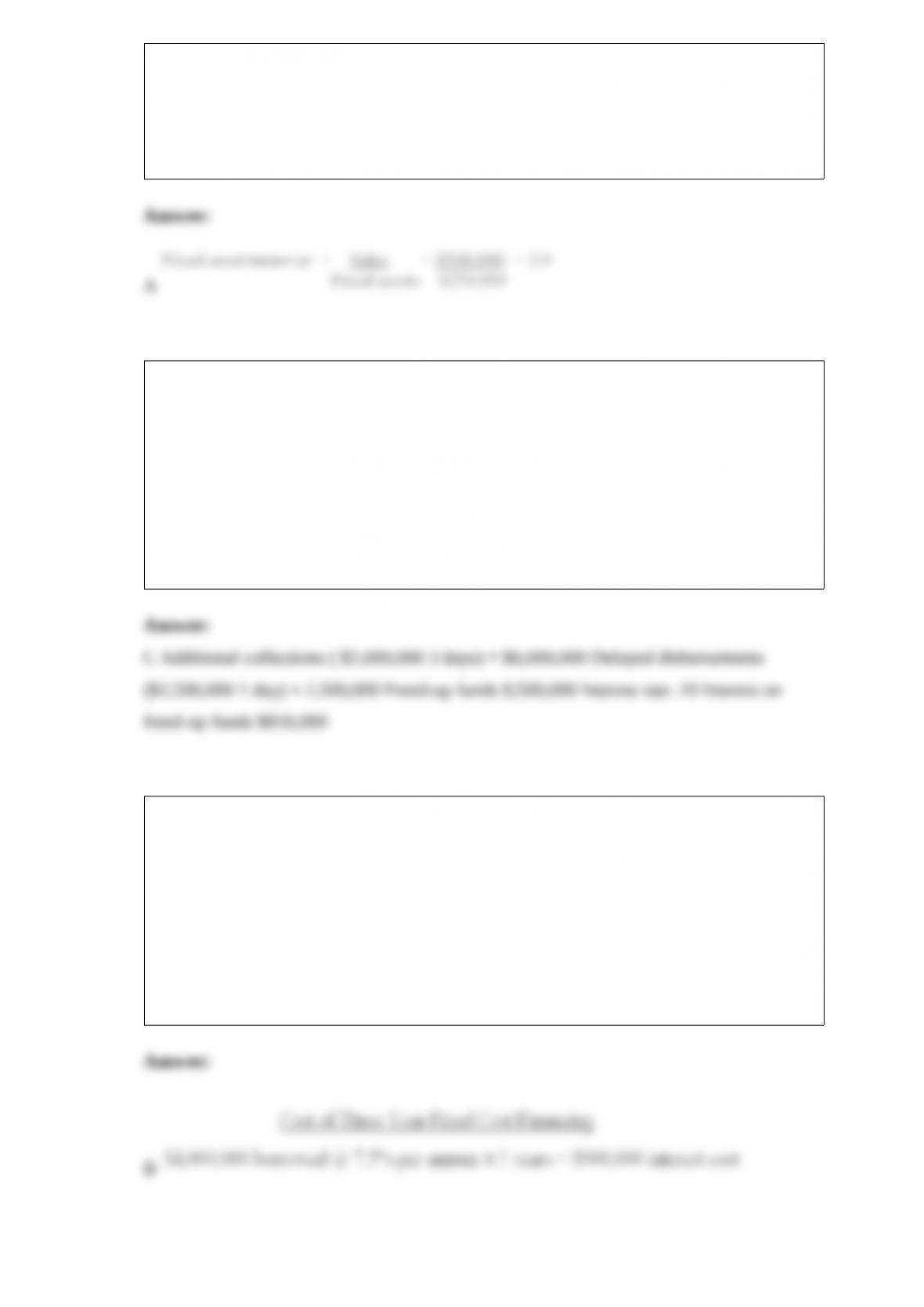
Refer to the figure above. The firm’s fixed asset turnover ratio is ____.
A.2.0x
B.1.6x
C.0.5x
D.1.3x
18) If a company can implement cash management systems and save three days by
reducing remittance time and one day by increasing disbursement time based on
$2,000,000 in average daily remittances and $2,500,000 in average daily disbursements
and their return on freed-up funds is 10%, what is the maximum that they should spend
on the system?
A.$2,000,000
B.$650,000
C.$850,000
D.$1,000,000
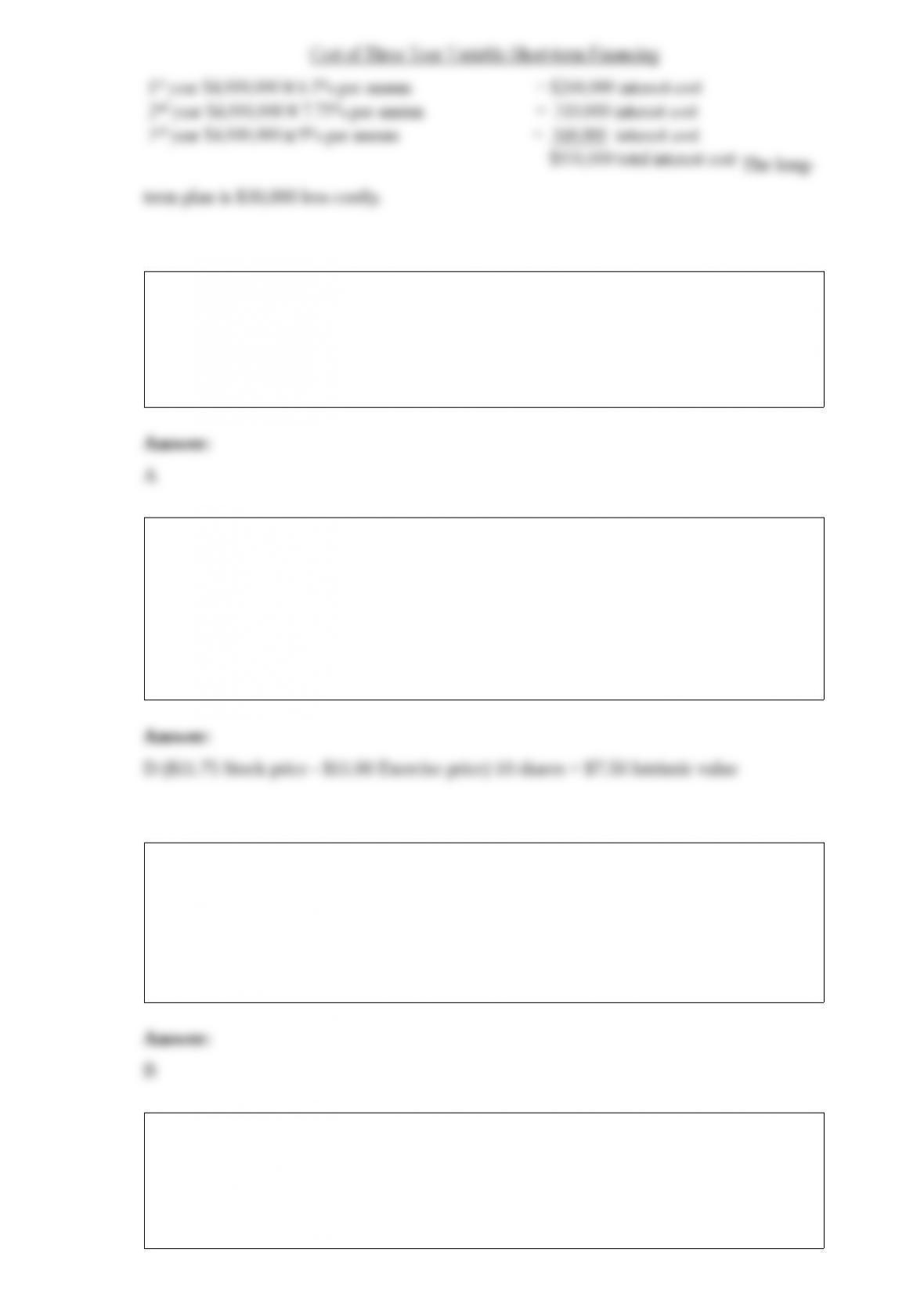
19) Riley Co. is considering a short-term or long-term financing plan for $4,000,000 in
assets. They expect the following one-year rates over the next three years: 6.5%, 7.75%,
and 9%. Their long-term interest rate will be 7.5% for the three years. Assuming the
rates follow their expectations, what will be the difference in interest costs over the
three years?
A.Long-term interest will be $30,000 more than short-term interest
B.Long-term interest will be $30,000 less than short-term interest
C.Long-term interest will be $140,000 less than short-term interest
D.None of the options
20) In planning mergers, there is a tendency to _____ synergistic benefits.
A.overestimate
B.underestimate
C.correctly estimate
D.not estimate
21) Sen Corporation warrants carry the right to buy 10 shares of Sen common stock at
$11.00 per share. The common stock has a current market price of $11.75 per share.
The intrinsic or minimum value of one Sen warrant is ________.
A.$0
B.$1.50
C.$15
D.$7.50
22) As mergers, acquisitions, and restructuring have increased in importance, agency
theory has become more important in assessing whether
A.a stock repurchase should be undertaken
B.shareholder goals are truly being achieved by managers in the long run
C.managers are actually agents or only employees of the firm
D.managers and owners are actually the same people with the same interests
23) How many of the following items are found on the balance sheet, rather than the
income statement?
Accounts receivable
Retained earnings

Income tax expense
Accrued expenses
Cash
Selling and administrative expenses
Plant and equipment
Operating expense
Marketable securities
Interest expense
A.Three of these items are found on the balance sheet
B.Four of these items are found on the balance sheet
C.Five of these items are found on the balance sheet
D.Six of these items are found on the balance sheet
24) Characteristics of a money market deposit account include
A.a lower risk than money market funds
B.insurance by federal agencies
C.generally a limit of three deposits or withdrawals per month
D.All of the options
25) The computation of “basic earnings per share” will include consideration of
A.all convertible securities
B.only shares outstanding
C.shares outstanding and convertible securities
D.None of these options
26) Match the following with the items below:
1>fixed costs
2>financial leverage
3>leverage (concept in general)
4>degree of combined leverage
5>variable costs
6>combined leverage
7>degree of operating leverage
8>degree of financial leverage
9>contribution margin
10>operating leverage
11>break-even analysis

12>nonlinear break-even analysis
A. A reflection of the extent that fixed assets and fixed costs are utilized in the business
firm.
B. The amount of fixed costs covered by each unit of sales. This amount is derived by
subtracting variable cost per unit from the sales price of each unit.
C. Costs that move directly with a change in volume.
D. A measure of the impact of fixed costs on earnings from the operation’s viewpoint of
the firm.
E. A numerical and graphical technique used to determine at what point the firm will
equate its costs and revenues.
F. The use of fixed charge obligations with the intent of magnifying the potential returns
to the owners of the firm.
G.A measure of the amount of debt used in the capital structure of the firm.
H. Costs that remain relatively constant regardless of the volume of sales, as long as
they are within the company’s relevant range.
I. A measure of the impact of debt on the earnings capability of the firm.
K. The total impact of operating and financial leverage.
L. The use of break-even analysis based on the assumption that cost and revenue
relationships to quantity sold may vary at different levels of sales.
M. A measure of the total effect on earnings per share of operating and financial
leverage.
27) The floating rate feature on preferred stock allows the shareholders
A.to receive more dividends than the quoted yield when the firm enjoys a good year
B.to pay lower taxes when the dividend yield increases
C.to receive dividends that the corporation did not pay in previous years
D.to receive a higher or lower dividend yield depending on current competitive market
conditions
28) The conversion premium will be large
A.if investors have great expectations for the price of the common stock
B.if interest rates decline
C.when the conversion value is much greater than the pure bond value
D.when the stock price is very stable
29) A firm is paying an annual dividend of $2.65 for its preferred stock that is selling
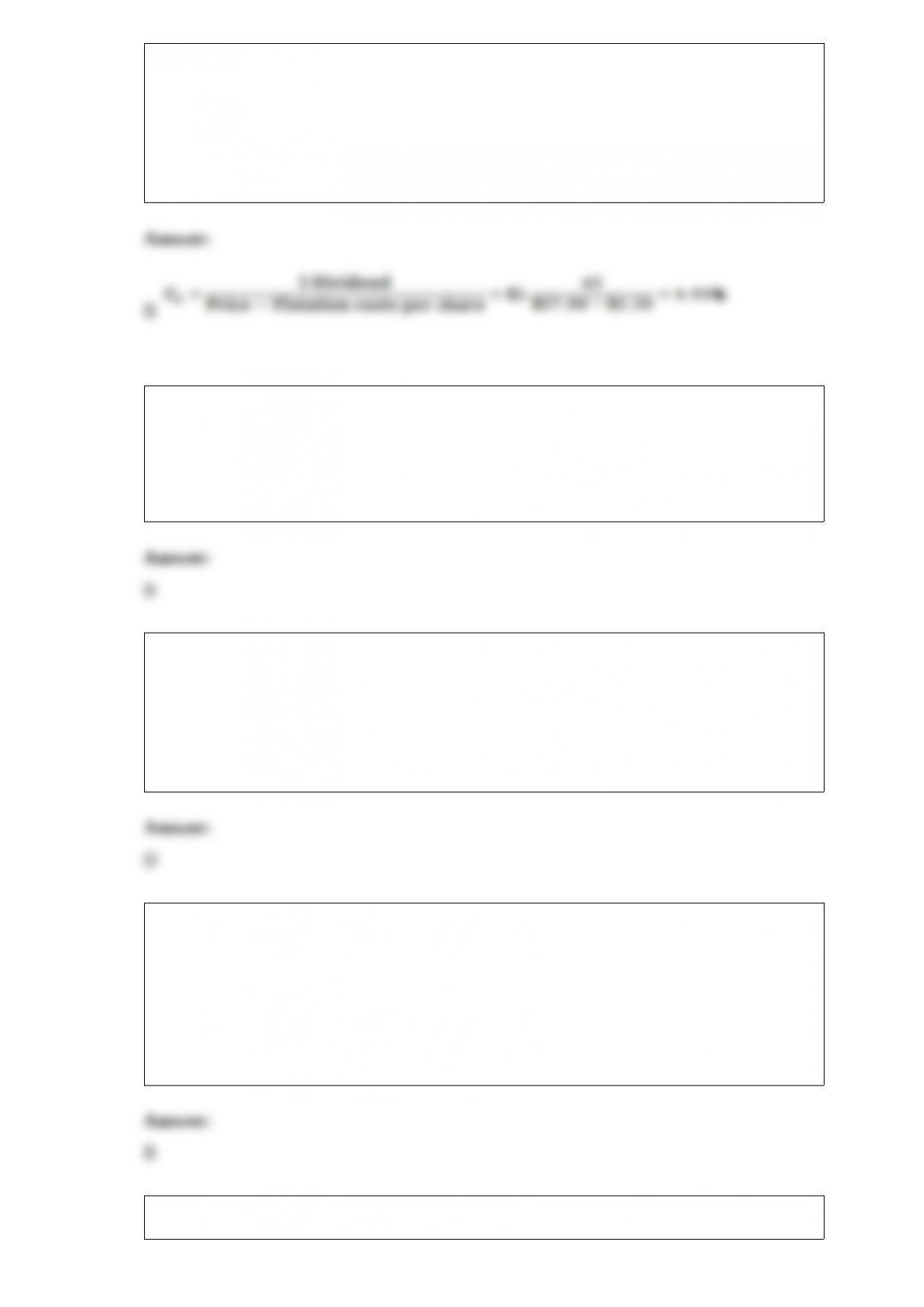
for $57.00. There is a selling cost of $3.30. What is the after-tax cost of preferred stock
if the firm’s tax rate is 33%?
A.2.02%
B.4.93%
C.5.79%
D.6.11%
30) Which of the following is true about warrants?
A.At high stock prices, the warrant premium is high
B.A rising stock price is usually followed by an increase in the price of the warrant
C.Both of these options are true
D.None of these options are true
31) A decreasing average collection period could be associated with (select the one best
answer)
A.increasing sales
B.decreasing sales
C.decreasing accounts receivable
D.increasing sales and decreasing accounts receivable
32) A reverse stock split
A.occurs when a company wants to increase the price of its common stock because the
market hasn’t recognized the improvements the company has made in achieving
profitability
B.exchanges fewer new shares of common stock for old shares of common stock
C.will not change earnings per share
D.is more popular in bull markets than in bear markets
33) Holland Construction Co. has an outstanding 180-day bank loan of $475,000 at an
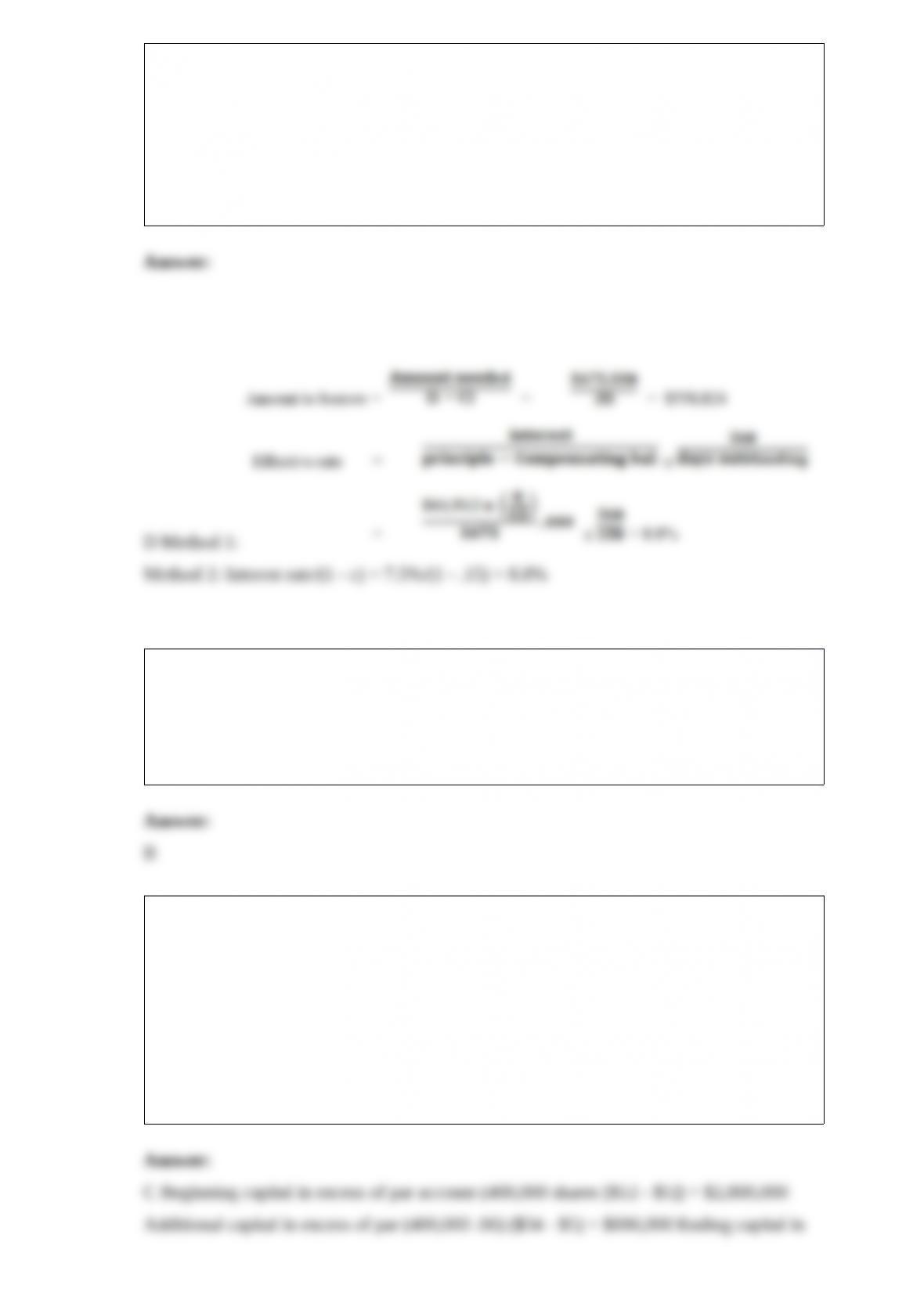
annual interest rate of 7.5%. The company is required to maintain a 15% compensating
balance in its checking account. What is the effective interest rate on the loan? Assume
the company would not normally maintain this average amount.
A.11.2%
B.19.0%
C.22.45%
D.8.8%
34) The economic order quantity
A.assumes that inventory usage is seasonal
B.assumes that delivery times of each order are consistent
C.considers stock-outs
D.All of the options
35) CBA Inc has 400,000 shares outstanding with a $5 par value. The shares were
issued for $12. The stock is currently selling for $34. CBA has $5,000,000 in retained
earnings and has declared a stock dividend that will increase the number of outstanding
shares by 6%. What will be the “capital in excess of par account” after the stock
dividend?
A.$7,685,000
B.$2,685,000
C.$3,496,000
D.$2,385,000

36) In using a systems approach to financial planning, it is necessary to develop a
A.pro forma income statement
B.cash budget
C.pro forma balance sheet
D.All of the options
37) The subscription rate of a new offering is generally _______ than the rights-on
price and _______ than the ex-rights price.
A.higher; higher
B.higher; lower
C.lower; higher
D.lower; lower
38) Dan would like to save $1,500,000 by the time he retires in 25 years and believes he
can earn an annual return of 8%. How much does he need to invest in each of the
following years to achieve his goal?
A.$20,518
B.$40,850
C.$18,900
D.$58,000
E.$25,304
39) Money market funds
A.are modeled after money market deposit accounts
B.are insured up to $100,000
C.have a minimum balance of $2,500
D.earn competitive market rates of return

40) Well-implemented Web-based supply chain management has all of the following
benefits except
A.it reduces inventory on hand
B.it speeds up the ordering and delivery process
C.it reduces the number of suppliers bidding for a company’s business
D.it decreases overall costs
41) A home buyer signed a 20-year, 8% mortgage for $72,500. Given the following
information, how much should the annual loan payments be?
Present value of $1 PVIF = .215
Future value of $1 FVIF = 4.661
Present value of annuity PVIFA = 9.818
Future value of annuity FVIFA = 45.762
A.$1,584
B.$7,384
C.$15,555
D.$15,588
42) Zero-coupon bonds
A.provide no annual interest payments
B.have highly stable prices even with changing interest rates
C.provide an investor with tax-free income until maturity
D.Two of the options
43) Match the following with the items below:
1>underpricing
2>aftermarket
3>privatization
4>shelf registration
5>underwriting syndicate
6>leveraged buyouts
7>agent
8>underwrite
9>best efforts

10>restructuring
A. The act of taking on any risk that might be associated with the issue of a new
security.
B. Taking on the responsibility of distributing a security without transferring the risk
associated with the new issue from the company to the investment banker.
C. A group of investment bankers formed to share the risk of a security offering.
D. The act of setting the price of a new security slightly under the market value to
ensure a receptive sale.
E. A secondary market where securities are traded after their initial offering to the
public.
F.One who sells or places an asset for another party.
G. Permits large companies to file one comprehensive statement with the Securities and
Exchange Commission (SEC) outlining their financial plans for the next two years.
H. Occurs when either management or another investment group borrows most of the
needed cash to repurchase all traded shares from the stockholders.
I. When divisions and products are sold and assets are redeployed into higher-yielding
areas.
J. Investment bankers that take a company public, but instead of selling companies
owned by individuals, the investment bankers sell companies previously owned by
governments.
44) Dr. J. wants to buy a Dell computer that will cost $3,000 three years from today. He
would like to set aside an equal amount at the end of each year in order to accumulate
the amount needed. He can earn an 8% annual return. How much should he set aside
beginning a year from now?
A.$879
B.$627
C.$924
D.$1,243
45) When the term structure of interest rates is downward sloping and interest rates are
expected to decline, the
A.financial manager generally borrows short-term
B.financial manager borrows at the lower long-term rates
C.corporation’s ratio of short-term to long-term debt is low
D.None of the options
46) Large firms tend to be
A.net users of trade credit
B.net suppliers of trade credit
C.firms with high levels of profitability
D.firms with low levels of inventory turnover and accounts receivable turnover
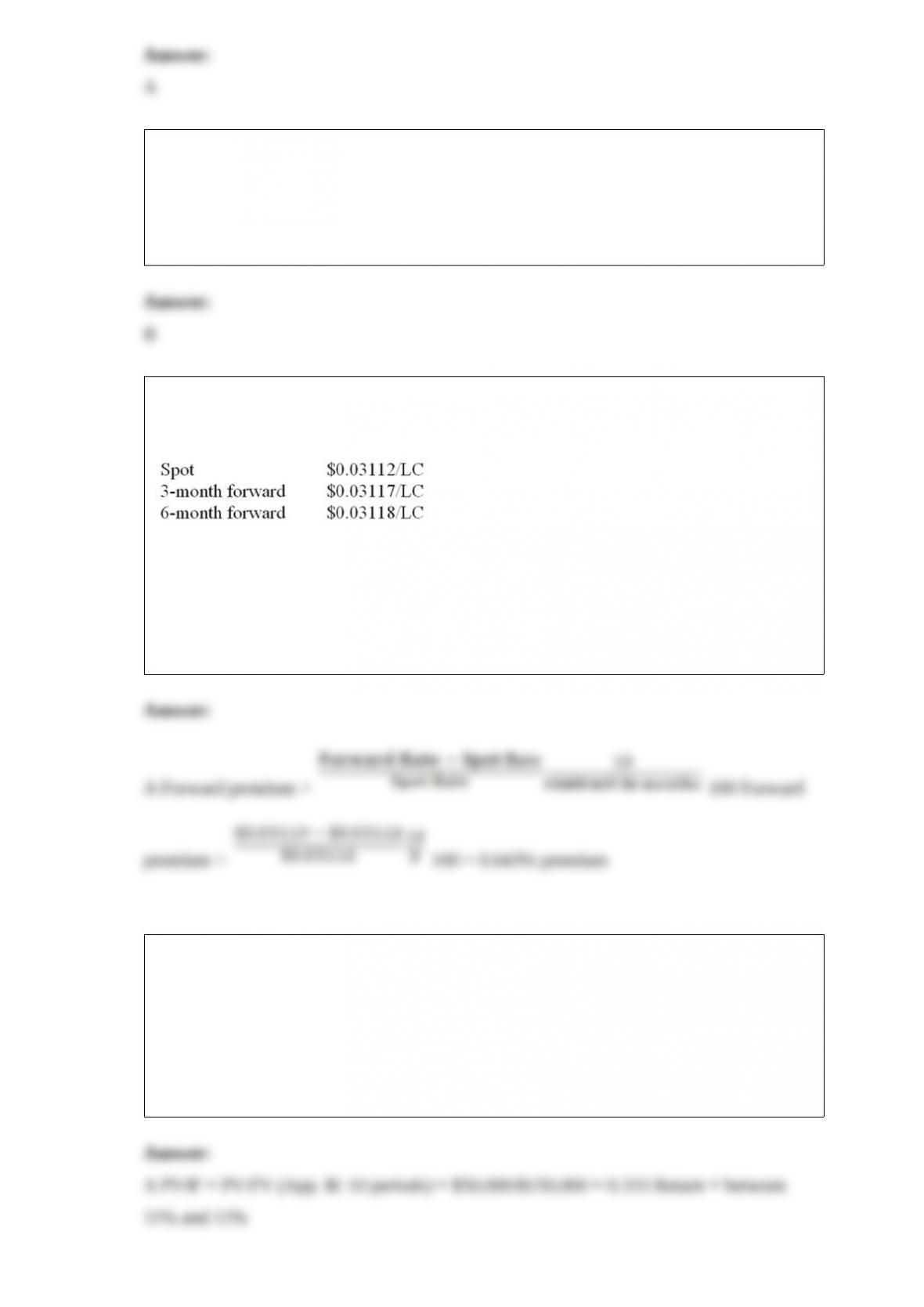
47) The following are the prices in the foreign exchange market between the U.S. dollar
and another local currency (LC).
What was the approximate discount or premium on a three-month forward for LC?
A.0.643% premium
B..013% premium
C..013% discount
D.0.643% discount
48) Kathy has $50,000 to invest today and would like to determine whether it is
realistic for her to achieve her goal of buying a home for $150,000 in 10 years with this
investment. What return must she achieve in order to buy her home in 10 years?
A.About 12%
B.About 13%
C.About 9%
D.About 10%
49) Tobin’s Barbeque has a bank loan at 8% interest and an after-tax cost of debt of 6%.
What will the after-tax cost of debt be when the loan is due if a new loan is taken out
yielding 11%.
A.7.52%
B.8.25%
C.13.33%
D.None of these options
50) The Burma Hat Company’s warrant is trading for $10.20. The warrant carries the
option to purchase two shares of common stock for $48. What is the speculative
premium if the stock price is $51.30?
A.$3.30
B.$3.60
C.$6.60
D.None of these options
51) The cost of not taking the discount on trade credit of 3/20, net 90 is approximately
______.
A.15.9%
B.16.3%
C.18.0%
D.17.4%
52) The “efficient frontier” indicates
A.alternatives with neutral combinations of risk and return
B.alternatives with the highest returns
C.alternatives with the best combination of risk and return
D.alternatives with no risk
53)
Refer to the figure above. Tew’s quick ratio is ____.
A.1.5:1
B.1:1
C.2:1
D.None of the options