
1) With an auto leasing arrangement, you are renting the car with the ownership title
remaining with the lease grantor.
2) Approximately 20 percent of all loans granted by consumer finance companies are
for the purpose of debt consolidation.
3) The money left over after a company pays its expenses and interest to bondholders is
called profit.
4) Generally speaking, there is a trade-off between risk and rewards on investments.
5) A debt management plan is an arrangement whereby the consumer makes monthly
payments that are distributed to each creditor.
6) When one forgoes buying a new television set because he or she spends the money
on college books, the television set is the opportunity cost of buying the books.
7) Future value is the valuation of an asset projected to the end of a particular time
period in the future.

8) The early termination payoff is the total amount you would need to repay should you
wish to end the lease agreement early and includes the early termination charge and the
unpaid lease balance.
9) The surplus section on an individual’s cash-flow statement is similar to net profit for
a business.
10) A policy with high annual limits may not be a good buy if episode limits are too
low.
11) Personal injury protection pays the driver and passengers in the covered automobile
without regard to fault.
12) Insurance companies use statistical information to establish rates for various classes
of insureds.
13) A buyer of a futures contract benefits if the price of the commodity increases.
14) Volatility is a mutual fund’s tendency to rise and fall in price over a period of time.

15) Charitable contributions of goods and property to a qualifying organization should
be valued at fair market value when used as an itemized deduction.
16) Speculative investments are associated with
a. high-risk investments
b. options
c. futures contracts
d. all of these
17) Which of the following types of assets is primarily used for emergencies,
maintenance of living expenses, savings, and payment of bills?
a. Monetary
b. Tangible
c. Investment
d. Capital
18) Which of the following is (are) required to withdraw money from an automated
teller machine (ATM)?
a. Debit card
b. Credit card
c. Personal identification number
d. ATM card and personal identification number
19) Which is not an advantage of dollar-cost averaging?
a. It reduces the average share cost
b. It avoids the risks of investment timing
c. It minimizes taxes
d. It requires investor discipline

20) The practice in which any unspent dollars in an account at the end of the year are
forfeited and not returned to the employee is known as the
a. use-it-or-lose-it rule
b. defined-contribution retirement plan
c. situation of taxes paid out
d. expense reimbursement account
21) The cost of a health maintenance organization is generally a(n)
a. monthly fee and coinsurance
b. annual premium and a deductible
c. monthly premium, deductible, and coinsurance
d. monthly fee, a deductible, and copayments
22) The legal document detailing the debtor’s responsibilities regarding the bond issue
is called the
a. debenture
b. registration
c. mortgage obligation
d. indenture
23) Liz Guillot, a university student, earned $4,000 working as a waitress during the
summer and over Christmas vacation last year. How many Social Security credits did
Liz earn for Social Security coverage?
a. 1
b. 2
c. 3
d. 4

24) Buying without fully considering priorities and alternatives is called
a. impulse buying
b. unplanned purchasing
c. money saving
d. planned buying
25) Real estate property taxes are typically not
a. locally assessed taxes
b. tax-deductible expenses
c. levied on the assessed value of property
d. based on the purchase price of the home
26) ____ is (are) generally part of the monthly house payment.
a. Principal and interest
b. Real estate property taxes
c. Homeowner’s insurance premium
d. All of these
27) Martha and Gordon purchased a home for $175,000 six years ago with a 7.5
percent, 30-year $140,000 mortgage. Their home now has a market value of $210,000
and they owe $134,000 on the mortgage. What is the equity in their home?
a. $76,000
b. $70,000
c. $41,000
d. $35,000
28) When a stock dividend is paid out,
a. the total value of an individual’s holdings will increase
b. each current shareholder will receive more shares of stock
c. the total value of the corporation will increase
d. each shareholder will own a larger percentage of the corporation

29) The full additional cost of credit measured in dollars is called the
a. APR
b. interest
c. finance charge
d. finance fee
30) The average length of a bull market is ____ months, whereas the average length of
a bear market is ____ months.
a. 10; 25
b. 25; 10
c. 14; 33
d. 29; 9
31) Canceled checks provide a source of information for the value of
a. assets
b. liabilities
c. income
d. expenditures
32) A brokerage firm that maintains an inventory of specific securities to sell to other
brokerage firms and stands ready to buy these same securities at market price is ____
these securities.
a. making a market in
b. underwriting
c. issuing
d. churning
33) At a minimum you should contribute enough into your retirement account to receive
the maximum

a. employer matching contribution
b. tax write-off
c. take-home pay
d. earned income credit
34) High-income households who have sufficient adjustments, deductions and credits to
reduce their income tax liability to low levels may instead be subject to the
___________________ so that they pay a more appropriate level of taxes for their
gross income.
a. alternative-minimum tax
b. value-added tax
c. progressive adjusted tax
d. gross adjusted tax
35) The purpose of a revolving savings fund is to
a. save for long-term goals
b. accumulate funds for large, irregular expenses
c. meet occasional deficits
d. both accumulate funds for large, irregular expenses and meet occasional deficits
36) Dana Garcia has a renter’s policy with a maximum limit for personal property of
$30,000. When her apartment suffered fire damage, $15,000 of her personal property
was destroyed. The insurance would pay no more than ____ in this case.
a. $30,000
b. $20,000
c. $15,000
d. $5,000
37) In what way(s) can health care costs potentially provide an income tax benefit?
a. Flexible spending arrangement through an employer
b. Itemizing deductions for health expenditures
c. Writing off a portion of premium by self-employed people
d. All of these
38) Lenders use ____ ratios when setting limits on how much a home buyer can
borrow.
a. front-end and back-end
b. only front-end
c. assets-to-debt
d. equity-to-liability
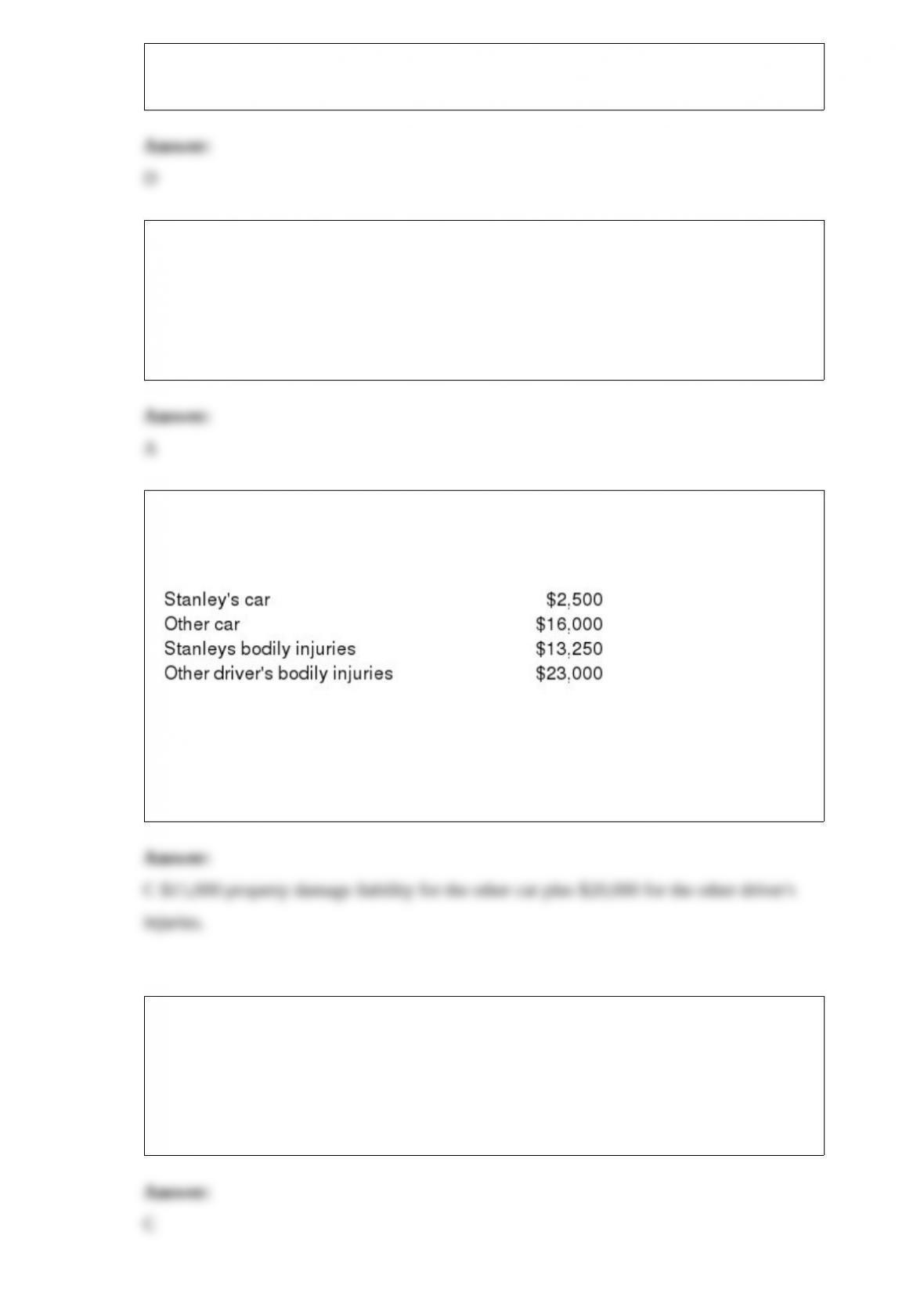
39) Stanley Matthews was involved in an auto accident that was ruled his fault. He
carried only liability coverage on his car, and its limits were only 20/40/15. The
following damages were incurred in the accident:
How much of these damages will Stanley’s auto insurance policy pay?
a. $54,750
b. $39,000
c. $35,000
d. $33,250
40) ____ make both secured and unsecured loans and require repayment on a monthly
installment basis.
a. Sales finance companies
b. Stockbrokers
c. Consumer finance companies
d. Insurance companies

41) All states now require the registration of securities to be sold
a. within the state
b. and the licensing of brokerage firms
c. and the licensing of stockbrokers
d. all of these
42) Which of the following investments normally produce(s) tax-exempt income?
a. Stocks
b. Municipal bonds
c. Corporate bonds
d. All of these
43) The option that one might purchase if he or she wanted to increase the amount of
cash value insurance held in the future is called
a. guaranteed renewability
b. guaranteed insurability
c. multiple indemnity
d. nonforfeiture
44) Debt payments can be handled through either debt-repayment needs or ____ needs.
a. income-replacement
b. final-expense
c. readjustment-period
d. college-expense
45) A POS terminal is an electronic computer terminal located at a store or other
merchant location that allows the customer to
a. use a personal check
b. make a cash withdrawal
c. get a cash advance
d. make purchases

46) Which is not a typical investment found in a bond fund?
a. Corporate bonds
b. Aggressive-growth stocks
c. Preferred stock
d. High-dividend-paying stocks
47) The Fishers did very well on their investment choice. They earned $280 in dividend
income from their stock investment this year. Later in the same year when they sold the
stock, they realized a long-term capital gain of $2,984. How much of this dividend and
capital gain income will they have to pay taxes on?
a. $2,704
b. $2,984
c. $3,264
d. $280
48) The collectibles industry is rife with forgeries, scams, and frauds, particularly with
regard to
a. gems
b. sports items
c. rock star memorabilia
d. religious artifacts
49) Habitability standards for rental property would not include things such as
a. running water
b. heat
c. a dishwasher
d. a working stove

50) The multiple-of-earnings approach addresses only the ____ needs in life insurance
needs evaluation.
a. final-expense
b. readjustment-period
c. debt-repayment
d. income-replacement
51) A fill-or-kill order instructs the stockbroker to buy or sell
a. at the market price or else cancel the order
b. and is valid only for the trading day
c. and remains valid until executed by the stockbroker or canceled by the investor
d. none of these
52) A net surplus in your monthly budget can not be carried forward to the next month.
53) Negative credit information of all types can be kept on your credit bureau file for up
to five years.
54) If you cut up your credit card, the account is effectively closed.
55) If you have an insurance policy with a $300 deductible and 30 percent coinsurance,
you would pay 30 percent of your insured loss plus $300.

56) With a fixed maturity, the borrower agrees to pay the investor a specific rate of
return for use of the principal.
57) Credit card bills only need to inform consumers of the method used to compute the
finance charges.
58) Withdrawals of funds from a non-Roth tax-sheltered retirement plan prior to age 59
are always taxable income and are subject to a 10 percent penalty.
59) The more efficient a market for investments the easier it is to find bargains..
60) Chargebacks are the same as cash discounts.

61) In states with community property laws, the law assumes that the surviving spouse
owns everything that both partners earned during the marriage.