
1) Which of the following is NOT a relevant cash flow and thus should not be reflected
in the analysis of a capital budgeting project?
a.Shipping and installation costs
b.Cannibalization effects
c.Opportunity costs
d.Sunk costs that have been expensed for tax purposes
e.Changes in net working capital
2) Bailey and Sons has a levered beta of 1.10, its capital structure consists of 40% debt
and 60% equity, and its tax rate is 40%. What would Bailey’s beta be if it used no debt,
i.e., what is its unlevered beta?
a.0.64
b.0.67
c.0.71
d.0.75
e.0.79
3) Which of the following statements is CORRECT?
a.All else equal, long-term bonds have less interest rate price risk than short-term bonds
b.All else equal, low-coupon bonds have less interest rate price risk than high-coupon
bonds
c.All else equal, short-term bonds have less reinvestment rate risk than long-term bonds
d.All else equal, long-term bonds have less reinvestment rate risk than short-term bonds
e.All else equal, high-coupon bonds have less reinvestment rate risk than low-coupon
bonds

4) DHF Company has a beta of 1.5 and is currently in equilibrium. The required rate of
return on the stock is 12.00% versus a required return on an average stock of 10.00%.
Now the required return on an average stock increases by 30.0% (not percentage
points). Neither betas nor the risk-free rate change. What would DHF’s new required
return be?
a.14.89%
b.15.68%
c.16.50%
d.17.33%
e.18.19%
5) Which of the following statements is CORRECT?
a. Corporations are at a disadvantage relative to partnerships because they have to file
more reports to state and federal agencies, including the Securities and Exchange
Administration, even if they are not publicly owned
b. In a regular partnership, liability for the firm’s debts is limited to the amount a
particular partner has invested in the business
c. A fast-growth company would be more likely to set up as a partnership for its
business organization than would a slow-growth company
d. Partnerships have difficulty attracting capital in part because of their unlimited
liability, the lack of impermanence of the organization, and difficulty in transferring
ownership.

e. A major disadvantage of a partnership relative to a corporation as a form of business
organization is the high cost and practical difficulty of its formation
6) Which of the following statements is CORRECT?
a.If Project A’s IRR exceeds Project B’s, then A must have the higher NPV
b.A project’s MIRR can never exceed its IRR
c.If a project with normal cash flows has an IRR less than the WACC, the project must
have a positive NPV
d.If the NPV is negative, the IRR must also be negative
e.If a project with normal cash flows has an IRR greater than the WACC, the project
must also have a positive NPV
7) Which of the following statements is CORRECT?
a.An example of an externality is a situation where a bank opens a new office, and that
new office causes deposits in the bank’s other offices to increase
b.The NPV method automatically deals correctly with externalities, even if the
externalities are not specifically identified, but the IRR method does not. This is another
reason to favor the NPV
c.Both the NPV and IRR methods deal correctly with externalities, even if the
externalities are not specifically identified. However, the payback method does not
d.Identifying an externality can never lead to an increase in the calculated NPV
e.An externality is a situation where a project would have an adverse effect on some
other part of the firm’s overall operations. If the project would have a favorable effect
on other operations, then this is not an externality
8) Which of the following statements is CORRECT, assuming stocks are in
equilibrium?
a.Assume that the required return on a given stock is 13%. If the stock’s dividend is
growing at a constant rate of 5%, its expected dividend yield is 5% as well

b.A stock’s dividend yield can never exceed its expected growth rate
c.A required condition for one to use the constant growth model is that the stock’s
expected growth rate exceeds its required rate of return
d.Other things held constant, the higher a company’s beta coefficient, the lower its
required rate of return
e.The dividend yield on a constant growth stock must equal its expected total return
minus its expected capital gains yield
9) Blueline Publishers is considering a recapitalization plan. It is currently 100% equity
financed but under the plan it would issue long-term debt with a yield of 9% and use the
proceeds to repurchase common stock. The recapitalization would not change the
company’s total assets, nor would it affect the firm’s basic earning power, which is
currently 15%. The CFO believes that this recapitalization would reduce the WACC and
increase stock price. Which of the following would also be likely to occur if the
company goes ahead with the recapitalization plan?
a.The company’s earnings per share would decline
b.The company’s cost of equity would increase
c.The company’s ROA would increase
d.The company’s ROE would decline
e.The company’s net income would increase
10) Which of the following statements is CORRECT?
a.Logically, it is easier to estimate the betas associated with capital budgeting projects
than the betas associated with stocks, especially if the projects are closely associated
with research and development activities
b.The beta of an “average stock,” which is also “the market beta,” can change over time,
sometimes drastically
c.If a newly issued stock does not have a past history that can be used for calculating
beta, then we should always estimate that its beta will turn out to be 1.0. This is
especially true if the company finances with more debt than the average firm
d.During a period when a company is undergoing a change such as increasing its use of
leverage or taking on riskier projects, the calculated historical beta may be drastically
different from the beta that will exist in the future
e.If a company with a high beta merges with a low-beta company, the best estimate of
the new merged company’s beta is 1.0

11) Kessen Inc.’s bonds mature in 7 years, have a par value of $1,000, and make an
annual coupon payment of $70. The market interest rate for the bonds is 8.5%. What is
the bond’s price?
a.$923.22
b.$946.30
c.$969.96
d.$994.21
e.$1,019.06
12) Stuart Company’s manager believes that economic conditions during the next year
will be strong, normal, or weak, and she thinks that the firm’s returns will have the
probability distribution shown below. What’s the standard deviation of the estimated
returns? (Hint: Use the formula for the standard deviation of a population, not a
sample.)
Economic
ConditionsProb.Return
Strong30% 32.0%
Normal40% 10.0%
Weak30%-16.0%
a.17.69%
b.18.62%
c.19.55%
d.20.52%
e.21.55%

13) Which of the following statements is CORRECT?
a. The corporate bylaws are a standard set of rules established by the state of
incorporation. These rules are identical for all corporations in the state, and their
purpose is to ensure that the firm’s managers run the firm in accordance with state laws
b. The corporate charter is a standard document prescribed by the state of incorporation,
and its purpose is to ensure that the firm’s managers run the firm in accordance with
state laws. Procedures for electing corporate directors are contained in bylaws, while
the declaration of the activities that the firm will pursue and the number of directors are
included in the corporate charter
c. Companies must establish a home office, or domicile, in a particular state, and that
state must be the one in which most of their business (sales, manufacturing, and so
forth) is conducted
d. Attorney fees are generally involved when a company develops its charter and
bylaws, but since these documents are voluntary, a new corporation can avoid these
costs by deciding not to have either a charter or bylaws
e. The corporate charter is concerned with things like what business the company will
engage in, whereas the bylaws are concerned with things like procedures for electing
the board of directors
14) The CFO of Cicero Industries plans to calculate a new project’s NPV by estimating
the relevant cash flows for each year of the project’s life (i.e., the initial investment cost,
the annual operating cash flows, and the terminal cash flow), then discounting those
cash flows at the company’s overall WACC. Which one of the following factors should
the CFO be sure to INCLUDE in the cash flows when estimating the relevant cash
flows?
a.All sunk costs that have been incurred relating to the project
b.All interest expenses on debt used to help finance the project
c.The investment in working capital required to operate the project, even if that
investment will be recovered at the end of the project’s life
d.Sunk costs that have been incurred relating to the project, but only if those costs were
incurred prior to the current year
e.Effects of the project on other divisions of the firm, but only if those effects lower the
project’s own direct cash flows

15) Which of the following statements is CORRECT?
a.If the cost of capital declines, this lowers a project’s NPV
b.The NPV method is regarded by most academics as being the best indicator of a
project’s profitability; hence, most academics recommend that firms use only this one
method
c.A project’s NPV depends on the total amount of cash flows the project produces, but
because the cash flows are discounted at the WACC, it does not matter if the cash flows
occur early or late in the project’s life
d.The NPV and IRR methods may give different recommendations regarding which of
two mutually exclusive projects should be accepted, but they always give the same
recommendation regarding the acceptability of a normal, independent project
e.The NPV method was once the favorite of academics and business executives, but
today most authorities regard the MIRR as being the best indicator of a project’s
profitability
16) Which of the following statements is CORRECT?
a.Commercial paper is a form of short-term financing that is primarily used by large,
strong, financially stable companies
b.Short-term debt is favored by firms because, while it is generally more expensive than
long-term debt, it exposes the borrowing firm to less risk than long-term debt
c.Commercial paper can be issued by virtually any firm so long as it is willing to pay
the going interest rate
d.Commercial paper is typically offered at a long-term maturity of at least five years
e.Trade credit is provided only to relatively large, strong firms
17) Which of the following items cannot be found on a firm’s balance sheet under
current liabilities?
a.Accrued payroll taxes
b.Accounts payable
c.Short-term notes payable to the bank
d.Accrued wages
e.Cost of goods sold

18) Which of the following statements is correct?
a. An open-market dividend reinvestment plan will be most attractive to companies that
need new equity and would otherwise have to issue additional shares of common stock
through investment bankers
b. Stock repurchases tend to reduce financial leverage
c. If a company declares a 2-for-1 stock split, its stock price should roughly double
d. One advantage of adopting the residual dividend policy is that this makes it easier for
corporations to meet the requirements of Modigliani and Miller’s dividend clientele
theory
e. If a firm repurchases some of its stock in the open market, then shareholders who sell
their stock for more than they paid for it will be subject to capital gains taxes
19) Suppose the exchange rate between U.S. dollars and Swiss francs is SF 1.41 =
$1.00, and the exchange rate between the U.S. dollar and the euro is $1.00 = 1.64 euros.
What is the cross-rate of Swiss francs to euros?
a.0.43
b.0.86
c.1.41
d.1.64
e.2.27
20) Carter & Carter is considering setting up a regional lockbox system to speed up
collections. The company sells to customers all over the U.S., and all receipts come in
to its headquarters in San Francisco. The firm’s average accounts receivable balance is
$2.5 million, and they are financed by a bank loan at an 11% annual interest rate. The
firm believes this new lockbox system would reduce receivables by 20%. If the annual
cost of the system is $15,000, what pre-tax net annual savings would be realized?
a.$29,160
b.$32,400
c.$36,000
d.$40,000
e.$44,000
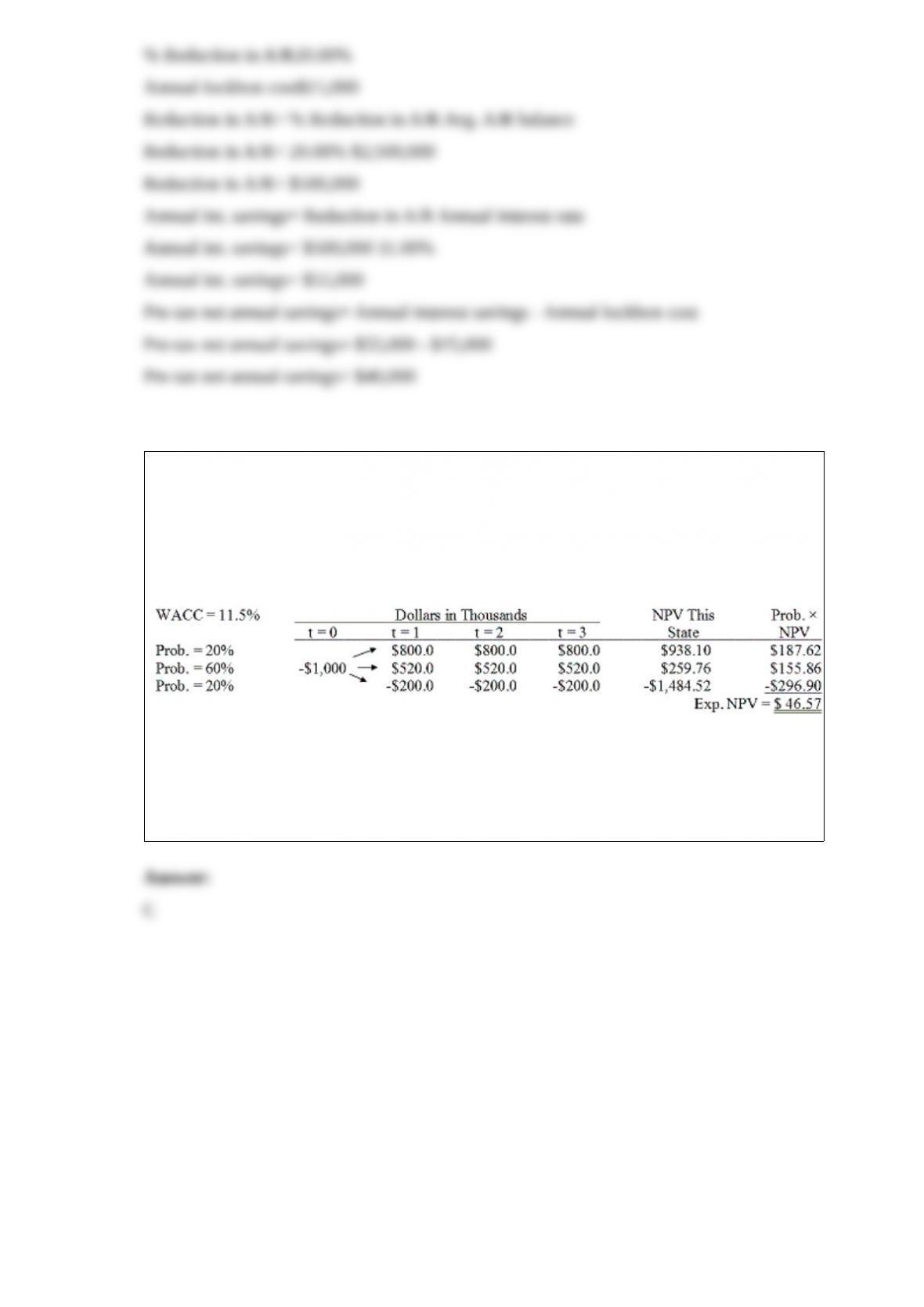
21) Brandt Enterprises is considering a new project that has a cost of $1,000,000, and
the CFO set up the following simple decision tree to show its three most likely
scenarios. The firm could arrange with its work force and suppliers to cease operations
at the end of Year 1 should it choose to do so, but to obtain this abandonment option, it
would have to make a payment to those parties. How much is the option to abandon
worth to the firm?
a.$55.08
b.$57.98
c.$61.03
d.$64.08
e.$67.29

22) Cordelion Communications is considering issuing new common stock and using the
proceeds to reduce its outstanding debt. The stock issue would have no effect on total
assets, the interest rate Cordelion pays, EBIT, or the tax rate. Which of the following is
likely to occur if the company goes ahead with the stock issue?
a. The times interest earned ratio will decrease
b. The ROA will decline
c. Taxable income will decrease
d. The tax bill will increase
e. Net income will decrease
23) Arnold Inc. purchases merchandise on terms of 2/10 net 30, and it always pays on
the 30th day. The CFO calculates that the average amount of costly trade credit carried
is $375,000. What is the firm’s average accounts payable balance? (Assume a 365-day
year.)
a.$458,160
b.$482,273
c.$507,656
d.$534,375
e.$562,500

24) Your new employer, Freeman Software, is considering a new project whose data are
shown below. The equipment that would be used has a 3-year tax life, and the allowed
depreciation rates for such property are 33.33%, 44.45%, 14.81%, and 7.41% for Years
1 through 4. Revenues and other operating costs are expected to be constant over the
project’s 10-year expected life. What is the Year 1 cash flow?
Equipment cost (depreciable basis)$65,000
Sales revenues, each year$60,000
Operating costs (excl. deprec.)$25,000
Tax rate35.0%
a.$30,333
b.$31,849
c.$33,442
d.$35,114
e.$36,869

25) If a firm adheres strictly to the residual dividend policy, then if its optimal capital
budget requires the use of all earnings for a given year (along with new debt according
to the optimal debt/total assets ratio), then the firm should pay
a. no dividends to common stockholders
b. dividends only out of funds raised by the sale of new common stock
c. dividends only out of funds raised by borrowing money (i.e., issue debt)
d. dividends only out of funds raised by selling off fixed assets
e. no dividends except out of past retained earnings
26) Gilligan Co.’s bonds currently sell for $1,150. They have a 6.75% annual coupon
rate and a 15-year maturity, and are callable in 6 years at $1,067.50. Assume that no
costs other than the call premium would be incurred to call and refund the bonds, and
also assume that the yield curve is horizontal, with rates expected to remain at current
levels on into the future. Under these conditions, what rate of return should an investor
expect to earn if he or she purchases these bonds, the YTC or the YTM?
a.3.92%
b.4.12%
c.4.34%
d.4.57%
e.4.81%
27) Which of the following is NOT a potential problem when estimating and using
betas, i.e., which statement is FALSE?
a.Sometimes, during a period when the company is undergoing a change such as toward

more leverage or riskier assets, the calculated beta will be drastically different from the
“true” or “expected future” beta
b.The beta of an “average stock,” or “the market,” can change over time, sometimes
drastically
c.Sometimes the past data used to calculate beta do not reflect the likely risk of the firm
for the future because conditions have changed
d.All of the statements above are true
e.The fact that a security or project may not have a past history that can be used as the
basis for calculating beta
28) Stocks A and B each have an expected return of 15%, a standard deviation of 20%,
and a beta of 1.2. The returns on the two stocks have a correlation coefficient of +0.6.
Your portfolio consists of 50% A and 50% B. Which of the following statements is
CORRECT?
a.The portfolio’s expected return is 15%
b.The portfolio’s standard deviation is greater than 20%
c.The portfolio’s beta is greater than 1.2
d.The portfolio’s standard deviation is 20%
e.The portfolio’s beta is less than 1.2
29) Which of the following statements is CORRECT?
a.If the calculated beta underestimates the firm’s true investment riski.e., if the
forward-looking beta that investors think exists exceeds the historical betathen the
CAPM method based on the historical beta will produce an estimate of rs and thus
WACC that is too high
b.Beta measures market risk, which is, theoretically, the most relevant risk measure for
a publicly-owned firm that seeks to maximize its intrinsic value. This is true even if not
all of the firm’s stockholders are well diversified
c.An advantage shared by both the DCF and CAPM methods when they are used to
estimate the cost of equity is that they are both “objective” as opposed to ‘subjective,”
hence little or no judgment is required
d.The specific risk premium used in the CAPM is the same as the risk premium used in
the bond-yield-plus-risk-premium approach
e.The discounted cash flow method of estimating the cost of equity cannot be used
unless the growth rate, g, is expected to be constant forever

30) The Meltzer Corporation is contemplating a 7-for-3 stock split. The current stock
price is $75.00 per share, and the firm believes that its total market value would
increase by 5% as a result of the improved liquidity that it thinks would follow the split.
What is the stock’s expected price following the split?
a. $32.06
b. $33.75
c. $35.44
d. $37.21
e. $39.07
31) A U.S.-based importer, Zarb Inc., makes a purchase of crystal glassware from a firm
in Switzerland for 39,960 Swiss francs, or $24,000, at the spot rate of 1.665 francs per
dollar. The terms of the purchase are net 90 days, and the U.S. firm wants to cover this
trade payable with a forward market hedge to eliminate its exchange rate risk. Suppose
the firm completes a forward hedge at the 90-day forward rate of 1.682 francs. If the
spot rate in 90 days is actually 1.638 francs, how much will the U.S. firm have saved or
lost in U.S. dollars by hedging its exchange rate exposure?
a.-$396
b.-$243
c.$0
d.$243
e.$638

32) Ellmann Systems is considering a project that has the following cash flow and
WACC data. What is the project’s NPV? Note that if a project’s expected NPV is
negative, it should be rejected.
WACC: 9.00%
Year0123
Cash flows-$1,000$500$500$500
a.$265.65
b.$278.93
c.$292.88
d.$307.52
e.$322.90
33) Yoga Center Inc. is considering a project that has the following cash flow and
WACC data. What is the project’s NPV? Note that a project’s expected NPV can be
negative, in which case it will be rejected.
WACC:14.00%
Year01234
Cash flows-$1,200$400$425$450$475
a.$41.25
b.$45.84
c.$50.93
d.$56.59
e.$62.88

34) Stock X has a beta of 0.7 and Stock Y has a beta of 1.7. Which of the following
statements must be true, according to the CAPM?
a.Stock Y’s realized return during the coming year will be higher than Stock X’s return
b.If the expected rate of inflation increases but the market risk premium is unchanged,
the required returns on the two stocks should increase by the same amount
c.Stock Y’s return has a higher standard deviation than Stock X
d.If the market risk premium declines, but the risk-free rate is unchanged, Stock X will
have a larger decline in its required return than will Stock Y
e.If you invest $50,000 in Stock X and $50,000 in Stock Y, your 2-stock portfolio
would have a beta significantly lower than 1.0, provided the returns on the two stocks
are not perfectly correlated
35) Rao Corporation has the following balance sheet. How much net operating working
capital does the firm have?
Cash$ 10Accounts payable$ 20
Short-term investmentsAccruals20
Accounts receivable50Notes payable 50
Inventory 40 Current liabilities$ 90
Current assets$130Long-term debt0
Net fixed assets 100Common equity30
Retained earnings 50
Total assets$230Total liab. & equity$230
a.$54.00
b.$60.00
c.$66.00
d.$72.60
e.$79.86

36) If D0 = $2.25, g (which is constant) = 3.5%, and P0 = $50, what is the stock’s
expected dividend yield for the coming year?
a.4.42%
b.4.66%
c.4.89%
d.5.13%
e.5.39%
37) Which of the following statements is CORRECT? Assume that the project being
considered has normal cash flows, with one outflow followed by a series of inflows.
a.A project’s regular IRR is found by compounding the cash inflows at the WACC to
find the present value (PV), then discounting the TV to find the IRR
b.If a project’s IRR is smaller than the WACC, then its NPV will be positive
c.A project’s IRR is the discount rate that causes the PV of the inflows to equal the
project’s cost
d.If a project’s IRR is positive, then its NPV must also be positive
e.A project’s regular IRR is found by compounding the initial cost at the WACC to find
the terminal value (TV), then discounting the TV at the WACC
38) Nystrand Corporation’s stock has an expected return of 12.25%, a beta of 1.25, and
is in equilibrium. If the risk-free rate is 5.00%, what is the market risk premium?
a.5.80%
b.5.95%
c.6.09%
d.6.25%
e.6.40%

39) Project S has a pattern of high cash flows in its early life, while Project L has a
longer life, with large cash flows late in its life. Neither has negative cash flows after
Year 0, and at the current cost of capital, the two projects have identical NPVs. Now
suppose interest rates and money costs decline. Other things held constant, this change
will cause L to become preferred to S.
40) The maturity matching, or ‘self-liquidating,” approach to financing involves
obtaining the funds for permanent current assets with a combination of long-term
capital and short-term capital that varies depending on the level of interest rates. When
short-term rates are relatively high, short-term assets will be financed with long-term
debt to reduce costs.
41) The NPV method is based on the assumption that projects’ cash flows are reinvested
at the project’s risk-adjusted cost of capital.
42) When considering the risk of a foreign investment, a higher risk might arise from
exchange rate risk and political risk while lower risk might result from international
diversification.

43) Exchange rate quotations consist solely of direct quotations.
44) Firms A and B have the same current ratio, 0.75, the same amount of sales and cost
of goods sold, and the same amount of current liabilities. However, Firm A has a higher
inventory turnover ratio than B. Therefore, we can conclude that A’s quick ratio must be
smaller than B’s.
45) When a new issue of stock is brought to market, it is the marginal investor who
determines the price at which the stock will trade.
46) A basic rule in capital budgeting is that if a project’s NPV exceeds its IRR, then the
project should be accepted.