
Lisa is interested in purchasing 1,000 shares of TJH, Inc. when the shares are issued.
Her broker just gave Lisa a preliminary prospectus on these shares for her to review as
she waits for the shares to be cleared for sale. What is the name of this prospectus?
A. Green Shoe
B. Rights offer
C. Red herring
D. Spread
E. Tombstone
Answer:
Currently, you can exchange €100 for $134.15. The inflation rate in Euroland is
expected to be 3.1 percent as compared to 3.6 percent in the U.S. Assuming that relative
purchasing power parity exists, what should the exchange rate be five years from now?
A. €0.7198/$1
B. €0.7270/$1
C. €0.7367/$1
D. €0.7405/$1
E. €0.7423/$1
Answer:

You want to create a $48,000 portfolio that consists of three stocks and has an expected
return of 14.5 percent. Currently, you own $16,700 of Stock A and $24,200 of Stock B.
The expected return for Stock A is 18.7 percent, and for Stock B it is 11.2 percent. What
is the expected rate of return for Stock C?
A. 13.67 percent
B. 14.14 percent
C. 15.38 percent
D. 15.87 percent
E. 16.11 percent
Answer:
Rocky Top pays a constant annual dividend. One year ago, when you purchased shares
of that stock at $12 a share, the dividend yield was 2 percent. Over this past year, the
inflation rate has been 2.6 percent. Today, the required return on this stock is 9 percent
and you just sold all of your shares. What is your total nominal return on this
investment? Round your answer to the nearest whole percentage.
A. -77 percent
B. -75 percent
C. -76 percent
D. 70 percent
E. 76 percent
Answer:
Over the past four years, a stock produced returns of 15 percent, 6 percent, 11 percent,
and 22 percent, respectively. Based on these four years, what range of returns would
you expect to see 95 percent of the time?
A. -6.58 percent to 31.33 percent
B. -6.58 percent to 27.02 percent
C. -6.58 percent to 24.39 percent
D. -0.02 percent to 24.39 percent
E. -0.02 percent to 27.02 percent
Answer:

The interest rate used to compute the present value of a future cash flow is called the:
A. prime rate.
B. current rate.
C. discount rate.
D. compound rate.
Answer:
James Fabricators just liquidated its poorest performing division and realized net
proceeds from the transaction of $2.2 million. The firm has 200,000 shares of stock
outstanding at a market price of $62 a share. Which one of the following is the best
estimate of the stock’s post-dividend price per share if the firm distributes the entire
liquidation proceeds in the form of a liquidating dividend? Ignore taxes and market

imperfections.
A. $51.00
B. $51.38
C. $53.40
D. $58.79
E. $62.00
Answer:
Gulf Shores Inn is comparing two separate capital structures. The first structure consists
of 260,000 shares of stock and no debt. The second structure consists of 200,000 shares
of stock and $1.5 million of debt. What is the price per share of equity?
A. $18
B. $21
C. $25
D. $30
E. $33
Answer:
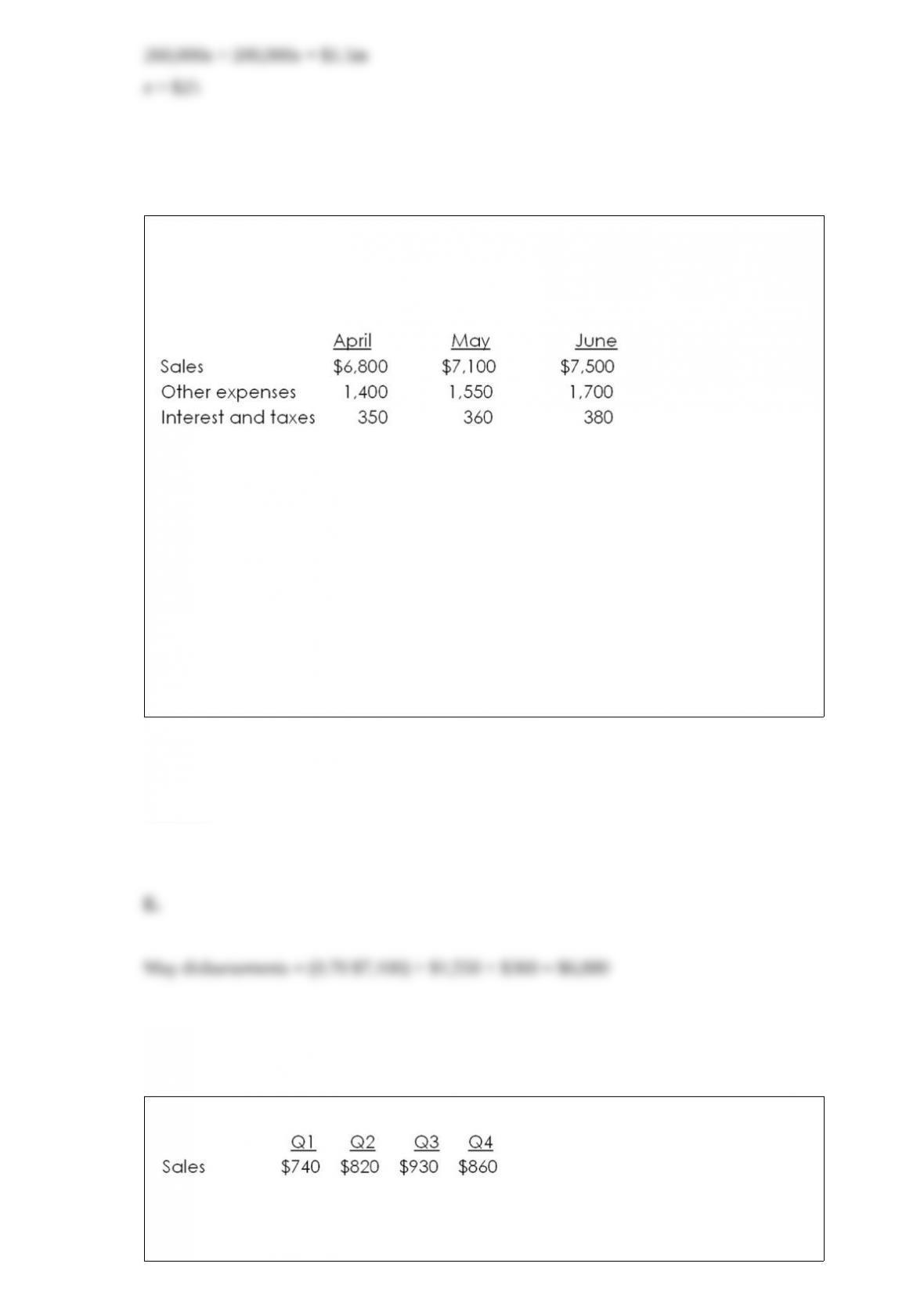
The Cookie Shops’ purchases are equal to 70 percent of the following month’s sales.
The accounts payable period for purchases is 30 days while all other expenditures are
paid in the month they are incurred. Assume each month has 30 days. The company has
compiled the following information.
What is the total amount of the firm’s disbursements for the month of May?
A. $5,990
B. $6,170
C. $6,410
D. $6,571
E. $6,880
Answer:
Pannick Motors has projected the following sales for the coming year.
Sales in the year following this one are projected to be 12 percent greater in each
quarter. Assume the company places orders during each quarter equal to 45 percent of

projected sales for the next quarter. How much will the firm pay its suppliers in quarter
3 if the firm has a 60-day payables period?
A. $408
B. $427
C. $463
D. $489
E. $511
Answer:
Which one of the following statements concerning the issuance of long-term debt is
correct?
A. Rarely is debt issued privately in the U.S.
B. All U.S. debt issues, private and public, must be registered with the SEC.
C. Private placements generally have shorter maturities than term loans.
D. It is easier to renegotiate a public issue than it is a private issue of debt.
E. A direct placement of debt generally has more restrictive covenants than a public
issue.
Answer:

You own a $46,000 portfolio comprised of four stocks. The values of Stocks A, B, and
C are $5,600, $16,700, and $11,400, respectively. What is the portfolio weight of Stock
D?
A. 24.57 percent
B. 25.39 percent
C. 30.33 percent
D. 32.10 percent
E. 32.58 percent
Answer:
Lunar Excursions wants to do an IPO but is very uncertain that underwriters will set the
most optimal offer price for the securities. Which one of the following might the firm
consider to address this uncertainty?
A. Extended quiet period
B. Extended lockup period
C. Best efforts underwriting

D. Dutch auction underwriting
E. Standby underwriting
Answer:
Who determines the offer price in a Dutch auction?
A. Lead underwriter
B. Chief financial officer of the issuing firm
C. SEC
D. Bidders
E. Board of directors of the issuing firm
Answer:
A committed line of credit:
A. guarantees that a set amount of funds will be available to a firm for a stated period of

time regardless of events that might occur during that time period.
B. is a guarantee that a bank will purchase a firm’s accounts receivable at full value.
C. provides greater assurance than a noncommitted credit line that funds will be
available when needed by a firm.
D. guarantees that any funds borrowed during a stated period of time will be charged
the lowest rate of interest the lending bank offers to any of its customers.
E. is a loan arrangement for a stated period of time which is free of all costs and fees
other than the actual interest paid on the funds borrowed.
Answer:
The Blackwell Group is unable to obtain financing for any new projects under any
circumstances. Which term best applies to this situation?
A. Contingency planning
B. Soft rationing
C. Hard rationing
D. Sensitivity analysis
E. Scenario analysis
Answer:

The Underground’s has annual sales of $1.46 million. The cost of goods sold is equal to
80 percent of sales. The firm has an average accounts receivable balance of $150,000
and an average accounts payable balance of $163,500. How many days on average does
it take the firm to pay its suppliers?
A. 7.14 days
B. 47.72 days
C. 49.81 days
D. 51.09 days
E. 56.67 days
Answer:
The stock of Wiley United has a beta of 0.92. The market risk premium is 8.4 percent
and the risk-free rate is 3.2 percent. What is the expected return on this stock?
A. 8.87 percent
B. 10.69 percent
C. 11.11 percent
D. 11.52 percent
E. 12.01 percent

Answer:
Bob Gibson’s has sales for the year of $311,400, cost of goods sold equal to 78 percent
of sales, and an average inventory of $42,800. The profit margin is 6 percent and the tax
rate is 35 percent. How many days on average does it take the firm to sell an inventory
item?
A. 5.68 days
B. 11.46 days
C. 64.32 days
D. 71.74 days
E. 82.03 days
Answer: