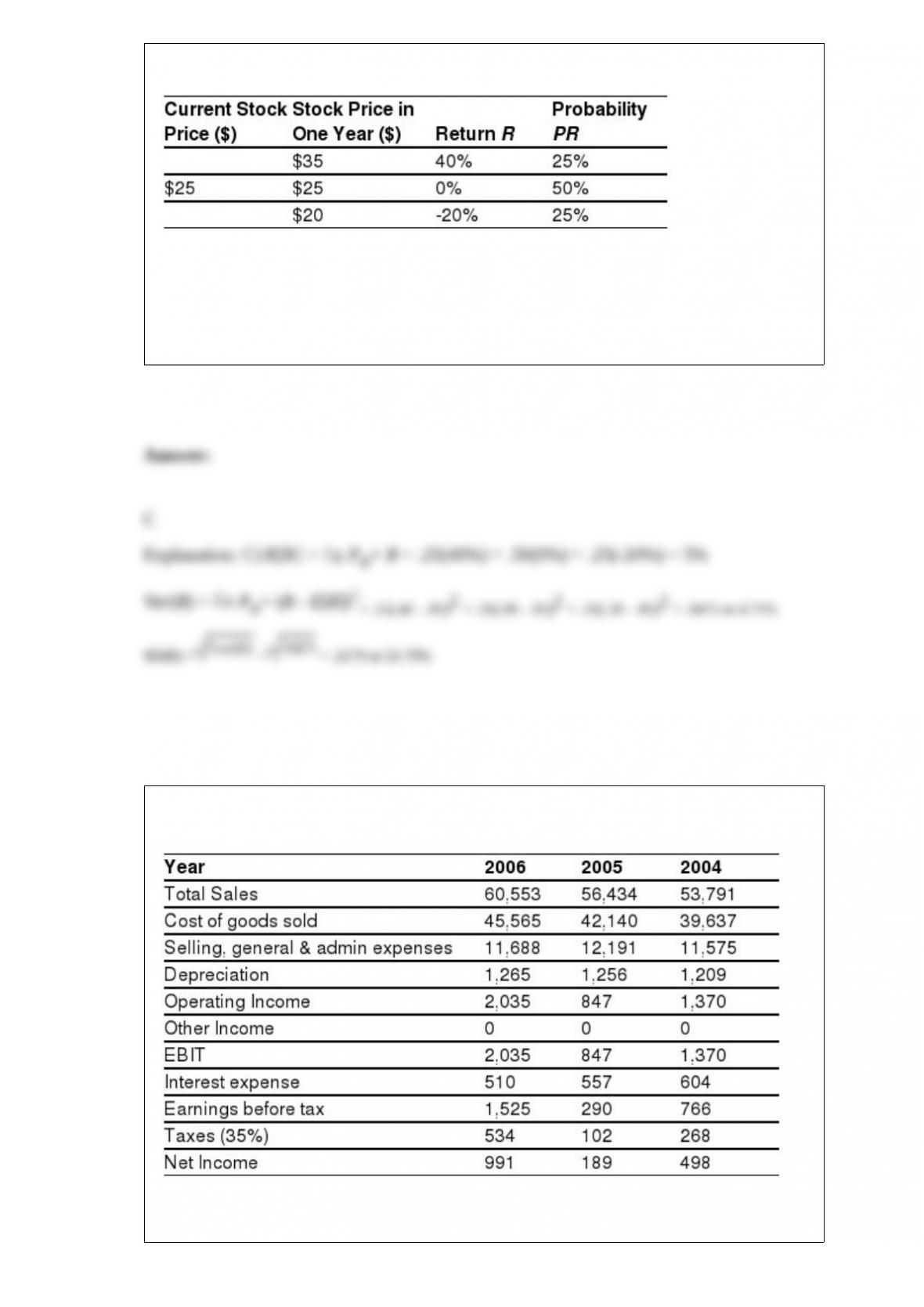
Consider the following probability distribution of returns for Alpha Corporation:
The standard deviation of the return on Alpha Corporation is closest to:
A) 22.4%
B) 19.0%
C) 21.8%
D) 19.4%
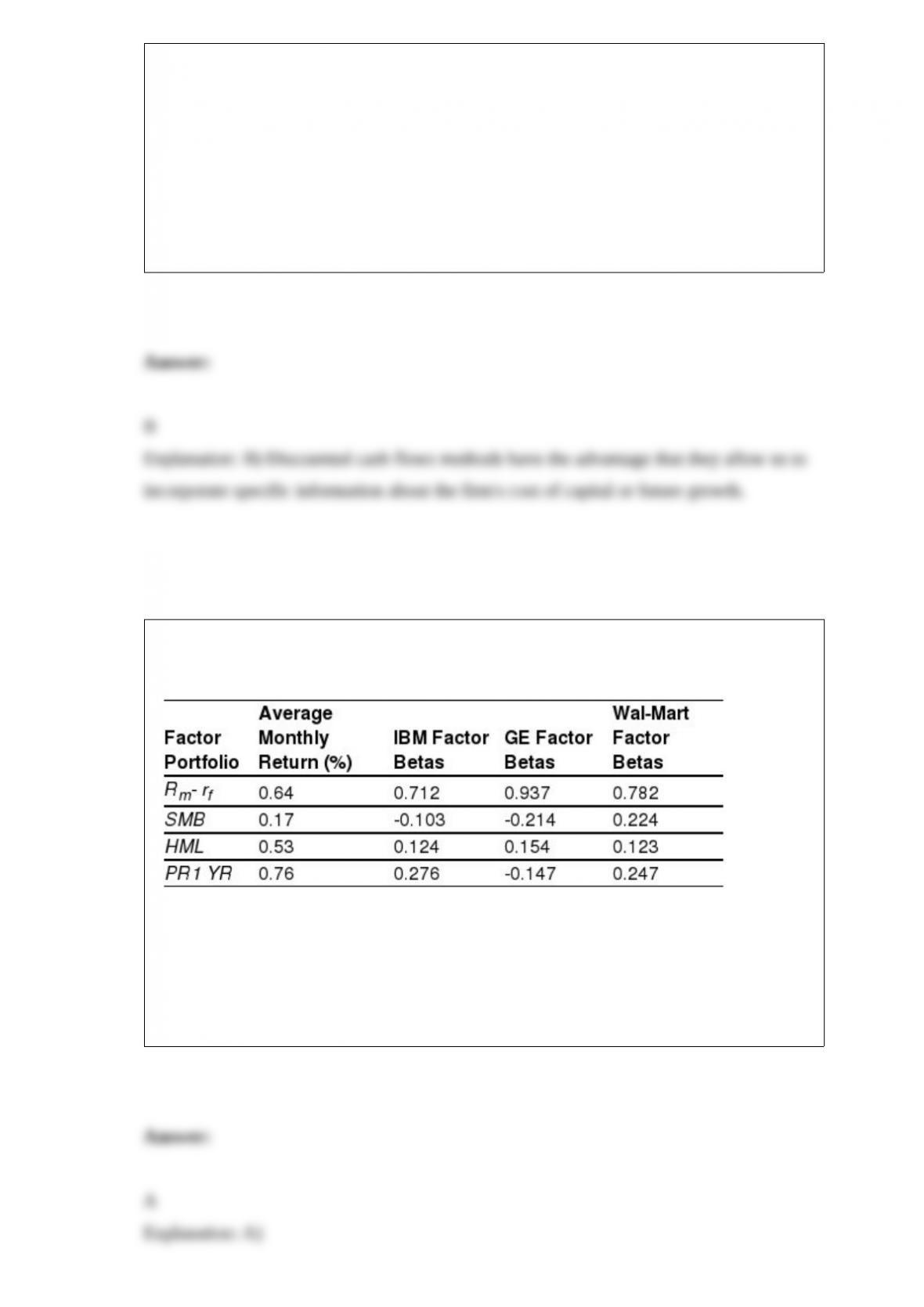
Consider the following income statement for Kroger Inc. (all figures in $ Millions):
The interest rate tax shield for Kroger in 2006 is closest to:

A) $187 million
B) $332 million
C) $534 million
D) $179 million
You are interested in purchasing a new automobile that costs $35,000. The dealership
offers you a special financing rate of 6% APR (0.5%) per month for 48 months.

Assuming that you do not make a down payment on the auto and you take the dealer’s
financing deal, then your monthly car payments would be closest to:
A) $729
B) $822
C) $842
D) $647
A key difference between sovereign default and corporate bonds is:
A) unlike a corporation, a country facing difficulty meeting its financial obligations is
can not default.
B) unlike corporate debt, sovereign debt prices are not inverse to yields.
C) unlike a corporation, any country can turn to the EMU to pay off its debts.
D) unlike a corporation, a country facing difficulty meeting its financial obligations
typically has the option to print more currency.

The risk-free rate of interest is 3% and the market risk premium is 5%.
The overall cost of capital for Wyatt Oil is closest to:
A) 8.1%
B) 8.5%
C) 8.8%
D) 9.3%
Which of the following statements is FALSE?
A) The fact that a firm has an exceptional management team, has developed an efficient
manufacturing process, or has just secured a patient on a new technology is ignored
when we apply a valuation multiple.
B) Valuation multiples have the advantage that they allow us to incorporate specific
information about the firm’s cost of capital or future growth.
C) For firms with substantial tangible assets, the ratio of price to book value of equity
per share is sometimes used.
D) Using multiples will not help us determine if an entire industry is overvalued.
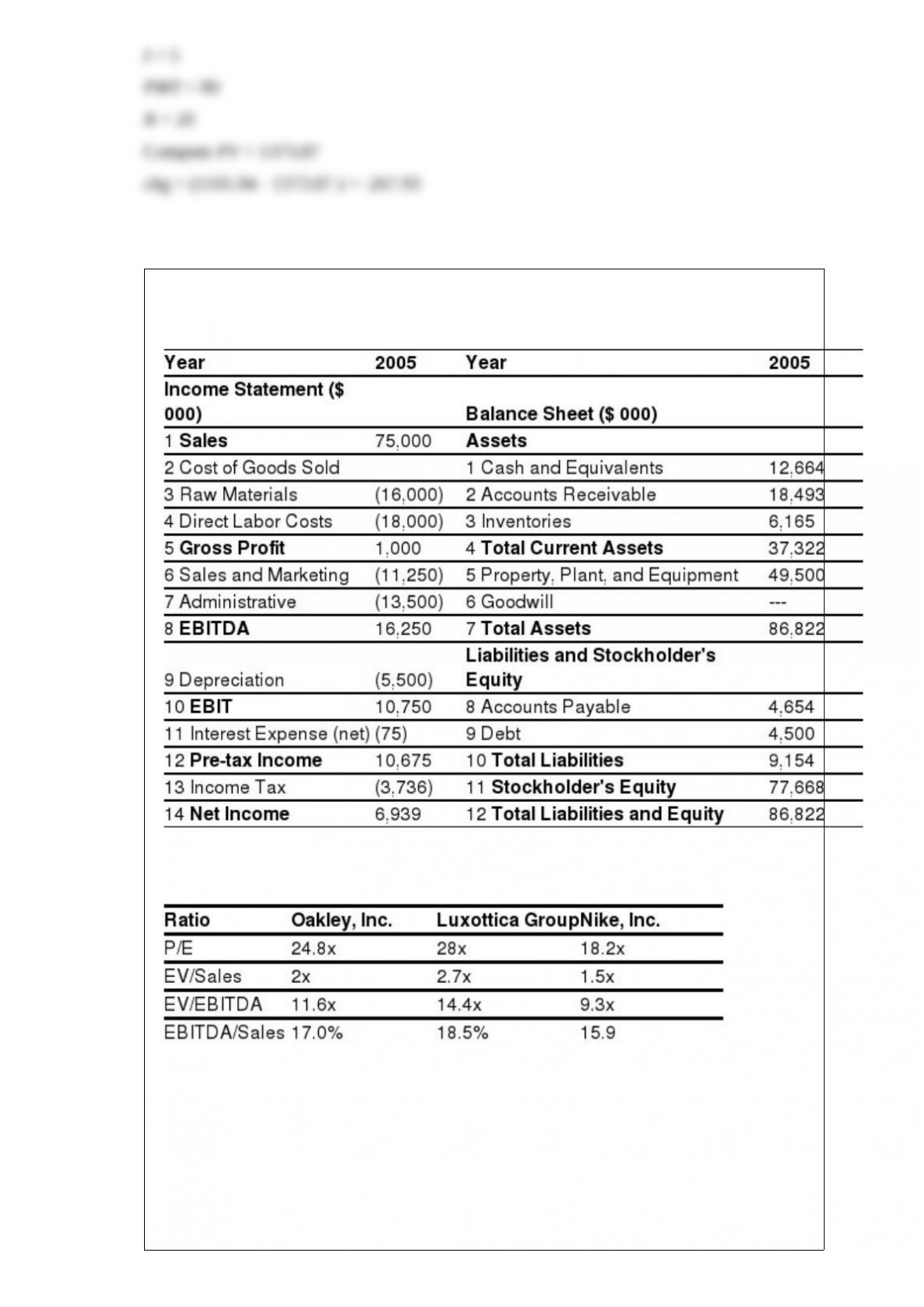
Consider the following information regarding the Fama French Carhart four factor
model:
Using the FFC four factor model and the historical average monthly returns, the
expected monthly return for GE is closest to:
A) 0.53%
B) 0.73%
C) 0.79%
D) 0.71%

Which of the following statements is FALSE?
A) The most important example of non-tradeable wealth is human capital.
B) If investors have a significant amount of non-tradeable wealth, this wealth will be an
important part of their portfolios, but will not be part of the market portfolio of
tradeable securities.
C) If the entire portfolio of investments is efficient, then just the tradeable part of the
portfolio should be efficient also.
D) Researchers have found evidence that the presence of human capital can explain at
least part of the reason for the inefficiency of the most commonly used market proxies.
Which of the following statements is FALSE?
A) If indeed alphas are positive, it is possible that the positive alpha trading strategies
contain risk that investors are unwilling to bear but the CAPM does not capture.
B) If indeed alphas are positive, it is possible that the costs of implementing investment
strategies are larger than the NPVs of undertaking them.
C) If indeed alphas are positive, then investors have to be systematically ignoring
negative-NPV investments opportunities.
D) The only way a positive NPV investment opportunity can exist in a market is if
some barrier to entry restricts competition.

When choosing between projects, an alternative to comparing their IRRs is:
A) to compute the incremental IRR, which tells us the discount rate at which it becomes
profitable to switch from one project to the other.
B) to compute the incremental payback period, which tells us the number of years
during which it becomes profitable to switch from one project to the other.
C) to compute the incremental NPV, which tells us the discount rate at which it
becomes profitable to switch from one project to the other.
D) There is no alternative selection criterion to comparing IRRs.
Consider the following four corporate bonds that have semiannual compounding:
Consider a bond that pays annually an 8% coupon with 20 years to maturity. The
amount that the price of the bond will change if its yield to maturity increases from 5%
to 7% is closest to:
A) -$270
B) -$225
C) -$310
D) -$250
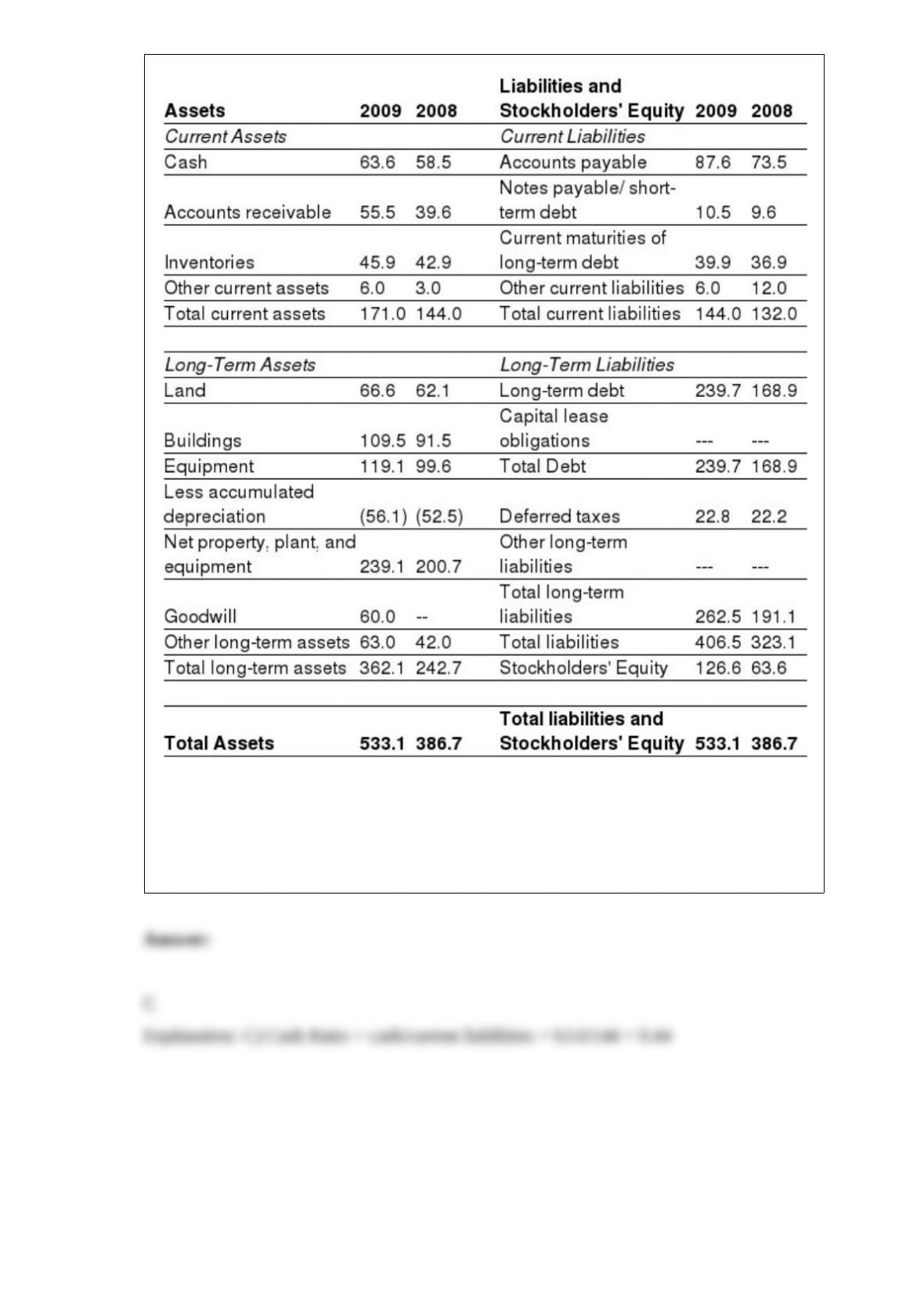
Estimated 2005 Income Statement and Balance Sheet Data for Ideko Corporation
The following are financial ratios for three comparable companies:
Based upon the average P/E ratio of the comparable firms, Ideko’s target market value
of equity is closest to:
A) $157 million
B) $155 million

C) $193 million
D) $165 million
Your investment portfolio consists of $10,000 worth of Google stock. Suppose that the
risk-free rate is 4%, Google stock has an expected return of 14% and a volatility of
35%, and the market portfolio has an expected return of 12% and a volatility of 18%.
Assume that the CAPM assumptions hold.The volatility of the alternative investment
that has the lowest possible volatility while having the same expected return as Google
is closest to:
A) 18.0%
B) 22.5%
C) 23.4%
D) 35.0%
Which of the following statements is FALSE?
A) Stocks generally trade in lots of 1000 shares, and in any case do not trade in units
less than one share.

B) Non-cash special dividends are commonly used to spin off assets or a subsidiary as a
separate company.
C) The typical motivation for a stock split is to keep the share price in a range thought
to be attractive to small investors.
D) If a company declares a 10% stock dividend, each shareholder will receive one new
share of stock for every 10 shares already owned.
Suppose the current zero-coupon yield curve for risk-free bonds is as follows:
Consider a zero-coupon bond with a $1000 face value and 10 years left until maturity.
If the YTM of this bond is 10.4%, then the price of this bond is closest to:
A) $1000
B) $602
C) $1040
D) $372
Which of the following statements regarding the valuing of costs and benefits is NOT
correct?
A) The first step in evaluating a project is to identify its costs and benefits.
B) In the absence of competitive markets, we can use one-sided prices to determine

exact cash values.
C) Competitive market prices allow us to calculate the value of a decision without
worrying about the tastes or opinions of the decision maker.
D) Because competitive markets exist for most commodities and financial assets, we
can use them to determine cash values and evaluate decisions in most situations.
Which of the following statements is FALSE?
A) Many managers make the mistake of focusing on accounting earnings as opposed to
free cash flows.
B) Given accurate information about any two of these variables (a firm’s future cash
flows, its cost of capital, and its share price) a valuation model allows use to make
inferences about the third variable.
C) A valuation model will tell us the most about the variable for which our prior
information is the least reliable.
D) The idea that investors are able to identify positive NPV trading opportunities is
referred to as the efficient markets hypothesis.
Ideko’s Planned Debt
If Ideko’s loans will have an interest rate of 6.8%, then the interest expense paid in 2009
is closest to:
A) $6,800
B) $7,310
C) $7,820
D) $7,990

You are opening up a brand new retail strip mall. You presently have more potential
retail outlets wanting to locate in your mall than you have space available. What is the
most appropriate tool to use if you are trying to determine the optimal allocation of your
retail space?
A) IRR
B) Payback period
C) NPV
D) Profitability index
If the current inflation rate is 5%, then the nominal rate necessary for you to earn an 8%
real interest rate on your investment is closest to:
A) 13.0%
B) 13.4%
C) 4.9%
D) 3.0%
Which of the following statements is FALSE?
A) Firms with high R&D costs and future growth opportunities typically maintain high
debt levels.
B) The tradeoff theory explains how firms should choose their capital structures to
maximize value to current shareholders.

C) With tangible assets, the financial distress costs of leverage are likely to be low, as
the assets can be liquidated for close to their full value.
D) Proponents of the management entrenchment theory of capital structure believe that
managers choose a capital structure to avoid the discipline of debt and maintain their
own job security.
Which of the following statements is FALSE?
A) The payback rule is useful in cases where the cost of making an incorrect decision
might not be large enough to justify the time required for calculating the NPV.
B) The payback rule is reliable because it considers the time value of money and
depends on the cost of capital.
C) For most investment opportunities expenses occur initially and cash is received later.
D) Fifty percent of firms surveyed reported using the payback rule for making
decisions.
Consider the following graph of the security market line:
Which of the following statements regarding portfolio “C” is/are correct?
1. Portfolio “C” has a negative alpha.
2. Portfolio “C” is overpriced.

3. Portfolio “C” is less risky than the market portfolio.
4. Portfolio “C” should not exist if the market portfolio is efficient.
A) 1 and 3
B) 2 and 4
C) 1, 3, and 4
D) 3 only
Luther Corporation
Consolidated Balance Sheet
December 31, 2009 and 2008 (in $ millions)
Luther Corporation’s cash ratio for 2009 is closest to:
A) 1.19
B) 10.6
C) 0.44
D) 0.41