
According to the Fisher hypothesis, if the real interest rate is 5 percent and the inflation
rate rises from 2 percent to 4 percent, then the nominal interest rate will____percentage
points and the real interest rate will change by_____percentage points.
a. rise by 0; −2
b. fall by 2; −2
c. rise by 2; 0
d. fall by 1; 1
Answer:
Risk that cannot be eliminated by diversification is referred to as
a. idiosyncratic risk.
b. market risk.
c. default risk.
d. interest-rate risk.
Answer:

The model in which money demand and supply determine the nominal interest rate is
known as the
a. liquidity-preference model.
b. ATM model.
c. aggregate money model.
d. monetarist model.
Answer:
The ratio of debt to equity in the United States is about
a. 2
b. 2.5
c. 3
d. 3.5
Answer:
Which of the following is an useful indicator of the stance of monetary policy?
a. The income tax rate

b. The federal funds rate
c. The exchange rate
d. The rate of unemployment
Answer:
Each Federal Reserve Bank is
a. a corporation.
b. a government owned enterprise.
c. a publicly traded company.
d. a government-sponsored enterprise.
Answer:
A rise in income will cause consumer spending to
a. decline.
b. not change.
c. rise.

d. fall at first, then rise later.
Answer:
GLTP Inc. transformed from a private company into a public company after offering its
shares in a securities exchange for the first time. Such transactions take place in a
a. tertiary market.
b. closed market.
c. secondary market.
d. primary market.
Answer:
A bank with transaction deposits totaling $45 million had reserves equal to $0.98
million. The reserve requirement for this bank is percent. (Hint: use the cutoff amounts
as per the reserve requirements for the year 2013)
a. 10
b. 8
c. 3

d. 2
Answer:
In the aggregate demand-aggregate supply model, everything else remaining
unchanged, an increase in money supply shifts the curve to the .
a. aggregate demand; right
b. aggregate demand; left
c. aggregate supply; right
d. aggregate supply; left
Answer:
When the Fed began paying interest on reserves, reserve balances
a. increased dramatically.
b. decreased dramatically.
c. decreased only slightly.
d. increased only slightly.

Answer:
Accounting rules require that a bank’s equals its________.
a. equity capital; assets plus liabilities.
b. assets; liabilities minus equity capital.
c. liabilities; assets plus equity capital.
d. liabilities; assets minus equity capital.
Answer:
Which of the following is true of the GarnSt. Germain Act?
a. It allows thrifts to invest up to 10 percent of portfolios in riskier assets such as stocks
and real estate.
b. It creates the system of national banks to be chartered by the Comptroller of the
currency.
c. It creates the Federal Reserve system and gives it the responsibility as the lender of
last resort.
d. It prohibits commercial banks from investment banking activities.
Answer:

Suppose an investor purchases a one-year bond today, for $960. The bond promises a
return of $1,000. She purchases anXOAXOA one-year bond, after a year, for $887 that
promises a return of $990. What is the yield to maturity earned by the investor on the
purchase of these two shortterm bonds?
a. 6.50 percent
b. 7.85 percent
c. 8 percent
d. 10 percent
Answer:
The longest economic expansion in U.S. history occurred from
a. 1929 to 1939
b. 1956 to 1966
c. 1970 to 1980
d. 1991 to 2001
Answer:

If the growth rate of velocity is -2 percent, the growth rate of money supply is 7
percent, and the inflation rate is 3 percent, what is the growth rate of real output?
a. 1 percent
b. 2 percent
c. 3 percent
d. 4 percent
Answer:
The discount rate is the
a. targeted inflation rate for an economy.
b. ongoing taxation rate in an economy.
c. interest rate that the Fed charges on the loans it makes.
d. nominal interest rate charged by financial intermediaries when they advance loans.
Answer:

More than half of all U.S. dollars can be found
a. in foreign countries.
b. in the United States.
c. in the underground economy.
d. in bank vaults.
Answer:
Suppose a country has a population of 122 million, of which 71 million are in the
working-age population. Of those, 16 million are not in the labor force and 50 million
are employed.
a. Calculate the number of people who are in the labor force.
b. Calculate the number of people who are unemployed.
c. Calculate the labor-force participation rate.
d. Calculate the unemployment rate.
Answer:

The discount rate is the interest rate on
a. loans of reserves between banks.
b. discount loans from the Federal Reserve.
c. discount bonds.
d. federal agency securities.
Answer:
Suppose a country has a population of 61 million, of which 37 million are in the
working-age population. Of those, 11 million are not in the labor force and 23 million
are employed. The labor-force participation rate is
a. 42.6 percent.
b. 60.7 percent.
c. 70.3 percent.
d. 88.5 percent.
Answer:

In a two-period model, assume that there are 20 households each with an income of
$35,000 in period one and an income of $45,000 in period two. The equilibrium rate of
interest faced by the household is 50 percent. The government decides to offer each
household a tax rebate of $1,500 in period one. As a rational economic agent you know
that the government will tax the households in period two, in order to repay its
borrowing. With the interest rate unaffected by the government’s action, the government
will impose a tax of ______per household, in period two.
a. $2,600
b. $3,265
c. $1,500
d. $2,250
Answer:
If the interest rate on a one-year bond today is 7.5 percent and the expected interest rate
on a one-year bond one year from now is 5.6 percent, then the interest rate on a twoyear
bond will be
a. 7 percent
b. 12.5 percent
c. 8.5 percent
d. 6.55 percent
Answer:

Which of the following functions of money encourages specialization in the production
of goods and services?
a. Unit of account
b. Store of value
c. Standard of deferred payments
d. Medium of exchange
Answer:
Suppose the following version of the APT is a good model of risk in the stock market.
There are three factors: (1) the stock market’s excess return, in percentage points; (2)
the change over the last year in the inflation rate, in percentage points; and (3) the
spread between ten-year Treasury bonds and three-month Treasury bills, in percentage
points. Suppose the stock market’s average excess return is 7 percentage points and the
average risk- free interest rate is 1 percent, the average change in the inflation rate is 0
percentage points, and the average spread between ten-year Treasury bonds and
three-month Treasury bills is 2 percentage points. Each of the following
stocks has the beta coefficients shown in the table below:
β1i β2i β3i
Microsoft 2 −1 1
Goldcrafters 3 2 −1
State Farm 0 −2 0
a. What is the expected return to each of the three stocks? Show your calculations.
b.If the market’s excess return were to rise 10 percentage points in a particular year (that
is,instead of the average of 7 percent, the market’s excess return will be 17 percent), what
would you expect the effect to be on the return to each of the three stocks? Show your
calculations.
c.If the inflation rate was expected to rise 2 percentage points in a particular year (that
is, instead of the average of 0 percent, the inflation rate will rise by 2 percentage points),
what would you expect the effect to be on the return to each of the three stocks?
d. If the interest-rate spread rose 2 percentage points in a particular year (that is, instead of
the average of 2 percentage points, the interest-rate spread will be 4 percentage points),
what would you expect the effect to be on the return to each of the three stocks?
Answer:
When a central bank decreases money growth, the bank is said to____ monetary policy.
a. tighten
b. loosen
c. destabilize
d. ease
Answer:

Suppose, the U.S. has domestic savings of $10 billion, a government budget deficit of
$250 billion, net exports of −$400 billion, and net income from abroad and net
unilateral transfers of $0. Based on these figures, the amount of net foreign investment
is $ billion.
a. 260
b. −140
c. −260
d. −400
Answer:
What will happen to the nominal interest rate and the equilibrium quantity of money
because of the following changes?
a. A decline in people’s incomes
b. An increase in the level of prices
c. A decline in the supply of money
Answer:

In the two-period model, suppose a household’s income in the first period is $40,000,
income in the second period is $50,000, and the real interest rate is 25 percent. By how
much would the household’s maximum spending in the first period increase if income in
the second period increased to 60,000?
a. $6,000
b. $8,000
c. $10,000
d. $12,000
Answer:
According to the expectations theory of the term structure of interest rates,
a. a short-term interest rate is equal to the average of current and expected future
long-term interest rates.
b. a short-term interest rate has no relation to long-term interest rates.
c. a long-term interest rate is equal to the average of current and expected future
short-term interest rates.
d. the yield curve is always flat.

Answer:
An economy has 100 households. The ten rich households each have incomes of
$50,000 in period 1 and $75,000 in period The ninety poor households each have
incomes of $20,000 in period 1 and $25,000 in period Assume that the price of the good
is $1 in both periods. Also assume that the households borrow from each other. Suppose
that each household decides that its consumption in period 1 will equal 50 percent of
the present value of its income from both periods. The equilibrium real interest rate is
about
a. 20 percent.
b. 30 percent.
c. 40 percent.
d. 50 percent.
Answer:
If Federal Reserve governors can only serve one fourteen-year term, how is it possible
that Greenspan joined the
Fed in 1987 and did not leave until 2006?
Answer:

Loretta buys a one-year debt security on December 31, 2013, for $10,000, which will
pay her a nominal interest rate of 5% percent. From December 31, 2013, to December
31, 2014, the inflation rate is 2 percent. Loretta has a tax rate of 40 percent.
a. How much nominal interest (in dollars) does Loretta earn during the year? Show your
calculations.
b. How much (in dollars) does Loretta pay in taxes on her interest income? Show your
calculations.
c. How much (in dollars) is Loretta’s after-tax nominal income? Show your
calculations. d. How much principal (in dollars) does Loretta lose because of inflation?
Show your calculations.
e. How much real interest income (in dollars) does Loretta earn? Show your
calculations.
f. How much (in dollars) is
Loretta’s after-tax real interest income? Show your calculations.
What percent of Loretta’s nominal interest income goes to: (1) her, in the form of after
tax
g. real interest income; (2) the government, in the form of taxes; and (3) inflation, in the
form of lost principal value? Show your calculations.
Answer:
What challenges do policymakers and researchers face in using the Taylor rule?
Answer:
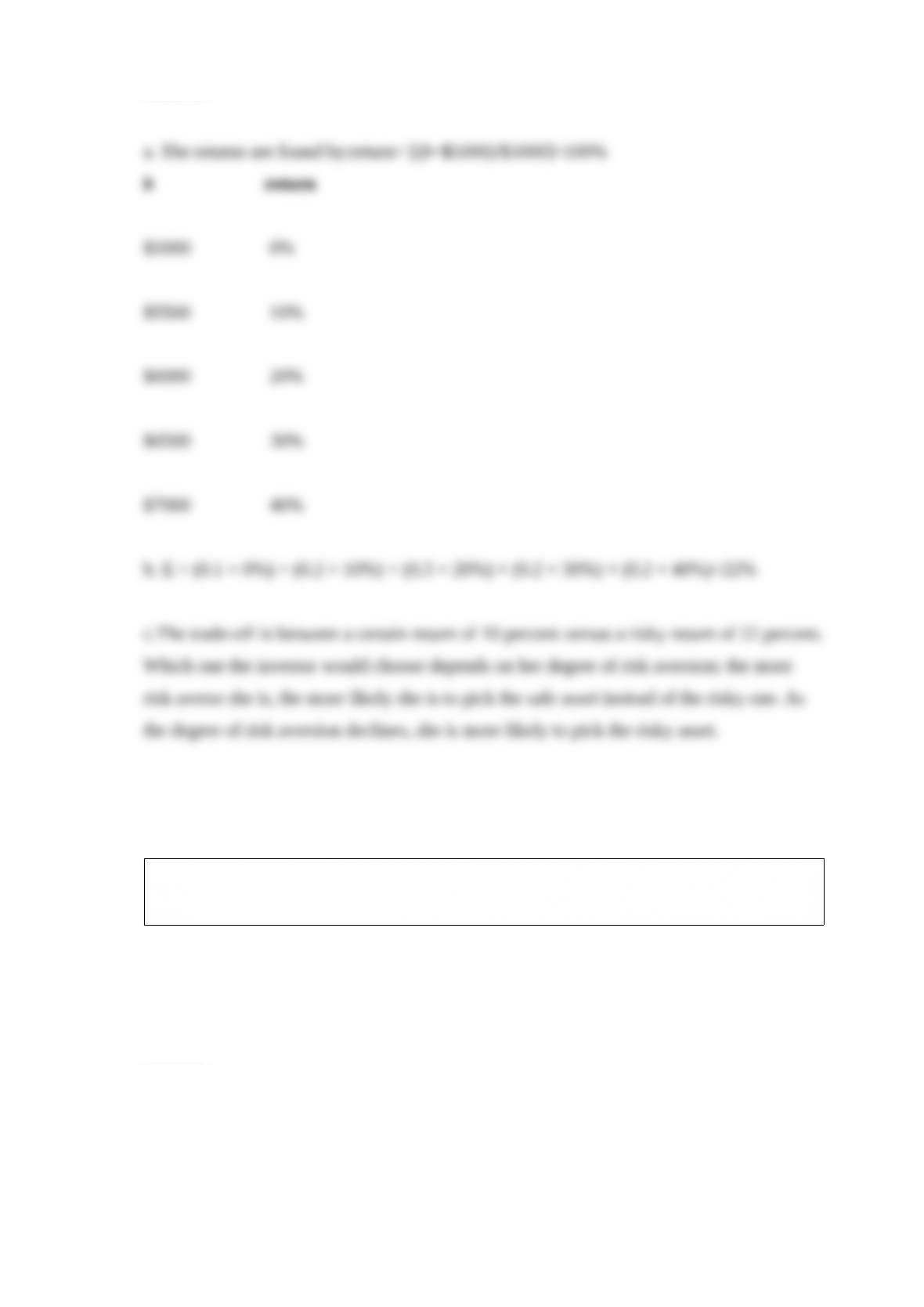
Suppose a discount bond costs $5,000 today and pays off some amount bin one year.
Suppose that bis uncertain according to the following table of probabilities:
a. Calculate the return (in percent) for each value of b.(Note: you may just calculate the
total return and not worry about how this is split up between current yield and
capital-gains yield.)
b. Calculate the expected return.
c.Suppose an investor has a choice between buying this security or purchasing a
different security that also costs $5,000 today, but pays off $5,500 with certainty in one
year. How is an investor’s choice of which security to purchase related to her degree of
risk aversion?
Answer:
Consider a fixed-payment security that pays $250 at the end of every year for eight
years. If the annual rate of discount is 3 percent, calculate the present value of the bond.
Answer:

Primary government securities dealers are____that meet certain capital requirements
and agree to actively transact with the Fed when it engages in open-market operations.
a. small investment banks and brokers
b. large stockbrokers
c. large investment banks and brokers
d. community banks and credit unions
Answer:
In the fourth quarter of 2004, economic statistics showed the following:
Real GDP $5,189.8 billion
Unemployment rate 10.7%

Inflation rate 4.4%
The conceptual variables corresponding to these data are:
Potential output $5,640.3 billion
Natural rate of unemployment 6.1%
Ideal inflation rate 1.0%
a. Calculate the output gap in percentage. Show your work.
b. Calculate the unemployment gap in percentage. Show your work.
c. Calculate the inflation gap in percentage. Show your work.
d. Calculate the output loss and the inflation loss. Show your work.
e. Calculate the total loss in the fourth quarter of 2004 if the weight on the inflation
loss equals
f. Calculate the total loss in the fourth quarter of 2004 if the weight on the inflation
loss equals
Answer:
Since the 2008 financial crisis, what has happened to the M1 and M2 multipliers?

Answer:
The Fed uses____monetary policy to cause the economy to grow slower in the short
run. A(n)____in the money supply is an example of such a policy.
a. expansionary; a decrease
b. expansionary; an increase
c. contractionary; an increase
d. contractionary; a decrease
Answer:
The ____theory states that the stock market goes through periods in which stock prices
rise higher than their fundamental value and other periods where stock prices fall below
their fundamental value.

a. rational expectations
b. adaptive expectations
c. irrational expectations
d. realized expectations
Answer:
Describe the Beigebook, the Greenbook, and the Bluebook.
Answer:
Consider a coupon bond that pays $150 every year and repays its principal amount of
$2,000 at the end of six years.
If the annual rate of discount is 5 percent, what is the present value of the bond?

Answer:
Comment on the success of various Fed chairmen in reducing inflation.
Answer:
Why are the deliberations of the FOMC kept secret?
Answer:

If a shock raises inflation, how fast should the central bank reduce it to its target level?
Answer:
Thrifts can have a maximum of 20 percent of their assets in the form of____and must
have____percent of their assets in the form of mortgage or consumer loans in order to
qualify for special funding from a Federal Home
Loan bank.
a. bank holding companies; 60
b. commercial loans; 65
c. securities; 75
d. government bonds; 70
Answer:

Suppose increased costs for security raised the costs of production for all firms. Explain
how this would affect aggregate supply, output, and the price level in the short run and
the long run.
Answer:
Describe each of the four functions of money and provide an example of how money
serves these roles.
Answer:
What are the major advantages and disadvantages of inflation targeting?
Answer: