
1) Most corporate bonds have a face value of $1,000, are sold at a discount, and can
only be redeemed at the maturity date.
2) Evidence that stock prices sometimes fall when a firm announces good news
contradicts the efficient market hypothesis.
3) Different interest rates have a tendency to move in unison.
4) Bank holding companies that have begun to rival the money center banks in size but
whose headquarters are not based in one of the money center cities are called
superregional banks.
5) One way of describing the solution that high net worth provides to the moral hazard
problem is to say that it makes debt contracts incentive compatible.
6) A positive liquidity premium indicates that investors prefer long-term bonds over
short-term bonds.
7) Mutual savings banks are the only financial institutions that are tax-exempt.

8) Federal Reserve monetary policy decisions must be approved by the Secretary of the
Treasury before they may be implemented.
9) Deposits that banks keep in accounts at the Federal Reserve less vault cash is called
reserves.
10) Securitization is the process of transforming illiquid financial assets such as
residential mortgages into marketable securities.
11) The higher the insurance coverage, the more the policyholder can gain from risky
activities that make an insurance payoff less likely.
12) An option ARM mortgage gives the borrower the option to reduce the monthly
interest being charged on the mortgage.
13) The evidence suggests technical analysts are not superior stock pickers.
14) According to the efficient market hypothesis
A) one cannot expect to earn an abnormally high return by purchasing a security
B) information in newspapers and in the published reports of financial analysts is
already reflected in market prices
C) unexploited profit opportunities abound, thereby explaining why so many people get
rich by trading securities

D) all of the above are true
E) only A and B of the above are true
15) The Federal Deposit Insurance Corporation Improvement Act of 1991
A) reduced the scope of deposit insurance in several ways
B) limited the FDIC’s ability to use the “too-big-to-fail” policy
C) requires the FDIC to intervene earlier when a bank gets into trouble
D) did all of the above
16) Examples of the huge risks that “zombie S&Ls” undertook include
A) building shopping centers in the desert
B) buying manufacturing plants to convert manure to methane
C) purchasing billions of dollars of junk bonds
D) all of the above
E) only A and B of the above
17) When the borrower engages in activities that make it less likely that the loan will be
repaid, ________ is said to exist.
A) asymmetric information
B) adverse selection
C) moral hazard
D) fraud
18) Which of the following is not an advantage of a lease financing arrangement?
A) Companies with losses can still depreciate equipment if leased from a finance
company
B) Repossession is easier in a lease-finance arrangement because the finance company
already owns the equipment
C) Finance companies are in a good position to sell a repossessed asset, especially if
they are a subsidiary of the equipment manufacturer
D) The lessee often does not have to make as large of an upfront payment, relative to a
straight loan

19) The Glass-Steagall Act
A) separated commercial and investment banking
B) made it illegal for a commercial bank to buy or sell securities on behalf of its
customers
C) made it illegal for investment banks to engage in the underwriting of corporate
securities
D) did all of the above
E) did only A and B of the above
20) Financial markets and institutions
A) involve the movement of huge quantities of money
B) affect the profits of businesses
C) affect the types of goods and services produced in an economy
D) do all of the above
E) do only A and B of the above
21) When disintermediation occurs, the banking system ________ deposits and bank
lending ________.
A) gains; increases
B) gains; decreases
C) loses; increases
D) loses; decreases
22) Bonds with relatively high risk of default are called
A) Brady bonds
B) junk bonds
C) zero coupon bonds
D) investment-grade bonds

23) In an effort to control the use of derivatives by financial institutions, the
Dodd-Frank legislation of 2010 requires ________.
A) standardized derivatives products
B) over-the-counter trading (instead of exchange trading) of derivatives products
C) an increase in counterparty risk
D) all of the above
24) A financial innovation that enables banks to avoid the “tax” from reserve
requirements by taking any balances above a certain amount in a corporation’s checking
account at the end of the business day and investing them in overnight securities that
pay interest is called a ________.
A) money market mutual fund
B) deposit rate ceiling
C) sweep account
D) disintermediation
25) If the dollar ________ from 1.2 euros per dollar to 0.8 euros per dollar, the euro
________ from 0.83 dollars to 1.25 dollars per euro.
A) appreciates; appreciates
B) appreciates; depreciates
C) depreciates; depreciates
D) depreciates; appreciates
26) The largest one-day drop in the history of the American stock markets occurred in
A) 1929
B) 1987
C) 2000
D) 2001
27) On a bank’s income statement, the amount available to keep as retained earnings or
pay to the stockholders in dividends is the bank’s
A) net income
B) net operating income

C) net extraordinary items
D) net interest margin
28) A negotiable certificate of deposit
A) is a term security because it has a specified maturity date
B) is a bearer instrument, meaning whoever holds the certificate at maturity receives the
principal and interest
C) can be bought and sold until maturity
D) all of the above
E) only A and B of the above
29) The yield to maturity for a one-year discount bond equals
A) the increase in price over the year, divided by the initial price
B) the increase in price over the year, divided by the face value
C) the increase in price over the year, divided by the interest rate
D) none of the above
30) The 20-year average return of venture capital firms has been about ________.
A) 50%
B) 8%
C) 20%
D) 100%
31) Which of the following is an advantage to a private equity buyout?
A) They are subject to the controversial regulations included in the 2002
Sarbanes-Oxley Act
B) The CEOs frequently have more time and flexibility to enact changes need to turn
around subpar companies
C) both A and B
D) neither A nor B

32) With large banks beginning to explore ways in which the liabilities on their balance
sheets could provide them with reserves and liquidity, this led to
A) the expansion of overnight loan markets
B) the development of negotiable CDs
C) the ability of money center banks to acquire funds quickly
D) all of the above occurring
33) Which of the following best explains the difference between brokers and dealers?
A) Brokers are pure middlemen; dealers make markets by standing ready to buy and
sell at given prices
B) Dealers are pure middlemen; brokers make markets by standing ready to buy and
sell at given prices
C) Dealers link up buyers and sellers, but do not stand ready to buy and sell from their
inventories of securities; brokers stand ready to buy and sell from their inventories of
securities
D) There is no difference between brokers and dealers
34) Which of the following bank assets are the least liquid?
A) reserves
B) mortgage loans
C) cash items in process of collection
D) deposits with other banks
35) The risk that occurs because stock prices fluctuate is called ________.
A) stock market risk
B) reinvestment risk
C) interest-rate risk
D) default risk
36) The theory of asset demand suggests that the most important factor affecting the

demand for domestic and foreign deposits is
A) the level of trade and capital flows
B) the expected return on these assets relative to one another
C) the liquidity of these assets relative to one another
D) the riskiness of these assets relative to one another
37) Which of the following are checkable deposits?
A) savings accounts
B) small-denomination time deposits
C) negotiable order of withdrawal accounts
D) certificates of deposit
38) That taxpayers were poorly served by thrift regulators in the 1980s is now quite
clear. This poor performance cannot be explained by
A) regulators’ desire to escape blame for poor performance, leading to a perverse
strategy of “regulatory gambling”
B) regulators’ incentives to accede to pressures imposed by politicians, who sought to
keep regulators from imposing tough regulations on institutions that were major
campaign contributors
C) Congress’s dogged determination to protect taxpayers from the unsound banking
practices of managers at many of the nation’s savings and loans
D) any of the above
39) Secondary reserves ________
A) can be converted into cash with low transaction costs
B) are not easily converted into cash and are, therefore, of secondary importance to
banks
C) count toward meeting required reserves, but only at a rate of $0.50 per dollar of
secondary reserves
D) none of the above
40) Price stability is desirable because
A) inflation creates uncertainty, making it difficult to plan for the future
B) everyone is better off when prices are stable
C) price stability increases the profitability of the Fed
D) it guarantees full employment
41) Which of the following functions are not performed by any of the twelve regional
Federal Reserve banks?
A) Check clearing
B) Conducting economic research
C) Setting interest rates payable on time deposits
D) Issuing new currency
42) Investment banks advertise upcoming securities offerings with block ads in the Wall
Street Journal. Such an ad is called a ________.
A) tombstone
B) marker
C) prospectus
D) registration statement
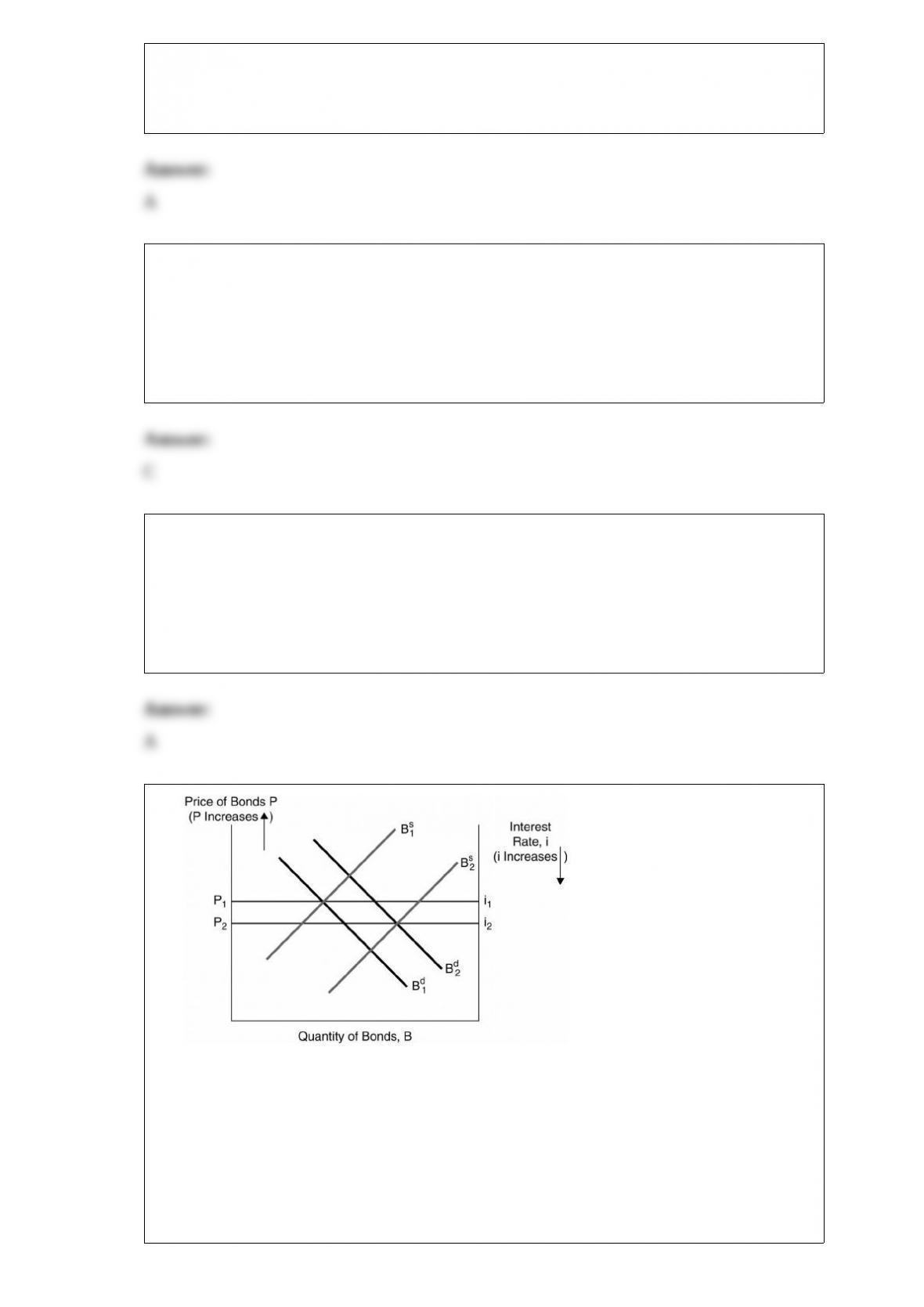
43)
Figure 4.2
In Figure 4.2, one possible explanation for the increase in the interest rate from i1 to i2
is
A) an increase in economic growth
B) an increase in government budget deficits
C) a decrease in government budget deficits
D) a decrease in economic growth
E) a decrease in the riskiness of bonds relative to other investments

44) ________ enables mutual funds to consistently outperform a randomly selected
group of stocks.
A) Managerial expertise
B) Diversification
C) Denomination intermediation
D) None of the above