
Debt financing is always better than equity financing because the interest on the debt is
tax deductible, whereas dividends are not tax deductible.
The Securities and Exchange Commission (SEC) has the power to issue accounting
standards, but generally defers this responsibility to the Financial Accounting Standards
Board (FASB).
A decrease in net operating profit margin will cause both return on net operating assets
and return on equity to decrease, all other things being equal.
Earnings yield is the reciprocal of the price-to-earnings ratio.

If a company has the necessary cash available, it almost always makes economic sense
to take a purchase discount offered by suppliers.
A capital-intensive company requires high cash turnover.
Interim financial reports are generally prepared using the same accounting methods as
used for the annual financial reports.

With a defined contribution plan the risk of pension fund performance rests with the
employees/retirees of the company, while with a defined benefit plan this risk rests with
the company.
Primary responsibility for fair and accurate financial statements rests with the auditors.
If an expense is recognized for financial reporting purposes but not allowed as a
bona-fide deduction for tax purposes, this results in a deferred tax asset.
Although interim financial reports are normally prepared using the same accounting
methods as the annual financial reports they are generally less reliable, in part because
of the increased use of estimates in the interim periods.

The higher the cash to current liabilities ratio of a company, the better is the company.
Adjusting earnings includes assigning earnings components from the recast income
statements to periods they likely belong.
Companies must report the economic pension cost in their financial statements.

All other things being equal, the lower a company’s cost of equity the higher will be its
stock price.
Current liabilities should always be expected to be liquidated within one year.
By using earnings management, managers always try to increase income.
All other things being equal, the greater the variability of sales, the higher the earnings
coverage ratios are.

Financial ratios are often used in models that predict financial distress.
If a company has excess cash it wishes to return to shareholders, it can do this by either
distributing extra dividends or repurchasing stock.
The number of outstanding shares of a company will affect its price-to-earnings ratio.
The major use of cash for rapidly growing companies is sale of investments.

Increases in working capital are a source of funds.
The current ratio is used to evaluate a company’s operating performance.
The accuracy of a cash flow forecast is inversely related to the forecast horizon.

Under accrual accounting, a company will recognize expenses as they are paid.
Capitalization of interest results in an understatement of the times interest earned.
Depreciation and amortization expense needs to be added back to net income if
preparing the statement of cash flows using the indirect method.
The current ratio is a superior tool to cash flow projections and pro forma financial
statements in assessing short-term liquidity.

The price-to-book ratio of a company can be shown to be a function of future expected
return on common stockholders’ equity and risk of equity capital.
Accounting changes are usually cosmetic and do not yield cash flow consequences.
Net income is usually higher than free cash flows.
Once the projected financial statements are prepared, there is no need for sensitivity
analysis to examine the assumptions used in the preparation.

Which of the following would be considered a use of cash?
A. Depreciation
B. An increase in working capital
C. Sale of bonds
D. An increase in wages payable
A company changes its depreciation method from an accelerated system to straight-line.
Which of the following would normally be true?
I. The change would be discussed in the auditor’s report.
II. The cumulative effect of the change would appear, net of tax, on the income
statement.
III. The change would appear in cash flow from operations as a cash inflow.
IV. The change would be mentioned in the footnotes.
A. I, II, III, and IV
B. I, II, and III
C. II and IV
D. I, II, and IV

Which of the following is true? The choice of LIFO versus FIFO will:
A. not affect net income or cash flow from operations.
B. not affect net income but will affect cash flow from operations.
C. affect both net income and cash flow from operations.
D. affect net income but will not affect cash flow from operations.
Which of the following statements about directors of a company is true?
A. Directors are elected by management of a company.
B. Directors only get paid if the company increases its profitability that year.
C. Directors are shareholders’ representatives.
D. All directors of a company are senior managers in that company.

Determine the amount Guido Inc. will record as an investment on its balance sheet
under the three scenarios: Weiner is considered trading marketable equity security
(MES), available for sale (AFS) MES, or using cost method.
A. Option A
B. Option B
C. Option C
D. Option D
Which of the following is not an extraordinary item?
I. Loss on abandonment of property
II. Gain on disposal of a business segment
III. Effect of a strike against a key supplier
IV. Write-down of deferred research and development costs
A. I and III
B. II and IV
C. I, II, and III
D. I, II, III, and IV
Accounts Receivable and Inventory Turnover
Analysts maintain that two of the most important ratios are inventory turnover and
accounts receivable turnover.
a. You are analyzing ABC Company, a computer manufacturer. You notice that
inventory turnover this year is significantly lower than prior years. Provide three
explanations that would be consistent with this observation. Explain whether these
would be of concern to you and what the effect might be on next period’s financial
results.
b. You are analyzing ABC Company, a computer manufacturer. You notice that accounts
receivable turnover this year is significantly lower than prior years. Provide three
explanations that would be consistent with this observation. Explain whether these
would be of concern to you.
Old Co. was acquired by Raptor for cash, at a significant premium to book value, on
January 1, 2004. Since that time, the now wholly owned subsidiary has had modest
growth and all of its earnings have been distributed to its parent. Some of Old’s bonds
remain publicly traded. Which of the following is most likely be true considering the
above scenario?
A. An increase in Old’s total assets from 2003 to 2005
B. An increase in Old’s pretax income from 2003 to 2005

C. An increase in Old’s stockholders’ equity from 2003 to 2005
D. A Raptor guarantee of the bonds
Which of the following does not represent future expected cash inflows?
A. Accounts receivable
B. Prepaid expenses
C. Inventory
D. Notes receivable
Widget has a higher EBIT/Revenue but lower net operating profit margin than Tool.
Which of the following statements could explain this better as a percentage of sales?
A. Widget has greater interest expense and taxes.
B. Widget has greater interest expense but lower taxes.
C. Widget has lower interest expense but higher taxes.
D. Widget has lower interest expense and taxes.

Compared with companies that expense costs, firms that capitalize costs can be
expected to report:
A. higher asset levels and lower equity levels.
B. higher asset levels and higher equity levels.
C. lower asset levels and higher equity levels.
D. lower asset levels and lower equity levels.
Which of the following would affect cash flow from operations?
A. Sale of land for a gain
B. Payment of dividends
C. Depreciation of fixed assets
D. Capitalizing costs that were previously expensed
Which exchange rates are used for foreign subsidiaries with different functional
currencies? Using the following abbreviations, identify which of the below are correct
methods for converting inventory.

Year-end rates: YE
Average rates: AR
Historical rates: HR
A. Option A
B. Option B
C. Option C
D. Option D
To determine a company’s sustainable earning power, an analyst needs to first determine
the recurring component of the current period’s accounting income by excluding
nonrecurring components of accounting income. Such adjusted earnings are often
referred to as:
A. core earnings.
B. transitory earnings.
C. basic earnings.
D. operating earnings.

10-K reports are:
A. the quarterly reports to stockholders.
B. quarterly filings made by a company with the SEC.
C. annual filings made by a company with SEC.
D. filings made by a company with SEC when a company changes its auditors.
Which of the following lease provisions would cause a lease to be classified as an
operating lease?
A. The lease contains a bargain purchase option.
B. The collectability of lease payments by the lessor is unpredictable.
C. The term of the lease is more than 75 percent of the estimated economic life of the
leased property.
D. The present value of the minimum lease payments equals or exceeds 90 percent of
the fair value of the leased property.
When examining quarterly results of a company in a seasonal business, it is useful to:
A. compare to the preceding quarter.
B. match the company’s results against economic statistics.
C. compare to the same period in the prior year.

D. analyze using a percentage income statement.
If price-to-book ratio at the end of 2005 equals 1.00, then PE ratio at end of 2004 equals
(pick closest number):
A. 8.38.
B. 4.78.
C. 4.19.
D. Not determinable
Pensions
Pawn Company’s 2006 Annual Report included the following information about its
defined benefit pension plan:
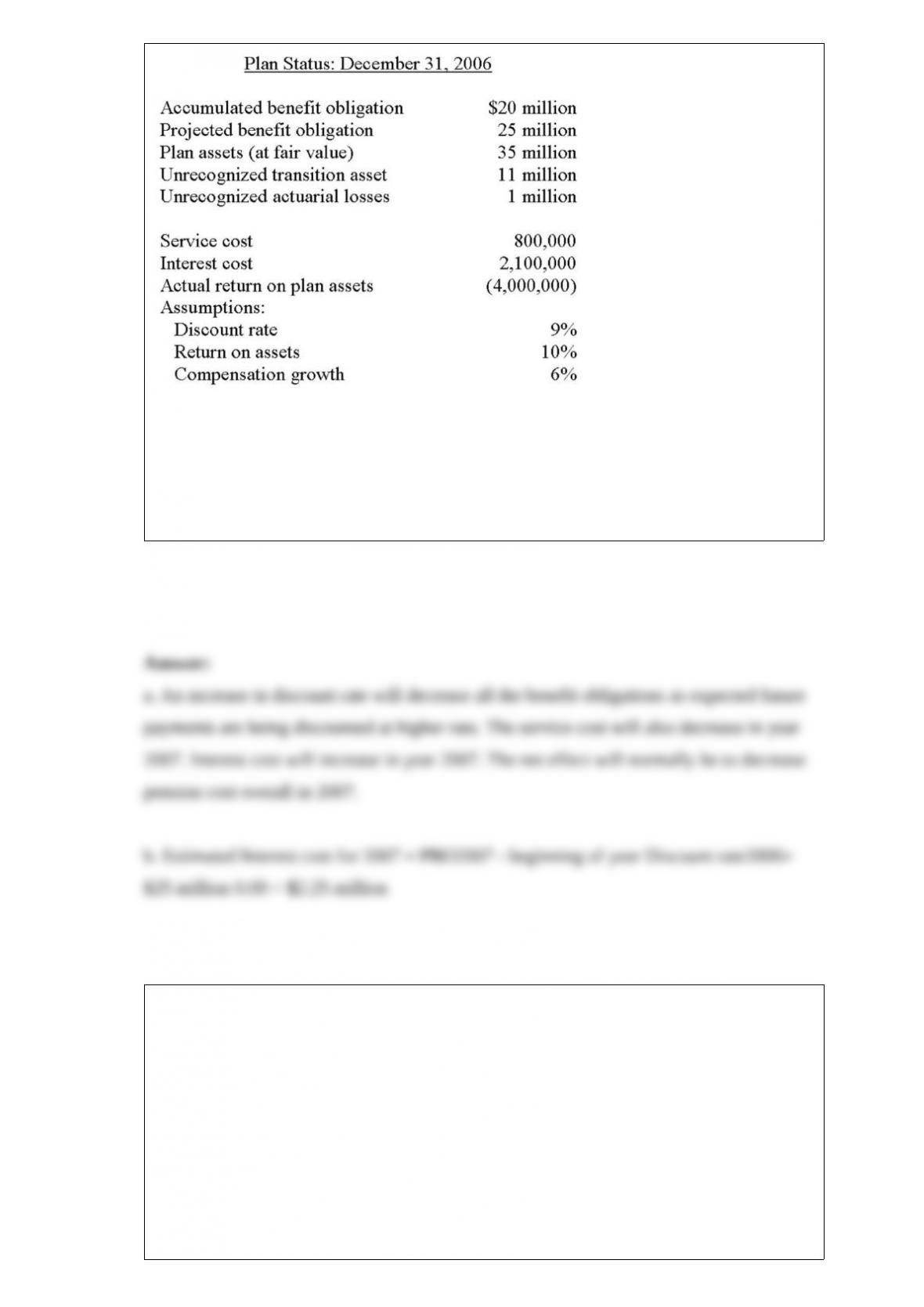
a. If Pawn had increased its discount rate to 10% in 2006 what would be the effect on
the accumulated benefit obligation, the projected benefit obligation, service cost and
interest cost?
b. Estimate the interest cost for 2007 under the existing plan.
Using LIFO rather than FIFO in a time of rising prices:
I. lowers the current ratio.
II. increases inventory turnover.
III. increases profit margin.
IV. increases debt to equity ratio.
A. I, II, and IV

B. I and II
C. II and III
D. I only
A corporation wants to increase its current ratio from its present level of 1.2 before it
ends the fiscal year. The action having the desired effect is:
A. delaying the next payroll.
B. writing down impaired assets.
C. selling furniture for cash.
D. selling current marketable securities at cash for their book value.
LIFO liquidation occurs when:
A. a firm changes from LIFO to another inventory method.
B. a firm experiences an increase in cost of raw materials.
C. the LIFO reserves decline in value.
D. the quantity of goods sold is greater than the quantity produced.
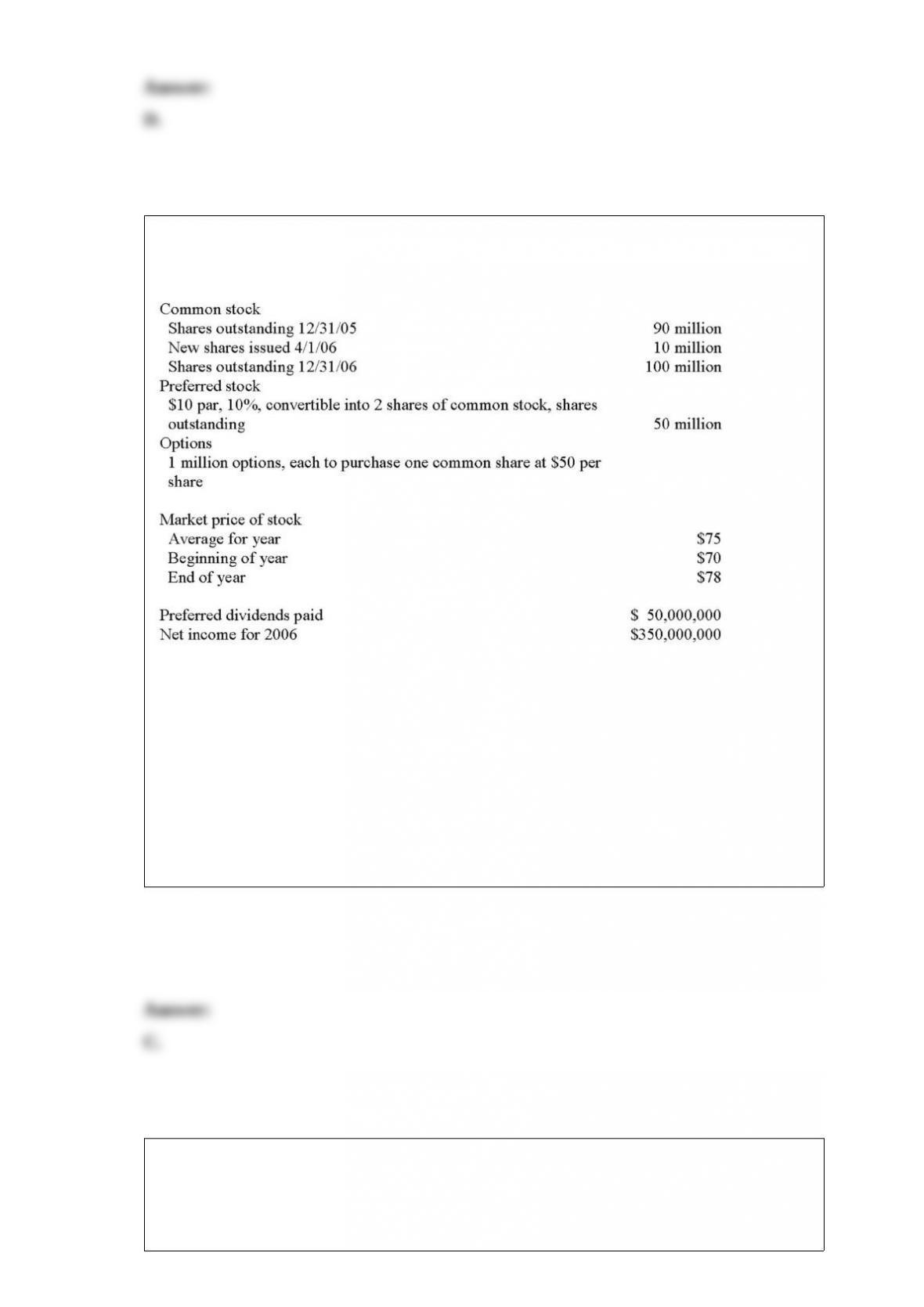
The following information was extracted from Smurm Corporation’s 2006 annual
report:
Basic earnings per share for 2006 was:
A. $3.50.
B. $3.16.
C. $3.08.
D. $3.00.
All of the following are basic approaches to valuation except:
A. market approach.

B. book value approach.
C. income approach.
D. cost approach.
What is change in cash?
A. $81,000
B. $72,000
C. $71,000
D. $62,000
Which of the following should be attempted in order to gauge the quality of a
company’s earnings?
I. Assessing an adequacy of discretionary expenditures
II. Assessing degree of conservatism in reporting assets
III. Assessing degree of conservatism in reporting liabilities
IV. Assessing degree of conservatism in application of accounting principles
A. I, II, III, and IV
B. I, II, and IV

C. II, III, and IV
D. I, III, and IV
Which of the following is required to be filed with the SEC, if a company changes its
auditors?
A. 10-K
B. 10-Q
C. 8-K
D. S-1
The management of Finner Company believes that “the statement of cash flows is not a
very useful statement” and does not include it with the company’s financial statements.
As a result the auditor’s opinion should be:
A. qualified.
B. unqualified.
C. clean.
D. disclaimed.

Which of the following statements is most correct?
A. Technical analysis concerns itself with determining the intrinsic value of a stock.
B. Active investing is defined as buying and selling stock within six months.
C. Fundamental analysis attempts to value a company by examining the past prices
patterns of a company’s stock.
D. Individuals who apply active investment strategies primarily use technical analysis,
fundamental analysis, or a combination.
Which of the following is a change in accounting principle?
I. A change from LIFO to FIFO
II. A change in estimated salvage value of depreciable asset
III. A change from an accelerated depreciation method to straight-line depreciation
IV. Recording depreciation for the first time on machinery purchased five years ago

A. I, II, III, and IV
B. I, II, and III
C. I, III, and IV
D. I and III
Two companies, A and B, both have $1 million in assets, earnings before interest and
taxes (EBIT) of $160,000, and the same tax rate. Company A is all equity financed, and
Company B is 50% debt financed and 50% equity financed. If Company B’s pretax cost
of debt is 8%, then Company A will have a ROA that is _____ and a ROE that is _____
than Company B’s.
A. Option A
B. Option B
C. Option C
D. Option D
Return on operating assets is a measure of which of the following?
A. Profitability
B. Efficiency
C. Solvency
D. Liquidity
SFAS 157 defines fair value as the:
A. entry price.
B. exchange price.
C. net asset value.
D. real value.

Which of the following statements is most correct?
A. Common-size financial income statements provide information about major sources
and uses of cash.
B. Companies with the highest sales growth will have the fewest liquidity problems.
C. Pro forma statements are the same as common-size statements.
D. The more efficiently a company manages its working capital the greater its liquidity,
all else equal.
Which of the following statements are correct?
I. A company’s choice of accounting principles for financial reporting purposes affects
net cash flow for the accounting period.
II. A company’s choice of accounting principles for financial reporting purposes does
not affect operating cash flow.
III. If a company sells its receivables, this will increase operating cash flow.
IV. If a company sells its receivables, this will increase financing cash flow.
A. I and III
B. I, II, and III
C. II and IV
D. I and IV