
1) the london interbank offered rate or libor is used as a benchmark to set loan interest
rates.
2) the international monetary fund was created to assist countries with balance of
payment difficulties and monitor an adjustable peg system with the u.s. dollar as the
anchor currency.
3) the united states, germany, and china are examples of net creditor nations, where the
country owes more to the rest of the world than it is owed.
4) the real interest rate is equal to the nominal interest rate minus the expected rate of
inflation.
5) the foreign exchange exposure premium is the difference between the forward
exchange rate and the expected future spot exchange rate.
6) the maer emphasizes money demand and money supply as determinants of exchange
rate movements.
7) the double-entry bookkeeping for the balance of payments tracks tariffs and currency
exchanges.

8) under flexible exchange rate system, fiscal policy is ineffective, but monetary policy
is effective in changing domestic income.
9) in general, the basic monetary approach to exchange rate (maer) does not capture the
short run volatility of prices.
10) pegging exchange rates at fixed levels by buying and selling to maintain the fixed
rate by the central bank means that domestic and foreign currency interest rates will
have to adjust to parity levels.
11) when a government seizes foreign investment, it is called capital flight.
12) country risk analysis is the evaluation of a countrys overall political and financial
situations that may influence the countrys ability to repay its loans.
13) if the expected inflation in brazil in higher than the expected inflation in the u.s.,
and the real interest rates are equal across countries, then:
a.there is a forward premium on the dollar
b.there is a forward flat on the dollar
c.there is a forward discount on the dollar
d.there is a spot discount on the dollar

14) the overshooting theory by dornbusch is based on the assumption that:
a.covered interest parity does not hold in the short run
b.uncovered interest parity does not hold in the short run
c.fisher equation does not hold in the short run
d.purchasing power parity does not hold in the short run
15) the main reason(s) why governments sometimes chose to devalue their currencies is
(are):
a.devaluation allows the government to fight domestic unemployment by stimulating
export sector
b.devaluation improves the current account balance
c.devaluation preserves foreign reserves held by the central bank
d.all of the above
16) assume that the united states faces a 5 percent inflation rate while no (zero) inflation
exists in japan. according to the relative ppp, the dollar would be expected to:
a.appreciate by 5 percent against the yen
b.depreciate by 5 percent against the yen
c.remain at its existing exchange rate
d.none of the above is correct
17) typically, the is curve is:
a.horizontal
b.vertical
c.downward-sloping
d.upward-sloping
18) in general, the basic monetary approach to exchange rate (maer) does not capture
the short run volatility of:
a.prices
b.money supply
c.exchange rates
d.foreign currency inflation
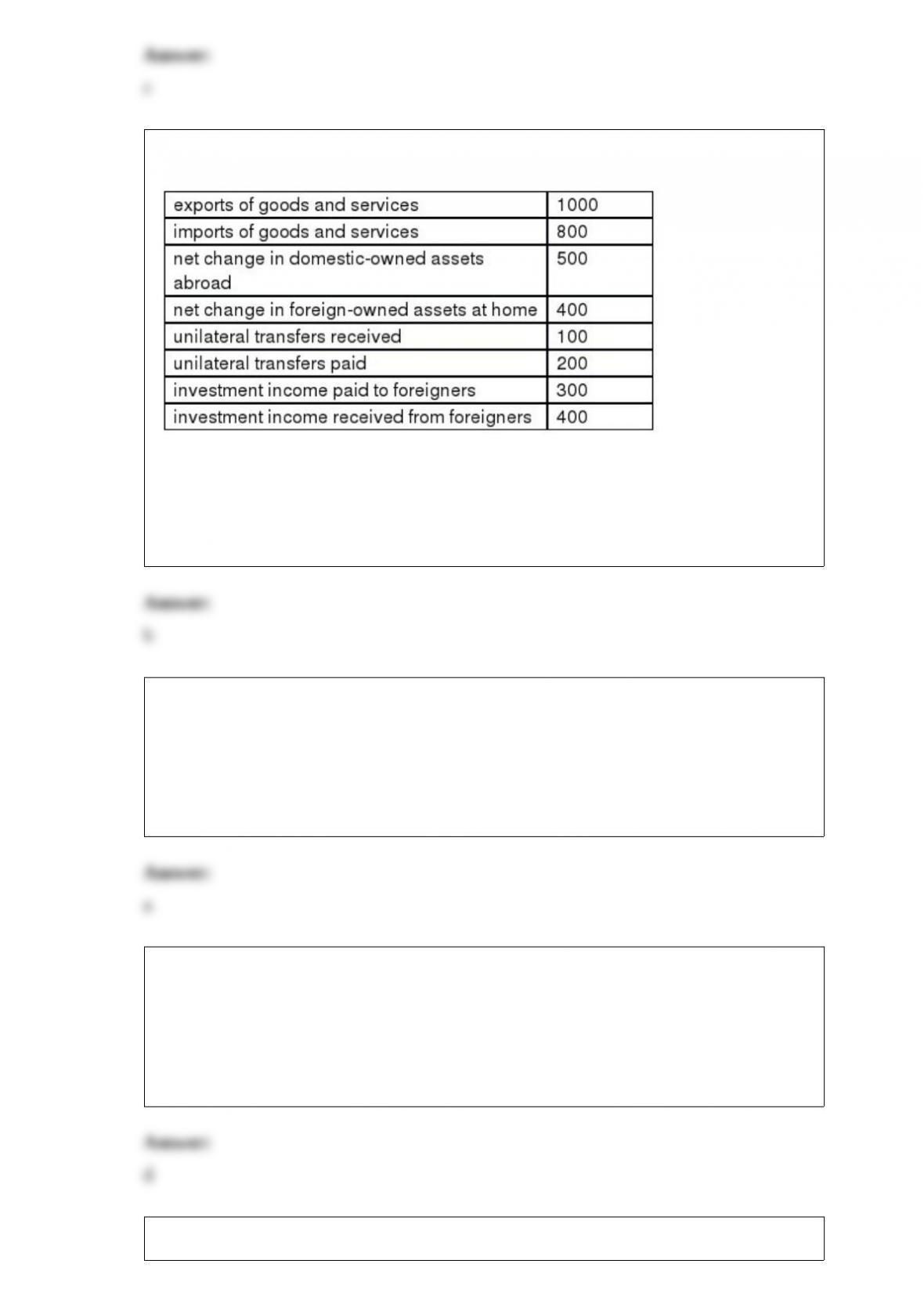
19) table 3-1:
refer to table 3-1. the balance on the current account is:
a.+ 100
b.+ 200
c. 100
d.0
20) the liquidity premium theory of term structure of interest rates suggests that
long-term bonds should________ short-term bonds due to investor risk aversion.
a.hold a premium over
b.have a discount over
c.offer the same return as
d.be entirely separate of
21) to square off,
a.a bank adjusts its buy and sell rates of a currency to receive zero spread
b.a bank increases its buy rate, but decreases its sell rate
c.a bank decreases its buy rate, but increases its sell rate
d.a bank could raise both buy and sell rates or lower both buy and sell rates to return to
its desired foreign currency holding position
22) foreign currency options contracts that give the buyer the right to sell are called:

a.call options
b.selling rights
c.put options
d.strike rights
23) which of the follow are not reasons for offshore banking?
i.avoid interest rate controls
ii.avoid free entry of new banks
iii.avoid quotas on banking activity
iv.access more competitive banking
a.ii only
b.iv only
c.iii and iv
d.all are reasons for offshore banking
24) which of the following statements is correct about the absorption approach?
i.if a country is operating below its full-employment level, it cannot improve trade
balance by a currency devaluation.
ii.if a country is operating at its full-employment level, the only way to improve trade
balance is by reducing the domestic absorption.
a.only i is correct
b.only ii is correct
c.both i and ii are correct
d.neither i nor ii is correct
25) the monetary approach is derived from the assumption(s) that:
a.money demand equals money supply
b.money demand is a fixed proportion of the domestic price level times real income
c.the law of one price holds
d.all of the above are correct

26) the weighted average of the returns on the individual assets is know as the
a.diversification process
b.covariance average
c.return on the portfolio
d.systematic risk
27) what is a spread?
a.the average of the deposit and loan interest rates
b.the quarterly increase of earnings for eurobanks
c.the difference between the deposit and loan interest rates
d.the tool used by regulators to monitor deposit and loan interest rates
28) assume the following: the current spot rate s¥/$ = 100.0 and the annual interest
rates: ijapan = 2% and ius = 10%. according to covered interest parity, if an intern at
citibank sets the one-year forward rate: f360¥/$ = 91, then:
a.the intern has correctly set the forward rate
b.both u.s. and japans investment returns are equal
c.the japans investment return exceeds the u.s. investment return
d.the u.s. investment return exceed the japans investment return
29) eurobanks operate on a narrower spread (in comparison to us banks), but still make
profit because:
a.eurobanks have no reserve requirements, so they can lend a larger percentage of their
deposits
b.eurobanks have very little or no regulatory expense
c.eurobanks have low operating expenses
d.all of the above are correct
30) which of the following statements describes the currency substitution approach?
a.as expectations of a trade deficit change, the exchange rate today will change due to
the expected change in asset holdings
b.exchange rate adjusts to compensate for changes in international currency portfolios
c.slowly adjusting goods prices may cause the exchange rate to over-react in the short

run
d.all of the above are correct
31) the theory of exchange rate overshooting explains high exchange rate volatility by
assuming that ________ does not hold in the ________, but ________ does.
a.ppp, short run, cirp
b.cirp, short run, ppp
c.ppp, long run, cirp
d.cirp, long run, ppp