
Economies of scale are rarely realized in a horizontal merger.
In two successive years, it is possible for a firm to have identical profit and maintain
identical levels of assets, but have different return on equity.
The technical analyst forecasts a company’s cash flows to arrive at value. The
fundamental analyst relies on past price patterns repeating themselves.
Investing in stock represents partial ownership of a corporation and gives the investor
the potential for future cash flows from earnings distribution and stock price
appreciation if the business prospers.

People speculate on exchange rates for profit rather than for doing international
business; however, speculative transactions are never large enough to affect the overall
supply and demand for a foreign currency.
Vendors extend trade credit when they deliver product without demanding immediate
payment.
Capital budgeting consists of two distinct processes. The first is estimation of the cash
flows associated with the specific projects being considered, and the second is use of
techniques such as NPV and IRR to evaluate those estimates.
“Leaning on the trade” is an expression associated with a customer’s insistence that
vendors extend more liberal credit terms.

The opportunity cost of using a resource in some way, is the amount the resource could
earn if used in an alternative way.
The mutually exclusive decision rule for the NPV technique is
NPVB> NPVA® choose project A over B
Most spontaneous financing comes from trade payables created when vendors sell on
credit allowing deferred payment.
Dividends are the basis of value for stocks even though many stocks that don’t pay

dividends have substantial value.
Because events causing business-specific risks are random, their effects simply cancel
out when added together over a substantial number of stocks. This canceling effect
enables us to say that business-specific can be “diversified away.”
In a(n) ____, stock in a subsidiary or a newly incorporated division is distributed to
shareholders of the parent company.
A.spin-off
B.reverse LBO
C.equity carve-out
D.tender offer
A thirty year $200,000.00 mortgage has a monthly payment of $1,199.10 based on a
rate of 6% APR. After making 180 payments over fifteen years, how much of the
mortgage do you still owe?
A.$100,000.00
B.$57,901.85
C.$142,098.15
D.$112,567.83
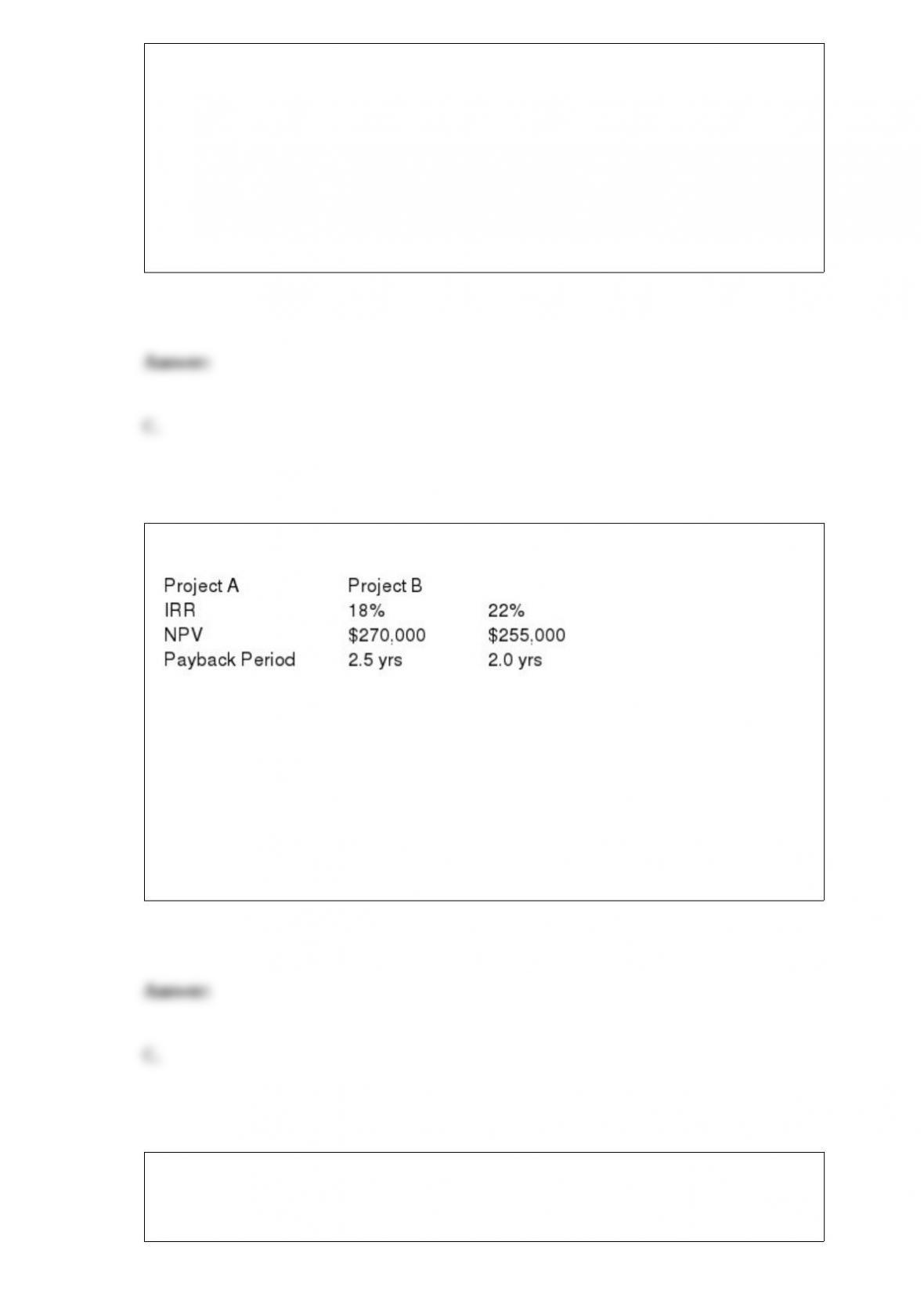
Capital budgeting analysis of mutually exclusive projects A and B yields the following:
Management should choose:
A.project B because most executives prefer the IRR method.
B.project B because two out of three methods choose it.
C.project A because NPV is the best method
D.Either project because the results aren’t consistent.
Cash flow from operating activities is increased by:
A.depreciation and amortization.

B.a decrease in accounts receivable.
C.a decrease in inventory.
D.an increase in accounts payable.
E.All of the above
The return on a share of stock consists of two principal yields:
A.the capital gains yield and the capital appreciation yield.
B.the dividend yield and the capital gains yield.
C.the capital gains yield and the earnings per share.
D.All of the above
Emperor Corporation’s financial statements for the last year are shown below. All
figures are in thousands ($000). The firm paid a $1,000 dividend to its stockholders
during the year. Two million shares of stock are outstanding. The stock is currently
trading at a price of $50. There were no sales of new stock. Lease payments totaling
$400 are included in cost and expense.
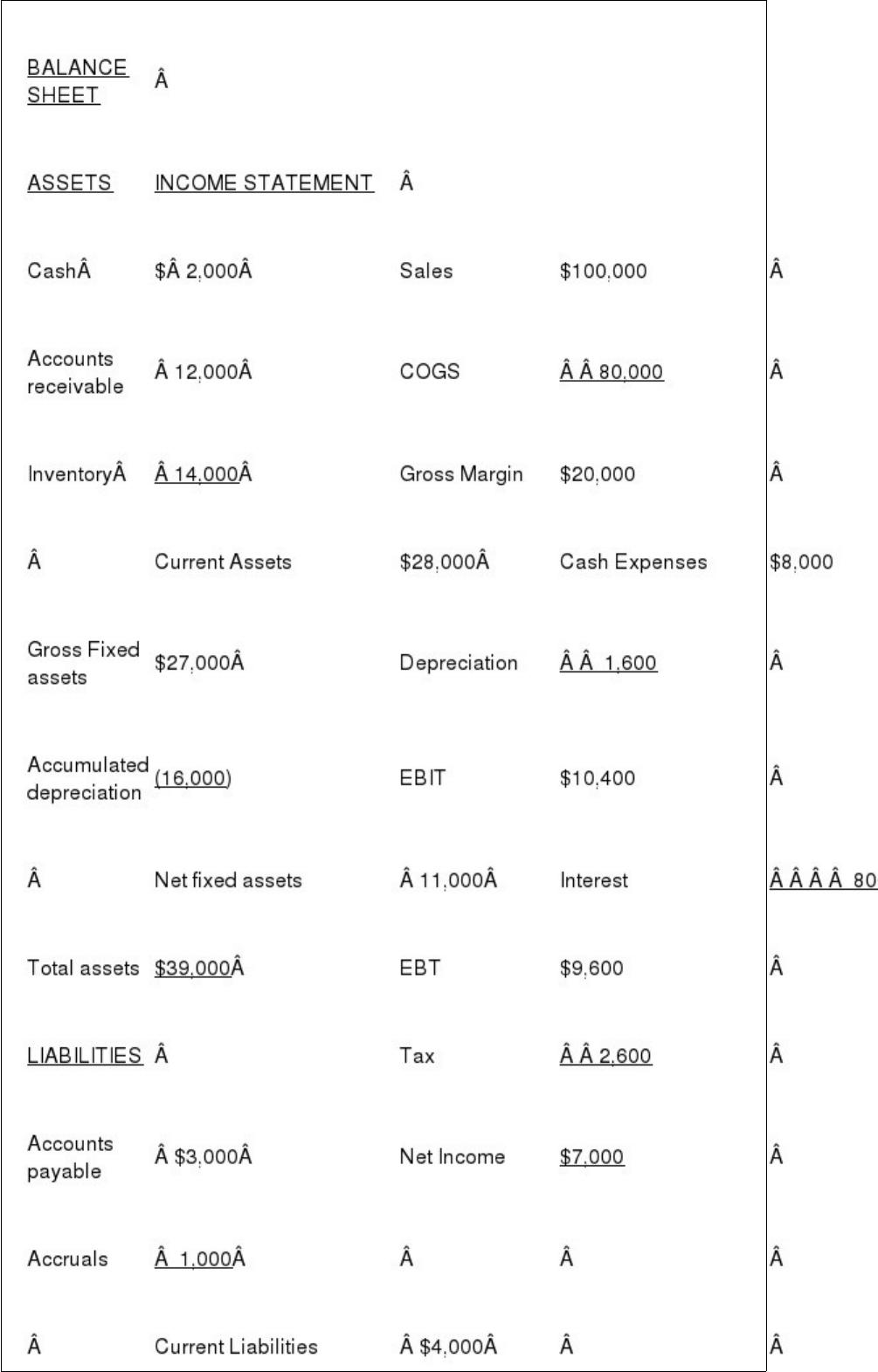

Develop Emperor’s:
Current Ratio
Quick Ratio
Average Collection Period (ACP)
Inventory Turnover
Fixed Asset Turnover
Total Asset Turnover
Debt Ratio
Debt to Equity ratio
Times Interest Earned (TIE)
Cash Coverage
Fixed Charge Coverage
Return on Sales (ROS)
Return on Assets (ROA)
Return on Equity (ROE)
Price Earnings Ratio (P/E)
Market to Book Value Ratio

A series of equal payments that occur at equal intervals and go on forever is called a(n):
A.ordinary annuity.
B.annuity due.
C.perpetuity.
D.non-ending stream.
E.None of the above

Which of the following definitions does not describe the risk-free rate?
A.The interest rate for a stable, prosperous company
B.The pure rate plus an inflation premium
C.The rate on a 90-day treasury bill
D.The conceptual floor for the structure of interest rates
E.All of the above describe the risk-free rate.
You want to purchase a car for $40,000 when you graduate in two years. At that time
you will take out a 5-year bank loan at 12% compounded monthly. Based on your
estimated earnings, you think you’ll be able to afford loan payments of $750 per month.
You plan to save up the difference between the cost of the car and the amount you’ll
borrow by making quarterly deposits over the next two years in a bank account that
pays 8% compounded quarterly. How large must those deposits be? (Round to the
nearest dollar)
A.$523
B.$637
C.$732
D.$845

If a project’s NPV is negative:
A.the project earns less than the cost of capital.
B.the investment will not add value or contribute to shareholder wealth.
C.the present value of expected cash outflows is greater than the present value of
expected cash inflows.
D.All of the above
If a bond rating lowers, one can expect the bond€s current yield to ____.
A.remain the same
B.increase
C.decrease
D.equal the coupon rate
The book value of a firm’s capital accounts:

A.should be used when evaluating new projects.
B.fluctuates frequently.
C.represents the cost of existing capital.
D.Both a & c
A collection of securities is called a:
A.basket.
B.conglomerate.
C.portfolio.
D.Any of the above
Match the following:
1>Reconciliation A. Depreciation expense as a noncash item
2>Financing activity B. Sale of new 30-year bonds
3>Investing activity C. Proceeds from the sale of old machinery
4>Operating activity D. Change in cash balance

Risk varies with project type, and the least risky of the capital projects, in terms of the
probability of making less than management’s expectations is:
A.inventory management.
B.equipment replacement.
C.new business ventures.
D.expansion.

Since equity cash flows are uncertain, the following approaches are used in estimating
the cost of equity:
A.CAPM and the dividend growth model.
B.risk premiums, the dividend growth model, and the accounting beta method.
C.the dividend growth model, risk premiums, and CAPM.
D.All of the methods mentioned above are used, but CAPM is unquestionably the best.
Compute the risk premium for the stock of Omega Tools if the risk-free rate is 6%, the
expected market return is 12%, and Omega’s stock has a beta of 0.8.
A.10.8%
B.4.8%
C.48.0%
D.16.8%
The dividend irrelevance theory states that although the reduction or elimination of
dividends in the near term will have a negative effect on P0:
A.transaction costs will decrease.
B.the additional earnings retained will help the firm grow faster permitting larger
dividends.

C.dividend theories do not address the long term future.
D.None of the above
A firm which has a 2.5 DOL (degree of operating leverage) would find that an 8%
increase in EBIT would result from a(n) ____ increase in sales.
A.3.2%
B.5.4%
C.20.0%
D.2.0%